LEGO has had Formula 1 sets before. A Ferrari here, a McLaren there — one-offs scattered across Speed Champions like afterthoughts. What's happening now is fundamentally different. Starting in 2025, LEGO launched F1 sets across five separate themes simultaneously: Speed Champions, Technic, City, Icons, and even Duplo. Every single F1 team got its own Speed Champions car. Both Ferrari and Red Bull got premium Technic builds. The City theme got pit stops, garages, transport trucks, and team pairings. And for the first time, LEGO is putting a real car on a real racetrack.
This isn't a licensing deal anymore. This is an invasion.
The timing isn't accidental. Formula 1's audience has exploded over the past five years, driven by Netflix's Drive to Survive series, aggressive expansion into the American market with races in Miami, Las Vegas, and Austin, and a younger demographic that engages with the sport through social media rather than traditional broadcast. LEGO saw the audience shift and went all in. The result is the most comprehensive motorsport product line the company has ever produced.
The Speed Champions lineup is where the scale of LEGO's commitment becomes undeniable. For the first time ever, all ten Formula 1 teams have their own dedicated set. Ferrari, Red Bull, Mercedes, McLaren, Aston Martin, Alpine, AlphaTauri (now Racing Bulls), Sauber, Haas, and Williams — every single constructor on the grid, built in LEGO's signature 8-wide format with printed nose cones and team-accurate liveries.
The consistency across the line is impressive. Each car sits at the same scale, uses the same chassis architecture, and features the new helmet mold that debuted with this wave. Sponsor logos, team colors, and aero details are all pad-printed — no stickers. Line up all ten and you've got a miniature starting grid that looks genuinely striking on a shelf.
For collectors, the strategic question is obvious: do you buy your team, or do you buy the grid? At the Speed Champions price point, buying the full set of ten is actually feasible, and the display impact of the complete lineup justifies it.
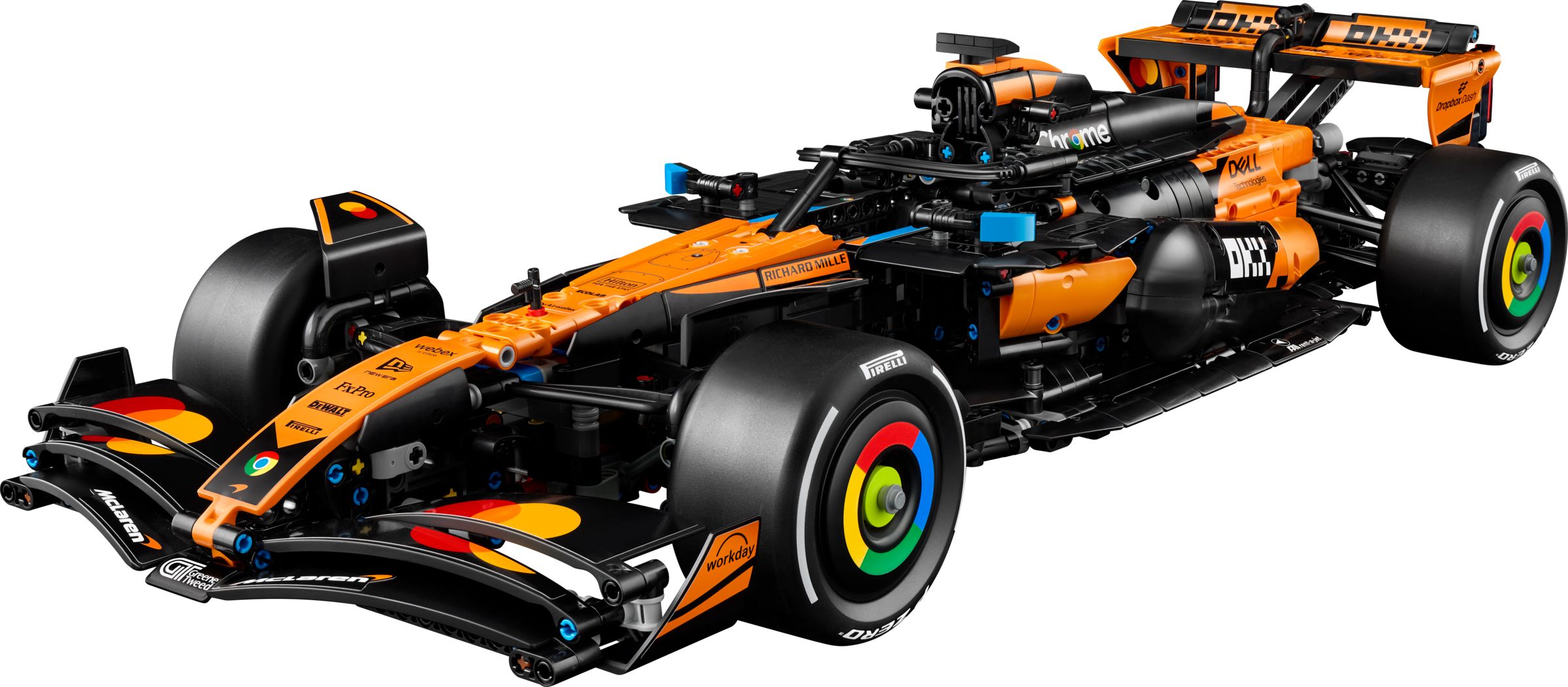
If Speed Champions captures the look of Formula 1, the Technic line captures the engineering. The Ferrari SF-24 (#42207) and Red Bull RB20 (#42206) launched in March 2025 as the first wave of 1:8-scale Technic F1 cars, each weighing in with over 1,300 pieces and featuring suspension systems, steering mechanisms, and detailed power unit assemblies.
The McLaren MCL39 (#42228) followed in March 2026 and raised the bar further. At 1,675 pieces, it celebrates McLaren's 2025 Constructors' Championship victory with a model that includes working DRS (the drag reduction system that opens the rear wing), functional suspension, a detailed gearbox, and the kind of surface detail work that makes the papaya orange livery pop at display distance. At roughly 24 inches long, it dominates any shelf it sits on.
These aren't toys. They're engineering exercises that happen to result in display pieces. The build experience is closer to assembling a mechanical kit than snapping together a playset — you're building gear trains, linkages, and structural frameworks before the bodywork even goes on. For builders who value the process as much as the result, the Technic F1 line delivers hours of genuinely engaging construction.
The McLaren MCL39 Technic build took me the better part of two evenings. The DRS mechanism alone is worth the experience — watching that rear wing open and close on a model you built yourself is deeply satisfying.
Not every F1 fan wants a 1,675-piece Technic build, and LEGO knows it. The City theme serves as the accessible entry point to the F1 universe, with sets ranging from a simple McLaren driver-and-car combo (#60442) all the way up to a full F1 garage with Mercedes and Alpine cars (#60444).
The Ferrari Pit Stop (#60443) hits the sweet spot — it's got the car, the crew, the equipment, and the tire-change drama that makes pit stops one of F1's most exciting elements. The F1 Display Truck with Audi Race Car (#60493) anticipates Audi's entry into F1 and gives you a transport truck that unfolds into a display stand. Smart design, great playability.
The City sets serve a different audience than Speed Champions or Technic. These are the sets that get kids into F1, that sit on a playmat next to fire stations and police cars, and that introduce the concept of team strategy and pit crew coordination through play. They're also the sets that adult fans buy for desk displays when a 24-inch Technic model would get them fired.
On the Icons side, set #10353 — the Williams Racing FW14B with Nigel Mansell — is a love letter to F1 history. It recreates the legendary 1992 car and includes a Mansell minifigure, bridging the gap between modern F1 fandom and the sport's heritage.
The APXGP Team Race Car (#77252) is LEGO's tie-in with the Brad Pitt F1 movie, and it occupies a unique space in the lineup. It's not a real team. It's not a historical car. It's a fictional constructor built for a film, and LEGO gave it the full Speed Champions treatment — accurate livery, custom printing, and the same build quality as the real-team sets.
Whether the movie-to-brick pipeline is brilliant marketing or shameless cross-promotion depends on your perspective, but the set itself is solid. The APXGP livery is distinctive enough to stand out in a lineup of real-team cars, and for F1 movie fans, it's the only way to own a piece of the fictional team. LEGO is betting that the film will expand F1's audience even further, and having a set ready on day one is a smart hedge.

And then there's the move nobody saw coming. In November 2025, at the Las Vegas Grand Prix, LEGO announced a multi-year partnership with F1 Academy — and they're not just slapping their logo on someone else's car. LEGO Racing is fielding its own entry on the 2026 F1 Academy grid, with Dutch driver Esmee Kosterman behind the wheel and MP Motorsport running the car.
Kosterman is a 20-year-old Dutch racer who became the first woman to win in the Ford Fiesta Sprint Cup series in 2023 and made her F1 Academy debut as a wildcard at Zandvoort in 2024. She's the real deal — fast, driven, and exactly the kind of talent that F1 Academy was designed to develop.
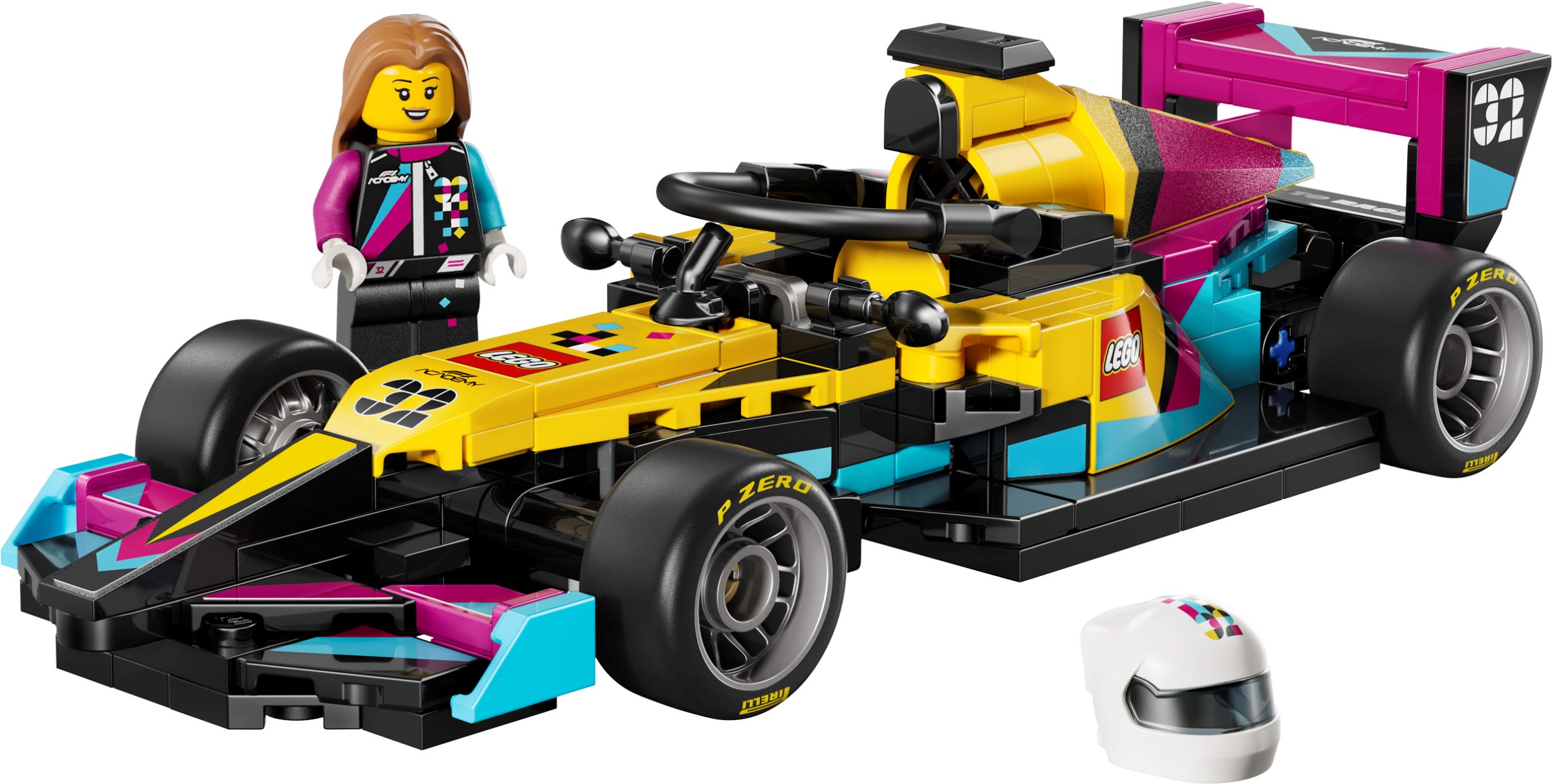
The LEGO Racing livery on a real F1 Academy car is striking — unmistakably LEGO, but designed for the track rather than the toy shelf. And yes, there's a Speed Champions set to go with it. The F1 Academy LEGO Race Car (#77258) is a 201-piece set featuring the #32 car in LEGO Racing colors with a Kosterman-inspired minifigure.
This is LEGO stepping from product licensing into actual motorsport participation. The message is clear: Formula 1 isn't a theme for LEGO. It's a commitment.
A toy company putting a real car on a real grid is unprecedented. LEGO Racing in F1 Academy isn't marketing — it's motorsport participation, and it changes the relationship between the brand and the sport entirely.
We've built and reviewed nine LEGO F1 sets across Speed Champions, City, and Technic. Here's the full lineup with links to each review and where to buy.




LEGO isn't slowing down. The Ferrari SF-24 Technic (#42207) remains one of the most sought-after builds in the lineup. The collectible Formula 1 minifigure blind-box series brings F1 into the impulse-buy tier. And with the 2026 F1 regulation changes bringing completely redesigned cars to the grid, expect a new wave of Speed Champions and Technic sets that reflect the sport's next era of aerodynamic design.
The question isn't whether LEGO will continue expanding its F1 range. It's whether any other toy company can mount a credible challenge. With licensing across every team, sets at every price point, a movie tie-in, and an actual racing team, LEGO has built a wall around the Formula 1 brick market that would be extraordinarily expensive to replicate.
Thirty-plus sets across five themes, covering every team on the grid, with a real car on a real track. LEGO didn't dip a toe into Formula 1 — they dropped the entire pit wall into it.
LEGO's F1 expansion matters beyond the sets themselves. It proves that the company is willing to invest deeply in a single license when the audience is there — and it sets the template for how LEGO might approach other sports, entertainment properties, or cultural phenomena in the future.
For builders, it means more variety, more quality, and more reasons to engage with themes you might not have considered. If you've never watched a Grand Prix but you love Technic engineering, the MCL39 will convert you. If your kid loves cars but hasn't found their entry point into LEGO, the City F1 sets are it. If you care about representation in motorsport, the F1 Academy LEGO Racing car with Esmee Kosterman is a meaningful statement wrapped in a fun build.
Formula 1 took over the brick world because the brick world was ready for it. And based on what we've seen so far, this is only the starting grid.