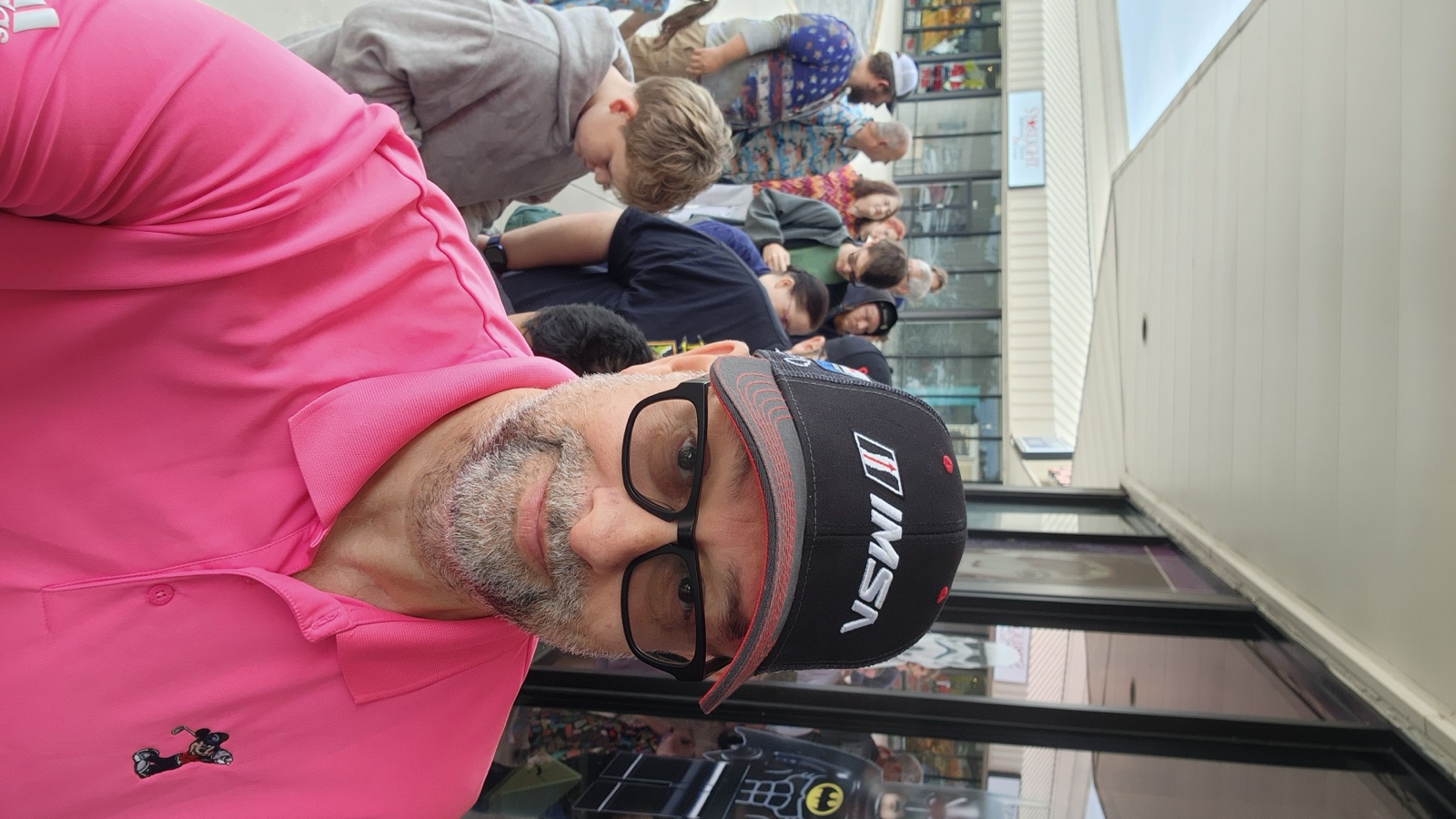
We pulled into the shopping plaza in Leesburg, Florida on March 14, 2026 - grand opening day for the newest Bricks & Minifigs location in Central Florida. The parking lot was already packed. Cars circled for spots. And before we even got out of the car, we could see the line. It was not a short one. It wrapped around the side of the building, through the covered walkway, and back out toward the parking lot. Families, couples, solo adults with LEGO hats, kids clutching minifigures - easily a hundred people deep, and more arriving every few minutes.
This was not a typical retail store opening. There were no free samples being handed out, no electronics to fight over, no celebrity appearances pulling a crowd. These people were here because they love LEGO. Adults and children standing side by side in the Florida sun, talking about sets they wanted to find, parts they needed for builds, and which retired sets they hoped might be hiding on the shelves inside. It felt more like a convention line than a store opening. That is the kind of energy Bricks & Minifigs generates - a community store for a community hobby.
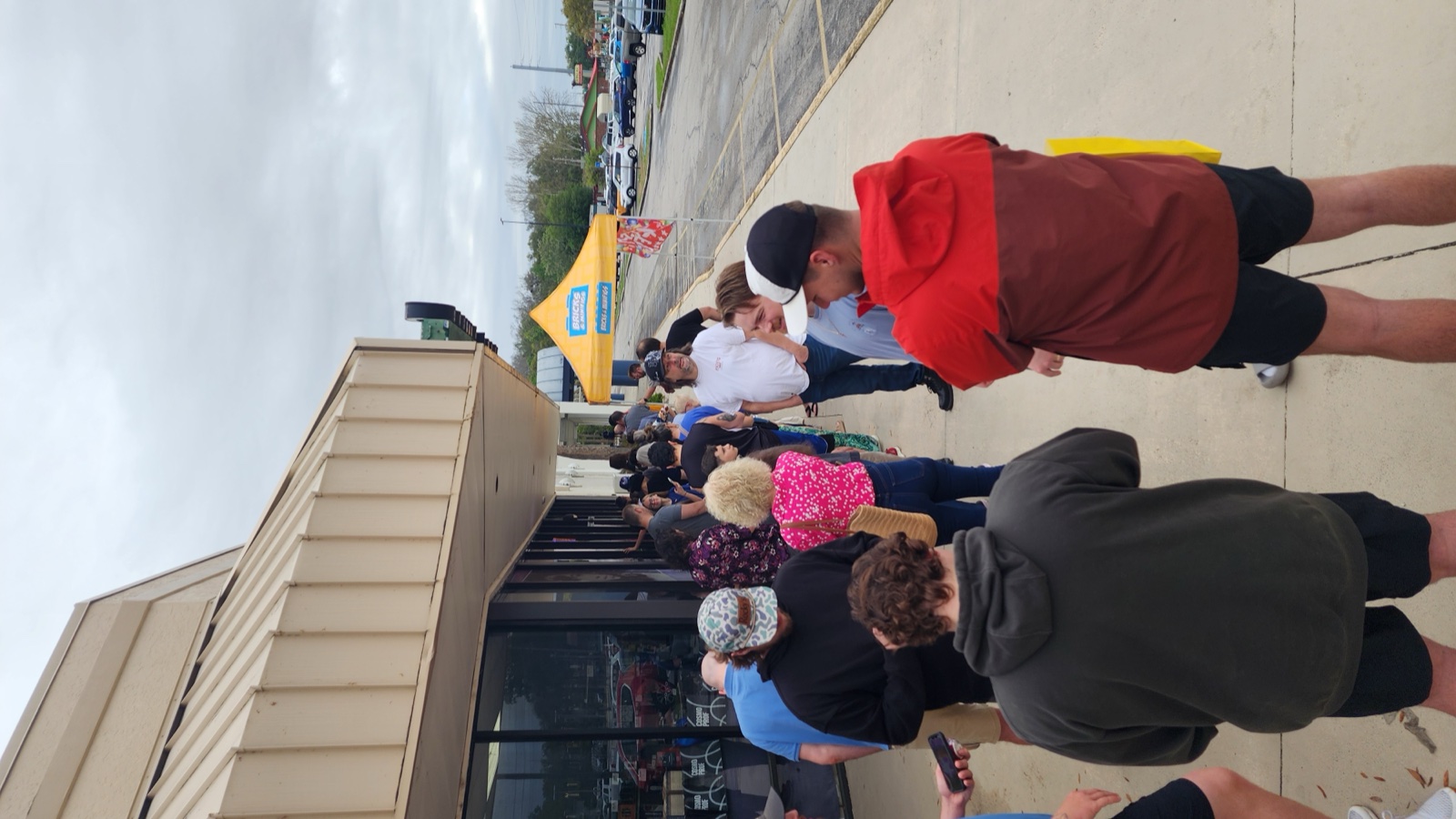
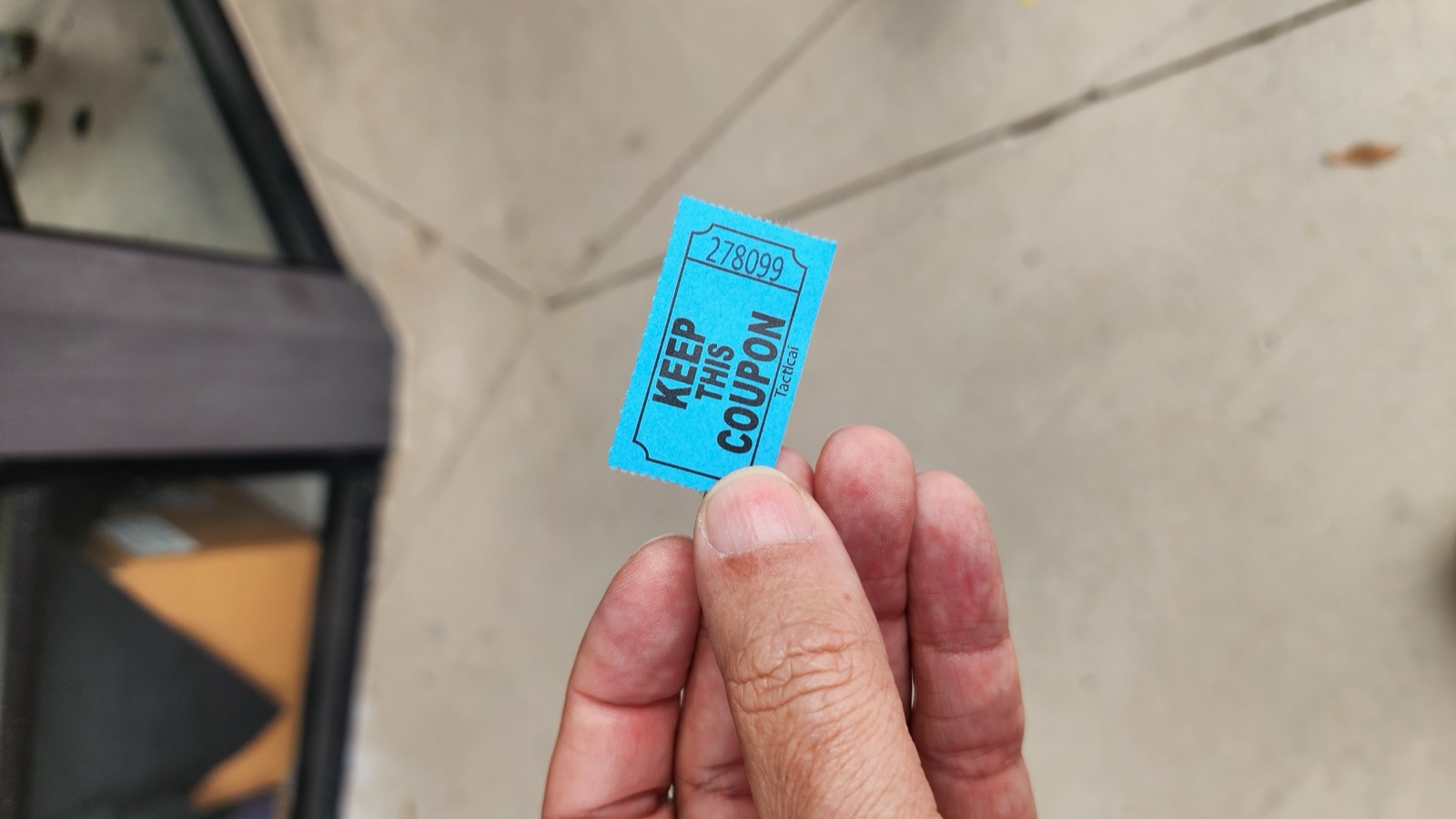
The store had a strict one-in-one-out policy. Staff at the door managed the flow - as one person left, they waved the next person in. This kept the interior from becoming dangerously crowded, but it also meant the line moved slowly. We waited about forty-five minutes before getting inside. Every customer was handed a numbered coupon at the entrance. Ours was #278099. A small detail, but it gives you a sense of how many people cycled through that store on day one. The coupon system also meant every visitor felt tracked and acknowledged - you were not just a body in a crowd, you were customer number 278099 at a brand new LEGO store, and there was something oddly satisfying about that.
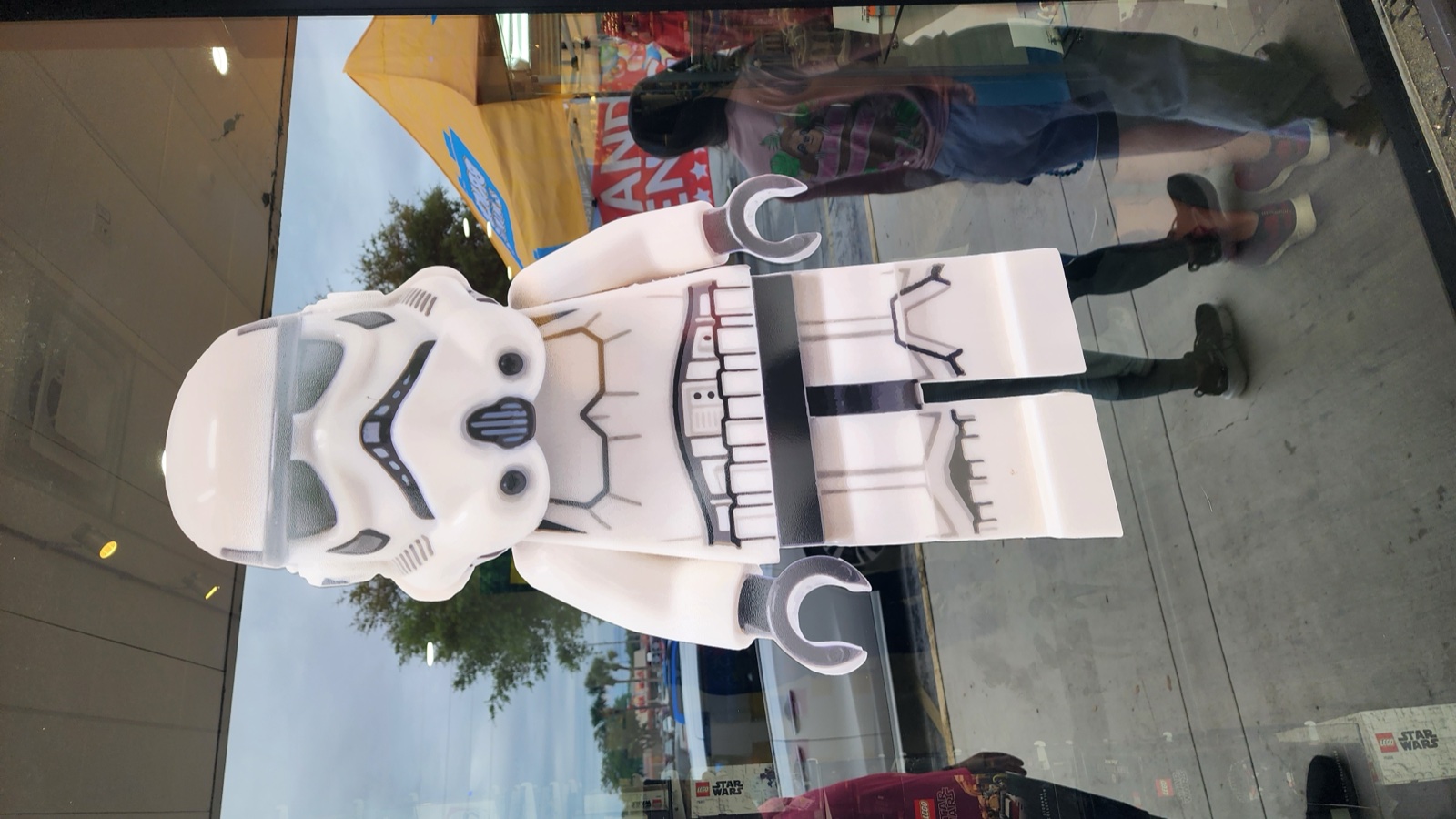
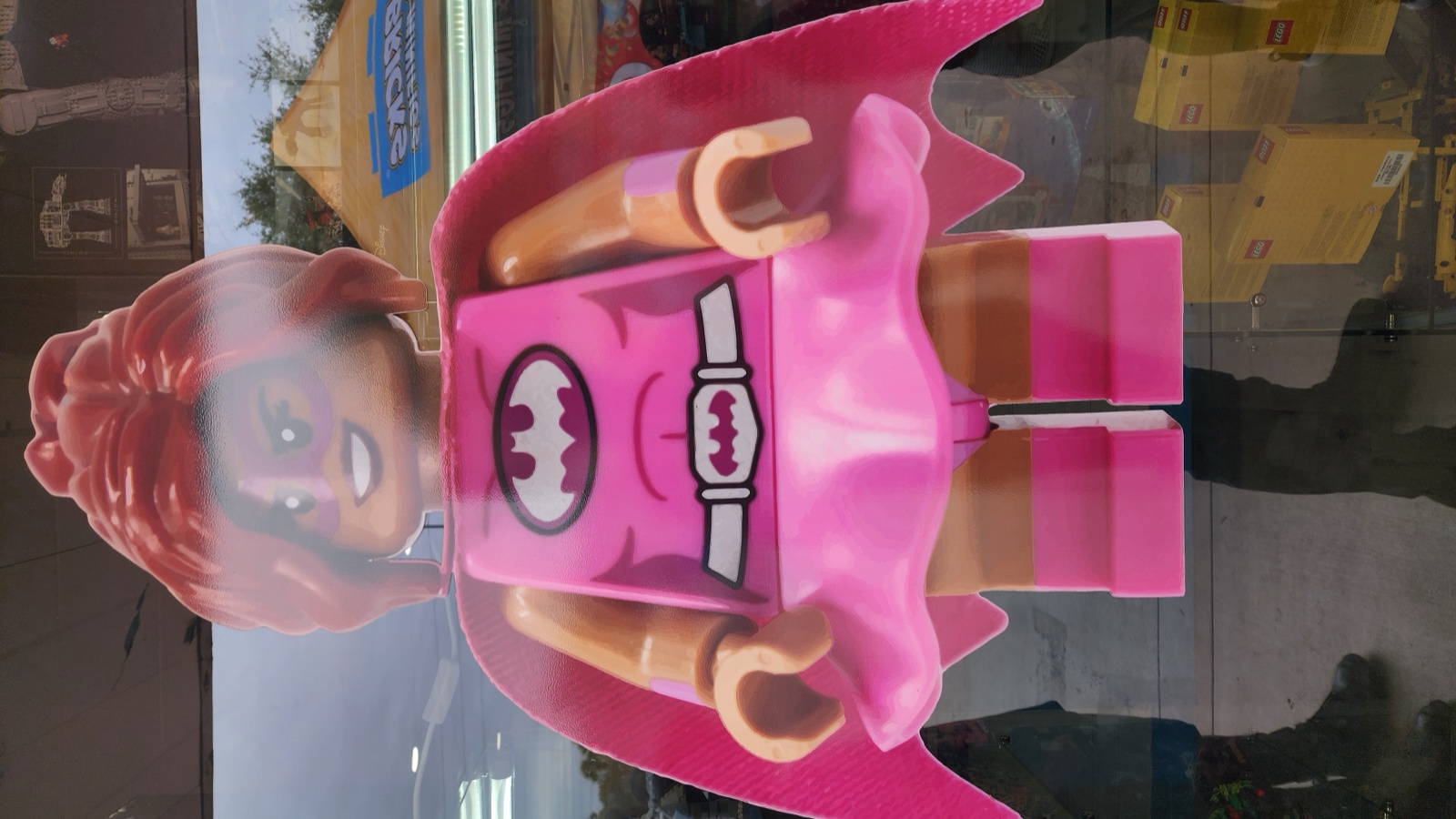
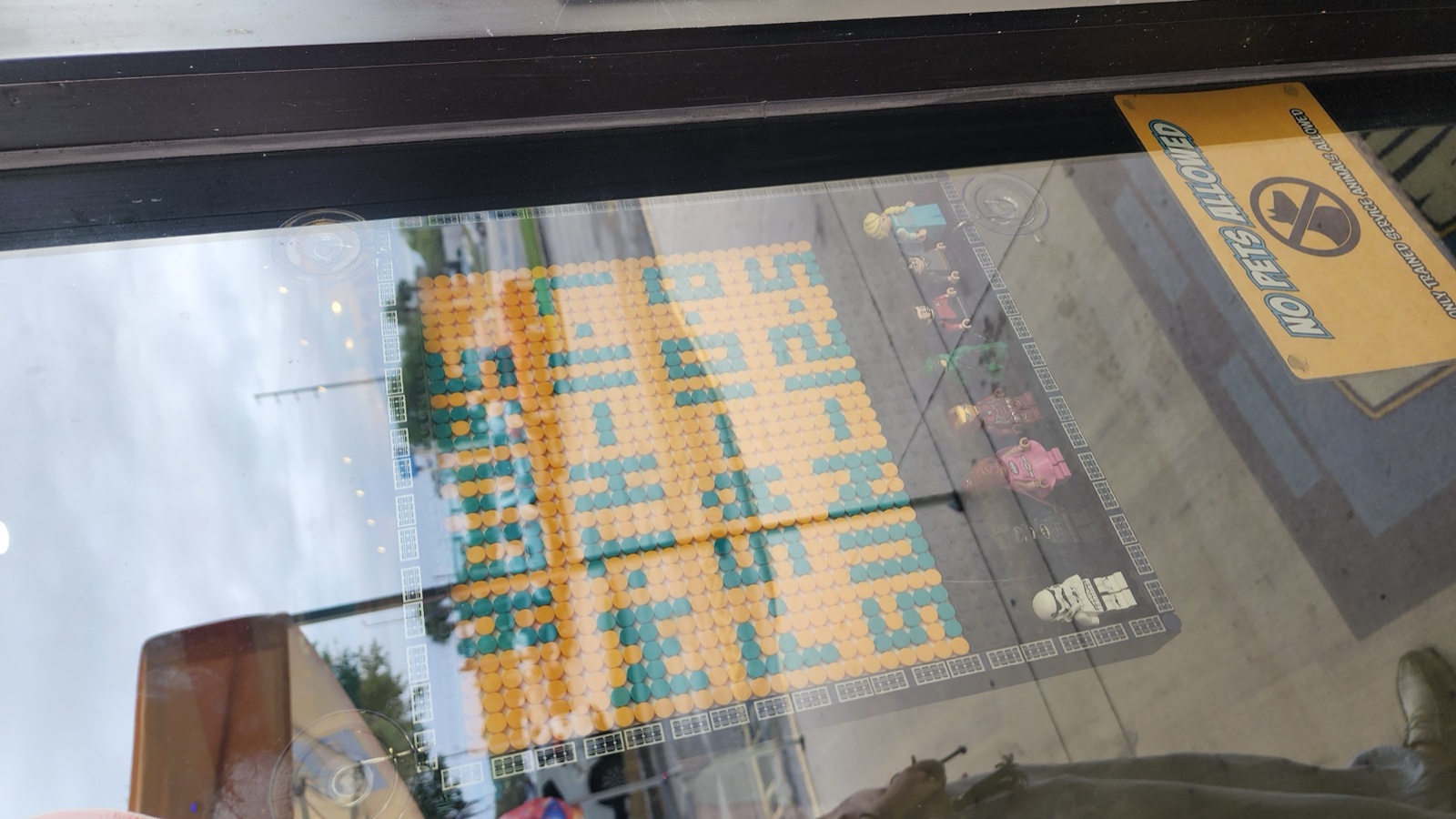
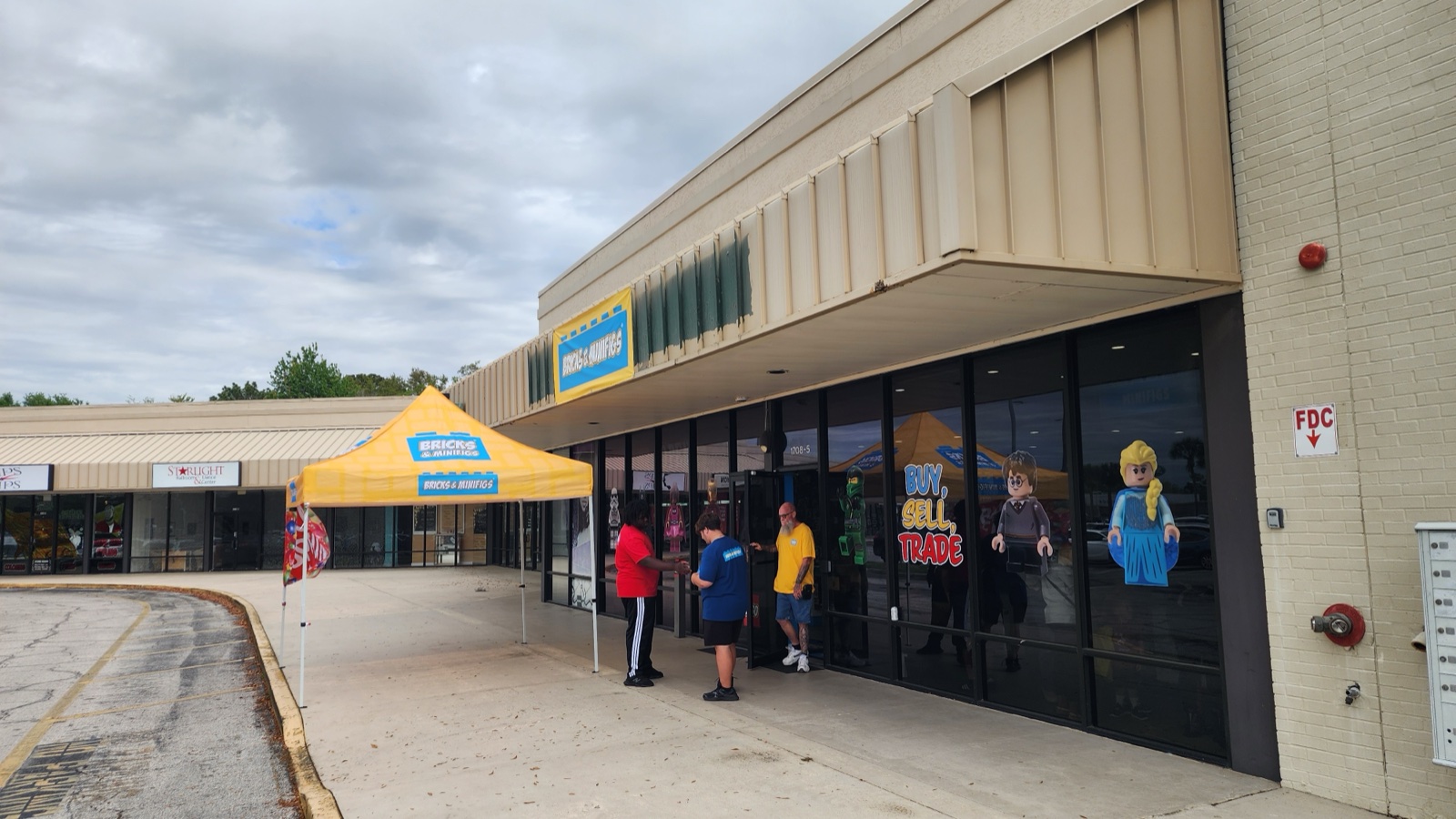
While we waited, there was plenty to look at. Giant life-size minifigure statues flanked the entrance. A Stormtrooper stood guard on one side, white armor gleaming in the morning light. On the other side, a pink Batgirl struck a heroic pose. Both statues were several feet tall and immediately attracted kids for photo opportunities. Between the statues, the storefront window featured a colorful brick mosaic - actual LEGO bricks assembled into a decorative panel that signaled what kind of store this was before you ever stepped inside.
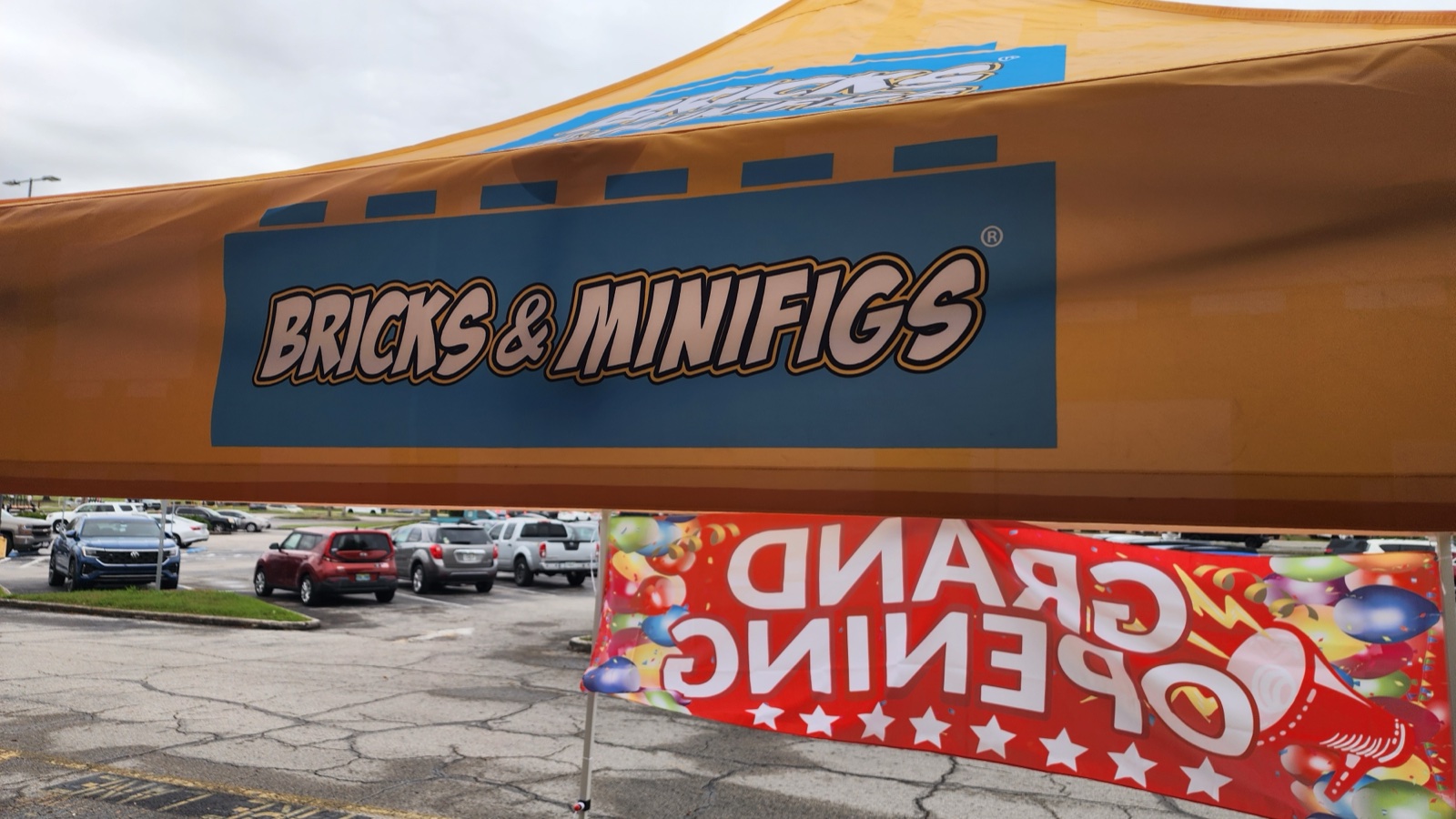
Out in the parking lot, a branded Bricks & Minifigs tent with a "Grand Opening" banner created a focal point for the event. It was impossible to miss from the road. The tent, the line, the statues - it all made the occasion feel significant. This was not just another franchise opening its doors. For LEGO fans in the greater Leesburg, Clermont, Villages, and Ocala area, this was the arrival of something the community had been waiting for: a dedicated space to buy, sell, and trade LEGO in person.
If you have never heard of Bricks & Minifigs, here is the short version: it is a franchise chain of retail stores dedicated entirely to LEGO. Not toys in general. Not collectibles broadly. Just LEGO. Every shelf, every display case, every bin in the store contains LEGO products - new sets, used sets, retired sets, individual minifigures, and loose bulk bricks. The business model is built around three words printed on the storefront: Buy, Sell, Trade.
The concept is straightforward. Customers can bring in their old LEGO collections - complete sets, partial sets, loose bricks, minifigures - and trade them for store credit or cash. The store then sorts, cleans, prices, and resells that inventory. This creates a constantly rotating selection of products that you simply cannot find at a standard LEGO Store or big-box retailer. Retired sets that have been off shelves for years show up here. Rare minifigures from limited-edition polybags end up in the display cases. Bulk bricks in every color fill the tables. It is a LEGO ecosystem that feeds itself.
Bricks & Minifigs is a nationally branded franchise, which means each location is locally owned and operated by someone in the community. The franchise model ensures consistency - you know what to expect when you walk into any B&M location - but the local ownership means each store has its own personality. The Leesburg location clearly invested heavily in its LEGO city display, its bulk table selection, and its minifigure inventory. Other locations might lean harder into retired sealed sets or built display models. Every store is a little different, and that is part of the appeal.
How does Bricks & Minifigs differ from an official LEGO Store? The LEGO Store sells current sets at retail price. That is essentially its entire business. It does not buy back your old sets. It does not sell retired products. It does not have bulk tables where you can hand-pick individual pieces by color and type. The LEGO Store experience is polished and brand-controlled. The B&M experience is community-driven and treasure-hunt oriented. You walk into a LEGO Store knowing what you will find. You walk into a B&M wondering what you might discover.
The AFOL - Adult Fan of LEGO - community has embraced Bricks & Minifigs in a way that few retail brands experience. For adult builders, these stores solve real problems. Need 200 light bluish gray 1x4 plates for a MOC? The bulk table might have them. Looking for a retired modular building to complete your street? Check the used sets shelf. Want to trade in a collection you have outgrown for store credit toward something new? Walk up to the counter. For more on the franchise model and what makes these stores work, read our our blog.
The absolute centerpiece of the Bricks & Minifigs Leesburg location is a massive LEGO city display behind glass. It sits prominently in the store with a "DO NOT TOUCH" sign that is entirely necessary - the temptation to reach in and adjust a minifigure or peek inside a building is overwhelming. This display is not a random collection of sets placed next to each other. It is a curated, intentional cityscape that tells a story about what LEGO can become when sets are combined, displayed together, and given room to breathe.
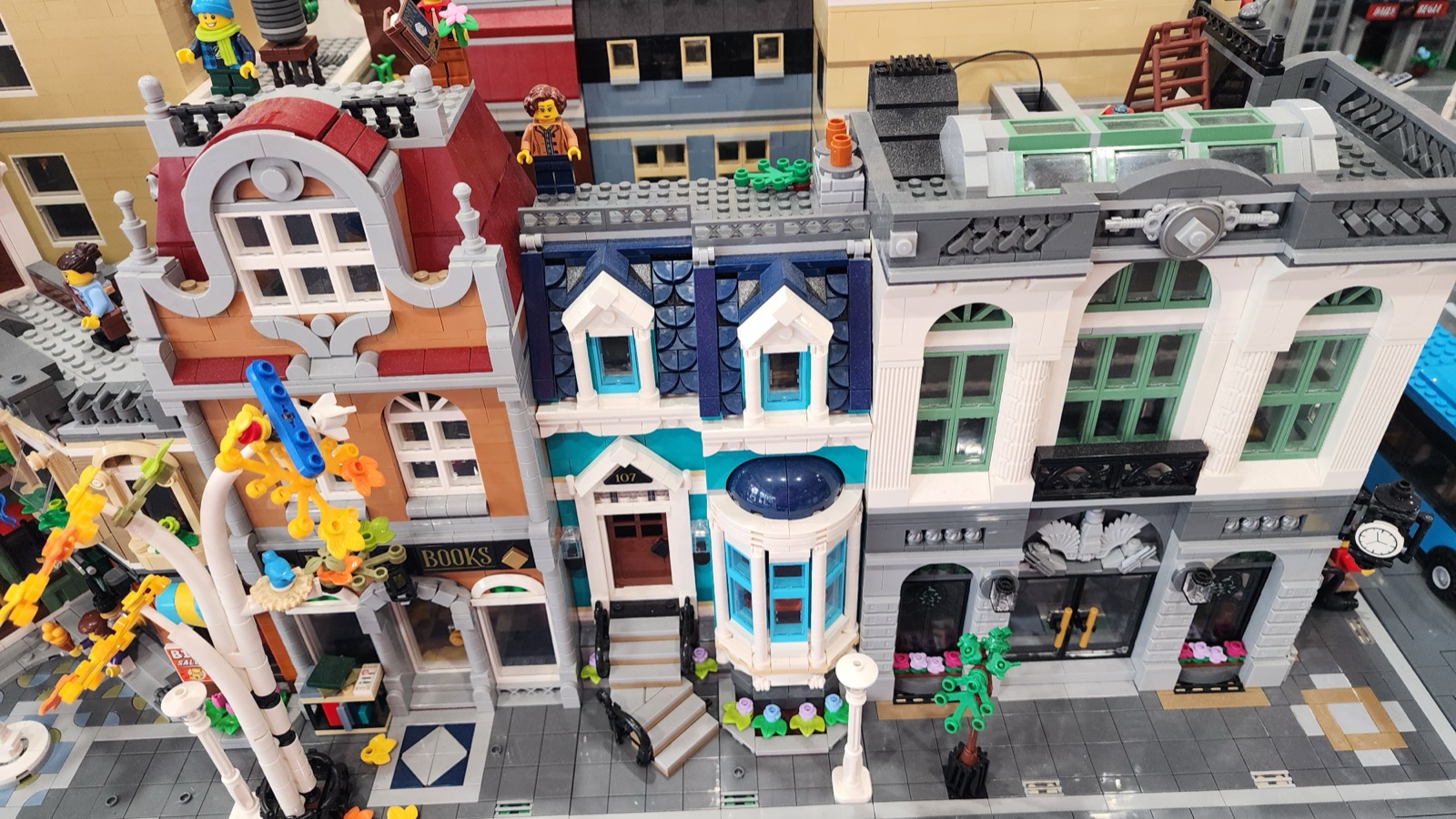
The display features a row of modular buildings along a main street. The Bookshop is there, with its detailed facade and tiny book displays visible through the windows. A blue townhouse stands next to it. A bank with a dark green exterior anchors one end. Apartment buildings with balconies and fire escapes fill the gaps. These are LEGO's official modular building sets, but seeing them lined up together in a single streetscape is entirely different from seeing them individually on a shelf in a box. Together, they create a neighborhood. You can imagine minifigures walking between buildings, stopping at the bookshop, heading to the bank, sitting on those tiny balconies. Context changes everything.
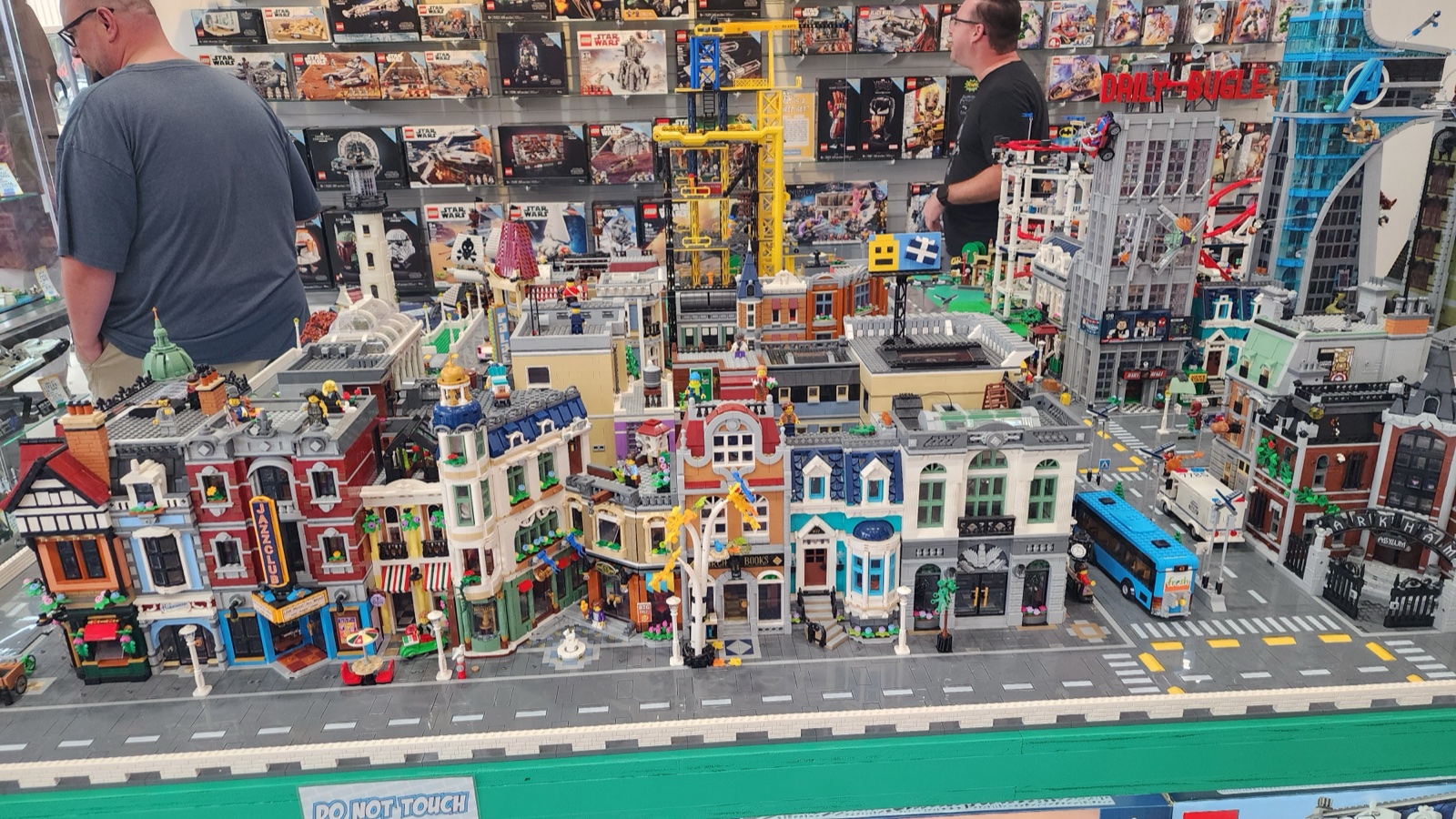
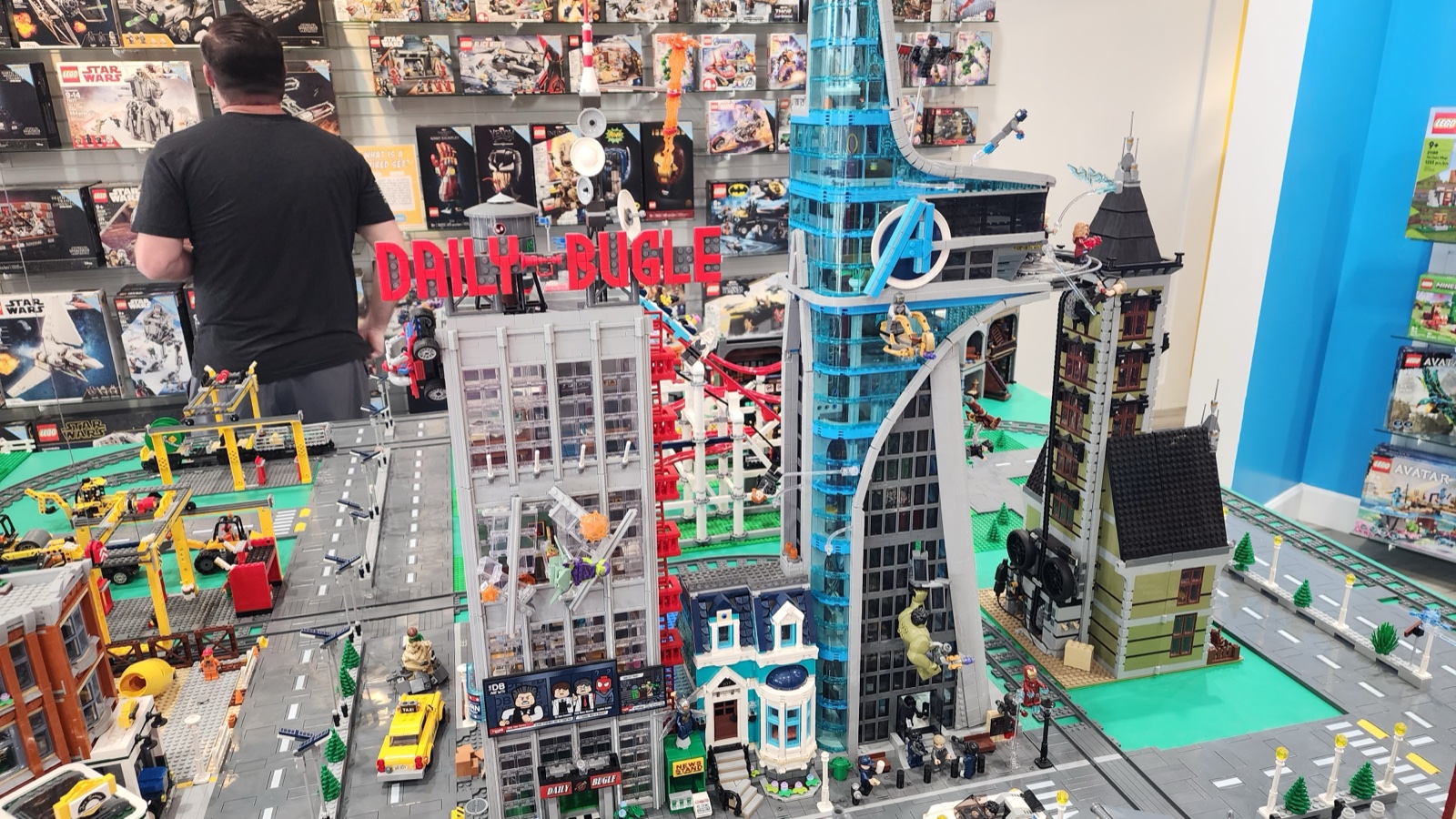
Rising above the modular street, the Daily Bugle and Avengers Tower dominate the skyline. The Daily Bugle - that massive Marvel set with its newspaper office, Spider-Man villains scaling the walls, and detailed interiors on every floor - towers over the surrounding buildings exactly as it should. The Avengers Tower stands alongside it, creating a superhero skyline that draws your eye upward. These are some of the tallest LEGO sets ever produced, and seeing them fully built and towering over a city of modular buildings gives you a visceral sense of their scale that no product photo can replicate.
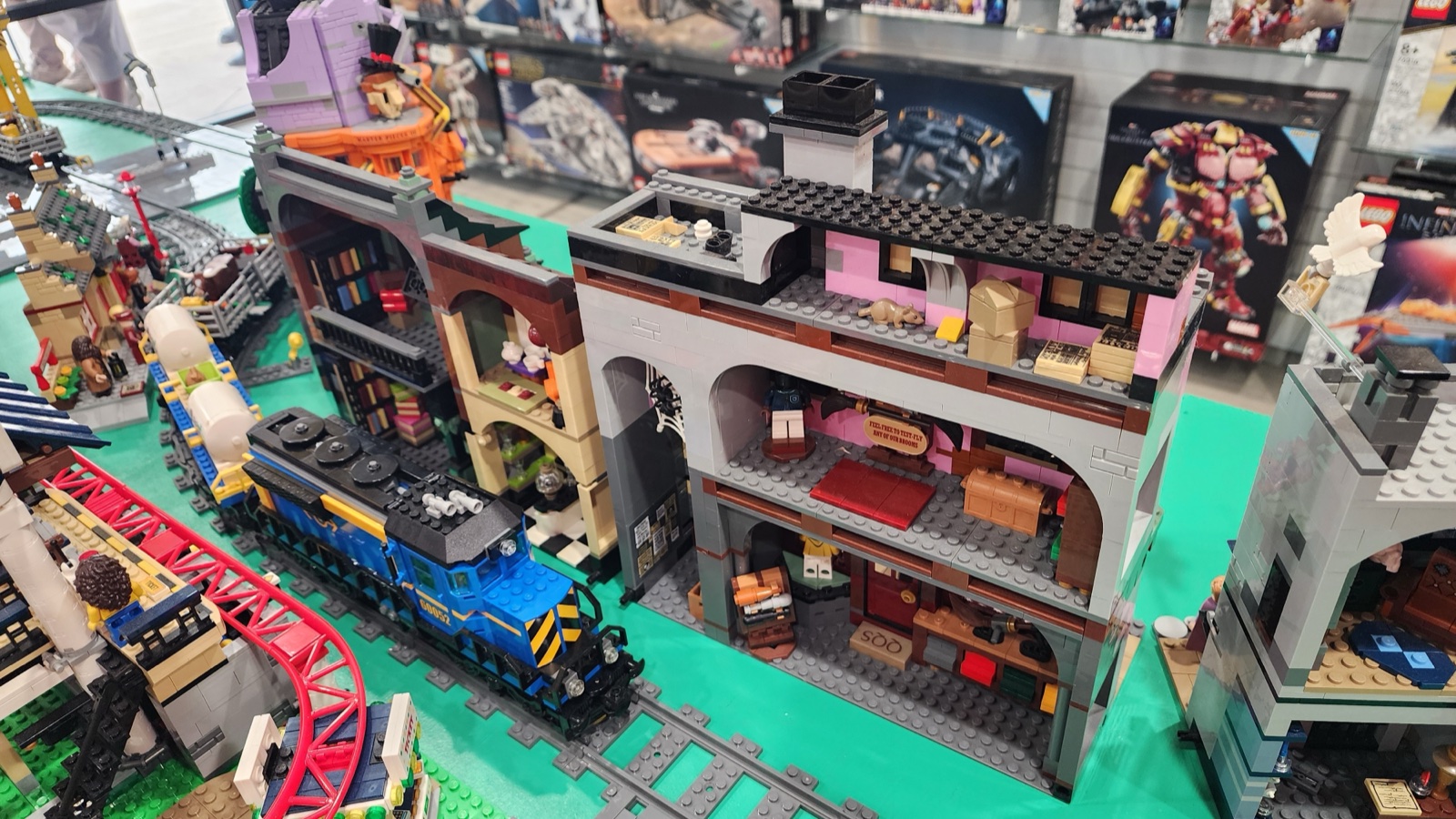
One section of the city transitions into Harry Potter territory. Diagon Alley stretches along a side street with its distinctive crooked buildings and magical storefronts. A train track runs through this section - the Hogwarts Express, presumably - adding movement and energy to the display even when it is not running. The blending of the Harry Potter theme into the broader city layout is clever. It does not feel forced. It feels like a neighborhood within a neighborhood, which is exactly how Diagon Alley functions in the books and films.
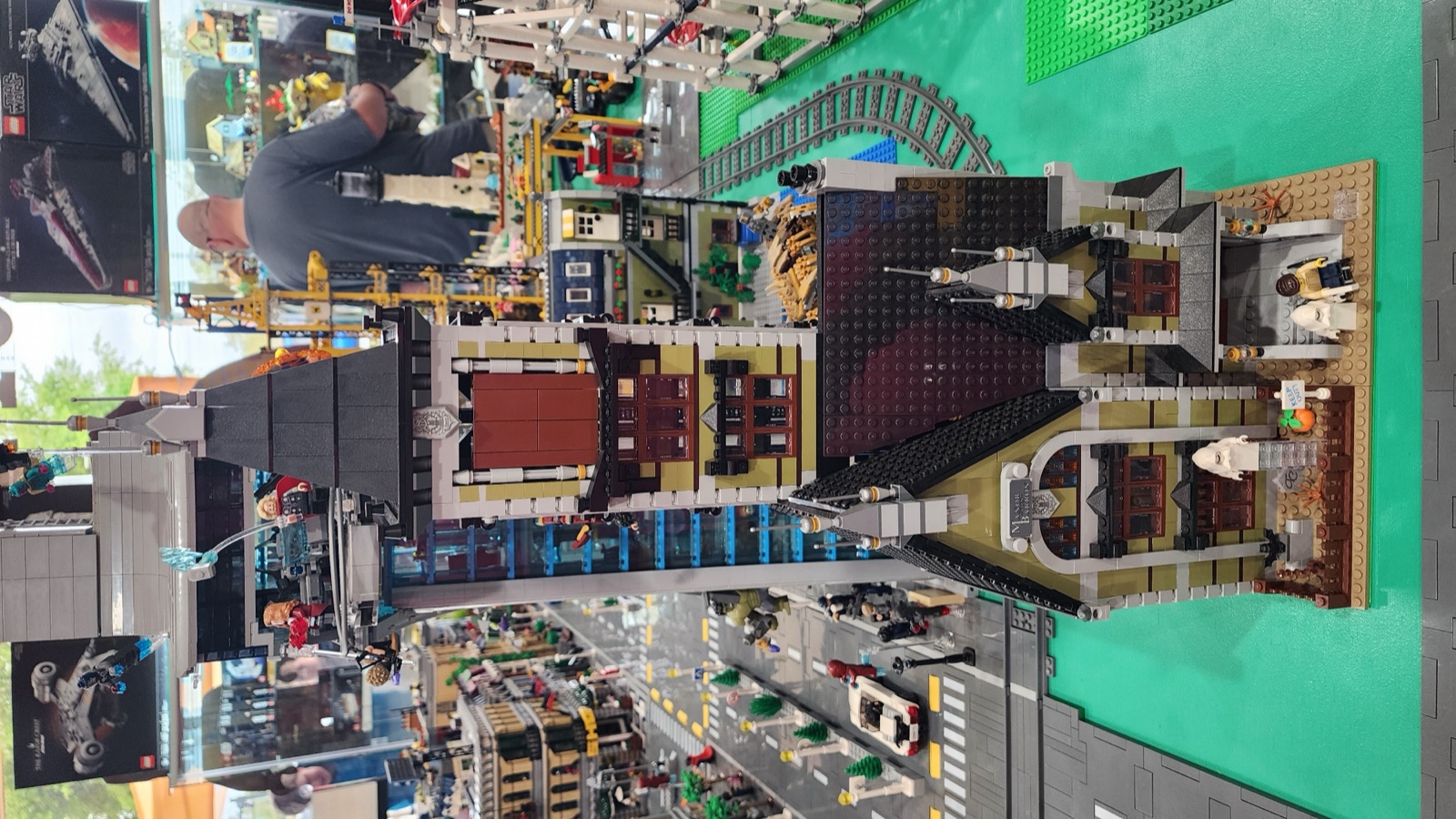
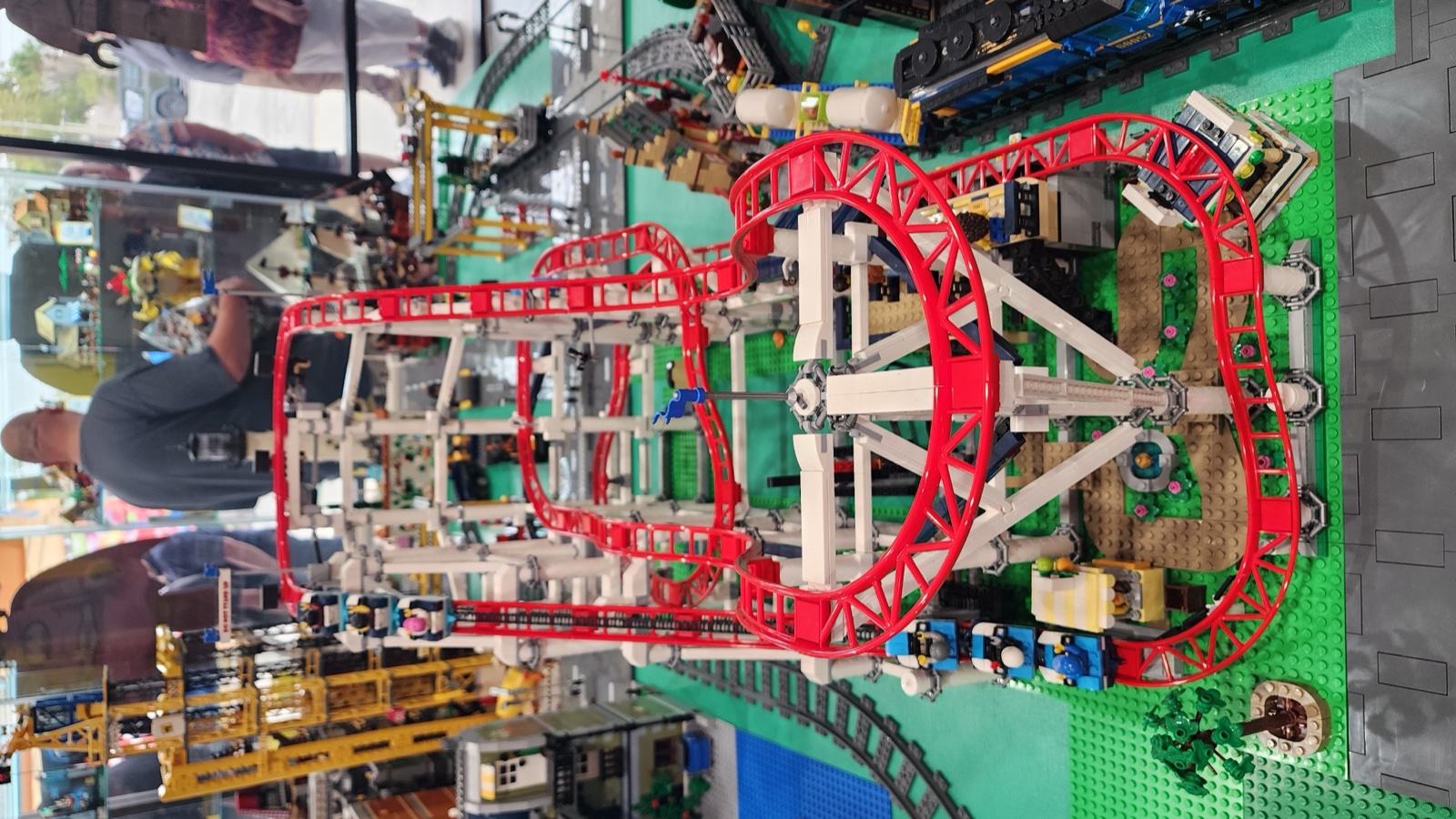
In the background, a red roller coaster track winds its way through the city. The LEGO Roller Coaster set is one of those builds that is impressive on its own but transformative when integrated into a larger layout. The track curves and dips behind buildings, over streets, and through sections of the city that you might not notice at first glance. It adds depth and dimension to the display - your eye keeps finding new details the longer you look.
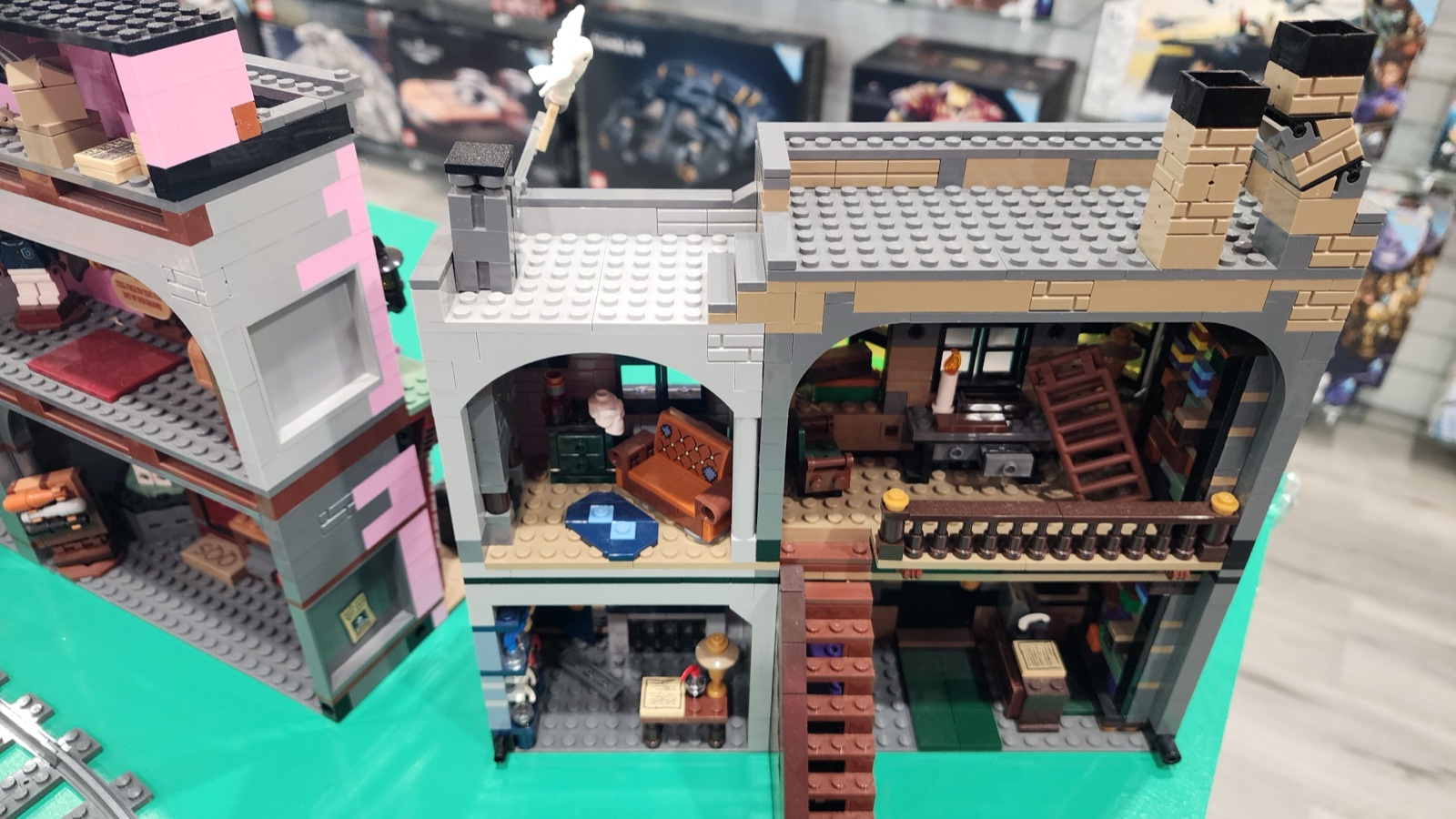
Perhaps the most impressive detail is visible from the back of the display. The modular buildings are designed to be opened from behind, revealing fully detailed interiors. Kitchens with tiny pots and pans. Living rooms with sofas and televisions. Bedrooms with beds and nightstands. The Bricks & Minifigs team positioned the display so that customers can walk around and see these interiors through the glass. It is a thoughtful decision that rewards curiosity. Most people will look at the facades and move on. The ones who walk around the back get a second, entirely different experience.
Why does a display like this matter? Because it inspires. A kid standing in front of this glass case is not just looking at LEGO sets. They are looking at a world. An adult builder sees techniques, layout ideas, and combinations they might not have considered. A parent who came in to buy a birthday present suddenly understands why their child is so passionate about these bricks. The display sells the dream of what LEGO can become, and it does so more effectively than any marketing campaign or product listing ever could.
The shelves at Bricks & Minifigs are a carefully organized mix of everything LEGO. Used sets are built and displayed with yellow price tags showing the set number, year, piece count, and price. Retired sealed boxes line the upper walls. New current releases sit alongside used inventory at competitive prices. The inventory strategy is what sets B&M apart from every other option - you get access to products spanning LEGO's entire modern history in a single store.
The first thing that catches your eye when you look up is the built LEGO Titanic sitting proudly on the top shelf under the "USED SETS" sign. It is one of the largest LEGO sets ever produced - over 9,000 pieces and more than four feet long when assembled. Seeing it fully built and displayed at eye level (well, above eye level) gives you an immediate sense of what this store is about. This is not a place that deals in small impulse purchases. This is a place where serious sets live.
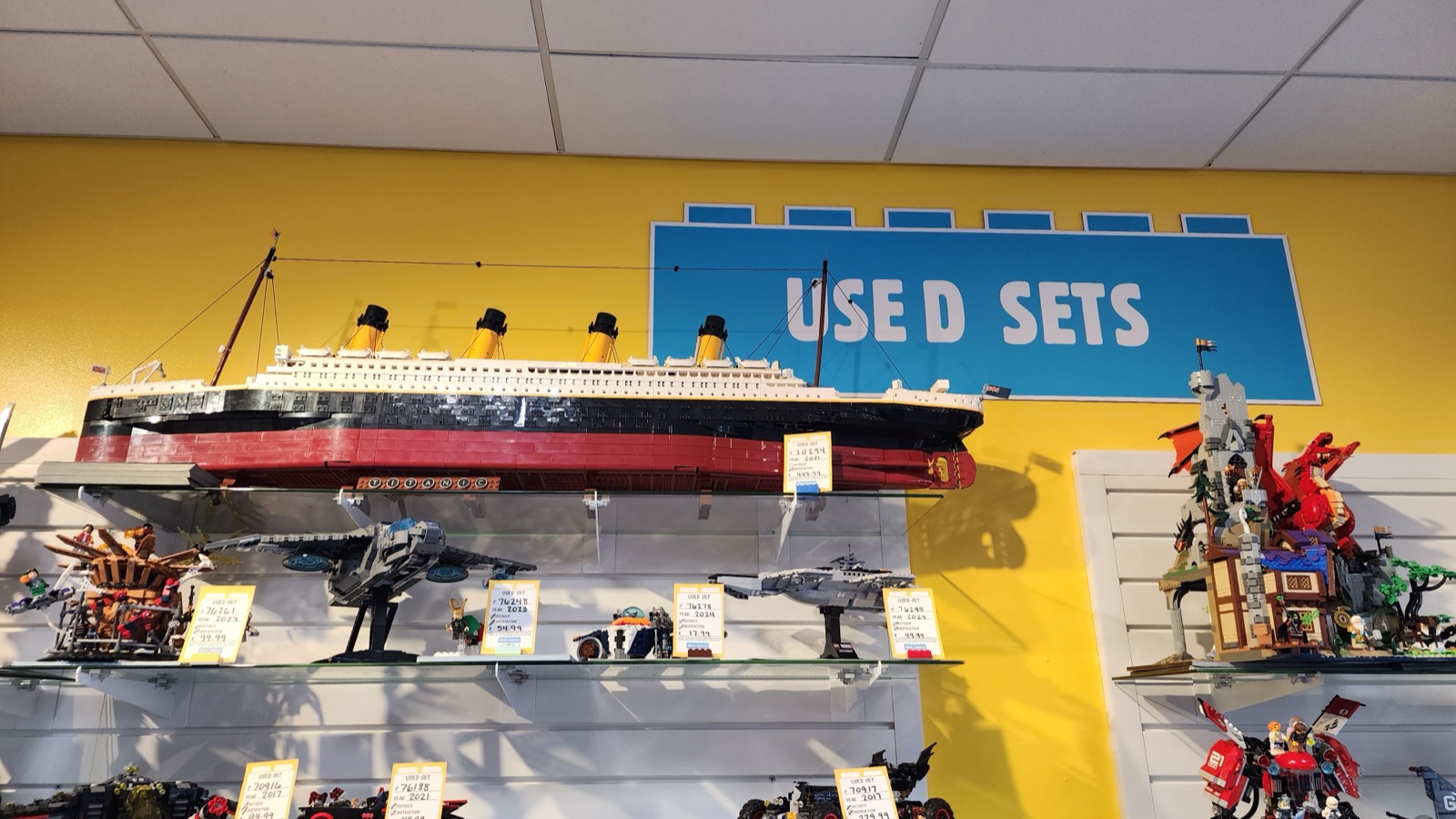
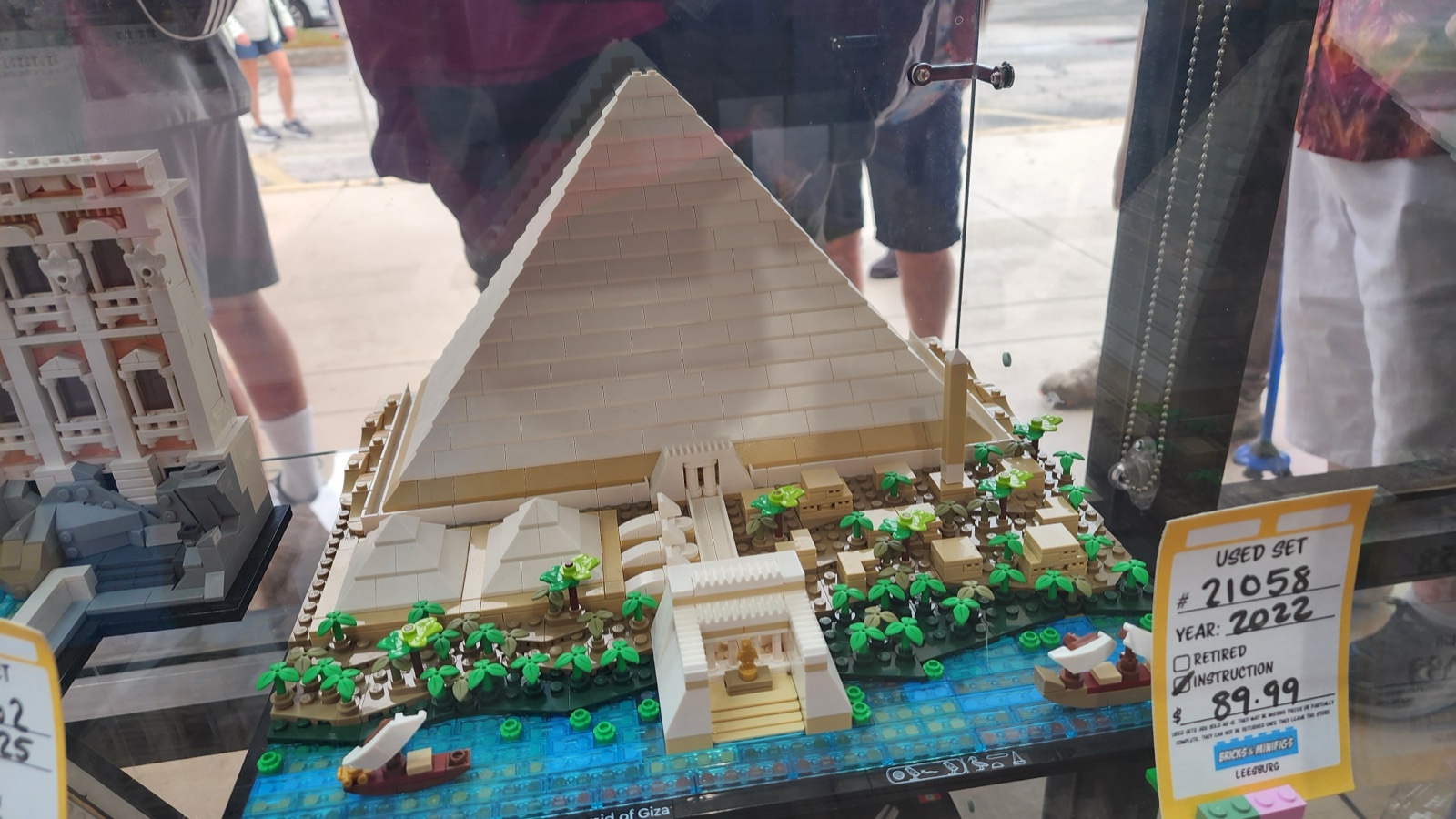
The used set pricing follows a consistent format. Each set gets a yellow tag with the set number, the year of release, and the B&M price. One example that stood out: the LEGO Architecture Great Pyramid of Giza, set #21058, priced at $89.99. This set retailed at $129.99 when it was current and is now retired and selling for significantly more on secondary markets like eBay and Amazon third-party sellers. At $89.99 used at B&M, it represents genuine value - especially since you can inspect the built set right there on the shelf before committing. That kind of transparency is rare in the LEGO resale market. No guessing about missing pieces. No hoping a BrickLink seller was honest about condition. The set is right there. You can see it.
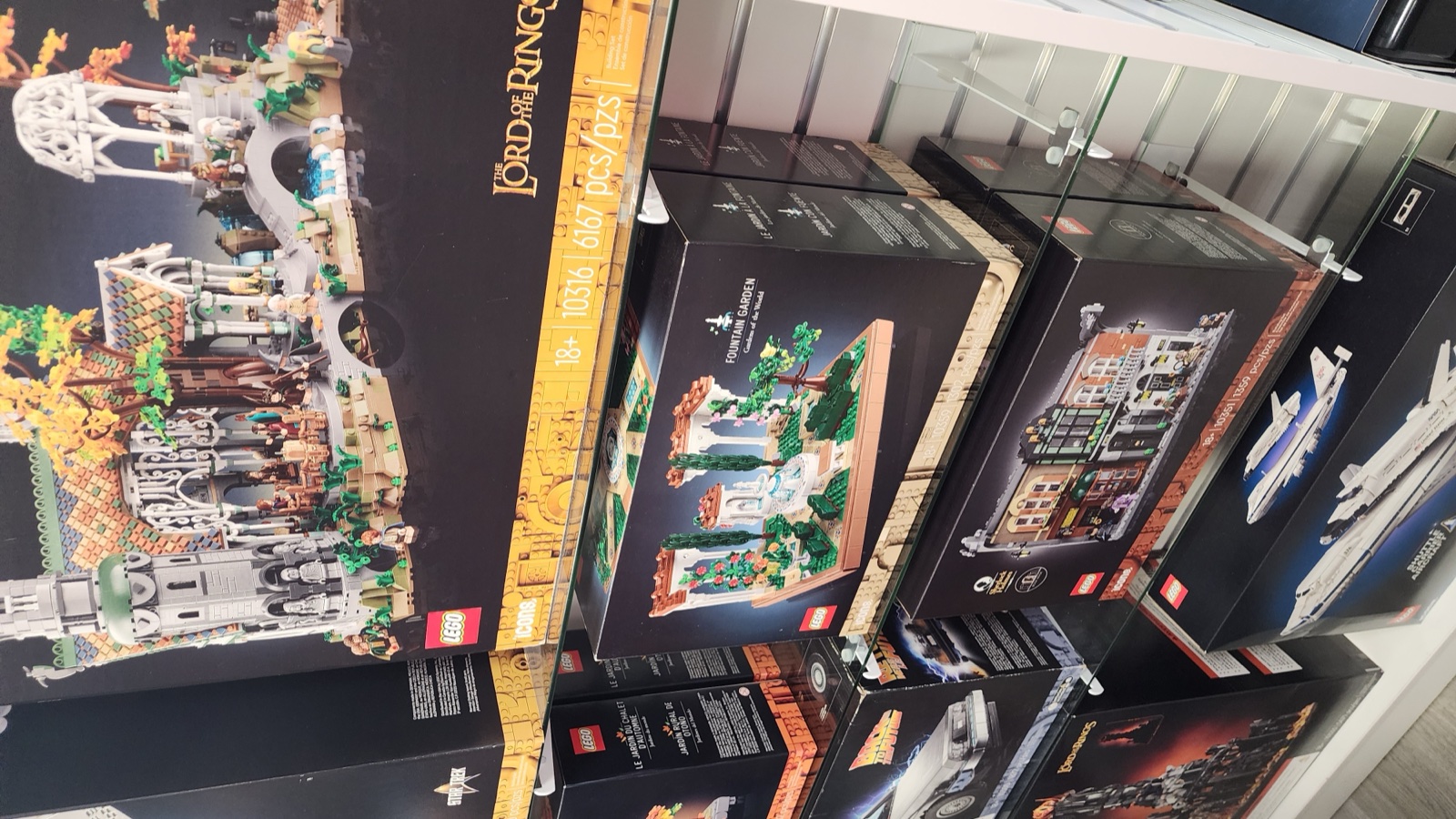
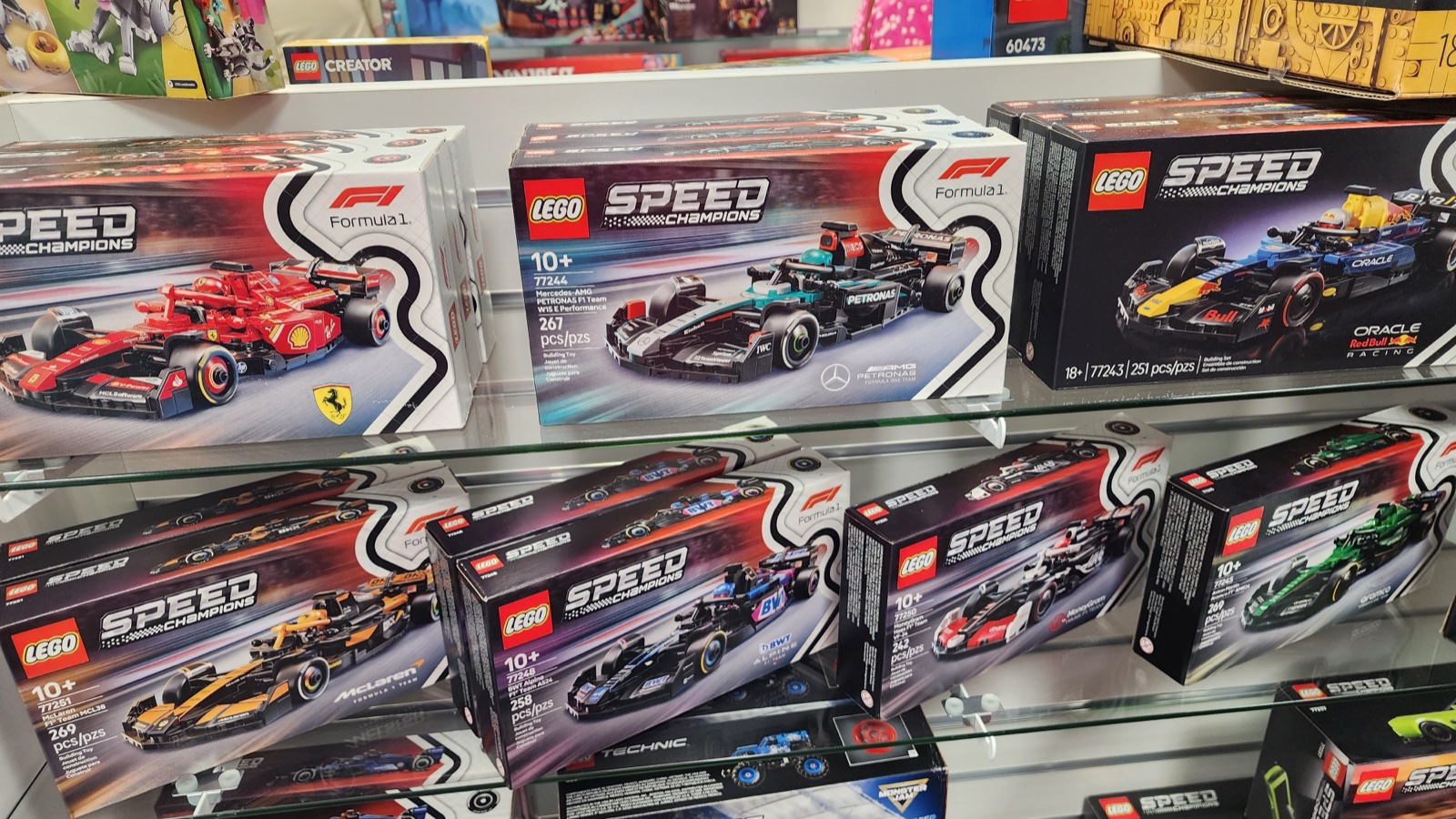
New current releases are here too, and the selection was impressive for a store that is not an official LEGO retailer. Speed Champions F1 cars from Ferrari, Mercedes, Red Bull, McLaren, and Williams sat in a row - a complete Formula 1 collection that would make any motorsport fan stop in their tracks. Icons sets like Lord of the Rings Rivendell and Tranquil Garden were sealed on the shelves. Whether you are hunting a retired set you missed or picking up a current release without paying LEGO Store retail, there is something for every budget and every interest.
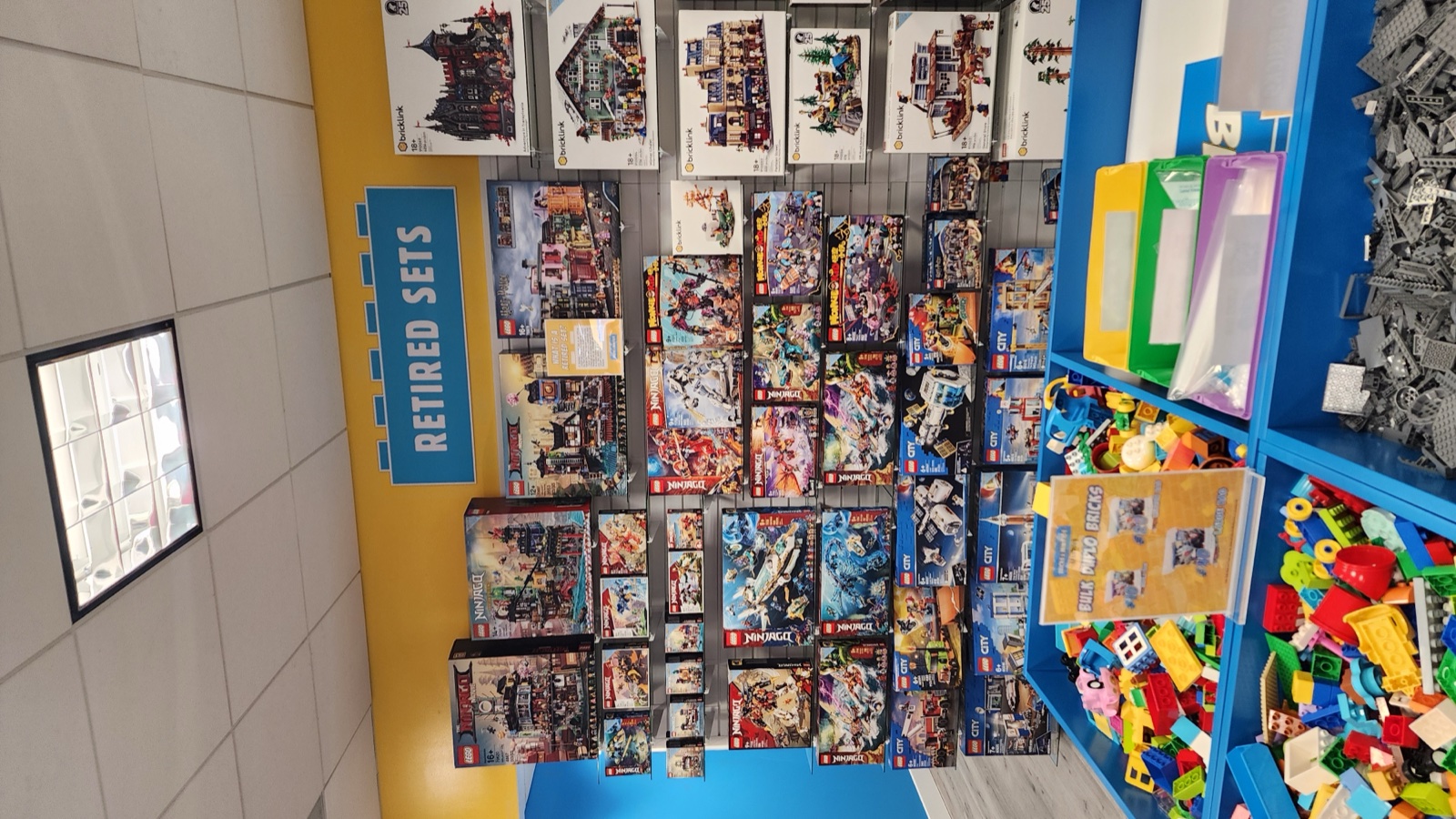
The retired sets wall deserves special mention. Sealed boxes from Ninjago, Star Wars, City, and other themes lined the upper shelves. These are the sets that collectors and builders have been searching for online, often paying inflated prices from third-party sellers with questionable storage practices. At B&M, you can see the box condition in person. You can ask the staff about the set's history. And the pricing, while not always below secondary market rates, is typically fair and reflects the actual condition of the product rather than speculative collector markup.
The Trade Counter area at Bricks & Minifigs features one of the most addictive experiences in any LEGO store: the Build-a-Minifig wall. This is exactly what it sounds like - a wall of individual minifigure components organized by type. Torsos in one section. Legs in another. Heads, hair pieces, hats, helmets, capes, weapons, tools, and accessories are all separated and displayed for mix-and-match assembly. You pick the pieces, you build the minifigure, you pay a flat rate. The creative possibilities are staggering.
The Build-a-Minifig concept is brilliant because it taps into something that even experienced LEGO collectors crave: customization. Official LEGO sets come with predetermined minifigures. The characters are what LEGO designed them to be. But at the Build-a-Minifig wall, you are the designer. Want a Stormtrooper wearing a cowboy hat and carrying a wizard's wand? Done. Want a City police officer with a pirate hook hand? Nobody is stopping you. For kids, it is pure creative freedom. For adult collectors and MOC builders, it is a practical tool for populating custom builds with unique characters that no one else has.
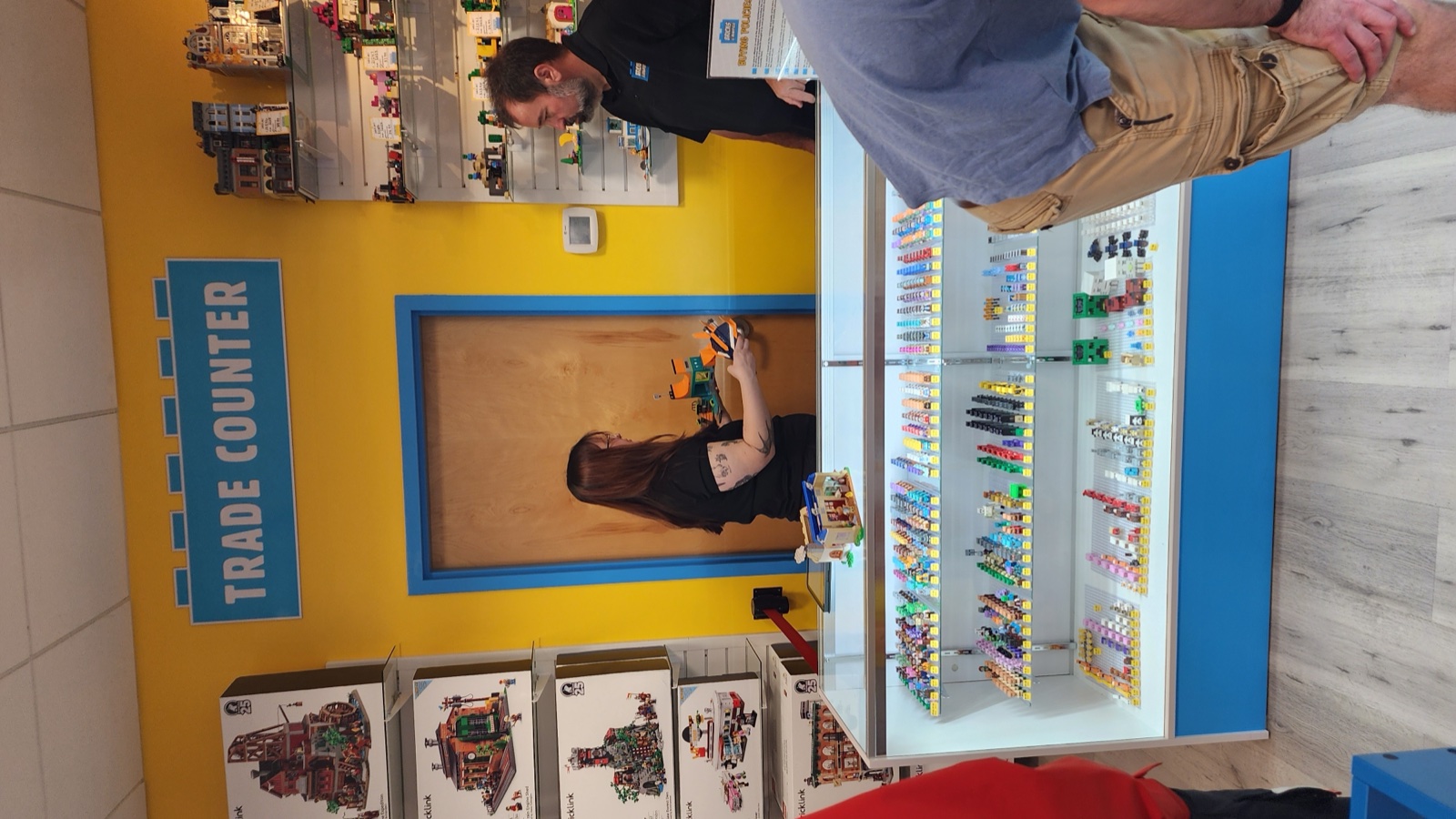
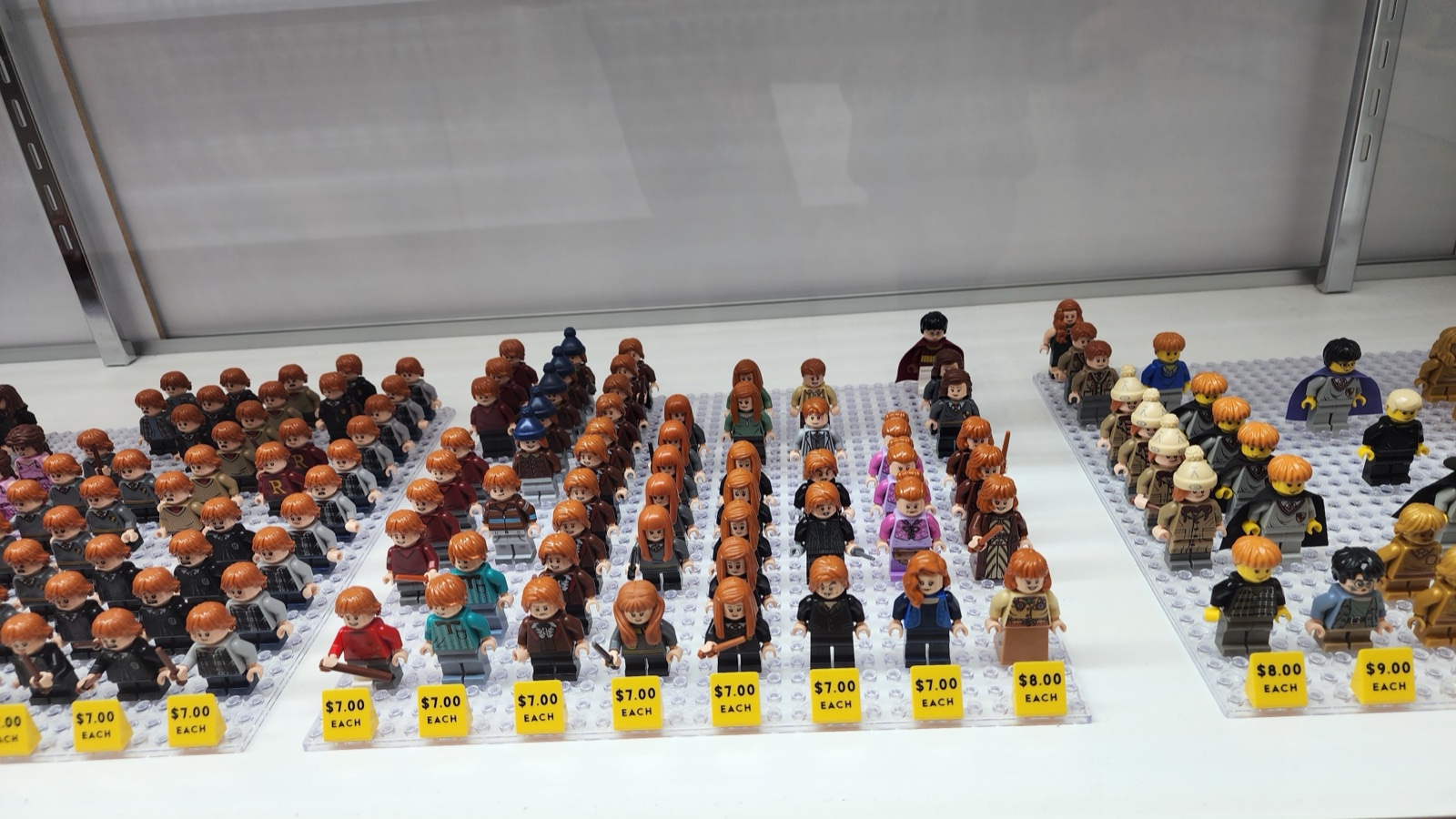
Beyond the Build-a-Minifig station, display cases throughout the store feature individually priced minifigures. Harry Potter characters were priced between $7 and $9 each - figures like Dumbledore, Hagrid, and various Hogwarts students in their house robes. For context, some of these minifigures only appeared in a single set that may now be retired, which means the only way to get them is through the secondary market. BrickLink prices for rare Harry Potter minifigures can easily exceed $15 to $20 per figure before shipping. At $7 to $9 at B&M, the value is clear - especially since you can physically inspect the figure's condition before buying.
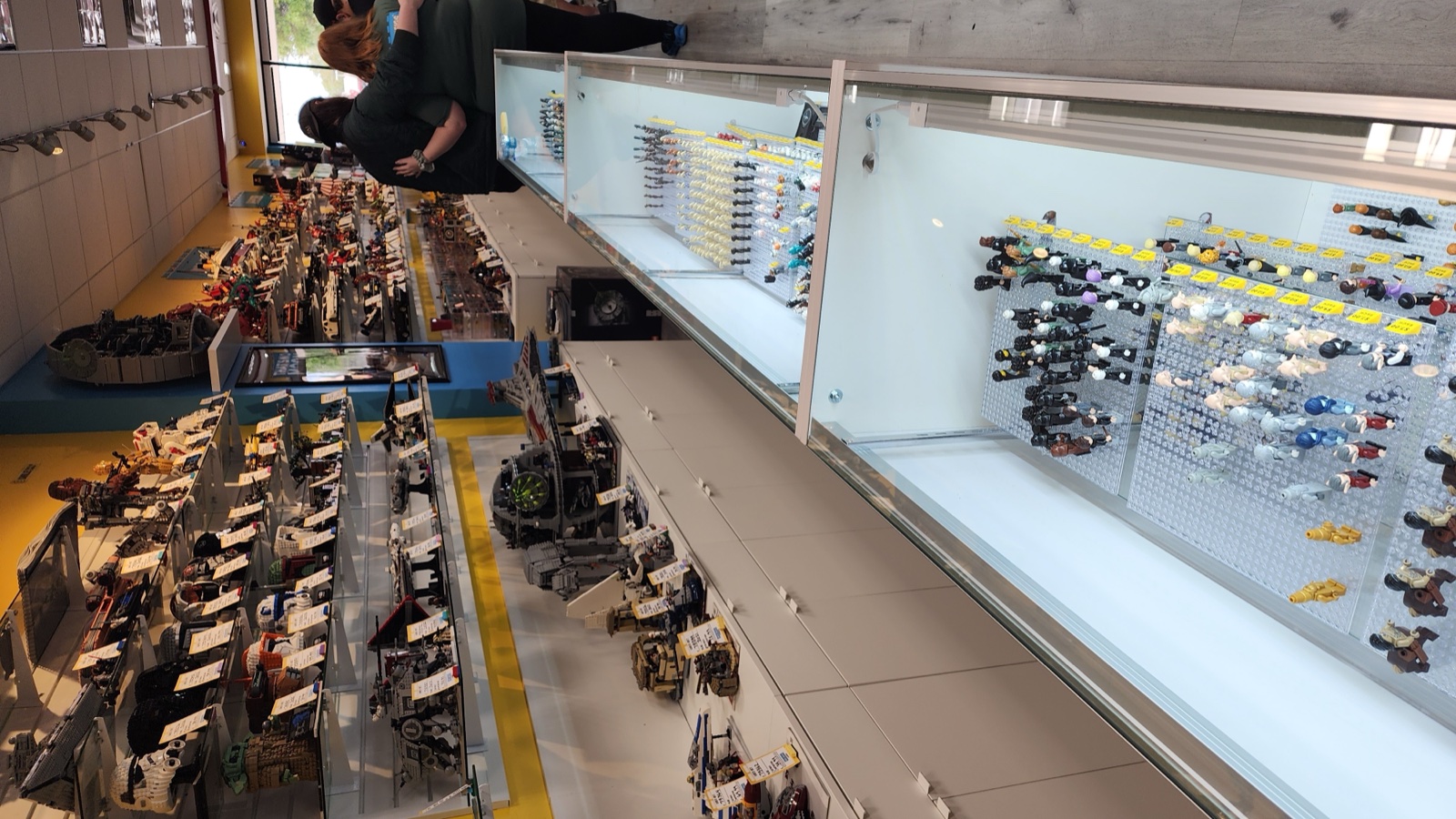
The display cases also contained Star Wars vehicles, built display models with B&M price tags, and shelves of Harry Potter items organized by sub-theme. Walking past these cases is dangerous for collectors. You start by looking. Then you start calculating. Then you start justifying. "I need that minifigure for my Hogwarts display. And that one would look perfect in the Great Hall MOC. And that accessory pack has the wand I have been looking for..." Before you know it, you are carrying a basket.
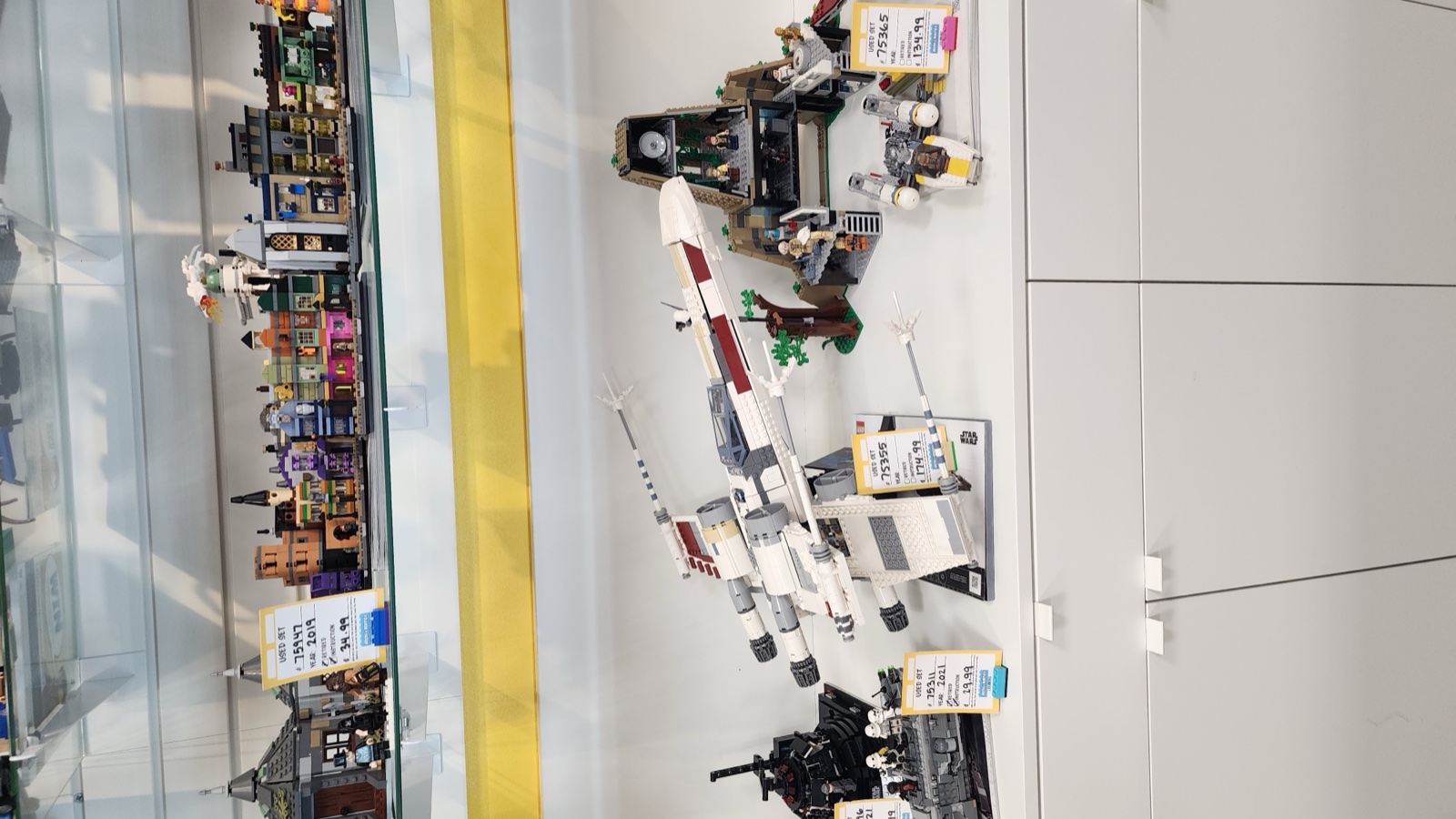
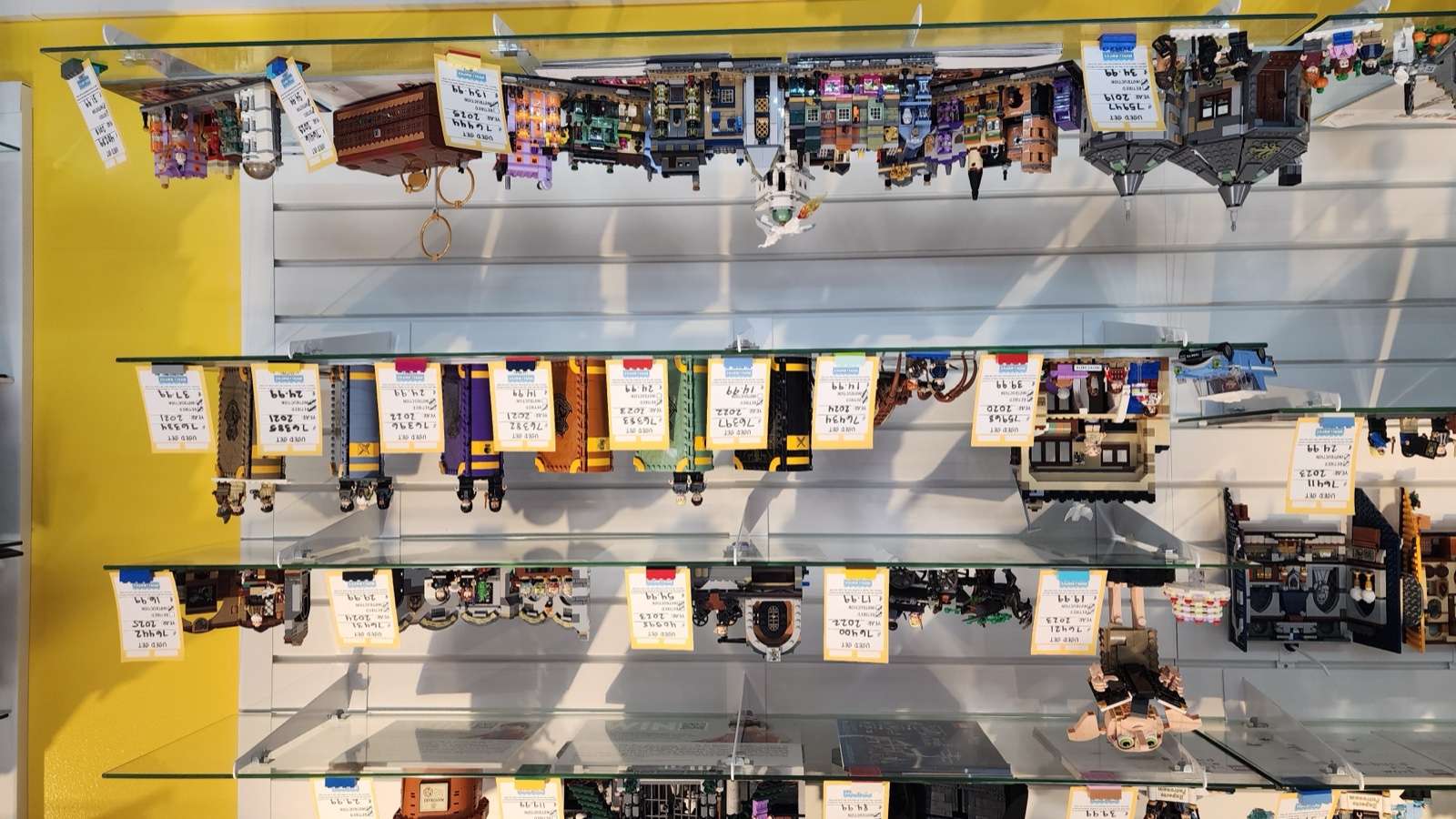
For minifigure collectors specifically, Bricks & Minifigs fills a gap that no online marketplace can fully replicate. On BrickLink or eBay, you are trusting seller photos and descriptions. At B&M, you pick the figure up. You check the print quality. You confirm the torso matches the legs. You verify that the accessory is the correct color variant. That tactile, visual confirmation is worth the trip alone.
For MOC builders - anyone designing and constructing their own LEGO creations rather than building official sets - the bulk brick tables are the main event. This is the section of the store that justifies the drive, the wait in line, and the time spent browsing everything else. The bulk tables at Bricks & Minifigs Leesburg feature large blue bins sorted by color. Mixed and colorful pieces in some bins. Black bricks in others. Dark gray. Light gray. White. The sorting is not perfect - you will find the occasional rogue red brick in the gray bin - but it is organized enough that targeted shopping is entirely practical.
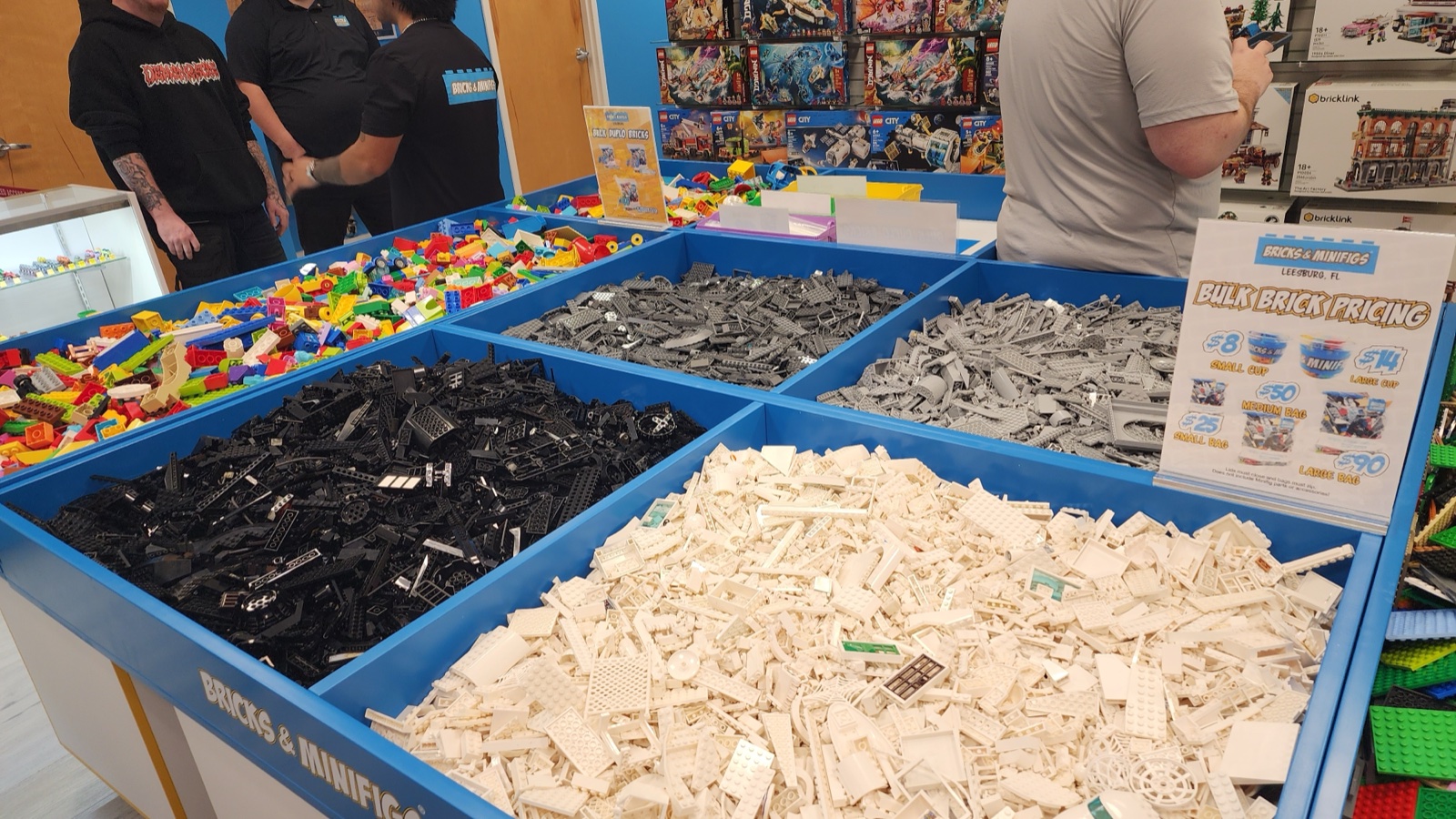
A "Bulk Brick Pricing" sign above the tables shows prices by bag size. You grab a bag, fill it with exactly the parts and colors you need, and pay a flat rate based on the bag. No per-piece pricing calculations. No shipping costs. No minimum orders. No waiting three to five business days for a BrickLink package to arrive. The parts are in your hands the moment you pay for them.
For builders working on large MOCs that require hundreds or thousands of pieces in specific colors, this system is transformative. The economics are simple: buying 200 white 1x4 plates on BrickLink means finding a seller with adequate stock, paying per-piece pricing, and paying shipping - often from multiple sellers if no single store has the quantity you need. At B&M, you walk up to the white bin, pull out every 1x4 plate you can find, drop them in a bag, and you are done. The per-brick cost is typically lower, and there is zero shipping overhead.
There is another advantage that numbers cannot capture: the tactile experience. When you dig through a bin of bulk bricks, you can feel the clutch quality. You can inspect each piece for discoloration, bite marks, or excessive wear. You can confirm that the shade of gray matches what you already have at home. Online marketplaces describe condition with words - "used, good condition" or "like new" - but those descriptions are subjective. At the bulk table, your hands and eyes make the judgment call. For builders who care about consistency in their MOCs - and most of us do - that physical inspection is invaluable.
The comparison to LEGO's own Pick-a-Brick wall is also worth noting. The PAB wall at official LEGO Stores lets you fill a cup with available parts, but the selection rotates and you cannot control which parts are in stock on any given day. At B&M, the bulk tables are consistently available, the variety is broader because the inventory comes from traded-in collections rather than LEGO's distribution pipeline, and you can often find parts that never appear on a PAB wall. I wrote about every bulk sourcing strategy builders use - and the B&M bulk tables remain one of the best options if you have a location within driving distance.
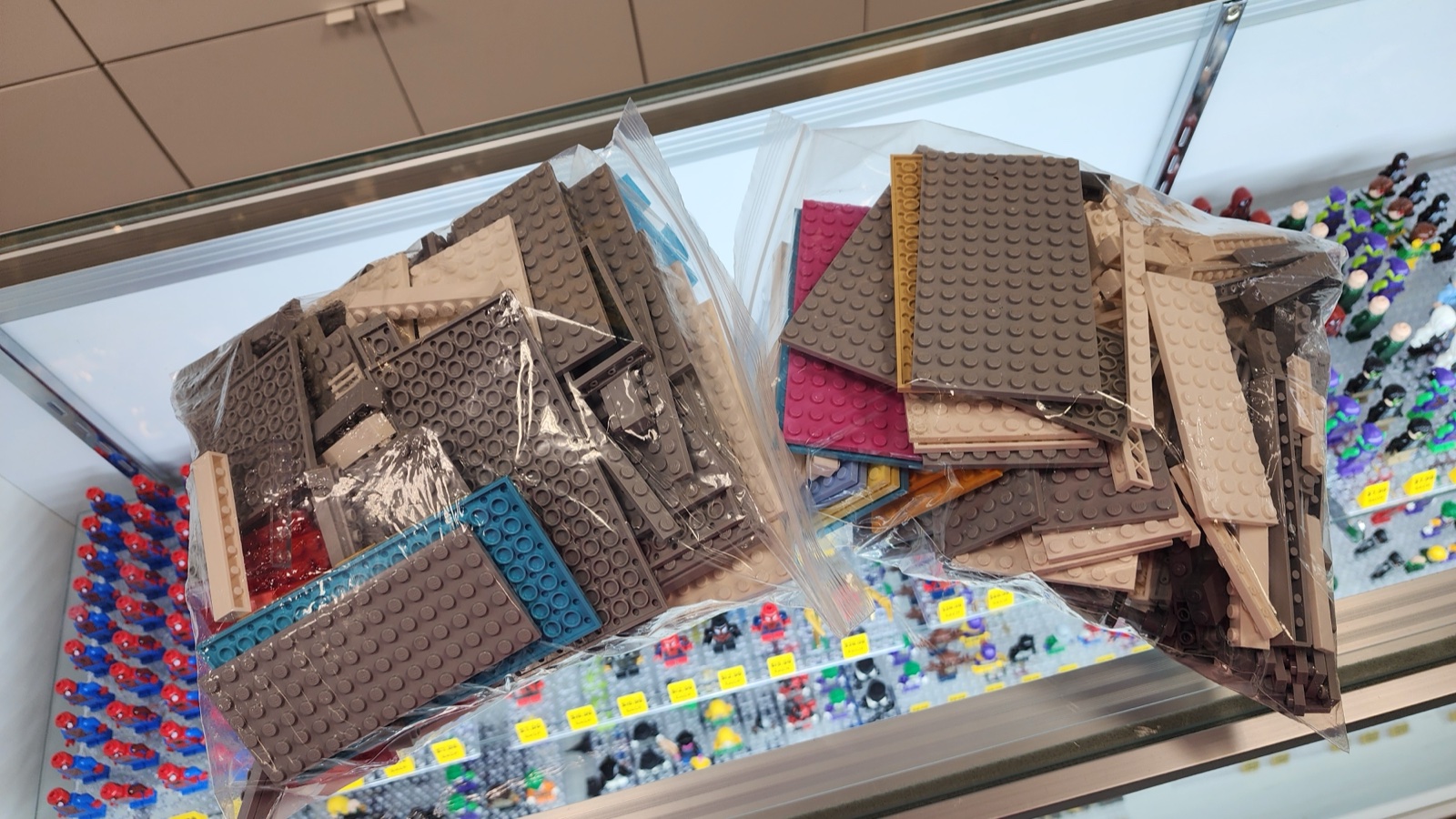
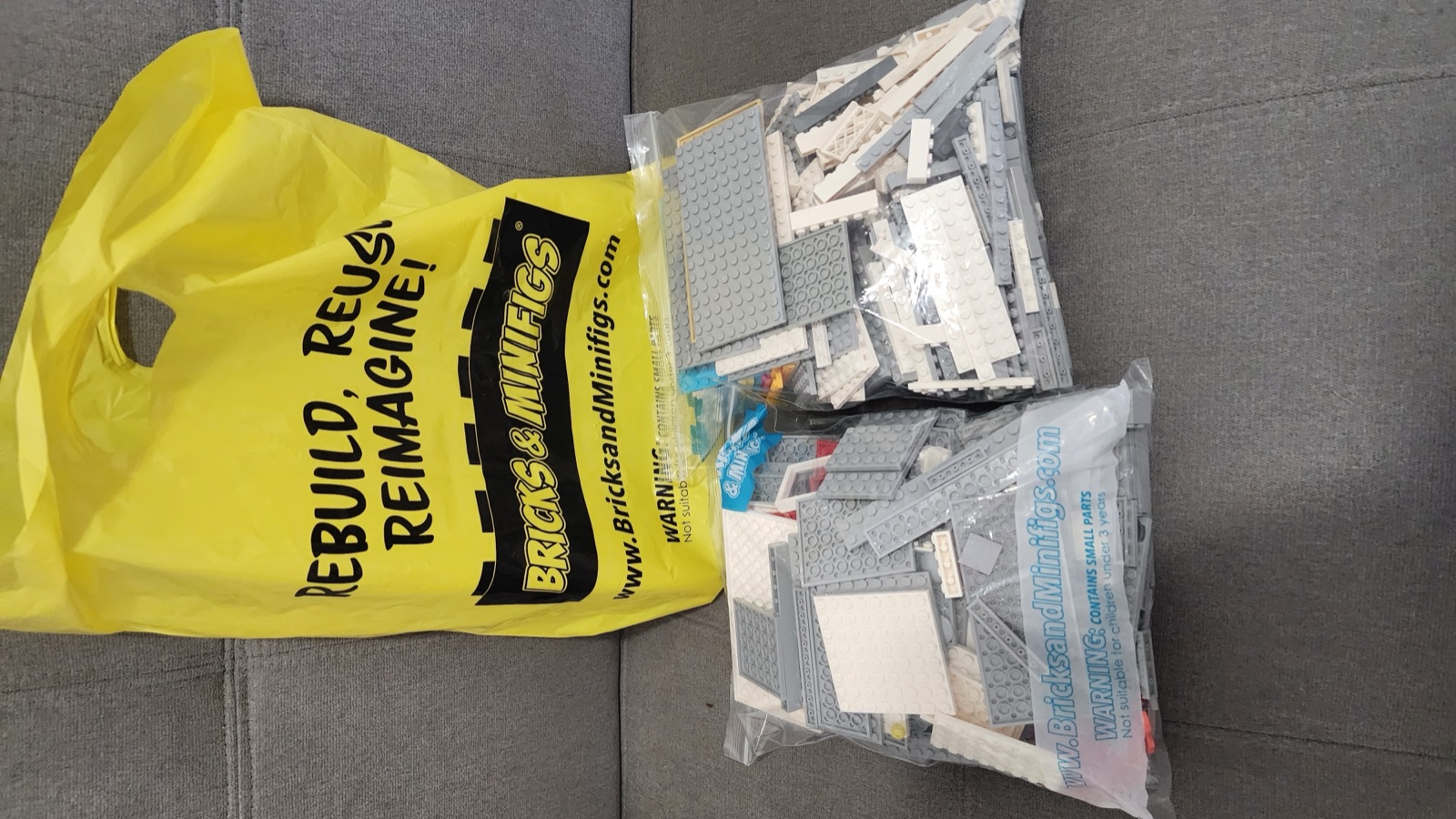
So what did we actually walk away with? Two bags of bulk bricks - specifically gray and white bricks and plates for the IMS Pagoda build. This is a large-scale MOC project that requires significant quantities of light bluish gray and white plates for the exterior facade. The Pagoda's architecture is dominated by these two colors, and sourcing them in quantity has been an ongoing challenge throughout the build. Every trip to a B&M location is an opportunity to stock up.
We spent about twenty minutes at the bulk tables, methodically picking through the gray and white bins. Gray baseplates. White plates in various sizes. Light bluish gray 1x4s and 2x4s. Every piece was inspected as it went into the bag - checking for color consistency, clutch quality, and general condition. The vast majority of pieces were in excellent shape. A handful had slight discoloration or visible wear and were left in the bin. That ability to quality-check each piece before purchasing is one of the key advantages of in-person bulk buying.
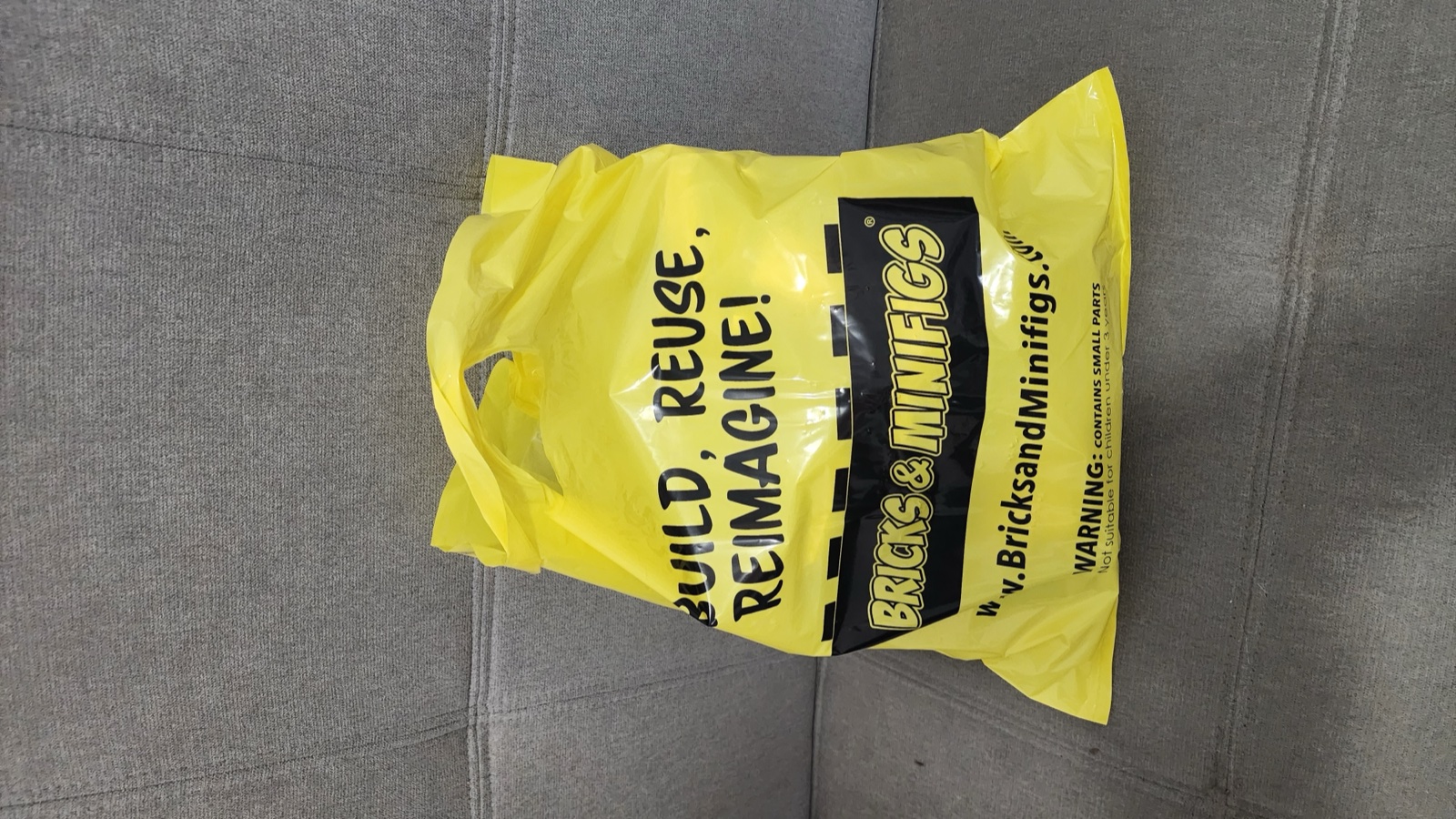
The iconic yellow Bricks & Minifigs bag says it all: "Rebuild, Reuse, Reimagine!" That tagline captures the entire B&M philosophy in three words. These are not new bricks fresh from a LEGO factory. They are bricks that lived in someone else's collection, were part of someone else's builds, and are now getting a second life in a new creation. There is something satisfying about that cycle. The bricks do not care who owns them. They just want to be built with.
Total cost for two bags of targeted parts was a fraction of what the same pieces would have cost on BrickLink after shipping from multiple sellers. We estimated the savings at roughly 40 to 50 percent compared to online sourcing for the same quantity and types of pieces. That margin adds up fast when you are building a MOC that ultimately requires thousands of parts. Every B&M trip chips away at the parts list and keeps the project budget manageable.
If you have never been to a Bricks & Minifigs location before, a few practical tips will help you make the most of the experience. These apply whether you are visiting the Leesburg store specifically or any B&M location across the country.
Arrive early on weekends. Grand opening aside, B&M stores tend to get busy on Saturday mornings. Families come in after breakfast. AFOL builders stop by for their weekly bulk table run. If you want first pick of the inventory - especially the bulk tables, which get picked through as the day goes on - showing up within the first hour of opening gives you the best selection.
Bring a list of parts you need. It is easy to get distracted by the sheer volume of inventory. A minifigure catches your eye. A retired set tempts you. The Harry Potter display cases pull you in. Before you know it, you have spent an hour browsing and forgotten why you came. If you are working on a specific MOC, bring a parts list - either printed or on your phone. Know which colors, which sizes, and roughly how many pieces you need. The bulk tables reward focused shopping.
Check the bulk table colors before filling bags. Not every B&M location has the same color bins available at all times. The Leesburg store had excellent gray, white, and black selections on opening day. Other locations might have stronger inventories in tan, dark red, or dark blue. Do a quick visual scan of what is available before you commit to a bag size. If the colors you need are sparse, you might want a smaller bag and plan to return another day.
Ask about their trade-in program. If you have old LEGO collections sitting in bins in a closet - sets your kids have outgrown, impulse purchases you never built, or collections inherited from relatives - B&M will evaluate them and offer store credit or cash. The trade-in rates vary by location and by the quality and completeness of what you bring in, but it is a legitimate way to convert unused LEGO into store credit for sets and parts you actually want. Bring your collection sorted and clean for the best evaluation.
Follow them on social media for restock alerts. B&M locations frequently post on Instagram and Facebook when new inventory arrives - especially notable retired sets, rare minifigures, or fresh bulk table refills. Following your local store's social accounts ensures you hear about new arrivals before they sell. Retired sets in particular tend to move fast once they hit the shelves.
Check their website for locations. Bricks & Minifigs has been expanding steadily across the United States. New locations open regularly. If there is not one near you today, there might be one soon. The franchise map on bricksandminifigs.com shows every current and upcoming location.
The Bricks & Minifigs Leesburg grand opening was everything a LEGO fan could hope for from a new store. The line was long, but the atmosphere was positive and community-driven. The store interior was well-organized, visually impressive, and stocked with deep inventory across every category. The LEGO city display alone is worth the visit - it is the kind of installation that inspires builders of all ages and skill levels. The bulk tables delivered exactly what we needed for the IMS Pagoda project. And the minifigure selection, retired set inventory, and used set pricing made it clear that this location was thoughtfully curated for the local LEGO community.
If you are in Central Florida - anywhere from The Villages to Clermont to Ocala to the greater Orlando metro area - the Leesburg location is worth the drive. It is located in a shopping plaza that is easy to find and has ample parking (grand opening day excepted). The staff was friendly, knowledgeable, and clearly passionate about LEGO themselves. They managed the opening day crowd with professionalism and good humor despite the volume of customers cycling through.
If you are anywhere in the United States, check bricksandminifigs.com for a location near you. Whether you are sourcing parts for a MOC, hunting retired sets, building custom minifigures, or just want to browse and dig through bulk tables - Bricks & Minifigs delivers an experience you simply cannot get online. The ability to see, touch, inspect, and hand-pick every piece changes the sourcing game entirely. And if you end up walking out with a yellow bag full of bricks you did not plan on buying, well, that is part of the charm.
See how B&M stacks up against other sourcing options in our sourcing bulk bricks guide, or learn more about getting started on BrickLink.
If the energy at this grand opening has you curious about larger-scale LEGO community events, check out our LEGO Conventions Guide for everything you need to know about BrickFair, Brickworld, BrickCon, and other AFOL gatherings around the country.