There is a Bricks and Minifigs store in Leesburg, Florida that I visit whenever I am in the area. If you have never been to one, the concept is simple: shelves and bins full of used LEGO sets, loose minifigures, and bulk bricks, all priced by the store. Some prices are fair. Some are great. Some are quietly terrible. And the only way to know the difference is to check what the set actually sells for on the secondary market.
I stood in that store one afternoon holding a used Ninjago City Gardens - no box, built, appears complete - with a $280 price tag. Is that good? The set retailed for $300. It is retired. Used complete sets on BrickLink were selling for $350 to $400 at the time. So yes, $280 was a solid buy. But I did not know that standing in the store. I had to pull up BrickLink on my phone, search the set, navigate to the price guide, find the used complete average, and do the comparison manually. That five-minute process is what GameSetBrick's market prices and deal score eliminate entirely.
Whether you shop at Bricks and Minifigs, browse Facebook Marketplace, hunt clearance aisles, or attend LEGO conventions, the fundamental question is always the same: is this price good? GameSetBrick gives you a definitive answer in seconds.
Every set detail page in GameSetBrick shows real market data pulled from the BrickLink API. You get prices for both new and used conditions, with minimum, average, and maximum sold prices from the last six months. This is not what people are asking for their sets - it is what sets actually sold for. There is a massive difference between a listing price and a transaction price, and GameSetBrick only shows you transaction data.
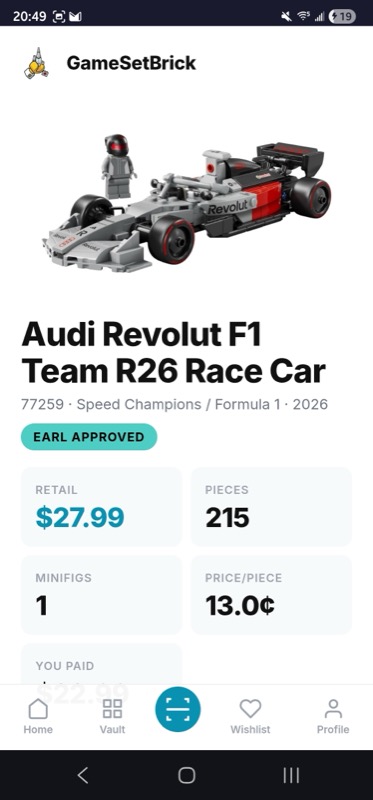
Here is what each price data point means and how to use it:
- New sealed minimum. The lowest price a new sealed copy sold for in the last six months. This is your baseline for what a patient buyer can find. If you see a set at or below this price in a store, you are getting a deal that beats even BrickLink's cheapest sellers.
- New sealed average. The typical transaction price for new sealed. This is the most useful single number for most decisions - it represents the fair market value.
- New sealed maximum. The highest price someone paid. Usually reflects urgency buying, rare variants, or sets that have become scarce.
- Used complete minimum, average, maximum. Same breakdown for built sets with all pieces and minifigures. Critical for evaluating used sets at thrift stores, garage sales, and resale shops.
Price history sparklines give you the trend at a glance. Is the set appreciating? Holding steady? Dropping after an initial retirement spike? You can see six months of price movement in a tiny chart that tells you more than a single number ever could. Trends matter - a set worth $200 that was $250 last month is a very different proposition than a set worth $200 that was $150 last month.
The deal score is the number that makes everything click. It takes the price you are looking at - whether it is a retail shelf tag, a Facebook Marketplace listing, or a garage sale sticker - and compares it to the current market data. Here is how to interpret it:
- 90 to 100: Exceptional deal. Significantly below market value. Buy immediately if you want it.
- 70 to 89: Good deal. Below market average. Worth buying at this price.
- 50 to 69: Fair price. At or near market value. Buy if you want the set, but you are not getting a discount.
- 30 to 49: Above market. You are paying a premium. Consider waiting or looking elsewhere.
- 0 to 29: Significantly overpriced. Walk away unless this is the only way to get the set.
The algorithm behind the score considers multiple factors beyond simple price comparison:
- Condition. A used complete set is compared to used complete market data, not new sealed prices. The comparison is always apples to apples.
- Current average sold price. The primary reference point - what buyers are actually paying right now.
- Price trend direction. A set with rising prices gets a slightly higher score at the same discount because the deal is likely to disappear. A set with falling prices gets a slightly lower score because you might get an even better price by waiting.
- Retirement status. A retired set trending up at 10% below average scores higher than an available set at the same discount, because the retired set's price floor is rising and the discount window is closing.
- Availability. Sets that are widely available at retail have a lower urgency factor. Sets that are out of stock or approaching retirement have a higher one.
I use this score every single time I shop for LEGO. In stores, at conventions, on marketplace apps, even browsing LEGO.com to decide whether to buy now or wait for a sale. It replaced the entire mental calculation I used to do manually.
Here is the exact process for checking market prices and deal scores:
Method 1: Barcode scan (in-store).
- Open gamesetbrick.com on your phone
- Tap the scan button
- Point your camera at the barcode on the LEGO box
- The set detail page loads with market prices and deal score in about two seconds
Read the full barcode scanner guide for tips on getting the best scans in different environments.
Method 2: Set number search (online or in-store).
- Open GameSetBrick in any browser
- Type the set number in the search bar (like 76919, 10300, or 21060)
- Tap the result to see the full detail page with prices
Method 3: Theme browsing (discovery).
- Open GameSetBrick and browse by theme
- Scroll through sets in any theme - Architecture, Speed Champions, Star Wars, etc.
- Each set card shows a quick price snapshot. Tap for full details.
Clearance hunting at retail stores. Walmart, Target, and Barnes and Noble all run LEGO clearances. A yellow clearance sticker does not tell you whether the discount is meaningful relative to market value. I have seen "30% off" clearance prices that were still above what the set sells for new on BrickLink because the original retail price was already high. The deal score cuts through the noise - green means the clearance is real, red means it is still overpriced.
Evaluating used sets at resale shops. Bricks and Minifigs, thrift stores, and consignment shops all price used LEGO based on their own assessment. Some are generous, some are not. The used complete market prices in GameSetBrick give you the exact benchmark to evaluate any used set price. Read more about buying strategies in our buying guide comparing BrickLink, Pick a Brick, and Amazon.
Facebook Marketplace and Craigslist. Private sellers often price based on what they originally paid, not current market value. Sometimes that is in your favor (they underprice a set that has appreciated). Sometimes it is not (they overprice a set that has depreciated). Market prices give you the negotiation leverage to pay a fair price.
LEGO conventions and swap meets. With dozens of vendors and hundreds of sets at varying prices, the deal score is indispensable. I scan sets at vendor tables the same way I scan them in stores - point, scan, check score, decide. It turns an overwhelming experience into a methodical treasure hunt.
Deciding when to buy from LEGO.com. LEGO.com rarely discounts sets, but the market price data helps you decide whether paying full retail makes sense. If the secondary market price is already above retail (common for popular sets approaching retirement), buying at retail is actually a deal. If the secondary market price is below retail, you might find a better price elsewhere.
BrickLink price guide (direct). BrickLink is the source data that GameSetBrick uses. Going directly to BrickLink gives you the same underlying data, but the experience is designed for sellers and advanced users. You need to search the set, navigate to the price guide tab, select the condition, and interpret the results. GameSetBrick presents the same data in a mobile-friendly format with the deal score calculated for you.
BrickEconomy. Excellent for long-term price history charts and investment analysis. Desktop-focused and not designed for quick in-store price checks. No deal score calculation.
Google search. Searching "LEGO 76919 price" gives you retail listings from Amazon, Walmart, and LEGO.com. It does not show secondary market values, historical pricing, or whether the retail price is actually fair relative to market data.
Amazon price trackers. CamelCamelCamel and similar tools track Amazon price history, which is useful but narrow. Amazon prices for LEGO are often inflated by third-party sellers, and Amazon's own price is just one data point. GameSetBrick shows the entire secondary market picture.
The unique value of GameSetBrick is combining BrickLink's trusted transaction data with instant access (barcode scan or quick search) and contextual analysis (the deal score). No other tool gives you all three in a free, mobile-first package.
Market prices are not just a standalone feature - they are the foundation that powers the rest of GameSetBrick. Your Vault collection value is calculated from live market prices. Your ROI tracking compares your purchase price to current market value. The Flip Finder uses market data to project post-retirement appreciation. Even the GWP Tracker shows estimated secondary market values for promotion sets.
If you are serious about understanding LEGO values, pair GameSetBrick's price data with our editorial guides: LEGO Investing 101 explains the fundamentals of LEGO as an investment asset, and our most valuable retired sets roundup shows what strong appreciation looks like in practice.
Market prices and deal scores are available for every set in GameSetBrick - no account required for basic lookups. The full feature set, including price alerts and portfolio tracking, is covered in the GameSetBrick launch post. But prices and deal scores are where most people get hooked, because once you see real market data next to a price tag, you can not go back to guessing.
Check the market value of any LEGO set right now at gamesetbrick.com. Search by set number, scan a barcode, or browse by theme. It is free to use, works on any device, and requires no app store download. The next time someone asks "is that a good price?" you will know in two seconds.
- GameSetBrick - All Features - See everything GameSetBrick can do
- How to Use the Barcode Scanner
- Flip Finder - Spot Retirement Investments
- The Vault - Your Digital Collection