Is the LEGO Orchid Worth Buying?
9.42/10. Worth buying. LEGO flora done right. The most relaxing 608 pieces you'll ever build.

The Orchid landed on my bench during a season when I was deep in architectural MOCs and complex mechanisms, the kind of building that leaves you mentally exhausted. Something about the box art stopped me cold. Not because it promised spectacle, but because it promised almost nothing. A single flower, rendered in LEGO form, with no gimmicks, no motorization, no thematic narrative hanging on it. That's a dangerous proposition in a hobby built on escalation. The 608 pieces felt like a deliberate constraint, a statement that LEGO could be genuinely satisfying at a smaller scale when the subject matter demanded precision over quantity.
What struck me immediately during the build was how rare this approach has become. Most botanical sets in the Icons line lean toward environmental storytelling, foliage, terrain, multiple plants creating a scene. The Orchid refuses that instinct entirely. It's a single, anatomically considered flower with a stem, roots, and a pot. That focus forces the designer's hand. Every piece has to earn its place, and the build rhythm reflects that discipline. This isn't about leisure building; it's about attention.
The Orchid is the most purely therapeutic build in the Botanical Collection. It doesn't demand attention, it rewards presence. 608 pieces build into two phalaenopsis orchids at display scale - the kind of slow, repetitive stem-and-petal assembly that achieves the same mental state as actual gardening. No instructions anxiety, no complex subassemblies. Just building, piece by piece, toward something beautiful.
The build divides naturally into three phases: the pot and root system, the stems and leaves, and the blooms themselves. Each phase has its own rhythm. The pot goes quickly and gives you something solid to anchor the rest of the build. The stems introduce the Technic-axle spine that runs the length of each plant, and you start to understand why this set holds its poses so well. Then the blooms arrive, and the pace slows to something almost meditative. You're placing curved plates at precise angles, watching each petal fan out into something organic. It's the rare LEGO build where going slower actually makes it better.
There's a deliberate simplicity here that some builders might mistake for a lack of ambition. It's not. The design team at LEGO understood that the Orchid needed to feel like an evening activity, not a weekend project. You can finish it in a single sitting with a cup of tea, and you'll feel genuinely relaxed when you're done. That's not something I say about many 600-piece sets. If you've read our ranking of every Botanical Collection set, you'll know this one consistently lands near the top for build enjoyment.
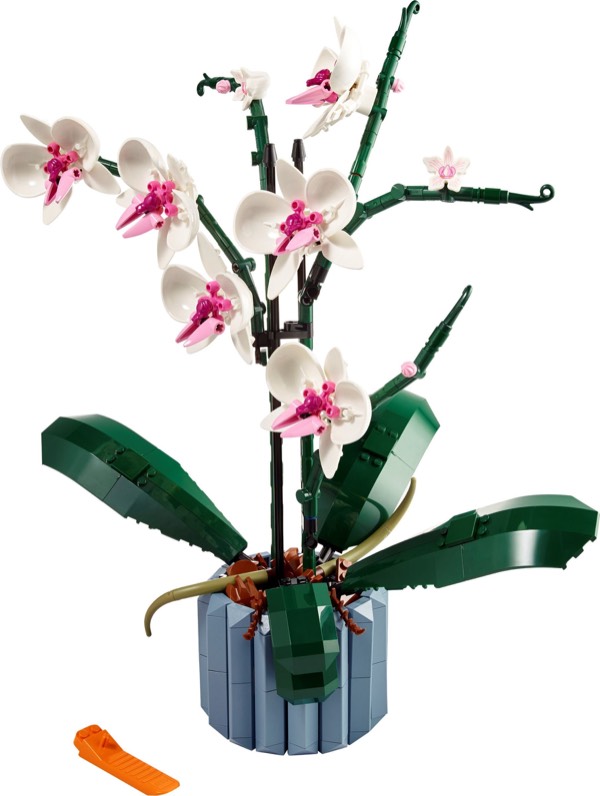
The petal construction is the technical showcase: curved plates positioned at compound angles to achieve the characteristic spread of an orchid bloom. The stem uses a Technic-axle spine for flexibility and stability simultaneously. The way the roots emerge from the base pot - using 1×1 round bricks in irregular patterns - is the most creative part of the build and translates directly to any organic-form MOC.
What makes the technique here worth studying is the layering. Each bloom is built from the center outward, with the yellow-and-pink stamen core seated on a turntable element that allows subtle rotational adjustment. The outer petals attach via ball joints hidden behind the curved plates, which means you can tweak the angle of every single bloom after the build is complete. That level of adjustability in a set with no visible hinges or joints is genuine engineering. LEGO's Botanical team solved the "how do you make plastic look organic" problem better here than in almost any other set in the line.
The leaf construction deserves its own mention. The large leaves at the base use a stacked-plate technique with slight offsets at each layer to create a natural taper and curl. It's a technique that looks simple in the finished product but requires careful alignment during the build. If you're someone who builds MOCs with organic shapes - creatures, landscapes, custom flora - pay close attention to how the leaves attach and how the designers achieved that downward droop. It's a masterclass in using rigid elements to suggest flexibility.
608 pieces in pink, white, green, and dark green. The curved petal elements are standout pieces for flower and organic MOC work. The green leaf prints are unique to the Botanical Collection. Strong haul of round plates, 1×1 round bricks, and flexible Technic elements. This is the best parts box for organic builders.
Let's break down what matters. You get a generous supply of 1×1 round bricks in dark brown and reddish brown for the roots, which are useful in any terrain or tree MOC. The pink and white curved slopes come in quantities you won't find in most sets at this price point. The Technic axles and connectors that form the stem spine are standard but welcome additions to any builder's stash. And the dark green plant leaf elements - the large, printed ones - are exclusive to the Botanical line and hold their value on the secondary market precisely because they're so hard to source elsewhere.
The real hidden gem in this parts list is the collection of small ball-and-socket joints used throughout the bloom assemblies. These are the same elements that show up in buildable figure sets and mech MOCs, but here they're used in a completely different context. Having a dozen or so of these on hand opens up possibilities for articulated MOC work that has nothing to do with flowers. If you ever part this set out - and I'm not suggesting you should - the individual element value holds up remarkably well against the original purchase price.
Exceptional. The Orchid is designed to be displayed and it shows - realistic proportions, correct bloom spread, convincing roots-in-pot presentation. In warm light the pink petals glow and the white with yellow centers reads as genuinely botanical. Lives happily on any shelf or desk. People who don't know LEGO will ask if it's real from a distance.
The display profile of this set is its single strongest selling point. At roughly 39 cm tall, it occupies the same visual space as a real potted orchid. The pot itself - a medium blue fluted design - reads as ceramic from across a room. I've had this on a bookshelf for months, and visitors consistently do a double-take before realizing it's LEGO. That's the benchmark for any display set: can it pass the "across the room" test? The Orchid passes it every time.
Lighting matters with this set more than most. Under warm LED light or natural daylight, the pink petals take on a translucent quality that's almost uncanny. Under harsh fluorescent light, the plastic reads as plastic. If you're placing this on a shelf, consider the light source. A small LED strip behind or above the shelf transforms this from "nice LEGO set" to "genuine conversation piece." The adjustable blooms mean you can angle petals toward the light source for maximum effect. Track your collection and see how the Orchid stacks up against other display sets on GameSetBrick.
608 pieces - great value for a D2C Botanical set. But the value case for Orchid is beyond piece count - it's the hours of calm it delivers, the shelf presence it achieves, and the fact that it disappears from shelves during sale periods. Buy it at full price. Don't wait for a discount.
At its standard retail price, the Orchid sits at a price-per-piece ratio that's competitive with the best value sets in the Icons theme. But price-per-piece is a crude metric, and it undersells what's happening here. The Orchid delivers a complete display piece with no additional investment needed. You don't need a baseplate, a display case, or a lighting kit to make it look good. It comes out of the box, gets built, and goes on the shelf. That self-contained value proposition is rare in LEGO sets above 500 pieces.
The secondary market tells its own story. The Orchid has maintained its value since launch and spikes during holiday seasons when stock runs low. It's not a set you buy to flip - the margins aren't there for that - but it's a set that holds its value if you ever decide to move it along. More importantly, the cost-per-hour of enjoyment is outstanding. Between the build itself, the display satisfaction, and the inevitable conversations it starts with visitors, you're looking at one of the highest-return purchases in the entire Botanical Collection. For a full breakdown of how every Botanical set compares, see our complete Botanical Collection ranking.
The Orchid has the widest appeal of any set in the Botanical Collection, and possibly the widest appeal of any LEGO set under 1,000 pieces. It works for experienced builders looking for a palate cleanser between large Technic or modular builds. It works for complete beginners who've never touched a LEGO set as an adult. It works for people who actively dislike LEGO but appreciate well-designed objects in their home. That range is almost unheard of.
If you're buying for yourself, this is the ideal weeknight build. It doesn't require a cleared table, a dedicated workspace, or a full afternoon. It fits on a coffee table, builds in 90 minutes to two hours at a comfortable pace, and cleans up completely when you're done because the finished product is the only thing left. For stressed professionals, anxious overthinkers, or anyone who struggles to put their phone down in the evening, the Orchid is a better intervention than most things you'll find in the self-care aisle.
For the LEGO veteran, the value here is different but equally real. The techniques are worth studying. The parts are worth having. And the display quality gives you something to point to when someone asks why you spend money on plastic bricks. The Orchid is proof that LEGO design has matured beyond toys and hobbyist kits into something that belongs in an adult living space without apology. If you're on the fence about the therapeutic side of LEGO building, this is where you start.
The Orchid doesn't need company, but it thrives with the right neighbors. The obvious first pairing is the Bonsai Tree (10281), which shares the same design DNA and sits at a complementary height. Together they create a botanical shelf that reads as intentional interior design rather than a LEGO display. The Bonsai's earthy tones and horizontal spread balance the Orchid's vertical elegance and pink palette. If you only buy two Botanical sets, make it these two.
The Japanese Maple (10348) is the more ambitious pairing. It's a larger, more dramatic build with deep red foliage that creates a striking color contrast against the Orchid's pink and white. Displayed together, they suggest a curated collection rather than random purchases. The Maple's wider footprint means you'll need shelf space, but the visual payoff is worth it. These three - Orchid, Bonsai, Maple - form the core of the best Botanical display shelf you can build.
For a tighter arrangement, consider the Mini Orchid (10343) as a companion piece. It's a smaller, simpler build that echoes the same flower in a more compact form. Placing the full Orchid and Mini Orchid side by side creates a parent-and-child display that's charming without being cute. The Mini uses a different color scheme - lavender and white - which prevents it from looking like a redundant purchase. It's also a fraction of the price, making it an easy add-on if you're already committed to the full-size set.
Here's the truth about gifting LEGO to non-builders: most sets are a gamble. You don't know if the recipient has the patience, the interest, or the table space. The Orchid eliminates almost every objection. It's beautiful in the box. The build is accessible. The finished product earns its place in any room. I've given this set as a gift more than any other LEGO product, and the success rate is close to perfect.
What makes the Orchid the best LEGO gift for someone who doesn't build LEGO is the outcome. Nobody looks at a finished Orchid and thinks "that's a toy." They think "that's a nice orchid." The barrier between LEGO-as-hobby and LEGO-as-home-decor disappears completely with this set. Mothers, partners, colleagues, friends who've never expressed interest in building - the Orchid converts them. Not necessarily into LEGO fans, but into people who own and display a LEGO set without any self-consciousness about it.
For holidays, birthdays, housewarming gifts, or "I don't know what to get you" situations, the Orchid is the answer. It photographs well for the gift-opening moment. It provides an activity for the afternoon. And it leaves behind something permanent and attractive. The only gift-giving risk is buying it for someone who already has one - and even then, two orchids on a shelf looks intentional. At its price point, it sits in the sweet spot between thoughtful and affordable. If you're building a gift list and want to see how the full Botanical Collection stacks up, check our complete ranking of every Botanical set.
- ✓ Most therapeutic build in the collection
- ✓ Petal technique is genuinely beautiful
- ✓ Excellent parts for organic MOC work
- ✓ Non-LEGO friends think it's real
- ✓ for a D2C Botanical
- ✗ Repetitive - very similar construction across both plants
- ✗ Some may prefer more variety in the set
Affiliate link. Some products may be provided by the manufacturer. All opinions are my own.
- Every Botanical Set Ranked - The complete collection, scored and compared
- Best LEGO Art Sets - Our ranking of the best creative and botanical builds
- Bonsai Tree Review - The companion botanical display piece
- Best Sets for Anxiety - Why botanical builds are perfect for unwinding
The root structure nearly derailed my first attempt. Rather than simple curved slopes, LEGO employed a weaving technique with slope elements and specialized connectors that required a specific sequence, deviate and you'll jam the geometry irreversibly. That moment of constraint, where you realize the designer has engineered a *correct* way to assemble this plant, changes how you relate to what you're building. The orchid becomes less sculpture and more biological accuracy translated through a specific building vocabulary.
The second surprise was the pot's interior. Most sets would detail only what's visible from the front. This one features a complete rootball structure hidden inside the ceramic vessel, invisible to anyone casually observing the finished model. That decision, spending pieces on unseen construction, reveals the intended audience immediately. The builder knows what they built, and that knowledge matters here more than display value.
Track it in your vault on GameSetBrick - our free collection app. Log your condition, price paid, and watch the real-time market value.
Track in Your Vault →Save it to your wishlist on GameSetBrick. Share your list with friends and family - every set has a buy button so gift givers know exactly where to go.
Add to Wishlist → GameSetBrick is a free app by The Earl of Bricks. See all features. Scan it. Track it. Trade it.