Is the LEGO LOTR: Rivendell Worth Buying?
9.6/10. Worth buying. The Last Homely House East of the Sea, rendered in 6,167 pieces of breathtaking Elven architecture. This is LEGO at its most beautiful.
Rivendell demands a conversation that most reviewers skip entirely: this set exists in direct conflict with what LEGO typically sells. At 6,167 pieces and a the retail price price point, it refuses the modularity that drives Icons sets. There's no sectional build here, no discrete rooms you can rearrange or photograph individually. Instead, Brickset and I spent roughly 20 hours constructing a single, unified architectural statement, a building so geometrically complex and contextually specific that it only works as Tolkien intended. The astonishing part isn't the piece count or the license; it's that LEGO greenlit a set with virtually zero replay value, zero customization expectation, and zero appeal to impulse buyers.
That's precisely why serious builders need to understand what they're actually getting before deciding whether this belongs on their shelves. This isn't entertainment in the traditional sense. This is craftsmanship as product, the kind of thing that teaches you something about structure, proportion, and material discipline while you're building it. After 25 years of assembly, I can tell the difference between a set designed to move units and one designed to exist as a permanent reference point. Rivendell is unambiguously the latter.
This is not a weekend project. I want to say that up front. At 6,167 pieces across dozens of numbered bags, Rivendell took me about 22 hours of focused building over the course of two and a half weeks. Every one of those hours was worth it.
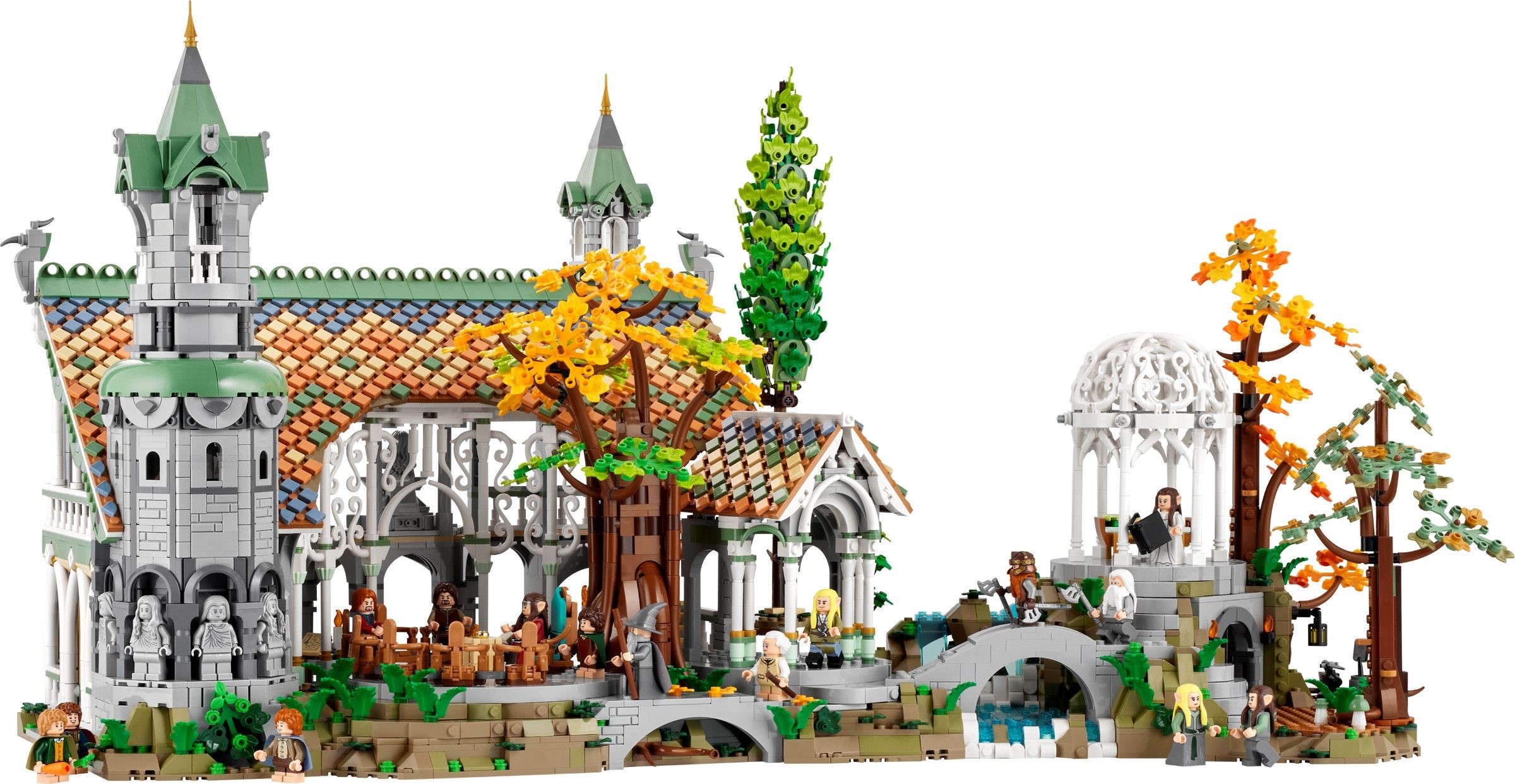
The build starts with the rocky base and waterfalls, which is smart because you learn the layered rock technique early - dark grey, dark tan, and earth green elements stacked at offset angles to look like natural stone. The waterfalls use transparent blue and white elements cascading over the rock faces. Before you have built a single Elven building, the landscape alone looks incredible sitting on the table.
The architecture is where things get extraordinary. Each building is built separately and then connected to the base. The design language - curved arches, leaf-shaped windows, organic columns, multi-level balconies - stays consistent across every structure but varies enough that nothing feels repetitive. The Council of Elrond hall is the emotional high point. The circular discussion area, Elrond's elevated seat, the pedestal where the One Ring sits. I am not going to pretend I did not hear Hugo Weaving's voice in my head while I placed the ring. I did.
The bridges deserve a special mention. They use curved slopes and arch bricks to create spans that look impossibly thin but are surprisingly solid. When you connect the first bridge between two buildings, the whole thing clicks. The separate structures stop being separate. Rivendell becomes a place. That moment alone is worth the price of entry.
The technique density here is staggering. Elven architecture demands curves and organic forms, and LEGO bricks are rectangles. The designers solved this through aggressive SNOT (Studs Not On Top) building, curved elements at odd angles, and layered construction that creates the illusion of carved stone and living wood. If you want to learn advanced building techniques, this set is a graduate-level course.
The leaf-motif windows are the signature move. Each one uses a radial arrangement of leaf elements, small curved slopes, and bar connections to create vine-like frames that look grown rather than constructed. The technique repeats across multiple windows at different scales, and studying them closely will teach you more about organic LEGO architecture than any YouTube tutorial. No other retail set does this.
The trees advance what The Shire (#10354) started. They are taller, more varied, and some of them grow through the buildings themselves - roots visible below, canopies shading balconies above. The trunk construction mixes brown brick stacking, angled connections, and vine elements to create gnarled, ancient-looking forms. The result is an environment where nature and architecture are inseparable, which is exactly how Tolkien wrote it.
The water effects are excellent. Transparent blue plates for the falls, trans-white tiles for foam, trans-clear for still pools. Staggering them at different heights creates depth and movement in a completely static model. Put an LED strip behind it - the set is practically asking you to - and the water elements glow. Combined with the Balrog Book Nook, you can build a Middle-earth display that covers both water and fire effects.
6,167 pieces with exceptional variety. The earth-tone palette dominates - dark tan, dark green, olive green, sand green, reddish brown, dark brown, medium nougat - all in quantities that would cost a fortune on BrickLink. The green selection alone rivals three or four Botanical sets combined, and having multiple shades means you can build nuanced landscapes instead of flat monochrome ones.
The architectural elements are the hidden treasure. Curved slopes in dark tan and sand green, arch bricks in multiple sizes, column elements, railings, decorative tiles, printed pieces. If you have ever wanted to build your own Elven city or fantasy fortress, this set basically hands you the parts library.
Transparent elements are substantial too. Trans-blue plates and tiles in multiple sizes, trans-clear for windows and water, trans-white for foam, trans-light blue for shallow water. Transparent pieces are always expensive on the aftermarket, so getting this many in one set is real savings if you use them in MOCs.
For 6,167 pieces, the price-per-piece comes to about 8.1 cents - well below the LEGO average and impressive for a licensed set. The 15 minifigures add significant value on top of that. This is one of the best parts-per-dollar ratios in the Icons catalog.
Rivendell is one of the most beautiful LEGO sets I have ever built. Over 30 inches wide, multi-level Elven architecture nestled into a cliffside with waterfalls on both sides. When I put it on display, every person who walked into the room stopped and asked about it. It does not need explanation or context. It just stops people.
The color palette is what makes it work. Warm earth tones - dark tan, sand green, reddish brown - against the grey rock base and blue-green vegetation. The transparent blue waterfalls add life. The tree canopies soften the rooflines. Everything feels natural and inviting, which captures exactly what Rivendell is supposed to be - a place where Elven civilization and the natural world are the same thing.
Unusually for a set this size, it looks good from every angle. Front shows the facade, bridges, and waterfalls. Sides reveal the cliffside depth and layered rock. The back opens to show furnished rooms and the Council chamber. Even from above, the tree canopy and building layout are interesting. No dead angles.
You need dedicated space for this. The footprint is large and the model is fragile enough that you do not want it somewhere it can get bumped. Deep shelf, display table, or glass cabinet. Backlighting makes a huge difference - a simple LED strip behind it makes the water glow and adds depth to the shadowed recesses. Paired with The Shire and Sauron's Helmet (#11373), it anchors a Middle-earth display collection. Belongs on any best adult LEGO sets of 2026 list.
the retail price is a lot of money. I am not going to pretend otherwise. But Rivendell earns it.
The build alone gives you 20 to 25 hours of focused, immersive construction. That works out to about the price range per hour of entertainment, which is competitive with basically any other leisure activity - and those do not leave you with a display piece at the end. Rivendell stays on your shelf permanently.
The parts value is strong. 8.1 cents per piece is well below average, and the element variety - especially the earth tones, transparents, and architectural pieces - would cost significantly more to source individually. The 15 minifigures include several exclusives, and LOTR minifigures have historically performed well on the secondary market.
When this set retires, secondary market prices will climb. Evergreen IP, massive build, stunning display, deep minifigure roster - all the ingredients for appreciation. But honestly, once you build Rivendell, you are not going to want to sell it. It is too beautiful to let go.
Fifteen minifigures. Elrond leads the lineup with ornate dark red and gold robes, detailed printing on the torso, legs, and cape, and a dual-sided head that captures both wisdom and authority. The new circlet headpiece is a great touch.
Arwen is in her white riding outfit from the flight to the ford. Gandalf the Grey appears in his Rivendell attire. The fellowship members at the Council - Frodo, Aragorn as Strider, Legolas, Gimli, Boromir - all get detailed prints and character accessories. Aragorn's broken Narsil is a nice narrative detail.
The real highlight for Tolkien purists is Glorfindel, the Elf warrior who rescued Frodo in the books (the role the films gave to Arwen). This is his first-ever LEGO minifigure. Old Bilbo is here too, in comfortable robes carrying the Red Book of Westmarch. Two generic Rivendell Elves in green and silver robes fill out the compound. Every figure has a logical position in the display - Council members around the chamber, Bilbo in the study, Arwen near the bridge. It gives the whole thing a lived-in feel that static LEGO displays usually lack.
- ✓ Elven architecture techniques are unprecedented in LEGO design
- ✓ 20-25 hour build experience is immersive and emotionally resonant
- ✓ Display quality is among the highest of any LEGO set ever released
- ✓ 15 minifigures with exclusive characters including Glorfindel
- ✓ Waterfall and landscape effects are best-in-class
- ✓ Price-per-piece ratio of 8.1 cents is exceptional for a licensed set
- ✓ Earth tone and transparent element parts haul is outstanding
- ✗ the retail price price point is a significant investment
- ✗ Large display footprint requires dedicated shelf or table space
- ✗ Some architectural sections are fragile and prone to dislodging during moves
- ✗ Tree canopies can shed leaf elements with handling
Some products may be provided by manufacturers. This page contains affiliate links. All opinions are my own.
- The Shire Review - The peaceful heart of Middle-earth in LEGO form
- Balrog Book Nook Review - The dark side of Middle-earth in book nook form
- Sauron's Helmet Review - The Dark Lord's crown in display-scale detail
- Best LEGO Sets for Adults 2026 - Our picks for the year's top builds
- LEGO Pricing Hot Take - Which sets are worth it and which are not
The bridge assembly caught me off guard. Most builders expect the iconic waterfall structure to carry visual weight through sheer height and complexity, but the actual engineering sits in the bridge's cantilever mechanics, that sweeping span uses a counterintuitive bracing system that only stabilizes once the full upper section loads into place. Building it in isolation feels precarious; completing the adjacent cliff work reveals why the designers committed to that approach. It's the kind of decision that separates Icon-level architecture from set-design efficiency.
What nobody discusses: the parts selection creates an unexpected color-theory problem that LEGO never addressed in marketing materials. The warm tans, cool grays, and Elven blue work brilliantly in photographs under controlled lighting, but in natural daylight the set reads flatter than promotional images suggest. Your build environment matters here in ways it doesn't for minifig-scale sets. This matters for collection display planning, inadequate lighting and this set underperforms against its own potential.
Track it in your vault on GameSetBrick - our free collection app. Log your condition, price paid, and watch the real-time market value.
Track in Your Vault →Save it to your wishlist on GameSetBrick. Share your list with friends and family - every set has a buy button so gift givers know exactly where to go.
Add to Wishlist → GameSetBrick is a free app by The Earl of Bricks. See all features. Scan it. Track it. Trade it.