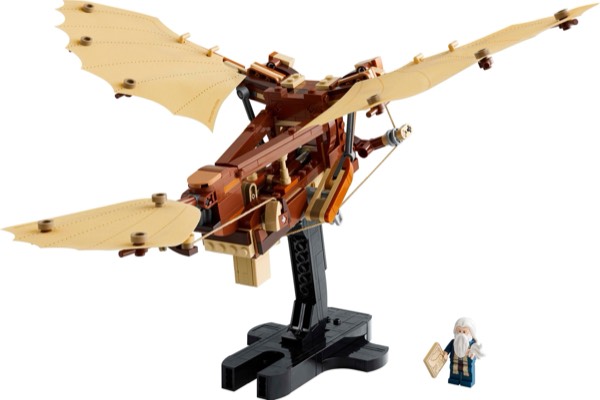
Leonardo da Vinci's Flying Machine is one of the most conceptually ambitious sets in the Icons range. At 493 pieces, it is one of the smaller Icons releases, but what it lacks in piece count it compensates for in design ingenuity. The build takes approximately 60-75 minutes and tasks you with recreating a Renaissance-era ornithopter - a human-powered flying machine that Leonardo sketched in his notebooks around 1485. The challenge for LEGO's designers was translating a concept that exists only as ink-on-paper sketches into a three-dimensional brick model that is both structurally sound and visually faithful to the original drawings. The result is a set that feels unlike anything else in the LEGO catalog.
The construction begins with the central fuselage and pilot cradle, establishing the mechanical core from which the wings extend. The wing assemblies are the heart of the build - large, articulated structures that use a combination of Technic beams, hinges, and plate elements to create the bat-wing membrane shape that Leonardo envisioned. The wings actually move, flapping through a range of motion that simulates the ornithopter's intended flight mechanics. Building the hinge assemblies and testing the wing articulation for smooth operation is the most satisfying phase of the construction. You are building a machine that was designed to fly, and even though it never will, the mechanical intent is palpable in every connection. There is a moment during the wing assembly when you first test the flapping motion and feel the resistance of the hinges working against each other in coordinated arcs - that moment is when the set transitions from a construction project into something that feels almost alive. Leonardo would have experienced a similar thrill sketching the same mechanism five centuries ago, and LEGO has bottled that feeling remarkably well.
The display stand elevates the completed machine above the base, creating the illusion of flight. The stand assembly is clean and unobtrusive, letting the flying machine itself command all the visual attention. A printed nameplate identifies the subject and artist. The overall build experience is meditative and educational - you are simultaneously learning about Renaissance engineering, Technic mechanism design, and the art of translating historical concepts into modern construction. It is one of the most intellectually engaging builds in the Icons range, even if the piece count is modest.
The wing mechanism is the primary technique feature and it is genuinely impressive at this scale. Each wing uses a Technic hinge assembly that allows controlled articulation through approximately 30 degrees of travel. The hinge geometry maintains structural rigidity at any point in the wing's range of motion, preventing the floppy, loose-jointed feel that plagues many articulated LEGO builds. The wing membrane is suggested through a combination of angled plates and tile elements that create a smooth, skin-like surface across the wing frame. For builders studying how to create large articulated surfaces - dragon wings, bird wings, deployable solar panels - the da Vinci flying machine provides a clean reference implementation.
The fuselage construction uses a combination of Technic and System elements that blend mechanical function with aesthetic intent. The pilot's cradle includes printed or detailed elements that reference da Vinci's original sketches, and the structural framework uses wood-toned elements that suggest the timber construction Leonardo specified in his notes. The overall material palette - browns, tans, and dark reds - creates a Renaissance aesthetic that is distinct from any other Icons set. For technique study, the most transferable lesson is how the set balances mechanical function (the moving wings) with display quality (the wood-toned aesthetic) without either compromising the other.
The engineering of the wing membrane itself deserves closer attention. The challenge of creating a large, flat surface that curves organically while remaining structurally connected to an articulated spine is not trivial at this scale. LEGO uses overlapping plate layers that are attached at staggered intervals along the Technic beam wing spar, allowing each section to move slightly relative to its neighbor as the wing articulates. The result is a membrane that looks and behaves more like fabric stretched over a frame than like a rigid panel - a subtle but important distinction that elevates the model from mechanical toy to sculptural interpretation. For MOC builders working on dragons, bats, pterodactyls, or any winged creature, this membrane technique is directly transferable and arguably better executed here than in any other current LEGO set.
493 pieces with a brown and tan color palette that skews toward organic, historical tones. The Technic elements from the wing mechanisms - beams, pins, axles, and hinges - are useful for any mechanical MOC project. The brown and dark tan plates and slopes are valuable for medieval, steampunk, and nature-themed builds. The wing membrane elements provide large flat surfaces in natural tones that are less common in most LEGO sets. The display stand components in dark grey and black are standard but useful.
A single minifigure representing Leonardo da Vinci is included, featuring period-appropriate clothing and a printed face that suggests the artist's iconic visage. The figure carries a scroll accessory - a nod to the notebooks that contained the original flying machine sketches. This is a unique minifigure exclusive to the set and represents one of history's most celebrated polymaths, giving it collector significance that extends beyond the brick content. The per-piece cost is higher than typical Icons sets, reflecting the specialized element selection and the licensed historical subject matter.
The brown and tan palette concentration is more useful than it might initially appear. These are foundational colors for medieval builds, fantasy architecture, natural landscapes, and any project that requires an organic or historical aesthetic. The Technic elements from the wing mechanisms - beams, pins, hinges, and axles - are universally useful building blocks for any mechanical project. While the overall piece count is modest for an Icons release, the specific elements included have been chosen with purpose rather than padded with filler, which means the aftermarket utility per piece is higher than the raw count suggests. For builders who work in earth tones and natural palettes, 493 focused pieces in this color range represent a meaningful inventory addition.
On a shelf, the flying machine is a conversation starter that transcends LEGO fandom. Visitors who have no interest in LEGO will recognize da Vinci's ornithopter concept and engage with the model on an intellectual level that most LEGO sets cannot reach. The wings, spread wide on the display stand, create a dramatic silhouette that draws the eye from across a room. The warm brown and tan palette distinguishes it from the bright colors and modern subjects that dominate most LEGO displays, giving it a museum-quality presence that reads as art rather than toy.
The display stand positions the machine at a slight angle that suggests upward flight, adding a dynamic quality to what could otherwise be a static model. The wingspan creates a substantial horizontal footprint that makes the set feel larger than its 493-piece count suggests. Under warm lighting, the wood-toned elements take on a rich, organic quality that enhances the Renaissance aesthetic. For builders who display LEGO alongside books, artwork, or historical artifacts, the da Vinci flying machine is the perfect bridge piece - it belongs in both a LEGO collection and an art collection. Positioned near the Sherlock Holmes Book Nook (#10351) or the Balrog Book Nook (#10367), it adds historical depth to a display of intellectual pursuits in brick form.
493 pieces at the Icons price point places this set at a higher per-piece cost than most Icons releases. The premium reflects the specialized subject matter, the Technic mechanism, and the unique element selection in historical tones. For builders evaluating purely on brick volume, the da Vinci machine is not the most efficient Icons purchase. The French Cafe (#10362) and the Fountain Garden (#10359) deliver more pieces for similar or lower prices.
The value proposition shifts when you consider what the set represents rather than what it contains. This is a LEGO interpretation of a 500-year-old invention by one of history's greatest minds, with functional articulated wings and a display presence that crosses over from toy to art object. The intellectual engagement of the build and the cultural significance of the subject matter add dimensions of value that piece count cannot measure. For art enthusiasts, history buffs, and builders who want their LEGO collection to tell a story beyond automotive engineering and fantasy worlds, the da Vinci flying machine delivers something truly unique. See our best sets for adults guide for the full picture.
A single Leonardo da Vinci minifigure is included wearing Renaissance-period clothing with detailed torso printing that reflects the artist's iconic wardrobe. The face print captures a dignified expression appropriate to one of history's most celebrated intellectuals. The figure includes a scroll accessory representing the notebook sketches that contained the original flying machine designs. An alternate hair piece may be included for display variety.
This is the first official LEGO minifigure representing Leonardo da Vinci, giving it historical and collector significance that few minifigures can match. The period clothing torso print is useful for medieval and Renaissance-themed dioramas beyond this specific set. For minifigure collectors who value historical figures alongside fictional characters, the da Vinci figure fills a unique slot - an artist, inventor, and engineer in one 4cm-tall package.
The da Vinci Flying Machine is for the builder who sees LEGO as more than a toy - it is for the person who sees it as a medium for exploring ideas. If you are drawn to history, art, science, or the intersection of all three, this set speaks your language. It belongs on the desk of the engineer who appreciates the roots of flight technology, on the shelf of the art lover who wants a three-dimensional tribute to Renaissance innovation, and in the hands of the parent who wants to build something with their child that teaches as much as it entertains.
It is also the ideal Icons purchase for builders who value intellectual depth over sheer brick volume. At 493 pieces, this is not a marathon build - it is a focused, meditative session that rewards attention and curiosity. If your collection tends toward the mechanical and the meaningful rather than the massive, the flying machine fits perfectly. Display it near books, artwork, or historical artifacts, and it elevates the entire arrangement. This is LEGO as cultural artifact, and it fills a unique slot that no other set in the current catalog occupies.
For gift buyers, the Flying Machine solves a specific problem: what do you buy for the person who has everything and wants something interesting rather than large? At the Icons price point, it is substantial enough to feel generous and unique enough to feel thoughtful. Anyone with an interest in history, engineering, art, or simply beautiful objects will find something to appreciate in this set. Leonardo designed the original for everyone who dared to imagine human flight. LEGO has built this set for everyone who still finds that imagination compelling.
- ✓ Functional articulated wings that actually flap
- ✓ Unique historical subject matter unlike anything else in Icons
- ✓ Museum-quality display presence that transcends LEGO fandom
- ✓ Leonardo da Vinci minifigure is a collector highlight
- ✓ Warm brown palette creates a Renaissance aesthetic
- ✓ Intellectually engaging build that educates as it entertains
- ✗ Higher per-piece cost than most Icons sets
- ✗ 493 pieces is a modest count for the price
- ✗ Wing membrane surface could be smoother at larger scale
Some products may be provided by manufacturers. This page contains affiliate links. All opinions are my own.
- Sherlock Holmes Book Nook Review - Another intellectual Icons display piece
- Balrog Book Nook Review - Fantasy meets literature in Icons form
- Blacktron Renegade Review - Retro space alongside Renaissance innovation
- Toothless Review - Another creature that was meant to fly
- Best LEGO Sets for Adults 2026 - Where Icons fits in the bigger picture
Track it in your vault on GameSetBrick - our free collection app. Log your condition, price paid, and watch the real-time market value.
Track in Your Vault →Save it to your wishlist on GameSetBrick. Share your list with friends and family - every set has a buy button so gift givers know exactly where to go.
Add to Wishlist → GameSetBrick is a free app by The Earl of Bricks. See all features. Scan it. Track it. Trade it.