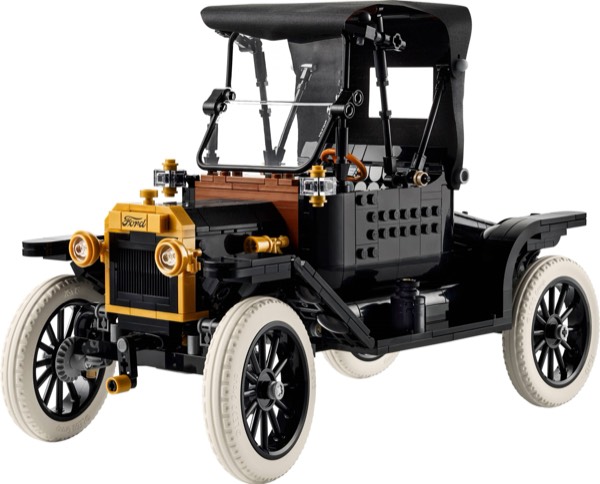
The Ford Model T is the car that changed the world. Between 1908 and 1927, Henry Ford's affordable automobile put millions of people behind the wheel for the first time and transformed society in ways still felt today. LEGO's Icons treatment gives this legendary machine roughly 1,060 pieces and a build experience that respects both the car's mechanical simplicity and its historical significance. Plan for 4-6 hours of construction that feels like assembling a piece of history.
The build begins with the chassis and running gear - a ladder frame with leaf spring suspension assemblies at both ends that capture the Model T's characteristic high-riding stance. The suspension builds are small but satisfying, using curved elements and Technic pins to suggest the flexible steel springs that gave the real car its ability to handle unpaved roads. The axles and wheel assemblies follow, with spoked wheel elements that immediately establish the vintage character.
The engine compartment builds next, with a simplified but recognizable representation of the Model T's inline four-cylinder engine. The radiator shell at the front is the face of the car - the tall, flat brass radiator surround that every Model T shared regardless of body style. LEGO captures this with a combination of dark tan and gold-tone elements that suggest the brass-era automotive aesthetic. The body construction follows, building up from the running boards through the doors, seat, and folding top canopy. The open touring body style shows off the interior and mechanical details rather than hiding them behind sheet metal panels.
The folding top canopy is the final assembly highlight - a fabric roof frame built from thin bar elements and cloth-effect pieces that captures the convertible nature of the early automobile. The steering column, pedal assembly, and dashboard complete the period details.
What makes this build genuinely special is how the construction sequence mirrors the actual assembly line philosophy that made the Model T revolutionary. Henry Ford's genius was not the car itself but the system that produced it - the moving assembly line that broke construction into simple, repeatable steps performed by specialized workers. LEGO's instruction sequence echoes this logic, with each bag focused on a specific functional system of the car: chassis, drivetrain, body, and trim. You are not just building a car; you are following the same logical progression from frame to finished vehicle that Ford's Rouge River plant perfected over a century ago. Whether LEGO's designers intended this parallel or it emerged naturally from good build design, the effect is the same: the construction teaches you something about the car's significance while you build it, which is the mark of an outstanding educational building experience.
The chassis and suspension construction teaches fundamental vehicle engineering in brick form. The ladder frame, leaf spring suspension, and rigid axle configuration represent the earliest form of automobile chassis design, and understanding how these elements connect teaches principles that apply to any vehicle MOC from vintage to modern. The high ground clearance and narrow track width require specific proportional calculations that differ from modern car builds.
The body construction demonstrates early automotive bodywork techniques - how to create curved fenders, running boards, and open bodywork that suggests thin sheet metal without the structural rigidity of modern enclosed bodies. The fender curves use a combination of curved slopes and arched elements that create smooth, flowing lines from angular brick elements. The brass-era radiator shell construction teaches period-specific front-end design using color and shape to evoke an era before chrome and stamped steel.
The spoked wheel construction and folding top frame assembly are specialized techniques that apply specifically to vintage and veteran car MOCs. The convertible top mechanism, even in its simplified LEGO form, demonstrates how to suggest flexible, movable components in a static display model.
The leaf spring suspension assemblies are the technique highlight that most builders will want to study and replicate. The real Model T used transverse leaf springs - flat steel strips that flexed under load to absorb road impacts - and LEGO's representation uses curved bar elements held under tension between two mounting points. The result is a suspension assembly that visually reads as a correct leaf spring while maintaining the structural rigidity needed to support the model above it. This is a technique that transfers directly to any vintage vehicle MOC from the brass era through the 1940s, when leaf springs were the universal suspension technology. Builders who study how the spring elements connect to the axle and chassis will learn a reusable assembly pattern that saves hours of trial and error on future vintage vehicle projects.
The radiator shell construction deserves particular attention as a study in how color and proportion convey era. The real Model T's brass radiator was its most distinctive visual feature, and LEGO creates this using a flat assembly of dark tan and gold-tone elements that captures the tall, rectangular profile perfectly. The key insight is that the radiator shell works not because it uses exotic or specialized elements, but because the proportions are exactly right - the height-to-width ratio, the slight taper from bottom to top, and the recessed center section all match the real component with precision that can only come from extensive reference study. This approach to period-accurate design - achieving recognition through proportion rather than detail - is a transferable philosophy that applies to any historical vehicle build at LEGO scale.
At roughly 1,060 pieces, the Model T delivers a focused haul in a vintage automotive palette. Black dominates - the famous "any color so long as it is black" - with dark tan, gold, and dark brown accents for the brass-era trim and wooden details. The spoked wheel elements are specialized pieces valuable for any vintage vehicle build. Curved slope and arch elements in black provide fender and body panel pieces that serve car MOCs of many eras.
Small detail elements including bar pieces for the folding top frame, clip-and-bar assemblies for the mechanical details, and gold-tone accent pieces for the brass trim work are versatile additions to any vehicle builder's parts collection. The chassis elements - plates, Technic pins, and structural beams - are universally useful.
The black element concentration deserves specific analysis because it serves a dual purpose. The Model T's famous all-black color scheme was not an aesthetic choice but an economic one - black Japan enamel dried faster than any other color, which kept the assembly line moving at maximum speed. LEGO's faithful reproduction of this monochrome palette means you end up with a substantial collection of black elements across a wide variety of shapes and sizes. Black is the second most consumed color in MOC building after white, and it is used extensively in vehicles, buildings, space ships, creatures, and display bases. The concentration of black curved slopes, arches, plates, and tiles in this set provides a useful boost to any builder's black inventory, and the variety of shapes is better than you might expect from a single-color vehicle. The gold-tone and dark tan accent pieces, while fewer in number, are genuine rarities that appear in very few other sets and carry disproportionate value for period-specific building projects.
The Ford Model T is instantly recognizable. The high-riding stance, the brass radiator shell, the spoked wheels, and the folding top canopy create a silhouette that is unmistakably early automobile - and unmistakably Model T. The black body with brass accents is elegant in its simplicity, and the open body style means the interior details remain visible and add to the display interest rather than being hidden behind doors and windows.
At display scale, the Model T has a charm that modern vehicle sets cannot replicate. It comes from an era when cars were mechanical sculptures rather than aerodynamic envelopes, and every component - the springs, the engine, the running boards, the folding top - is visible and contributes to the visual story. Under warm lighting, the gold-tone brass accents glow against the black body, and the model takes on a museum-quality presence that works beautifully on a desk, bookshelf, or in a display case alongside other automotive Icons.
For automotive history enthusiasts, the Model T is a conversation piece that connects the viewer to the dawn of the automobile age. It displays not just as a car model, but as a piece of cultural history in brick form.
The Model T's display character changes dramatically depending on the surface and lighting context, and this versatility is one of its greatest strengths as a display piece. On a dark wood shelf, the black body creates a cohesive, understated silhouette where the gold-tone brass accents become the star attraction, catching light and drawing the eye to the radiator, headlamps, and trim details. On a lighter surface, the black body stands in sharp contrast, and the overall form of the car - its height, its narrow stance, its spindly spoked wheels - becomes the dominant visual feature. Under warm incandescent or amber LED lighting, the entire model takes on a sepia tone that evokes vintage photography and reinforces the historical narrative. Under cool white light, the details sharpen and the model reads as a precise mechanical object. Each lighting and surface combination tells a slightly different story about the same car, and that display versatility keeps the Model T interesting on a shelf long after the initial build novelty has faded.
At approximately 1,060 pieces, the Ford Model T sits at an accessible price point for the Icons line. The build experience delivers 4-6 hours of historically informed construction, the technique education covers vintage chassis, bodywork, and mechanical detail building, and the display piece has universal recognition and genuine charm. For automotive enthusiasts, LEGO collectors, and history buffs alike, the Model T represents excellent value as both a building experience and a display piece. Henry Ford made the automobile affordable for the masses - LEGO has made the Model T affordable for the shelf.
The value proposition extends beyond the immediate build when you consider the Model T's position within the broader Icons vehicle collection. LEGO's Icons line has produced some of the finest vehicle sets in the company's history, and the Model T joins a lineage that includes the Porsche 911, the Corvette, and the Land Rover Defender. Within that company, the Model T holds a unique position as the oldest vehicle represented, and its presence on a display shelf anchors a historical timeline that stretches from the dawn of the automobile era to the modern sports car age. That narrative role gives the Model T a significance in a collection that transcends its individual build quality or parts count - it provides historical context that makes every other vehicle set on the shelf more meaningful.
For gift buyers, the Model T occupies an ideal position: it is recognizable enough that the recipient will immediately understand what they are looking at, accessible enough in price that it works for birthdays and holidays without being extravagant, and interesting enough in its build techniques and historical details that even experienced LEGO builders will find genuine satisfaction in the construction. It is also one of the rare LEGO sets that appeals strongly to an older demographic - grandparents, history teachers, automotive journalists, and museum enthusiasts - who might not typically engage with the LEGO brand. That broad appeal makes it a versatile purchase that delivers satisfaction across a wider audience range than most sets in the catalogue.
The Ford Model T speaks to anyone who appreciates the intersection of engineering, history, and design. Automotive enthusiasts will find a model that respects the mechanical significance of the car that made personal transportation accessible to ordinary people. LEGO Icons collectors will gain a historically important vehicle that fills a gap in the timeline between the classic era and the modern sports cars that dominate the current lineup. History educators and students will discover a tangible, hands-on way to engage with the industrial revolution's most transformative consumer product.
The set is particularly well-suited to builders who enjoy vintage subjects and the challenge of capturing period-appropriate aesthetics in brick form. The brass-era detailing, the exposed mechanical components, and the open body construction present design challenges that differ fundamentally from modern vehicle builds, and the solutions employed here teach techniques that apply to any pre-war automotive project. Builders who have grown accustomed to the sleek, enclosed profiles of modern LEGO vehicles will find the Model T's honest, everything-visible design philosophy refreshingly different.
This is also a set that bridges generational gaps in a way that few LEGO products can. A grandparent and grandchild building the Model T together creates a natural conversation about how the world has changed in a century - from horse-drawn carriages to electric vehicles, from dirt roads to interstate highways, from hand-cranked engines to push-button starts. The model provides a physical anchor for those conversations, and the build time creates the space for them to happen naturally. If you are looking for a LEGO set that generates meaningful connection between builders of different ages and backgrounds, the Ford Model T is one of the most effective choices in the current catalogue.
It is worth stepping back from build scores and parts inventories to consider what the Model T actually represents, because the historical weight of this subject adds a dimension to the LEGO set that pure product analysis cannot capture. Before Henry Ford's assembly line produced the Model T at scale, automobiles were luxury items affordable only to the wealthy. Ford's insight was that the automobile was not a luxury - it was a tool of liberation. By reducing the price from $850 in 1908 to $260 by 1925 through relentless manufacturing innovation, Ford put fifteen million Model T cars on American roads and fundamentally restructured society in the process.
The Model T created suburbs, enabled rural communities to access urban services, launched the petroleum industry into dominance, demanded the construction of paved road networks, and established the consumer credit systems that eventually financed the modern economy. It is not an exaggeration to say that the Model T is the single most consequential consumer product in the history of industrial civilization. LEGO's brick-built version captures the physical form of the car with accuracy and charm, but it also captures something less tangible: the sense that revolutionary things can come in simple packages. The Model T was not the fastest, the most beautiful, or the most technically advanced car of its era. It was the most important. And sometimes, in LEGO as in life, importance matters more than spectacle.
- ✓ Instantly recognizable Model T silhouette and proportions
- ✓ Brass-era details with gold-tone accents are visually striking
- ✓ Open body style keeps interior and mechanical details visible
- ✓ Chassis and suspension teach fundamental vintage vehicle engineering
- ✓ Accessible price point for an Icons vehicle
- ✗ Folding top canopy elements can feel delicate on display
- ✗ Black-on-black color scheme limits some surface detail visibility
- ✗ Spoked wheels are simplified compared to the real wire wheels
Some products may be provided by manufacturers. This page contains affiliate links. All opinions are my own.
- Every Speed Champions Set Reviewed - Modern cars in Speed Champions form
- V8 Engine Review - Classic automotive engineering in brick
- Dodge Challenger Review - American automotive history continues
Track it in your vault on GameSetBrick - our free collection app. Log your condition, price paid, and watch the real-time market value.
Track in Your Vault →Save it to your wishlist on GameSetBrick. Share your list with friends and family - every set has a buy button so gift givers know exactly where to go.
Add to Wishlist → GameSetBrick is a free app by The Earl of Bricks. See all features. Scan it. Track it. Trade it.