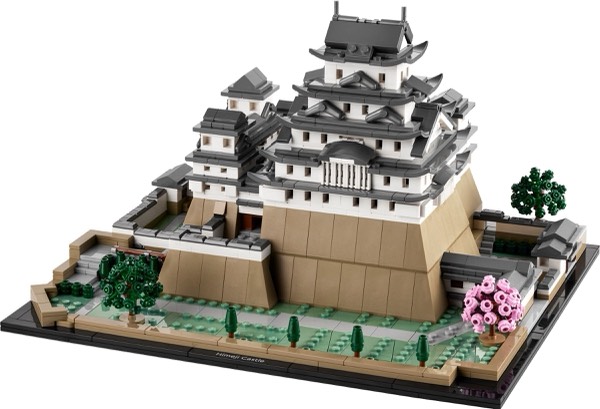
Himeji Castle is the set the LEGO Architecture line was born to make. At 2,125 pieces, it captures the soaring elegance of Japan's most famous castle - known as the White Heron for its pristine white walls and graceful rooflines that seem to take flight. The build is a 10-14 hour journey through Japanese architectural principles that will change how you think about building upward. There is a meditative quality to the construction that settles in around the second hour and never leaves. You are not just placing bricks. You are learning a building philosophy that has survived earthquakes, wars, and centuries of weather. That philosophy prioritizes flexibility, grace, and a deep respect for how structures interact with the landscape beneath them.
Construction begins with the stone foundation walls, using dark grey and dark bluish grey slopes to create the distinctive curved ishigaki stone walls that give Japanese castles their earthquake-resistant base. The battered wall technique - wider at the bottom, tapering inward as they rise - is achieved through carefully angled slope placement that creates a smooth, concave curve. It is elegant engineering in the real castle and in the LEGO version alike. What strikes you during this phase is how much thought went into the geometry. Each slope element is placed at a precise offset that, when combined with its neighbors, creates a curve that has no right to look this organic given that it is built from rigid rectangular elements. The foundation alone takes over an hour, and it is time well spent because everything that follows stands on this base - literally and visually.
The main keep rises through multiple stories, each stepping inward slightly from the one below. The white walls use a combination of white bricks, plates, and tiles to create the plastered surface that gives Himeji its luminous appearance. But the roofs are the real showpiece. Each level features sweeping curved rooflines with upturned eaves, built using a combination of dark blue slopes, curved slopes, and clip-and-bar connections that allow the roof edges to extend outward and curve upward. Building these roofs is intricate, occasionally fiddly, and completely rewarding. The moment you attach each completed roof section to its corresponding story and see the overhang settle into place is one of those pure LEGO moments where the model suddenly looks real. The cumulative effect as you stack story upon story - each one slightly smaller, each roof sweeping wider than the walls below - creates a visual rhythm that is genuinely breathtaking.
Cherry blossom trees surrounding the base add the final touch of seasonal beauty. Pink flower elements on brown branch assemblies frame the castle in its most iconic context - spring hanami season, when the White Heron floats above clouds of pink blossoms. These small tree builds are a welcome change of pace after the intensity of the roof construction, and they transform the model from an architectural study into a scene. The castle is no longer just a building. It is a place, in a season, inviting you to imagine the rest of the landscape around it.
The curved roof construction is the technique highlight, and it is worth the price of admission alone. Japanese castle rooflines require a combination of smooth curves, upturned tips, and layered overhangs that challenge every assumption about how slopes and plates can connect. LEGO's solution uses hinge plates, modified brackets, and curved slope elements at precise angles to create rooflines that genuinely evoke the real structure. Builders who master these techniques can apply them to any Japanese or East Asian architectural MOC. The specific angle calculations used here - the way hinge plates are set at precise increments to create the upward sweep at the eave tips - are not documented in any instruction manual I have seen outside this set. You are learning proprietary LEGO design team thinking, and it is first-rate.
The ishigaki stone wall technique transfers directly to castle and fortress builds of any style. The curved, battered profile uses angled slope placement with precise offset calculations that create a smooth concave surface from straight elements. The multi-tiered tower construction teaches how to create a tapering structure that maintains structural integrity while stepping inward at each level - a fundamental skill for any tower or spire build. What makes this especially valuable is the progressive reduction in footprint. Each story sits on a slightly smaller plate than the one below, and the connection between levels uses a locking system of overlapping plates that keeps everything aligned while allowing the step-in. If you have ever tried to build a tapered tower and had the upper levels drift off-center, this set shows you how to prevent that with simple, elegant connections.
The cherry blossom tree construction is a small but valuable technique lesson in organic, natural-looking plant builds using minimal elements to maximum visual effect. The branch assemblies use clip-and-bar connections at varied angles so no two branches point in the same direction, creating the asymmetry that makes natural forms look convincing. The pink flower elements cluster at the branch tips in a way that suggests fullness without weight. It is a masterclass in suggestion over literal representation, and the technique works for any tree build, not just cherry blossoms.
White elements dominate the haul - bricks, plates, slopes, and tiles in pristine white that serve any classical or modern architecture MOC. The dark blue roof elements, including curved slopes in multiple sizes, are premium pieces for any builder working on East Asian designs. Dark grey slopes for the stone foundations are universally useful for castle and landscape builds. The sheer volume of white elements alone makes this set a practical acquisition for builders who work in architectural styles that favor clean, light surfaces - classical European, Japanese, modernist, or anything where white walls are a defining feature.
The pink flower elements for the cherry blossom trees are charming accent pieces that appear in few other sets at this quantity. Modified plates, hinge elements, and brackets used in the roof construction are versatile connection pieces that every serious builder runs through faster than any other category. At 2,125 pieces, the overall volume is generous and the quality distribution across useful element types is strong. The dark blue curved slopes deserve special mention because they are among the most sought-after elements for Asian architecture MOCs and are not easy to accumulate from other sets. If you build pagodas, temples, or any structure with sweeping rooflines, this set is practically a required parts source.
Beyond the headline colors, there is a solid supporting cast of light bluish grey plates, dark tan accents, and a handful of gold elements used for decorative roof crests. These are small quantities but high-impact pieces that add authenticity to any historical or ornamental build. The baseplate provides a stable foundation for the model but is less useful for other projects given its specific dimensions. Overall, this is one of the strongest parts hauls in the entire Architecture line, combining volume, variety, and hard-to-find elements in a single box.
Himeji Castle may be the most beautiful LEGO Architecture set ever produced. The white walls glow under any lighting condition, the dark blue roofs create dramatic contrast, and the cherry blossom trees add a delicate seasonal touch that elevates the entire composition. The vertical profile - rising from broad stone foundations through progressively smaller stories to the ornamental roof crest - creates a silhouette that is unmistakably Himeji from any angle. There is a verticality to this model that most Architecture sets simply cannot match. It draws the eye upward in the same way the real castle does, guiding your gaze from the heavy stone base through the pristine white middle stories to the ornamental peak. That visual journey is the essence of Japanese castle design, and this model nails it.
The model rewards both distance and close inspection. From across the room, the soaring multi-tiered profile captures the castle's commanding hilltop presence. Up close, the curved rooflines, the wall textures, and the tiny blossom details reveal the care that went into every element. Under warm lighting, the white walls take on a golden glow that recalls sunset views of the real castle. Under cool lighting, the White Heron lives up to its name. I have had this model on display for weeks now, and it genuinely looks different depending on the time of day and the quality of light hitting it. That is not something I can say about most LEGO sets. The white surfaces act almost like a canvas, reflecting whatever ambient light is in the room, which means the model has a subtle life to it that static displays rarely achieve.
Display this where it catches light. The white surfaces and dark blue roofs respond to illumination changes throughout the day, making this a model that genuinely transforms with its environment. A shelf near a window is ideal - the cherry blossoms catch morning light beautifully, and the blue roofs deepen to near-black in evening shadow. If you have the space, position it slightly above eye level. Looking up at the castle from below replicates the real experience of approaching Himeji from its base, and the stacked rooflines create a layered silhouette that is simply stunning from that angle.
Himeji Castle is for the builder who treats LEGO as an architectural medium. If you appreciate design history, if you find beauty in structural engineering, if you have ever looked at a building and wondered how it achieves its visual effect, this set will speak directly to you. The 10-14 hour build time means it is not a casual afternoon project. It demands focus, patience, and a willingness to work through some genuinely fiddly roof connections. But every one of those hours teaches you something about how Japanese architects thought about space, structure, and beauty.
It is also an outstanding gift for anyone with a connection to Japan - whether through travel, heritage, or simply an appreciation for Japanese culture. Himeji Castle is a UNESCO World Heritage Site and the most visited castle in Japan, so the subject matter carries cultural weight that transcends the LEGO hobby. Non-builders will recognize the building and appreciate the craftsmanship. Experienced builders will recognize the technique work and appreciate the engineering. Either way, the model earns its place in a room through sheer presence and beauty.
If you only buy one Architecture set in your life, this is a legitimate candidate. It represents everything the line aspires to be: a faithful, intelligent translation of world-class architecture into brick form, with a build experience that educates and a finished model that inspires. The only people I would steer away from this set are those who need instant gratification. This build asks for your time and rewards your patience. If that exchange works for you, Himeji Castle will not disappoint.
Within the broader Architecture catalog, Himeji Castle occupies a tier that includes only a handful of other sets. The Neuschwanstein Castle matches it for ambition and piece count but takes a European approach to castle design - all towers and turrets rather than sweeping roofs and stone walls. The Taj Mahal offers a similar level of cultural significance but a completely different building experience centered on symmetry and dome construction. Himeji stands apart from both because it introduces techniques - the curved roofs, the battered walls, the organic tree construction - that exist nowhere else in the Architecture line.
Against the Skyline sets like Paris or Singapore, there is no real comparison. Himeji is a deep dive into a single building, while Skylines are broad surveys of multiple landmarks. They serve different purposes entirely. But if I had to choose one Architecture set to represent the line's best work, Himeji would be in the final conversation. The combination of technical innovation, cultural authenticity, and display impact is simply unmatched in the current range.
For collectors who already own several Architecture sets, Himeji fills the Japanese slot that has been conspicuously empty for years. The Architecture line has covered European landmarks extensively and given solid attention to American and Middle Eastern architecture, but East Asian representation has been largely limited to the Skyline format until now. Himeji is a full-scale, dedicated build that gives Japanese architecture the respect and attention it deserves, and the result is one of the finest sets LEGO has ever produced in any theme.
At 2,125 pieces with this level of architectural detail and display impact, Himeji Castle delivers exceptional value. The build experience is among the best in the Architecture line, the technique education in Japanese architectural construction is unique, and the display piece is genuinely stunning. For Architecture collectors, this fills the Japanese castle slot that the line has needed since its inception. For any LEGO builder who appreciates elegant design, Himeji Castle is essential.
The price-per-piece ratio is competitive with other large Architecture sets, and the value extends beyond the raw numbers. You are getting techniques that appear in no other set, a parts haul weighted toward premium colors and element types, and a finished model that will be the focal point of any shelf it sits on. When I factor in the hours of engaged building time, the educational value of the Japanese construction techniques, and the long-term display quality, Himeji Castle represents one of the best value propositions in the entire Architecture catalog. This is not a set you buy and forget. It is a set you build, display, admire, and reference every time you start a new architectural MOC.
- ✓ Curved roofline technique is a masterclass in Japanese architecture
- ✓ White walls create a luminous, photogenic display piece
- ✓ Cherry blossom trees add iconic seasonal context
- ✓ Stone foundation construction teaches battered wall techniques
- ✓ Multi-tiered tower profile is instantly recognizable
- ✗ Roof construction can be fiddly with small hinge connections
- ✗ White elements show dust readily on display
- ✗ Some interior detail would have added depth to the build
Some products may be provided by manufacturers. This page contains affiliate links. All opinions are my own.
- Best LEGO Architecture Sets Ranked - Our definitive ranking of every Architecture set
- Neuschwanstein Castle Review - Another spectacular castle in the Architecture range
- Microscale LEGO Building Guide - The techniques that make Architecture sets shine
Track it in your vault on GameSetBrick - our free collection app. Log your condition, price paid, and watch the real-time market value.
Track in Your Vault →Save it to your wishlist on GameSetBrick. Share your list with friends and family - every set has a buy button so gift givers know exactly where to go.
Add to Wishlist → GameSetBrick is a free app by The Earl of Bricks. See all features. Scan it. Track it. Trade it.