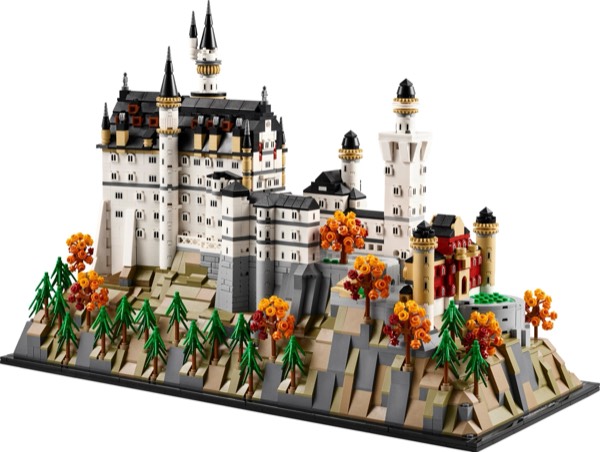
This is the one. At 3,455 pieces, Neuschwanstein Castle is the largest, most ambitious LEGO Architecture set ever produced, and it lives up to every ounce of that ambition. King Ludwig II's fairy-tale castle perched high in the Bavarian Alps has been the dream Architecture set since the line launched, and LEGO has given it the flagship treatment it deserves. Plan for 25-35 hours of construction that will test your patience, reward your precision, and leave you staring at the finished model in genuine awe.
The build begins with the cliff base and courtyard foundations. The rocky hillside terrain uses dark grey and dark bluish grey elements in irregular formations that establish the dramatic perch that makes Neuschwanstein so visually striking. The courtyard walls rise from this base, establishing the footprint of the castle complex before the vertical construction begins in earnest.
The main palace building is the centerpiece - a long, multi-story structure with the iconic white limestone walls and blue-grey turrets. Wall construction alternates between smooth white surfaces and detailed window sections with arched frames and decorative elements. The Romanesque Revival architectural details - round arches, paired windows, decorative cornices - are captured through careful element selection that suggests ornament without attempting literal replication at this scale.
The towers are where the build reaches its most dramatic heights. The tall round tower with its conical roof, the square gatehouse tower, and the various turrets each use different construction approaches suited to their shape and height. The cylindrical tower construction is particularly impressive, using a combination of curved wall elements and plate assemblies to create a smooth round profile that rises to a pointed slate-blue roof. Building these towers feels like raising actual turrets - each course of bricks adds visible height, and the progression from base to battlement to roof is deeply satisfying.
The alpine landscape base ties everything together with evergreen trees, rocky outcrops, and a suggestion of the gorge and waterfall that sit below the real castle. This is not just a building - it is a building in its landscape, and that context elevates the entire model.
What makes the build experience truly exceptional is the variety. Over the course of 25-35 hours, you never repeat the same construction sequence for long. The cliff base is a freeform rockwork exercise. The palace walls are precision facade construction. The towers are cylindrical engineering challenges. The roofs are angled slope puzzles. And the landscape finishing is organic terrain building. Five distinct building disciplines, all within a single set. Most builders will discover that they have a natural affinity for one of these phases and a new respect for another that they found more challenging. That range of experience is what justifies the time investment, and it is what makes Neuschwanstein feel less like assembling a model and more like completing an education in architecture at brick scale.
Neuschwanstein is a technique encyclopedia. The cylindrical tower construction alone is worth deep study - creating a smooth round tower from system bricks at this scale requires a combination of curved wall elements, hinge-plate assemblies, and precisely calculated diameter changes that maintain structural rigidity while reading as a single smooth surface. The conical roof that caps the main tower uses an elegant spiral slope technique that creates a seamless pointed roof from individual curved elements.
The cliff and terrain base teaches advanced rockwork construction at a larger scale than most Architecture sets attempt. Irregular plate stacking, angled slope placement, and deliberate gap creation produce a convincing rocky hillside that looks geological rather than geometric. The integration of vegetation elements into the rock structure demonstrates how to blend organic and structural building seamlessly.
Wall surface variation throughout the palace teaches how to create visual texture on large flat surfaces. Recessed window bays, protruding cornices, subtle pilaster columns, and alternating surface depths prevent the long palace walls from reading as flat slabs. These techniques are essential for any large-scale architectural MOC.
The roofing techniques across multiple structures demonstrate different approaches for different shapes: flat tile roofs for the palace wings, conical slopes for round towers, and peaked gable construction for the gatehouse. Each uses different element combinations and connection strategies, providing a complete roofing technique library in one box.
One technique that deserves special recognition is how the model handles the transition between the organic cliff base and the geometric castle walls above it. In real life, Neuschwanstein appears to grow out of the rock, and the LEGO model achieves this illusion through a gradual shift from irregular, gap-filled rockwork to progressively more structured stone courses that eventually become the smooth castle walls. The transition zone where natural rock meets dressed stone is handled with modified plates and angled connections that blur the boundary between landscape and architecture. This single technique, applied across the full width of the base, is responsible for much of the model's visual magic. It is what makes the castle look like it belongs on its cliff rather than sitting on top of a separate gray base. Study this transition carefully, because it applies to any castle, fortress, or hilltop structure you might build in the future.
Three thousand four hundred fifty-five pieces. The white and light bluish grey elements alone could stock a castle-building parts bin for a year. Slopes, arches, curved wall elements, and standard bricks in architectural stone tones arrive in extraordinary quantities. The dark blue and sand blue roof elements are premium pieces that command high secondary market prices. Dark grey rockwork elements - slopes, wedge plates, and modified bricks - are present in the volume needed for serious landscape building.
Specialized elements include curved wall sections for the towers, arch bricks in multiple sizes for the Romanesque windows, and decorative tile and plate elements for cornices and trim work. The evergreen tree elements and landscape accessories round out a parts haul that is, frankly, staggering in both volume and variety.
The depth of the parts inventory becomes clear when you consider what you could build from this set if you disassembled it. The white and light grey elements alone could construct a substantial palace or cathedral. The dark grey rockwork elements could build a mountain landscape diorama. The blue roof elements could cover multiple smaller buildings. The arch bricks could furnish an entire row of Romanesque-style facades. Very few sets offer this kind of versatile, high-volume parts inventory in colors that are universally useful for architecture builders. The curved wall elements for the towers are particularly valuable on the secondary market because they are produced in limited quantities and are essential for anyone building cylindrical structures. Getting them as part of a complete set rather than sourcing them individually represents meaningful savings, especially given recent trends in the secondary parts market.
Neuschwanstein Castle is the most visually impressive LEGO Architecture set ever made. Full stop. The model captures the fairy-tale silhouette that has inspired Disney castles and a million postcards - the soaring towers, the white walls against alpine blue sky, the dramatic cliff-edge perch. From across the room, the silhouette is unmistakably Neuschwanstein. From arm's length, the architectural detail is rich and rewarding. From inches away, the construction techniques themselves become the attraction.
The vertical drama of the model - from cliff base to tower peak - creates a display piece with genuine presence. This is not a model that sits quietly on a shelf. It commands the space around it, draws the eye, and invites sustained looking. The white and blue-grey color palette is timeless and elegant, working with virtually any interior decoration style.
Under changing light conditions, the model transforms. Morning light catches the white walls and makes them glow. Evening warm light deepens the blue-grey roofs and creates dramatic shadows in the courtyard and window recesses. This is a model designed for display, and it performs at the highest level.
The display quality extends beyond the model itself to the emotional response it generates in viewers. Most LEGO Architecture sets are appreciated intellectually. Visitors recognize the building, admire the construction, and move on. Neuschwanstein stops people in their tracks. The fairy-tale silhouette triggers something deeper than architectural recognition. It triggers the childhood memory of castle stories, the fantasy of a mountain fortress, the romance of a mad king building his dream in stone. This model does not just represent a building. It represents an idea, and that idea has been captivating human beings since Ludwig II first sketched it on a napkin in 1868. The LEGO version inherits all of that emotional power and adds the tactile reality of 3,455 carefully placed bricks. That combination of emotional resonance and physical presence is what makes this the definitive Architecture display piece.
As the flagship Architecture set, Neuschwanstein carries a flagship price. But the value proposition is compelling: 3,455 pieces, 25-35 hours of premium build experience, a technique education that covers towers, walls, roofs, terrain, and landscaping, and a finished display piece that is genuinely breathtaking. The parts haul alone - particularly the architectural stone tones and specialized curved elements - justifies significant investment. For Architecture collectors, this is the crown jewel. For any LEGO builder who appreciates ambitious design, Neuschwanstein is a once-in-a-decade set.
The comparison that puts the value into sharpest focus is with the Himeji Castle (#21060), the previous Architecture flagship. Himeji is an excellent set, but Neuschwanstein surpasses it in piece count, build variety, display drama, and technique diversity. If Himeji represented the peak of what Architecture could achieve, Neuschwanstein resets the ceiling entirely. Builders who bought Himeji and thought "this is as good as Architecture gets" need to recalibrate their expectations. This is better, and it is better in ways that will be apparent from the first bag to the last.
Long-term value also favors this set strongly. Architecture flagships have historically appreciated on the secondary market after retirement, and Neuschwanstein's combination of iconic subject matter, massive piece count, and enthusiast appeal suggests it will follow the same trajectory. Whether you display it for years or eventually sell it to fund your next collection, the investment holds. But honestly, once you build this and see it on your shelf, selling it is not going to cross your mind. Some sets are too good to let go.
Neuschwanstein Castle is for the builder who has been waiting for LEGO to go all in on the Architecture line. If you have collected the skylines, the landmarks, and the previous flagships, this is the set that rewards your loyalty with the most ambitious Architecture project LEGO has ever attempted. The 25-35 hour build time means this is not an impulse purchase or a weekend project. It is a commitment, and it is best suited to builders who enjoy extended, varied construction that covers multiple techniques and building disciplines.
Beyond the Architecture collector, this set has broad appeal for anyone drawn to fairy-tale aesthetics, European castle history, or Bavarian culture. It makes an extraordinary gift for the right recipient, someone who will appreciate both the build journey and the display result. It is not a set for young builders or casual fans looking for a quick satisfaction. It is a set for the adult LEGO enthusiast who wants to spend two weeks building something extraordinary and then spend the next decade admiring it. If that description fits you, stop reading this review and go order it. The castle awaits.
- ✓ The most ambitious and visually stunning Architecture set ever produced
- ✓ 25-35 hours of deeply engaging, varied construction
- ✓ Technique encyclopedia covering towers, walls, roofs, and terrain
- ✓ Massive 3,455-piece parts haul in premium architectural tones
- ✓ Alpine landscape base provides essential context
- ✗ Flagship price point will stretch some budgets
- ✗ Requires substantial display space
- ✗ Some repetitive wall construction in the palace midsection
Some products may be provided by manufacturers. This page contains affiliate links. All opinions are my own.
- Best LEGO Architecture Sets Ranked - Our definitive ranking of every Architecture set
- Himeji Castle Review - Another legendary castle in the Architecture range
- LetBricks Neuschwanstein Castle Review - An alternative take on the same castle
Track it in your vault on GameSetBrick - our free collection app. Log your condition, price paid, and watch the real-time market value.
Track in Your Vault →Save it to your wishlist on GameSetBrick. Share your list with friends and family - every set has a buy button so gift givers know exactly where to go.
Add to Wishlist → GameSetBrick is a free app by The Earl of Bricks. See all features. Scan it. Track it. Trade it.