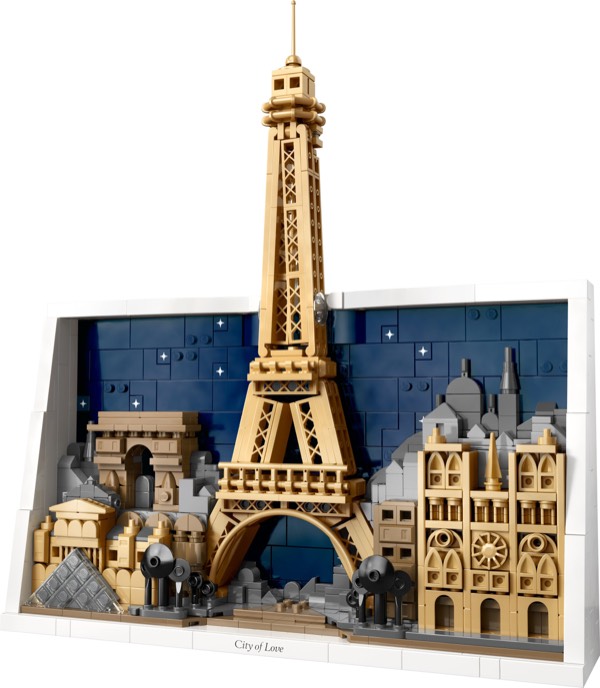
The Paris Skyline set continues LEGO's Architecture Skyline series with the most iconic urban silhouette on Earth. At approximately 958 pieces, this is a substantial entry in the Skyline range - larger than most of its predecessors - and the extra piece count shows in the detail and ambition of the individual landmark builds. Plan for 5-8 hours of construction across the five landmark sections plus the connecting base. This is a Skyline set that demands and rewards your full attention, because the microscale construction of five distinctly different architectural styles requires constant mental gear-shifting that keeps you engaged throughout.
The Eiffel Tower is naturally the centerpiece, and LEGO has given it the tallest allocation on the base. The lattice construction uses a combination of plate framework and strategic gaps to suggest the iron lattice structure at microscale. The characteristic tapering profile - wide at the base, narrowing through the observation decks to the antenna peak - is captured through progressive narrowing at each level. Building the Tower is the most technically demanding section and the most satisfying to complete. The challenge is in the negative space. You are not just building a tower - you are building the spaces between the iron beams, and that requires placing elements precisely enough that the gaps read as deliberate openings rather than construction errors. When you get it right, the result is unmistakable. When a piece is even slightly out of position, the whole thing looks wrong. That precision requirement elevates the build from simple stacking to genuine microscale craft.
The remaining landmarks fill out the Parisian skyline: the Arc de Triomphe with its characteristic arch and rooftop terrace, the Louvre Pyramid in transparent elements against a classical facade suggestion, Notre-Dame with its twin towers and rose window hint, and the Sacre-Coeur with its distinctive domed silhouette. Each landmark is a miniature build challenge with its own technique requirements, and the variety keeps the session engaging throughout. What I find most impressive about the landmark selection is the architectural diversity it represents. You are building Roman-inspired triumphal architecture, Gothic cathedral design, Renaissance palace aesthetics, modernist geometric glass, and 19th-century iron engineering - all in one set. That breadth of construction experience is unmatched in the Skyline series.
The connecting base plate with the printed Paris nameplate ties the composition together, establishing the horizontal flow that makes Skyline sets work as unified display pieces rather than collections of individual models. The base construction itself is straightforward, but it performs the critical function of establishing the stage for the landmarks above. The dark base with the white nameplate provides a clean foundation that lets the landmarks speak for themselves, and the spacing between structures is calibrated to give each landmark breathing room without wasting display real estate.
The Eiffel Tower's lattice construction is the standout technique. Creating the illusion of an open iron framework at microscale requires careful balance between structure and void - too many pieces and it looks solid, too few and it collapses. LEGO's solution uses plate-and-tile framework construction with deliberate gaps that read as the lattice openings from display distance. This technique applies to any microscale structure that needs to suggest openwork rather than solid mass - bridges, transmission towers, crane structures. The specific ratio of solid to void that makes the lattice work at this scale is worth studying closely, because it is a ratio that transfers directly to any build where you need to suggest structural transparency. I have already applied the same principle to a microscale bridge MOC with excellent results.
The Louvre Pyramid teaches transparent element integration - how to create a geometric glass structure that reads as both solid and see-through at microscale. The transparent elements catch and refract light in a way that adds visual depth to what is structurally a very simple assembly. The dome construction on Sacre-Coeur demonstrates curved surface building at small scale using a stepped slope approach that approximates the hemisphere. Getting a dome to read correctly at microscale is notoriously difficult because the stepped profile fights against the smooth curve you are trying to suggest. LEGO's solution here is to use the smallest available slope elements and accept the stepping, relying on the white color and the domed silhouette to carry the impression. It works, and the technique is applicable to any small-scale dome from mosque to observatory.
The Skyline format itself is a technique lesson in composition - how to arrange multiple structures at different scales on a single base to create a coherent urban portrait. The relative heights, spacing, and detail levels are carefully calibrated to make the eye read the collection as a unified cityscape rather than a lineup of separate models. The Eiffel Tower stands tallest because it is the most iconic. The Arc de Triomphe is widest because its identity is in its arch rather than its height. Each landmark is built at the scale that best communicates its essential character, not at a consistent scale, and that compositional decision is more sophisticated than it might appear at first glance.
At 958 pieces, the Paris Skyline delivers a solid parts haul in a neutral architectural palette. White, light grey, dark grey, and tan dominate, with transparent clear elements for the Louvre Pyramid and subtle color accents for specific landmark details. The micro-scale element selection - small plates, tiles, modified bricks, and slope elements in tiny sizes - is excellent for builders who work on microscale city or architecture MOCs. The neutral palette is the haul's greatest strength because these colors are universally useful across virtually every architectural style and period.
The plate and tile elements used for the Eiffel Tower lattice construction are useful framework pieces for any delicate structural build. Arch elements in small sizes serve well in microscale architecture projects. The transparent elements, while limited in quantity, are premium pieces for any build requiring glass or crystal effects. The tan and dark tan pieces from the classical landmarks are useful for historical architecture MOCs, and the white elements from Sacre-Coeur join the general-purpose white stock that every builder needs. The printed nameplate tile is a nice collector's piece but obviously specific to this set.
The haul is at its best when viewed as a comprehensive microscale starter kit. You get elements suitable for every major architectural category - structural framework, solid walls, glass surfaces, curved domes, classical ornament, and modern geometry - in small quantities that are individually useful and collectively versatile. It is the kind of parts distribution that makes you think "I could use that" about almost every element type in the box, even if you never plan to build Paris again.
Paris is the most recognizable urban skyline in the world, and this set captures it effectively. The Eiffel Tower's dominant height, the Arc de Triomphe's monumental profile, the Louvre Pyramid's geometric clarity, Notre-Dame's twin towers, and Sacre-Coeur's white domes create an immediately identifiable composition that needs no nameplate to announce its subject - though the nameplate adds a polished finishing touch. The instant legibility of this set is its greatest display asset. From across a room, from any angle, at any distance where the individual landmarks are visible, it reads as Paris. That universal recognition gives it a display power that more obscure skylines cannot match.
The horizontal format works perfectly on bookshelves, mantels, or desk surfaces. At roughly 12 inches wide, it fills a display space without overwhelming it. The neutral color palette integrates with any room decor, and the architectural subject matter gives it a sophistication that transcends the toy category. This is a display piece that adults are proud to show in living rooms and offices. I have seen these in corporate offices, hotel lobbies, and restaurant shelves, and they never look out of place. The subject matter carries enough cultural weight that even non-LEGO environments accept it as decor rather than toy.
Under warm lighting, the white and tan elements glow, and the transparent Louvre Pyramid catches and refracts light beautifully. The overall impression is elegant, cultured, and unmistakably Parisian. The dark base grounds the composition and provides contrast that makes the lighter landmarks pop. Evening lighting, particularly warm-toned lamps, brings out the best in this set by deepening the shadows between landmarks and giving the white elements a golden warmth that recalls the actual City of Light at dusk. If you have a display spot that catches evening lamplight, this set will reward that placement generously.
The Paris Skyline is the most giftable set in the entire Architecture line. Paris has universal appeal. It is a city that almost everyone has either visited, wants to visit, or associates with romance, culture, and beauty. That broad resonance makes this set appropriate for virtually any adult recipient, regardless of their LEGO experience or architectural knowledge. If you need a gift for someone who appreciates beautiful things and enjoys working with their hands, the Paris Skyline is a reliable choice that will be received well by builders and non-builders alike.
For Skyline collectors, Paris is non-negotiable. It is the defining city of the series - the skyline that everyone knows, the landmarks that everyone can name, the composition that anchors any Architecture display shelf. Your collection is incomplete without it. The 958-piece count and the five-landmark composition also make it one of the more substantial Skyline builds, which means it delivers a more satisfying build experience than smaller entries in the series. If you are going to own only one Skyline set, Paris is the default choice for good reason.
Anyone who has visited Paris and wants a tangible reminder of the trip will find particular satisfaction in building this set. The landmarks are accurate enough to trigger genuine memories, and the meditative microscale construction provides a quiet hour of reflection on a city that tends to inspire that kind of thinking. It is a souvenir that you build yourself, which gives it more emotional weight than a refrigerator magnet or a photo print. For the same reason, this set works well as a "bon voyage" gift for someone planning a Paris trip - build it before you go, and see the real thing with fresh eyes when you arrive.
The landmark selection in this set tells a specific story about Paris, and it is worth examining what that story is. The five structures span from the early 19th century (Arc de Triomphe, completed 1836) through the late 19th century (Eiffel Tower, 1889; Sacre-Coeur, 1914) to the late 20th century (Louvre Pyramid, 1989), with Notre-Dame representing the medieval Gothic tradition that predates them all. Together, they trace the evolution of Parisian architecture from medieval stone through classical monumentalism to industrial iron to contemporary glass and steel. That is a remarkable architectural narrative compressed into twelve inches of display space.
What the selection omits is also telling. There is no Pompidou Centre, no Tour Montparnasse, no Grande Arche de la Defense. The landmarks chosen are uniformly beloved - there are no controversial inclusions. This is the Paris of postcards and travel dreams, not the Paris of urban planning debates. That editorial choice is appropriate for a display piece and ensures broad appeal, but it also means the set presents an idealized Paris rather than a complete one. Whether that matters to you depends on what you want from a Skyline set. If you want architectural accuracy and comprehensive representation, no single display base can deliver that for any major city. If you want a charming, immediately recognizable tribute to the essence of Paris, this set delivers it with precision.
The relative scale of the landmarks tells you how LEGO prioritizes recognition over accuracy. The Eiffel Tower stands tallest on the base, which is geographically and dimensionally correct - it is the tallest structure in Paris. But the Arc de Triomphe is built wider relative to the other landmarks than it is in real life, because its identity depends on the width of its arch. Each landmark is built at the scale that makes it most recognizable, and that compositional intelligence is what makes the set work as a portrait of a city rather than a scale model.
At 958 pieces, the Paris Skyline sits at a comfortable mid-range price point for the Architecture line. The build experience delivers 5-8 hours of engaging microscale construction across five iconic landmarks. The technique variety - lattice work, dome building, arch construction, transparent integration - provides broad educational value. As a display piece, the Paris Skyline has universal appeal and works in virtually any setting. For Architecture Skyline collectors, Paris is an essential addition. For anyone who loves the City of Light, this is a charming and intelligent tribute.
The value calculation also benefits from the set's longevity. Some LEGO sets look dated after a few years as design sensibilities evolve. The Paris Skyline is immune to this because its subject matter is timeless. These five landmarks have looked essentially the same for decades or centuries, and they will continue to look the same long after newer sets have been retired. Buying the Paris Skyline is not buying into a trend - it is buying a permanent addition to your display that will look just as relevant and attractive in ten years as it does today. That permanence adds value that trend-sensitive sets cannot match.
- ✓ Five iconic landmarks create an instantly recognizable Parisian skyline
- ✓ Eiffel Tower lattice technique is clever and visually effective
- ✓ Larger piece count than typical Skyline sets adds detail
- ✓ Elegant display piece suitable for any room
- ✓ Louvre Pyramid transparent construction catches light beautifully
- ✗ Microscale necessarily simplifies each landmark significantly
- ✗ Notre-Dame representation is compact given its architectural complexity
- ✗ Base plate width limits individual landmark spacing
Some products may be provided by manufacturers. This page contains affiliate links. All opinions are my own.
- Best LEGO Architecture Sets Ranked - Our definitive ranking of every Architecture set
- Notre-Dame de Paris Review - A deeper dive into Paris's most famous landmark
- Singapore Skyline Review - Another stunning cityscape in the Architecture range
- Shanghai Skyline Review - One of the most detailed skyline builds in the series
Track it in your vault on GameSetBrick - our free collection app. Log your condition, price paid, and watch the real-time market value.
Track in Your Vault →Save it to your wishlist on GameSetBrick. Share your list with friends and family - every set has a buy button so gift givers know exactly where to go.
Add to Wishlist → GameSetBrick is a free app by The Earl of Bricks. See all features. Scan it. Track it. Trade it.