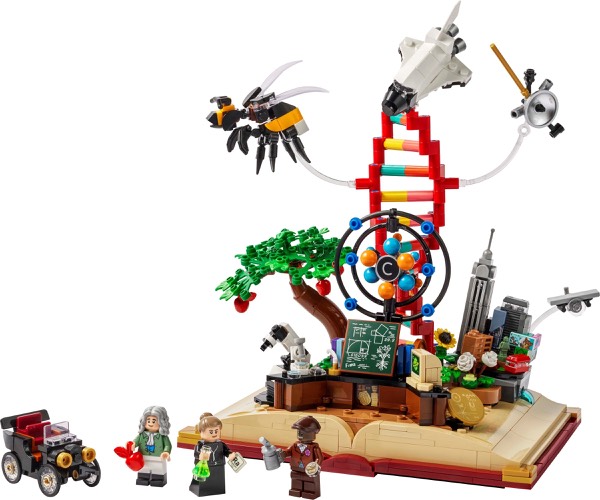
The Evolution of STEM is structured as a series of interconnected vignettes, each representing a different era and discipline of scientific discovery. This modular approach to the build is both its greatest strength and its defining characteristic - rather than one continuous construction, you are building several distinct scenes that combine into a unified display. The experience feels more like completing a curated collection than assembling a single model, which gives it a unique rhythm compared to most Ideas sets.
Each vignette takes roughly 30 to 45 minutes to complete, making this an ideal set for shorter building sessions. The astronomy section features an armillary sphere and telescope build that requires careful placement of small elements at precise angles. The biology section introduces a microscope build with a surprisingly elegant internal structure. The mathematics and computing sections round out the collection with builds that reference calculating machines, early computers, and mathematical instruments. Every section has its own personality, its own palette, and its own construction logic.
What makes the build experience genuinely engaging is the educational undercurrent. LEGO has included printed information panels for each era, and as you build, you absorb the narrative of scientific progress in a way that feels organic rather than didactic. This is the kind of set that would be equally at home on an adult collector's desk or in a classroom, and the build experience reflects that dual purpose beautifully. The Evolution of STEM also earns a spot in our best Ideas sets ranking, which covers the fan-designed sets that define the line. If you have read our coverage of the Da Vinci Flying Machine, you will recognize a shared design philosophy - LEGO at its most intellectually ambitious.
The technique across the vignettes varies intentionally, which is part of the set's charm. The astronomy section uses a combination of bar elements and clip connectors to create the rotating armillary sphere - a small but genuinely clever mechanism that allows the rings to move around a central axis. It is not complex by Technic standards, but within the context of a display-oriented Ideas set, it demonstrates how simple connections can create dynamic, interactive elements.
The microscope build is the technique highlight for me. The designers used a combination of transparent elements, SNOT building, and a clever internal stack to create a model that is instantly recognizable from any angle. The eyepiece section uses round plate elements nested inside cylinder pieces to suggest the optical assembly, and the slide platform is built with bracket elements that allow it to sit at the correct angle relative to the lens. It is a masterclass in building recognizable real-world objects at minifigure scale.
The computing section introduces some flat tile work that represents early circuit boards and punch cards - a more graphic, pattern-based technique that contrasts with the three-dimensional construction elsewhere. This variety in technique keeps the build feeling fresh across all sections and gives MOC builders several distinct approaches to study and adapt. The set may not push the boundaries of what LEGO can do structurally, but it demonstrates remarkable range in how different techniques serve different representational purposes.
At 879 pieces, the parts count is modest but the inventory is well-curated. The colour palette spans multiple schemes across the vignettes - deep blues and golds for astronomy, greens and whites for biology, greys and blacks for computing - which means you end up with a surprisingly diverse parts collection from a single set. The transparent elements are particularly useful, including several trans-light-blue and trans-clear pieces in shapes that work well for scientific or futuristic MOC builds.
The specialty elements include several printed tiles that are exclusive to this set, featuring scientific symbols, equations, and era-specific decorative elements. These printed pieces are the kind of detail that elevates a display set from good to memorable, and they represent genuine collectible value for fans of science-themed LEGO. The bar and clip connector pieces from the armillary sphere build are also useful additions to any parts inventory, especially for builders working on mechanical or kinetic models.
The three minifigures and their associated accessories contribute additional parts value. Each figure comes with era-appropriate scientific instruments and tools, and the printed torsos are unique to this set. While the overall parts count does not compete with larger Ideas sets, the quality and variety of what you get here punches above its weight for the price point. This pairs well with the Mineral Collection if you are building a science-themed display shelf.
The three minifigures represent scientists from different eras of discovery, and LEGO has executed them with care and personality. Each figure features unique printed torsos and legs that reflect the clothing and tools of their respective periods. The attention to historical costuming - from period-appropriate coats to modern lab wear - gives each figure a distinct identity that supports the educational theme of the set.
The accessories are thoughtful and era-specific. You get miniature scientific instruments, books, and tools that connect each figure to their vignette in a way that feels purposeful rather than generic. The hair pieces and facial expressions are well-chosen, with each figure projecting a sense of intellectual curiosity that suits the theme perfectly. These are not action figures - they are representations of thinkers, and LEGO has captured that distinction admirably.
While three minifigures is a modest count compared to some Ideas sets, the exclusive nature and thematic coherence of these figures gives them outsized value. They tell a story together that no single figure could tell alone, and their placement across the vignettes creates a narrative of human progress that is surprisingly moving for a collection of plastic people. Science educators, in particular, will find these figures invaluable as classroom display pieces.
The Evolution of STEM is designed to be displayed as a connected timeline, and in that configuration, it creates a striking visual narrative. The vignettes are built on matching base plates that connect seamlessly, creating a continuous display approximately 45cm wide and 15cm deep. The graduated colour palette - shifting from warm tones in the earlier eras to cooler, more technological colours in the later sections - gives the display a visual logic that reads clearly even from across a room.
What makes this set particularly effective as a display piece is its conversational quality. People stop and ask about it. The scientific instruments are recognizable enough to prompt questions, and the era-by-era progression invites viewers to examine each section individually. This is a set that does not just sit on a shelf - it engages people, which is the highest compliment you can pay a display piece. For tips on positioning and lighting, our LEGO display ideas guide has you covered.
The individual vignettes also work beautifully as standalone displays. If shelf space is limited, you can separate the sections and distribute them across a desk, bookshelf, or workspace. This modular display flexibility is a significant advantage, especially for builders who want to integrate LEGO into professional environments like offices, labs, or classrooms. The scientific theme gives it a sophistication that makes it appropriate for settings where overtly playful LEGO sets might feel out of place.
At $79.99 for 879 pieces, the price-per-piece sits at approximately 9 cents per brick, which is competitive for an Ideas set. The three minifigures, the multiple printed tiles, and the modular display design all contribute to a value proposition that feels balanced and fair. You are not paying a heavy premium for licensing here - the value is in the design, the educational content, and the display quality.
The build time is modest - expect 4 to 6 hours for the complete set - which makes this a solid option for a weekend project or a series of evening sessions. The educational angle adds a dimension of value that is difficult to quantify but very real. Parents building with older children, teachers looking for classroom displays, and science enthusiasts seeking desk decor will all find genuine utility beyond the standard build-and-display cycle.
Compared to other science-themed LEGO sets, the Evolution of STEM holds its own on value. It offers more narrative depth than most single-subject builds, and the modular format means you get multiple display configurations from one purchase. If you are curating a science or education shelf alongside sets like the Mineral Collection and the Da Vinci Flying Machine, this set fills a unique role as the connective thread that ties them all together. For our broader recommendations, see the best LEGO sets for adults in 2026 guide.
The Evolution of STEM is for science enthusiasts who want their passion represented on their shelf. If you work in a STEM field, if you studied science or engineering, if you believe that scientific discovery is one of humanity's greatest achievements - this set celebrates that belief in a format you can display with pride. It belongs on the desk of a professor, the shelf of a lab technician, or the bookcase of a student. The educational narrative gives it a purpose beyond display, and the modular format means it can adapt to any professional or personal space.
The second audience is educators looking for classroom display pieces that inspire curiosity. The Evolution of STEM works as both a teaching tool and a decoration, and its vignette format means individual sections can be placed near relevant classroom materials. The astronomy section near the physics books, the biology section near the lab equipment, the computing section near the technology area - the modular design enables contextual display that reinforces learning. Teachers who build this set with students will find it sparks conversations about scientific history that textbooks struggle to initiate.
The third audience is LEGO Ideas fans who appreciate the community-driven design philosophy that defines the line. Ideas sets represent what the LEGO community values - the themes, the subjects, the stories that fans feel deserve the brick treatment. The Evolution of STEM is a set that could only exist because someone in the community felt passionately about celebrating scientific progress, and LEGO agreed. If you buy Ideas sets because you believe in the program and want to support the community that drives it, this is a set that validates that support with thoughtful design and genuine substance.
- ✓ Unique vignette-based format tells a compelling scientific narrative
- ✓ Excellent educational value for classrooms and home displays
- ✓ Modular design allows flexible display configurations
- ✓ Clever techniques across armillary sphere, microscope, and computing builds
- ✓ Diverse colour palette yields versatile parts inventory
- ✓ Three exclusive, well-designed scientist minifigures
- ✗ Modest piece count for the price compared to non-Ideas sets
- ✗ Individual vignettes are small - may underwhelm if displayed separately
- ✗ Limited interactive or mechanical features beyond the armillary sphere
- ✗ Niche educational theme may not appeal to all collectors
Some products may be provided by manufacturers. This page contains affiliate links.
- Da Vinci Flying Machine Review - Another science-meets-art LEGO Ideas build
- Mineral Collection Review - Science display perfection in brick form
- LEGO Display Ideas - How to showcase your science-themed builds
- Best LEGO Sets for Adults 2026 - Our complete ranking across all themes
- Best LEGO Ideas Sets Ranked - Every fan-designed set evaluated
- All Reviews - Browse every set we have reviewed
Track it in your vault on GameSetBrick - our free collection app. Log your condition, price paid, and watch the real-time market value.
Track in Your Vault →Save it to your wishlist on GameSetBrick. Share your list with friends and family - every set has a buy button so gift givers know exactly where to go.
Add to Wishlist → GameSetBrick is a free app by The Earl of Bricks. See all features. Scan it. Track it. Trade it.