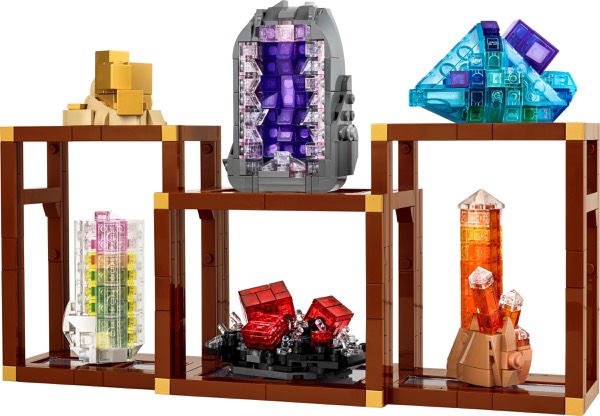
The Mineral Collection contains six individually buildable mineral specimens, each mounted on a small black display stand with a printed nameplate tile. The six minerals are amethyst, fluorite, pyrite, quartz, rhodochrosite, and tourmaline - a well-chosen selection that spans a wide range of crystal structures, colours, and geological formation types. There are no minifigures in this set; it is purely a display and educational build focused on recreating the natural beauty of mineral specimens through LEGO elements.
Each mineral is approximately 3-4 inches in its largest dimension, making them substantial enough to be visually interesting while remaining compact enough to group together on a desk, bookshelf, or display cabinet. The colour palette across the six specimens is genuinely striking - deep purple for the amethyst, greens and blues for the fluorite, metallic gold for the pyrite, clear and white for the quartz, pink and red for the rhodochrosite, and a rainbow of colours for the tourmaline. Together, they create a display that is both scientifically interesting and aesthetically gorgeous.
The box includes a small educational booklet alongside the standard building instructions, providing information about each mineral's real-world properties, crystal structure, formation process, and notable specimen locations. It is a nice touch that elevates the set beyond pure display into genuine educational territory, making it an excellent gift for science enthusiasts, geology students, or anyone who appreciates the intersection of natural beauty and careful engineering. The set sits in a unique niche that LEGO rarely occupies - somewhere between their Architecture line's precision and the creative expression of their Art sets.
Building the Mineral Collection is a unique experience within the LEGO catalogue because each of the six specimens is essentially a separate micro-build with its own construction logic. You work through them one at a time, and each one presents a different structural challenge. The pyrite uses angular, geometric construction to recreate its cubic crystal system - sharp edges, flat faces, and precise 90-degree angles that mirror the mineral's real-world crystallography. The amethyst, by contrast, is built with irregular, pointed elements protruding from a rock-textured base, capturing the geode-like appearance of natural amethyst clusters.
The variety keeps the build fresh throughout. Just when you have settled into the geometric precision of the pyrite, you shift to the flowing, organic curves of the rhodochrosite. Then the tourmaline challenges you with a multi-coloured column that requires careful colour placement to maintain the graduated rainbow effect. Each mineral takes roughly 20-30 minutes to complete, making the entire set a comfortable two-to-three hour build that works beautifully as a single relaxed session or as six distinct micro-sessions spread across a week. The pacing is excellent - no single specimen overstays its welcome.
The quartz specimen is perhaps the most satisfying individual build. You construct a cluster of hexagonal crystal points using transparent and white elements that catch light beautifully when complete. The technique for creating the hexagonal cross-section of each crystal point is genuinely clever, using a combination of angled plates and slope elements that approximate the six-sided geometry with surprising accuracy. If you enjoy the kind of focused, detail-oriented building that produces a beautiful small object, this set delivers that experience six times in succession. It shares the desk-display appeal of sets like the Evolution of STEM - compact builds with outsized visual impact. Both sets feature prominently in our ranking of the best Ideas sets ever made.
The technique across the Mineral Collection is more varied than you might expect from a set of this size. Each mineral required the designers to solve a different fundamental problem: how do you represent crystalline geometry, organic rock texture, transparency, metallic luster, and colour gradation using the same basic LEGO elements? The solutions are creative and, in several cases, genuinely innovative. The pyrite uses gold-coloured slope elements arranged in precise cubic formations that capture the mineral's characteristic "fool's gold" appearance. The surfaces are built at exact right angles using bracket elements, and the result is a geometric precision that feels almost architectural.
The fluorite specimen demonstrates a particularly interesting technique for colour layering. The mineral is built with transparent green, transparent blue, and transparent purple elements interleaved in a way that suggests the banded colour zones visible in real fluorite specimens. When light passes through the transparent elements, the colours blend subtly, creating an effect that is closer to the real mineral's appearance than you would think possible with opaque and transparent plastic. The amethyst uses a similar approach, with transparent purple elements of varying shades clustered together to simulate the depth and variation found in natural amethyst geodes.
For MOC builders, the techniques here have applications that extend well beyond mineral models. The geometric crystal construction of the pyrite is directly applicable to any architectural or abstract geometric MOC. The colour gradient technique used in the tourmaline - where you transition smoothly from one colour to another across a columnar structure - is useful for building rainbow effects, sunset skies, or any application where gradual colour change is desirable. The transparent element layering in the fluorite and amethyst specimens is a technique that translates to water effects, magical crystals in fantasy builds, or ice formations. The set punches above its weight as a technique reference, offering six distinct approaches to organic sculpting in a compact package. It pairs well conceptually with other science-adjacent builds like the Tropical Aquarium and the Fountain Garden, which also use creative techniques to simulate natural forms.
At 880 pieces across six specimens, the raw piece count is modest, and the per-specimen piece count (roughly 130-160 each) means no individual mineral is a substantial build. The parts distribution across the six models means you get small quantities of many different colours rather than large quantities of any single colour. This is both a strength and a limitation - it makes for excellent display variety but means you will not walk away with a deep inventory of any particular element type or colour.
The transparent elements are the standout parts value here. You get a genuinely useful collection of transparent purple, transparent green, transparent blue, and transparent clear elements across the amethyst, fluorite, quartz, and tourmaline specimens. These transparent pieces are consistently among the most expensive elements to acquire individually on BrickLink, so having a concentrated source is valuable for builders who work with crystal, water, or magical effects in their MOCs. The gold-coloured elements from the pyrite are also worth noting - metallic gold pieces appear infrequently across the standard LEGO catalogue.
The black base elements and nameplate tiles are standard fare, and the structural elements inside each specimen are small quantities of common pieces. The slope elements across the collection come in useful varieties and colours, but again in small quantities. Honestly, this is not a set you purchase for parts value. The price-to-parts ratio is acceptable but not exceptional, and the distribution across six separate colour palettes means no single colour gets the deep inventory that MOC builders typically need. The value here is in the build experience and the display - the parts are a pleasant bonus rather than a primary selling point. For sets with stronger parts-per-dollar ratios, our adult sets roundup covers the best options across all themes.
This is where the Mineral Collection truly earns its place in the Ideas lineup. Displayed together on their individual black stands, the six minerals create a museum-quality desk display that looks expensive, scientific, and genuinely beautiful. The colour range - purple, green-blue, gold, clear-white, pink-red, and rainbow - covers nearly the full spectrum, and the variety of shapes (cubic, columnar, clustered, layered) adds visual texture that keeps the eye moving across the collection. It is one of those sets that looks significantly more impressive than its piece count or price would suggest.
The individual stands are well-designed, with enough weight and footprint to keep each specimen stable without being so large that they dominate the display. The printed nameplate tiles add a museum specimen label quality that elevates the educational feel. You can display the six minerals together as a collection or scatter them individually across a room - the amethyst on a bookshelf, the pyrite on a desk, the quartz on a windowsill where it catches the light. The versatility of having six separate display pieces rather than one single model gives you creative flexibility that most LEGO sets cannot match.
The quartz and fluorite specimens are particularly striking under natural or LED light. The transparent elements catch and refract light in ways that genuinely evoke their real-world counterparts, and the effect changes throughout the day as ambient lighting shifts. The pyrite's gold elements have a subtle metallic sheen that looks premium on any surface. For anyone who keeps a curated desk, home office, or study, the Mineral Collection adds visual interest that reads as sophisticated rather than toy-like. It is a set that appeals to people who would never consider buying a typical LEGO set, which makes it an exceptional gift for science-minded adults. Our display ideas guide covers additional strategies for integrating educational sets like this into your decor.
At $59.99 for 880 pieces, the Mineral Collection comes in at roughly 6.8 cents per piece, which is actually quite good for an Ideas set. The lower price point makes this one of the most accessible Ideas releases in recent memory, and the value feels right for what you receive - six well-designed specimens, quality printed nameplate tiles, an educational booklet, and a display that genuinely exceeds expectations for a sub-$60 LEGO purchase. It is worth noting that the price-per-piece metric is less meaningful than usual here because many of the transparent and metallic elements carry individual values well above their contribution to the piece count.
The gift value of this set is outstanding. At $59.99, it sits in the sweet spot for birthday and holiday gifts - expensive enough to feel substantial and thoughtful, affordable enough to be a comfortable purchase. The universal appeal of minerals and crystals means it works for a broad audience: geology enthusiasts, science students, crystal collectors, desk accessory seekers, and LEGO fans looking for something different from their usual fare. The educational booklet adds perceived value beyond the bricks themselves, and the museum-quality display presentation makes the set feel premium despite its moderate price.
For LEGO enthusiasts specifically, the value calculation depends on what you prioritize. If you value parts haul above all else, the Mineral Collection is a decent but not exceptional purchase. If you value display quality and build variety, it overperforms significantly for its price point. And if you value sets that appeal to non-LEGO people in your life - gifts that will be appreciated by anyone, not just brick enthusiasts - this is one of the strongest options in the current catalogue. At $59.99, the Mineral Collection is easy to recommend broadly and difficult to find fault with at its price. It does exactly what it sets out to do, and it does it well.
- ✓ Six distinct builds with varied techniques - never repetitive
- ✓ Museum-quality desk display that looks premium
- ✓ Excellent transparent element collection for MOC builders
- ✓ Educational booklet adds genuine learning value
- ✓ Accessible $59.99 price point - outstanding gift option
- ✓ Versatile display - together or individually scattered
- ✗ Individual specimens are small - some may want larger scale
- ✗ Parts distribution is too spread across colours for deep inventory
- ✗ No minifigure - a tiny geologist would have been charming
- ✗ Some crystal shapes are simplified compared to real specimens
Some products may be provided by manufacturers. This page contains affiliate links.
- Evolution of STEM Review - Another science-themed Ideas display set
- Tropical Aquarium Review - Natural beauty recreated in brick
- Fountain Garden Review - Organic forms in a desk-friendly format
- LEGO Display Ideas - Creative ways to showcase your collection
- Best LEGO Sets for Adults 2026 - Our complete ranking of top adult builds
Track it in your vault on GameSetBrick - our free collection app. Log your condition, price paid, and watch the real-time market value.
Track in Your Vault →Save it to your wishlist on GameSetBrick. Share your list with friends and family - every set has a buy button so gift givers know exactly where to go.
Add to Wishlist → GameSetBrick is a free app by The Earl of Bricks. See all features. Scan it. Track it. Trade it.