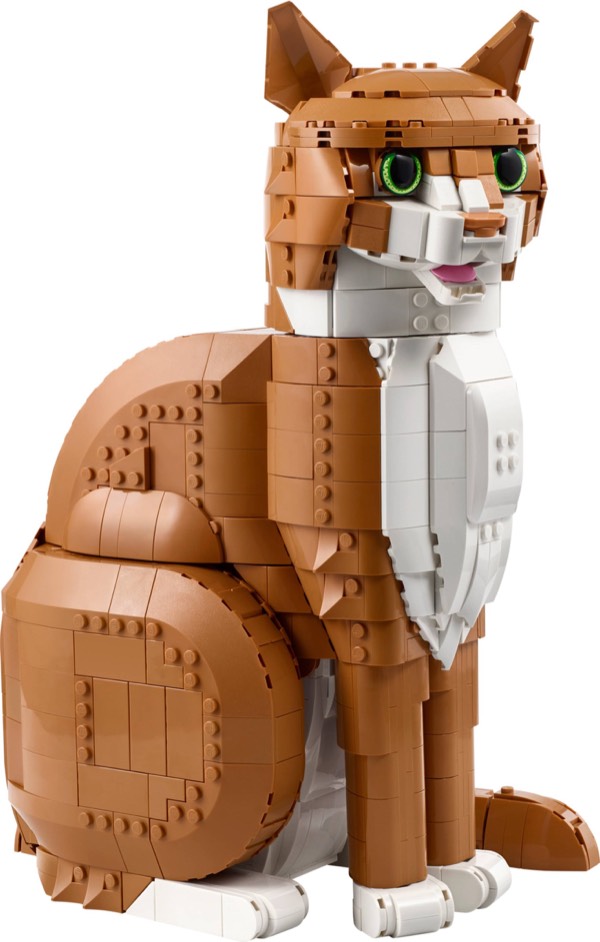
The Orange Cat is one of those Ideas sets that makes you smile before you have even opened the first bag. At approximately 1,755 pieces, the build takes around 2-3 hours and progresses through a sequence that gradually reveals the personality of the cat one layer at a time. You start with the internal structure and core body shape, then layer on the orange tabby fur texture, build the expressive face, and finish with the tail, paws, and the display base with its accessories.
The face assembly is the emotional turning point of the build. The moment the eyes, nose, and whisker details come together, the model stops being an abstract orange shape and becomes a cat with genuine character. LEGO's designers have captured that particular look orange cats give you - the one that says they know exactly what they did and feel no remorse whatsoever. The tail construction uses a series of ball joints or hinge elements that allow for posing, letting you adjust the attitude of the cat after completion. The build pacing is excellent, with enough variety in each bag to prevent any section from feeling repetitive.
The internal skeleton phase of the build is more interesting than it initially appears, and it sets up the entire structural success of the finished model. The core body uses a combination of Technic bricks and standard plates to create a rigid internal frame that defines the cat's seated posture. The angle of the spine, the width of the haunches, and the forward lean of the chest are all established in this internal framework, and they must be precise for the external contours to read correctly as a sitting cat. Builders who pay attention during this phase will notice how specific angle connections and offset plate placements create the subtle curves that distinguish a naturalistic sitting pose from a stiff, geometric one. The hind legs are particularly clever: the internal structure creates a Z-shaped profile that represents the folded haunch of a seated cat, with the knee joint positioned forward and the ankle joint tucked beneath the body. When the external orange panels are layered over this framework, the result is a seated posture that looks relaxed and natural rather than rigid and mechanical.
The exterior layering process that follows the skeleton is where the build transitions from engineering to artistry. Each panel of orange slopes and curved elements is placed over the internal frame to create the smooth, rounded contours of a cat's body. The fur texture effect is achieved through a combination of smooth tiles on the flanks and small slope elements along the edges where the color transitions from orange to white on the chest and belly. The build sequence is thoughtfully ordered so that you complete one section of the body at a time, giving you repeated opportunities to step back and see how each new panel changes the overall silhouette. By the time you reach the head assembly, the body is complete enough that adding the face feels like putting the finishing touch on a personality that the body has been suggesting all along.
Building organic animal forms from rectangular bricks is one of the hardest challenges in LEGO design, and the Orange Cat handles it with impressive skill. The body uses a combination of SNOT techniques and carefully selected slope elements to create the rounded contours of a cat's torso without visible stud patterns on the display surfaces. The transition from the broader body to the narrower head involves some clever bracket work that maintains smooth surface continuity while changing the cross-sectional profile.
The facial feature construction is where the technique value peaks. Capturing a recognizable cat expression at this scale requires precise element placement, and the combination of printed eye elements, small slope pieces for the nose bridge, and bar elements for whiskers creates a face that reads as unmistakably feline from any angle. The tabby stripe pattern is achieved through strategic color placement rather than printed elements, using dark orange and reddish brown accents within the primary orange bodywork to suggest the characteristic striped fur pattern. The poseable tail teaches a useful technique for any articulated appendage in animal or creature MOCs.
The seated posture engineering is the technique that elevates this build from a competent animal sculpture to a genuinely educational building experience. The real challenge of building a sitting cat is not the external form - it is the internal weight distribution. A seated cat is not symmetrically balanced; the weight is concentrated in the haunches and the center of gravity sits behind the vertical midline of the body. If the LEGO model followed the same weight distribution without compensation, it would tip backward. The designers solve this with a carefully positioned ballast plate in the chest area and a wide, flat base on the hind leg assemblies that extends the contact patch forward. The result is a model that sits stably on any flat surface without a display base, which is a remarkable engineering achievement for an asymmetrically posed animal sculpture. Builders who study how the internal weight management works will learn principles that apply to any seated or off-balance pose in animal and character MOCs.
The whisker attachment mechanism is a small but instructive detail worth examining. Cat whiskers are thin, protruding elements that face constant risk of being knocked off during handling. The Orange Cat uses a recessed bar-into-clip connection where the bar elements for the whiskers insert into clip elements that are set slightly behind the surface plane of the face. This recessed mounting means the whiskers sit slightly behind the most exposed surface of the nose, which protects them from direct frontal contact during casual handling. It is a thoughtful piece of defensive design that prioritizes long-term display durability over maximum visual accuracy, and it demonstrates the kind of practical thinking that separates a good LEGO designer from a great one.
Approximately 1,755 pieces with orange as the dominant color. This is significant because orange elements in the quantities provided here are not easy to accumulate from other sources. The spread includes orange slopes, curved slopes, plates, and tiles in various sizes that are immediately useful for any MOC requiring warm color tones. The dark orange and reddish brown accent pieces add secondary warm colors that complement the primary orange beautifully.
The structural elements inside the cat's body provide a selection of grey plates and Technic connectors that serve as the invisible skeleton. The display base elements contribute a small but useful assortment of tan and green pieces. The printed eye elements are set-specific but attractive collector pieces. The overall parts utility is strong for builders who work in warm color palettes, and the orange element selection alone makes this set worth considering as a parts source even if you have no interest in cats. But who has no interest in cats.
The orange element inventory warrants specific attention because it addresses a genuine gap in the LEGO color ecosystem. Orange is a color that appears across multiple themes but rarely in concentrated quantities within a single set. City vehicles might include four or five orange pieces. Creator 3-in-1 sets occasionally feature orange prominently but at lower piece counts. The Orange Cat delivers hundreds of orange elements across a comprehensive range of shapes: standard slopes in 25-degree, 33-degree, and 45-degree angles; curved slopes in 2x1 and 3x1 profiles; plates from 1x1 to 2x4; tiles in multiple sizes; and several modified plate types. This is the kind of shape variety within a single color that MOC builders dream about, because it means you can take on an orange-heavy project with confidence that you have the right elements for curves, transitions, and flat surfaces without gaps in your inventory.
The dark orange and reddish brown accent elements are the secondary inventory highlight. These warm brown-orange tones are even more scarce than standard orange in the LEGO catalogue, appearing mainly in Ninjago, seasonal, and occasional Creator sets in very small quantities. The Orange Cat provides them in sufficient numbers to meaningfully boost a builder's collection of warm accent colors. Combined with the primary orange inventory, these accent elements give you a three-tone warm color gradient (reddish brown to dark orange to orange) that is incredibly useful for autumn scenes, desert landscapes, animal builds, and any project that needs naturalistic warm tones. The parts haul is narrow in color family but remarkably deep within that family, and for builders who value warm palette options, the Orange Cat delivers in a way that no other single set can match.
The Orange Cat earns its display score through pure personality. This is a model that makes people react. Every visitor to your shelf will have an opinion about the cat, a story about an orange cat they know, or an observation about the expression. That level of emotional engagement is rare in a building set, and it transforms the Orange Cat from a display piece into a conversation starter.
The proportions are well judged, capturing the stocky confidence of an orange tabby without exaggeration. At roughly 8-9 inches tall in a seated position, the model has a presence that is substantial without dominating a shelf. The tabby stripe pattern adds visual texture that rewards close viewing, and the poseable tail allows you to adjust the display attitude to match your mood or shelf arrangement. The display base with its small accessories grounds the cat in a domestic scene that adds context and charm. Placed alongside other LEGO animal sets like the Floating Sea Otters (#21366), you begin building a natural history display with genuine warmth and character. The Orange Cat is the kind of set that earns a permanent spot on the shelf through sheer likability.
The expression is the single most important display element, and it is worth analyzing why it works so effectively. The Orange Cat's face communicates a specific emotional state that every cat owner will recognize instantly: relaxed confidence with a hint of mischief. The slightly half-lidded eyes suggest contentment, the upright ears indicate alertness, and the subtle asymmetry of the mouth suggests the faintest beginning of a self-satisfied smile. This is not a generic cat face - it is a specific cat personality rendered in brick, and the specificity is what makes it compelling. Generic expressions create generic reactions. Specific expressions create personal connections. Viewers do not just see a LEGO cat; they see their cat, or a cat they knew, or the cat they wish they had. That personal projection is what transforms the Orange Cat from a display model into a beloved object, and it is the result of design decisions made at the level of individual stud placement that collectively create an expression with genuine emotional depth.
The poseable tail deserves recognition as a display feature that extends the model's personality beyond the initial build. A cat's tail is its primary emotional indicator: straight up for happiness, curved for curiosity, wrapped around the paws for contentment, flicked to one side for attention. The Orange Cat's articulated tail allows you to cycle through these moods at will, effectively giving you a display model with multiple personalities depending on the tail position. In practice, most builders will settle on a favorite position and leave it, but the ability to change the cat's demeanor on a whim adds a layer of interactive charm that static sculptures cannot offer. It is a small feature with outsized impact on the model's long-term display appeal.
At approximately 1,755 pieces, the Orange Cat sits in the mid-range Ideas price tier. The build time is satisfying, the display result is charming, and the orange parts haul adds genuine building utility. For cat lovers, the emotional value far exceeds the monetary cost. For builders evaluating the set purely on construction merits, the organic sculpting techniques and orange element selection justify the investment.
The Ideas line carries a slight premium over standard themes, but the design quality and display distinctiveness of the Orange Cat earn that premium. This is not a set that will sit forgotten on a back shelf. It is a set that will make you smile every time you walk past it, and that kind of ongoing joy is worth paying for. A straightforward recommendation for animal lovers, Ideas fans, and anyone who understands that orange cats share a single brain cell and are perfect because of it.
The enduring appeal factor is central to the Orange Cat's value proposition and deserves explicit discussion. Many LEGO sets deliver a strong initial build experience and an impressive display moment, but their novelty fades within weeks as the eye adjusts to their presence on the shelf. The Orange Cat resists this fade in a way that most sets cannot, because its display impact is driven by personality rather than spectacle. Spectacular things lose their power through familiarity. Personality does not. The cat's expression will make you smile on day one and on day three hundred, because it is the kind of face that generates warmth through recognition rather than awe through novelty. That persistent emotional return on a one-time investment is a form of value that standard product metrics do not capture, but it is real and it matters. LEGO sets that earn permanent shelf space through ongoing emotional connection rather than mere display impressiveness are rare, and the Orange Cat is one of the best current examples.
The Orange Cat has the broadest natural audience of any current Ideas set, and it is worth mapping that audience explicitly. Cat owners and cat enthusiasts are the obvious primary market, and the set serves them with a model that captures feline personality with remarkable accuracy and warmth. But the appeal extends well beyond dedicated cat people. The Orange Cat taps into one of the internet's most universal cultural currents - the collective appreciation of orange cats as chaotic, lovable, confidently clueless creatures that embody a particular approach to life. That cultural resonance gives the set relevance to anyone who participates in contemporary online culture, which is essentially everyone under fifty.
For LEGO builders specifically, the Orange Cat offers a masterclass in organic animal sculpture that is accessible enough for intermediate builders while containing enough advanced technique to interest experienced MOC designers. The seated pose engineering, the tabby stripe color work, the facial expression design, and the poseable tail mechanism are all techniques that transfer directly to custom animal builds. If you have ever wanted to build your own pet in LEGO but did not know where to start, the Orange Cat provides a template and a tutorial in a single box.
Gift buyers will find the Orange Cat to be one of the safest and most universally appreciated purchases in the current LEGO catalogue. It works for birthdays, holidays, housewarming gifts, and "just because" gestures. It works for children, teenagers, and adults. It works for LEGO enthusiasts and people who have never built a set before. It works for cat people and, frankly, for most dog people too, because the model's personality is charming enough to transcend pet allegiance. The only audience that might not respond to the Orange Cat is the small subset of builders who evaluate every set purely on engineering complexity and parts utility without regard for charm. And even they will have to admit the seated pose engineering is clever.
The LEGO Ideas Orange Cat exists at the intersection of two powerful cultural forces: the LEGO hobby's expansion into adult display sets and the internet's long-running love affair with orange cats. The "orange cat brain cell" meme - the affectionate joke that all orange cats share a single communal brain cell, resulting in their famously goofy, fearless, and perpetually confused behavior - has become one of the most durable and universally recognized animal memes in internet history. LEGO's decision to produce an orange tabby through the Ideas platform was not just a product choice; it was a cultural moment that validated the orange cat's status as a modern folk icon.
The set's reception confirms this cultural reading. The Orange Cat generated more pre-release discussion, more social media engagement, and more genuine enthusiasm than most Ideas sets receive, and the enthusiasm came from well beyond the traditional LEGO builder community. Cat communities, meme pages, interior design accounts, and general-interest social feeds all amplified the set's announcement, creating a reach that few LEGO products achieve. This crossover appeal has practical implications for the set's long-term value: high demand from a broad audience suggests strong secondary market performance, limited availability windows, and the kind of cultural permanence that keeps a set relevant years after its initial release. The Orange Cat is not just a good LEGO set. It is a cultural artifact of a specific moment when the internet's collective affection for orange cats became tangible enough to hold in your hands. And on the shelf, it radiates exactly the kind of confident, unbothered energy that made orange cats beloved in the first place.
- ✓ Captures orange cat personality with genuine character and humor
- ✓ Organic sculpting techniques are impressive and educational
- ✓ Substantial orange parts haul in a color that is hard to source
- ✓ Poseable tail allows display attitude adjustment
- ✓ Tabby stripe pattern achieved through structural color placement
- ✓ Guaranteed conversation starter on any shelf
- ✗ Some internal structure is visible from certain low angles
- ✗ Whisker elements are delicate and prone to being knocked off
- ✗ No alternate pose options for the main body
Some products may be provided by manufacturers. This page contains affiliate links. All opinions are my own.
- Best LEGO Art Sets - Creative builds ranked and reviewed
- Floating Sea Otters Review - Another animal-themed display build
- Bonsai Tree Review - A nature display piece for your shelf
Track it in your vault on GameSetBrick - our free collection app. Log your condition, price paid, and watch the real-time market value.
Track in Your Vault →Save it to your wishlist on GameSetBrick. Share your list with friends and family - every set has a buy button so gift givers know exactly where to go.
Add to Wishlist → GameSetBrick is a free app by The Earl of Bricks. See all features. Scan it. Track it. Trade it.