Is the LEGO The Milky Way Galaxy Worth Buying?
8.54/10. Worth buying. 3,091 studs of deep space. A meditative wall art build that puts the entire galaxy on your wall.
Comparing your options? See where it lands in our best LEGO Art sets.

This set exists in an uncomfortable middle ground between two audiences, and that tension defines whether you'll love it or resent spending the retail price. The Milky Way Galaxy isn't trying to be a display model in the traditional sense, it's not competing with modular buildings or detailed Creator Expert sets. Instead, it's asking you to commit three hours to a meditative, almost puzzle-like experience where you're constructing something massive that reveals its purpose only after it's mounted. That's a legitimate creative choice, not a flaw, but it means the set demands something most LEGO buyers won't anticipate: patience without the dopamine hit of a completed model you can rotate and examine from every angle.
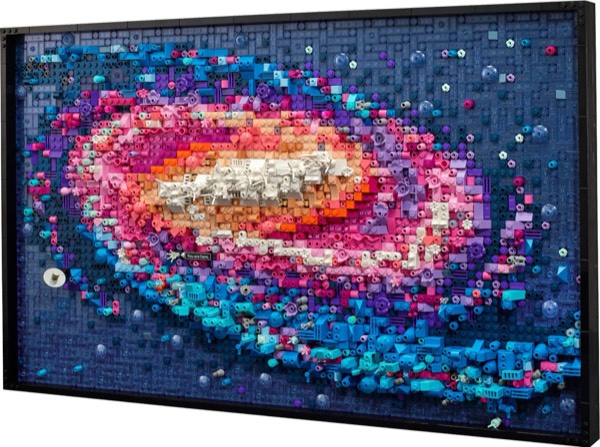
What caught me during the build was how honestly LEGO approached the subject matter. This isn't a kitschy space diorama. The scale of the piece, 33x73 centimeters when framed, and the deliberate flatness of the composition forces you to think about perspective and representation differently than you would a standard build. The piece functions as wall art first, and as LEGO construction second. That flip in priority is what makes this set either exactly what you're looking for or completely wrong for your collection.
The Milky Way Galaxy uses the LEGO Art system, which means the build is fundamentally different from a traditional set. You are placing round 1x1 studs and tiles onto baseplates, one by one, row by row, following a numbered pattern guide. It is pixel art in physical form. And it is either going to be the most relaxing thing you have done in months, or it is going to test your patience. There is very little middle ground with the Art system, and this set exemplifies both extremes across its 3,091-piece span.
For me, it landed squarely in the relaxing camp. This is a Bricks & Therapy set through and through. The repetitive nature of stud placement induces a genuine flow state - your hands work while your mind drifts. I built this across several evenings with music on, and each session felt restorative rather than tedious. The build is long at 3,091 pieces, but it never demands complex problem-solving. It just asks you to be present and place the next piece. That is its gift. There is no frustration, no re-reading instructions, no structural anxiety about whether a sub-assembly will hold together. Just you, a numbered guide, and a growing field of colored studs that slowly resolves into a galaxy.
The build divides naturally across multiple baseplate sections, which provides built-in session breaks. Each baseplate is its own mini-project, and finishing one gives you a sense of progress and accomplishment before you move to the next. This modular structure is one of the Art system's smartest design decisions - it turns a potentially overwhelming 3,000+ piece build into a series of manageable segments that you can tackle at your own pace. Some evenings I completed two baseplates. Other nights I did half of one. The set accommodates any rhythm you bring to it.
Let me be honest here: the LEGO Art system is not a technique playground. You are placing studs on pegs. There are no SNOT techniques, no complex sub-assemblies, no engineering challenges. The "technique" is in the design itself - how LEGO's designers translated the swirling arms of the Milky Way into a limited colour palette of round studs. The colour gradients from deep purples through blues to bright whites are beautifully mapped. Each transition between color zones is handled through careful stud selection, creating gradients that read smoothly from viewing distance despite being composed of discrete colored dots.
If you are building this to learn new techniques, you will be disappointed. If you are building this to appreciate how pixel-level colour theory works in physical media, you will find it fascinating. The technique here is artistic, not structural. And that is perfectly valid - just know what you are signing up for. There is genuine skill in how the designers mapped the spiral arm structure onto a grid of uniform studs, and studying the pattern reveals thoughtful decisions about where to place accent colors to suggest brightness gradients and nebular density variations.
The one transferable skill this build reinforces is patience and precision. The Art system punishes inaccuracy - one misplaced stud can throw off an entire row, and the tight color palette means errors are hard to spot until you are several rows past the mistake. Building this set teaches you to work methodically, to double-check your grid references, and to maintain focus across repetitive tasks. These are not glamorous skills, but they are real ones, and they apply to any large-scale LEGO project where accuracy matters.
3,091 pieces sounds enormous, and it is - but nearly all of them are 1x1 round plates and tiles. If you are a mosaic builder or you work in LEGO pixel art, this is a treasure trove of sorted colours in purples, blues, whites, and blacks. The baseplates themselves are useful for any Art-system project. But if you are looking for bricks, slopes, or Technic elements, there is nothing here for you. This is a single-purpose parts set for a single-purpose building style.
That said, within the mosaic niche, the color selection is excellent. The range of purple and blue tones is broader than most sets offer, and the white and light blue elements used for the galaxy's bright core and star clusters are immediately usable in any space-themed mosaic or pixel art project. The black elements - and there are hundreds of them - form the deep space background and are always useful. If you have any interest in creating custom mosaic designs, the Milky Way Galaxy is one of the most efficient ways to acquire a diverse palette of 1x1 rounds in a cosmic color scheme.
The frame pieces that border the finished artwork are a nice inclusion - they give the completed piece a polished, gallery-ready look without needing to source a separate frame. That is a practical detail that LEGO has handled well across the Art line. The frame elements are standardized across Art sets, which means you can swap frames between builds or combine multiple Art sets into larger gallery arrangements if you are ambitious about your wall display. The mounting system is also integrated into the frame, simplifying the transition from build table to wall.
This is where The Milky Way Galaxy earns its highest marks. Hanging on a wall, this set is absolutely stunning. The spiral arms of the galaxy rendered in graduated studs create a texture and depth that a printed poster simply cannot match. Each stud catches light differently, giving the image a subtle shimmer that changes throughout the day. It is genuinely beautiful. The three-dimensional quality of the studs means the surface is never truly flat - there is always a play of light and shadow across the face of the piece that gives it a living quality absent from any printed reproduction.
The dimensions are substantial - this is a proper wall piece that commands a space. In a darker room or a hallway, it becomes a conversation piece. Visitors consistently mistake it for some kind of high-end art installation before realising it is made entirely of LEGO studs. That moment of recognition is worth the build time alone. The color palette also works exceptionally well in interior design terms - the deep purples and blacks integrate with almost any wall color, while the bright whites and blues of the galactic core provide a focal point that draws the eye naturally to the center of the composition.
If you want a display piece that doubles as genuine wall art, this is one of the best options in the entire LEGO catalogue. It transcends the "LEGO set on a shelf" category entirely and enters the territory of "interesting art piece that happens to be made of LEGO." That distinction matters if you share your living space with someone who tolerates rather than embraces your building hobby - the Milky Way Galaxy is one of those rare sets that earns its wall space on aesthetic merit alone, regardless of the viewer's feelings about LEGO as a medium.
The price-per-piece on LEGO Art sets is always somewhat misleading because the pieces are almost entirely 1x1 rounds, which are among the cheapest elements LEGO produces. That said, the overall retail price for what you get - a framed, ready-to-hang wall art piece with a meditative multi-session build experience - is genuinely reasonable. Compare the cost to a framed art print of similar size, and the LEGO version comes with hours of entertainment built in. You are paying for the end product and the process, and both deliver.
The value proposition is strongest if you appreciate the build process itself as part of the product, not just the finished display. If you view the build as a chore and only want the end result, the value equation shifts - you could buy a printed poster for a fraction of the cost. But if you are reading this site, you probably understand that the build is the point. The hours spent placing studs while listening to music or podcasts are not a cost to endure before you get to the display. They are part of what you are buying, and they are worth paying for.
Within the LEGO Art line specifically, the Milky Way Galaxy offers above-average value because of its subject matter's universal appeal. Space imagery does not go out of style, does not require knowledge of a specific franchise or artist to appreciate, and works in virtually any room of a home. That versatility makes the purchase less risky than licensed Art sets that depend on the buyer's affinity for a particular pop culture property. The galaxy will still look good on your wall in ten years. A mosaic of a currently popular character might not age as gracefully.
Stress-builders. Meditation seekers. People who put on ambient music and work with their hands to decompress after a long day. The Milky Way Galaxy is the LEGO equivalent of an adult coloring book, and I mean that as a genuine compliment. It provides structure without pressure, progress without complexity, and a beautiful result without demanding any design decisions from the builder. If you have ever wanted a creative activity that asks nothing of your brain except "place the next piece," this is it.
Space enthusiasts are the other natural audience. Astronomers, science fiction fans, and anyone who looks up at the night sky with wonder will find deep satisfaction in building a galaxy for their wall. The subject matter has a timelessness and universality that transcends age, gender, and decorating style. This is not a niche interest piece - it is wall art that happens to depict one of the most photographed and admired objects in existence.
Who is this not for? Builders who want technique challenges. Builders who get restless with repetitive tasks. Builders who measure value in parts variety rather than build experience. If you need your builds to surprise you, to teach you new construction methods, or to produce models with moving parts and complex geometry, the Milky Way Galaxy will bore you. It is designed for a completely different kind of builder, and it serves that builder extraordinarily well.
There is a philosophical question embedded in the LEGO Art system that the Milky Way Galaxy forces you to confront: is placing studs on pegs really building? Purists will argue no - there are no connections, no structural decisions, no engineering. The studs sit in their pegs by friction, and the only skill required is reading a numbered guide and matching colors. By any technical definition of LEGO building, the Art system is the simplest possible expression of the medium.
And yet. The experience of watching 3,091 individual colored dots resolve into a recognizable image of a galaxy is genuinely compelling. There is a point in every Art build - usually around the 60 percent mark - where the image suddenly clicks into focus. The random-seeming dots coalesce into spiral arms, the color gradients reveal structure, and you realize you are looking at a galaxy. That moment of emergence is unique to the Art system, and it is more powerful than many technically complex builds manage to achieve. The Milky Way Galaxy produces that moment with particular force because the subject matter is inherently awe-inspiring.
The Art system will never satisfy builders who define the hobby through technique and engineering. But it has expanded the definition of what LEGO can be, and the Milky Way Galaxy is one of the strongest arguments for that expansion. It proves that LEGO can be a medium for creating wall art that holds its own against traditional prints and paintings - not by competing on resolution or color accuracy, but by offering something those mediums cannot: a tactile, three-dimensional surface created by the hands of the person who displays it. That handmade quality is the Art system's secret weapon, and the Milky Way Galaxy deploys it to stunning effect.
The Milky Way Galaxy is a beautiful set that asks a specific question: do you want to spend several evenings placing studs in meditative silence, and then hang the result on your wall? If the answer is yes, this is one of the best LEGO Art sets available. The finished piece is genuinely stunning, and the build process is therapeutic in a way that most sets cannot match. It is not for everyone - the repetitive nature will bore some builders. But for those who find peace in the process, this is deep space well spent.
- ✓ Absolutely stunning wall display piece
- ✓ Deeply meditative, therapeutic build process
- ✓ 3,091 pieces across multiple relaxing sessions
- ✓ Framed and ready to hang out of the box
- ✓ Excellent colour gradient work in the design
- ✗ Repetitive stud placement is not for everyone
- ✗ Zero structural technique - purely pixel art
- ✗ Parts haul is limited to 1x1 rounds and tiles
- ✗ Requires dedicated wall space to display properly
Some products may be provided by manufacturers. This page contains affiliate links.
- Best LEGO Art Sets - Our ranking of the best LEGO Art builds
- World Map Review - Another epic mosaic art display
- Best Sets for Anxiety - Why art builds are great for stress relief
This set belongs on the walls of architects, designers, and long-term MOC builders who think in composition and negative space, not casual builders. The people who appreciate it most are those already operating at the intersection of visual art and building. If you've spent time studying how colors work together, or if you've built large-scale mosaics or wall installations before, the constraint of working in a fixed frame becomes liberating instead of limiting. The palette itself (deep blues, blacks, grays, with sparse accent colors) teaches you something about subtlety that bright cheerful sets don't.
The secondary market value on this set will depend almost entirely on the quality of individual builds and how well they photograph. Unlike most sets, a well-mounted version becomes a functional room element, which changes its longevity. Collectors treating it as investment LEGO should understand: this doesn't age like sets with exclusive minifigures or rare parts. Its value is experiential and contextual to the builder's space, not speculative.
Track it in your vault on GameSetBrick - our free collection app. Log your condition, price paid, and watch the real-time market value.
Track in Your Vault →Save it to your wishlist on GameSetBrick. Share your list with friends and family - every set has a buy button so gift givers know exactly where to go.
Add to Wishlist → GameSetBrick is a free app by The Earl of Bricks. See all features. Scan it. Track it. Trade it.