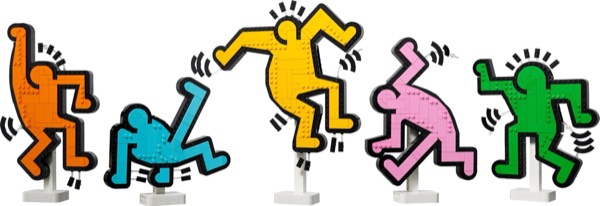
The Keith Haring LEGO Art set is a celebration of bold simplicity, and the build reflects that ethos perfectly. You place round studs and tiles onto baseplates following the numbered pattern guide, watching Haring's iconic dancing figures, radiant babies, and barking dogs emerge in vivid primary colors against solid backgrounds. The beauty of building a Haring piece is that you can see what you are making almost immediately. Unlike gradient-heavy Art sets where the image only resolves at the end, Haring's thick black outlines and flat color fields start to read within the first few rows. That instant legibility makes the build feel rewarding from the very beginning.
At around 1,773 pieces, this is a comfortably paced build. A focused builder can complete it in a single session; a more relaxed approach spreads it across two evenings. The color changes keep things engaging as you transition between the bright reds, yellows, blues, and greens that define Haring's palette. The black outline sections move quickly as you lay down uniform rows, while the colored figure sections require more attention to the pattern guide. It is a Bricks & Therapy experience that matches the joyful energy of the art itself. The mood of this build is fundamentally different from something like the Van Gogh Sunflowers. Where Sunflowers is contemplative and warm, the Haring build is energetic and playful. The bold colors demand attention, and the simple graphic forms give you frequent moments of recognition that keep your spirits up throughout the session.
There is also something philosophically satisfying about building a Keith Haring piece by hand. Haring believed art should be accessible to everyone, that it should live on subway walls and city streets rather than behind velvet ropes in galleries. Building his work yourself, stud by stud, with your own hands, feels aligned with that democratic spirit. You are not buying a Haring print. You are making a Haring piece, and that participatory quality echoes the artist's own values in a way that feels intentional and respectful.
The LEGO Art system is inherently limited in technique, and the Keith Haring set does not change that equation. You are placing studs on pegs. There are no structural tricks, no sub-assemblies, no engineering challenges. But the design work within those constraints is worth appreciating. Haring's art style is defined by bold, thick outlines and flat color fills, which translates to the stud grid format with remarkable clarity. The challenge for the LEGO designers was maintaining the energy and movement of Haring's line work within the rigid grid of round studs, and they have succeeded. The dancing figures retain their characteristic dynamism, the radiant lines emanating from the baby figure read clearly, and the overall composition captures that unmistakable Haring energy. The technique is in the pixel mapping, not in the physical building, and for this particular artist, the stud medium works exceptionally well.
What is worth studying from a design perspective is how the LEGO team handled Haring's line quality at stud resolution. Haring's original work features smooth, continuous lines of consistent thickness drawn in a single confident gesture. Translating those lines to a grid of round studs requires careful decisions about where curves bend, where lines step diagonally, and how line thickness is maintained across direction changes. The result is that some lines look smoother than others depending on their angle relative to the grid, and the designers clearly optimized for the lines that define the most recognizable features of each figure. The dancing figure's limbs, for instance, maintain convincing fluidity because the angle changes follow a rhythm that the eye reads as continuous motion rather than stepped approximation.
For anyone interested in pixel art, stud art, or mosaic design, the Haring set is a useful reference for how bold graphic styles translate to grid-based media. The general principle it demonstrates is that art styles with thick lines, flat colors, and simple shapes translate better to the stud grid than styles with subtle gradients, fine detail, or complex textures. This is useful knowledge for builders designing their own custom stud art pieces, because it helps you select source artwork that will produce satisfying results within the medium's inherent limitations.
The parts inventory is standard for the Art line: primarily 1x1 round plates and tiles. What makes the Keith Haring set interesting from a parts perspective is the color distribution. You get concentrated quantities of bright red, bright yellow, blue, green, and black round elements in the saturated primary tones that define pop art. These bold, vivid colors are surprisingly useful for custom mosaic projects, especially if you work in graphic or pop-art styles. The black elements alone, used for Haring's thick outlines, come in generous quantities that are useful for any stud-art project requiring strong border definition. The baseplate and frame components are standard across the Art line and work interchangeably.
If you are collecting Art sets to build a diverse mosaic parts library, the Haring set fills the "bright primaries" slot that cooler or more muted sets leave empty. The Van Gogh Sunflowers gives you warm yellows and golds. The Milky Way Galaxy gives you blues and purples. The Haring gives you pure, saturated primaries that are the foundation of any bold graphic design. Together, these sets provide a comprehensive stud-art palette that covers warm, cool, and vivid tones. Building a parts library from Art sets is not the most economical approach to mosaic building, but it is the most enjoyable, and each set provides a finished display piece while you accumulate elements.
The limitation is the same one that applies to every Art set: 1x1 round plates and tiles have narrow utility outside of mosaic work. If you do not build stud art, the parts haul is essentially decorative. The black elements have some crossover utility in other contexts - they work as detailing elements in system builds, and black round plates are always useful as micro-scale features. But the colored rounds are purpose-built for mosaic work, and if that is not your thing, the parts value is minimal. Know your building style before you factor parts haul into your purchasing decision.
On a wall, the Keith Haring LEGO Art set delivers pure visual energy. Haring's art was born on subway walls and city streets, designed to be seen quickly and felt immediately, and that quality translates perfectly to the stud medium. The bold black outlines pop against the vivid color fields, and the dancing figures radiate movement even in static form. From across a room, the composition reads instantly as Keith Haring. Up close, the individual studs add a physical texture that a flat print cannot replicate, giving each color field a subtle dimensionality as the round elements catch light at different angles.
This is one of the most visually striking LEGO Art sets in terms of sheer color impact. Where the Milky Way Galaxy is moody and meditative, and the Van Gogh Sunflowers is warm and classical, the Keith Haring is loud, joyful, and unapologetically bold. It works in contemporary spaces, home offices, creative studios, and children's rooms. The energy it brings to a wall is genuine and infectious. Non-LEGO visitors will recognize the Haring style immediately; LEGO fans will admire the execution. I have found that this set generates more spontaneous comments from visitors than any other Art set I have displayed, because Haring's visual language is so universally recognizable and so inherently positive that people respond to it before they even register that it is made of LEGO.
The set also benefits from Haring's cultural cachet. Displaying a Keith Haring piece signals an appreciation for art history, street culture, and creative energy that resonates in specific social contexts. In a home office or creative workspace, it announces a certain sensibility. In a living room, it adds a pop of contemporary art credibility. In a child's room, it brings genuine artistic quality alongside the bold colors and playful figures that children respond to naturally. Few LEGO Art sets carry this kind of cultural weight, and the Haring set leverages it effectively to create a display piece that functions as both art and conversation piece.
The Keith Haring Art set is for anyone who wants their wall to radiate energy rather than tranquility. If the Van Gogh Sunflowers is the Art set for quiet contemplation, the Haring is the Art set for creative motivation. It belongs in spaces where people work, create, and think. It belongs in rooms that benefit from a visual jolt of primary-color optimism. If your wall needs calm, buy the Sunflowers. If your wall needs energy, buy the Haring. The distinction is that simple and that useful.
Art enthusiasts and street art fans will appreciate the faithful translation of Haring's visual language into the stud medium. The set treats its source material with genuine respect, capturing both the graphic clarity and the emotional energy of Haring's work without diluting either quality. For fans who know Haring's history - his subway chalk drawings, his Pop Shop, his activist art, his tragically short career - building this set carries an emotional resonance that goes beyond the physical assembly. It is a tribute to an artist who believed that art belongs to everyone, built by your own hands in your own home. That alignment of message and medium is powerful.
For LEGO Art collectors assembling a wall display of multiple sets, the Haring provides essential tonal variety. Art collections need contrast to work visually, and the Haring's bold primaries and graphic energy contrast perfectly with the subtler, more meditative tones of other Art sets. Position it alongside cooler or more muted sets, and it becomes the visual anchor of the collection - the piece that draws the eye and sets the tone for the surrounding display. If your Art wall is starting to look too uniform or too subdued, the Haring is the corrective it needs.
Not every artist translates well to the stud grid. The LEGO Art format works best with art styles that feature clear forms, strong outlines, and flat color fields - essentially, styles that are already grid-compatible in their visual logic. Keith Haring's work is perhaps the single best fit for this format of any artist LEGO could have chosen. His thick black outlines translate perfectly to rows of black studs. His flat primary color fills translate perfectly to blocks of colored studs. His simple, recognizable figures translate perfectly to the limited resolution of the stud grid. There is no detail lost in translation because Haring's art does not rely on subtle detail. It relies on bold gesture, clear form, and pure color, and the stud medium delivers all three.
Compare this to the challenges of translating Impressionist art (soft edges, subtle color blending) or photorealistic art (fine detail, infinite gradation) to studs, and you see why the Haring set works so well. The format's limitations become invisible because the source artwork never required the qualities that the format lacks. This is not a compromise between art and medium. It is a genuine match. The round studs even add a quality that Haring's flat original work does not have: physical texture. The raised studs create a tactile surface that adds a dimension of engagement beyond pure visual impact, and that addition feels like a complement to Haring's work rather than a distortion of it.
This observation has practical implications for anyone designing custom stud art projects. If you are choosing artwork to translate into the LEGO Art format, the Haring set demonstrates the ideal characteristics to look for: bold outlines, flat color fills, simple recognizable forms, and an artistic style that communicates at low resolution. Artwork that meets these criteria will translate successfully; artwork that relies on subtlety, gradation, or fine detail will struggle. The Haring set is both a beautiful build and a useful case study in the principles of effective stud art design.
The Keith Haring set sits at a similar entry point to other recent Art releases, making it one of the more affordable ways to own a piece of pop art history in a unique physical format. The build experience is engaging without being exhausting, the finished piece is gallery-ready and culturally significant, and the parts provide a bright primary palette that complements other Art sets in your collection. Compared to a framed Haring print of similar dimensions, the LEGO version adds the build experience and the physical stud texture at a competitive premium.
For pop art fans, contemporary art enthusiasts, or anyone who wants to inject bold color and energy into their wall display, this represents solid value. The only caveat is for builders who crave structural complexity: the Art format will always leave that particular itch unscratched. The value here is in the display outcome and the meditative build process, not in engineering education. If you accept those terms, the Keith Haring delivers generously. The finished piece has a visual impact per dollar that rivals any LEGO display set on the market, because bold primary colors and iconic graphic design simply hit harder than subtle or complex compositions when viewed from normal display distance.
- ✓ Iconic pop art energy that reads instantly from across a room
- ✓ Bold primary color palette brings genuine visual impact to any wall
- ✓ Haring's graphic style translates perfectly to the stud grid format
- ✓ Approachable build length with rewarding early legibility
- ✓ Framed and ready to hang out of the box
- ✗ Repetitive stud placement with zero structural technique
- ✗ Parts inventory limited to 1x1 rounds in primary colors
- ✗ Smaller scale compared to the larger multi-baseplate Art sets
- ✗ Subject matter may not appeal to all art tastes
Some products may be provided by manufacturers. This page contains affiliate links.
- Best LEGO Art Sets - Our ranking of the best LEGO Art builds
- Van Gogh Sunflowers Review - Another art legend in LEGO form
- Starry Night Review - The 3D art display that started it all
Track it in your vault on GameSetBrick - our free collection app. Log your condition, price paid, and watch the real-time market value.
Track in Your Vault →Save it to your wishlist on GameSetBrick. Share your list with friends and family - every set has a buy button so gift givers know exactly where to go.
Add to Wishlist → GameSetBrick is a free app by The Earl of Bricks. See all features. Scan it. Track it. Trade it.