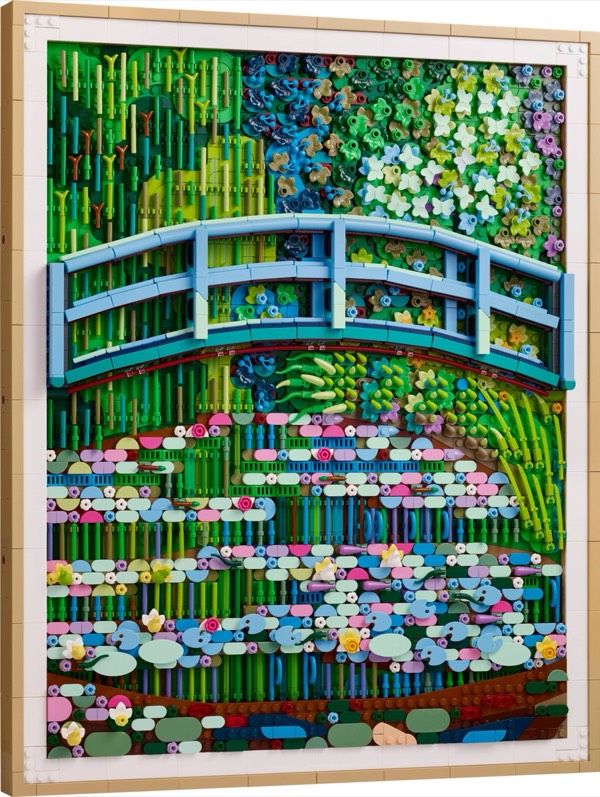
The Monet set is the most ambitious attempt LEGO Art has made at recreating a specific painting, and you feel that ambition in every bag. At 3,179 pieces, this is a substantial build - several sessions over multiple evenings - that asks you to place hundreds of small elements in precise positions to recreate Monet's 1899 painting of the Japanese bridge at his Giverny garden. The technique is where this set earns its reputation. Vertical bar elements form the background trees and their water reflections. Horizontal round tiles in varying sizes create the water lily brushstrokes. And the truly inspired parts usage starts appearing: frogs, lily pads, swords, bananas, and butterflies are all repurposed to mimic Impressionist brushwork.
This non-purist use of elements - what the community calls NPU - is the heart of the build experience. Watching a banana become a streak of green in the foliage or a sword become a reflection line in the water is the kind of creative translation that makes you appreciate LEGO as a design medium. Each time you pick up an element that you associate with one context and place it in a completely different one, you experience a small moment of creative revelation. These moments accumulate over the build, and by the time you finish, your understanding of what LEGO elements can represent has expanded permanently. That shift in perception is the build's most valuable contribution - it teaches you to see potential in every element.
The process is meditative but can edge into tedious during the longer placement sections. The sheer volume of small elements means some steps feel more like work than play, particularly in the middle sections where you are placing dozens of similar pieces in similar configurations. The build rewards patience and punishes impatience - rushing through the dense sections produces alignment errors that compound across subsequent rows. Developed in collaboration with the Metropolitan Museum of Art, the set includes a podcast featuring a Met curator discussing Monet's work - a thoughtful companion to a long build that provides cultural context and keeps your mind engaged during the more repetitive stretches.
The finished piece measures roughly 20 by 16 inches - substantial wall art by any standard - and comes with a brick-built frame and a Technic hook for wall mounting. The Impressionist effect is most apparent at distance, which is exactly how Monet's originals are meant to be viewed. Step back six feet and the bars, tiles, frogs, and bananas dissolve into a convincing impression of dappled light on water, green foliage reflected in a pond, and a wooden bridge arching across the composition. Step closer and the individual elements become visible, creating a second layer of visual interest. This dual-distance viewing experience is genuinely compelling - the set rewards both contemplation from across the room and close inspection from inches away.
The layering of elements does an impressive job of imitating oil paint texture. The surface is not flat - elements overlap, protrude, and catch light at different angles, giving the piece a physicality that a printed reproduction cannot match. The color palette is lush greens, blues, and purples with warmer accents throughout. Some community members have noted that the bridge perspective and certain color choices diverge from the original painting. These are fair observations for art history purists, but as a LEGO interpretation of Impressionism, the effect works. The set is not attempting photographic reproduction - it is attempting to capture the feeling of Monet's painting, the way light dissolves solid forms into color and reflection, and on that measure it succeeds convincingly.
This is a statement piece that will anchor a wall in any room. The green-dominant palette works particularly well in living rooms, offices, and bedrooms where it adds natural warmth without the visual weight of darker art pieces. The brick-built frame gives the piece a finished, gallery-ready quality that distinguishes it from sets that require external framing or display solutions. Straight out of the box and onto the wall, the Monet set is ready to display, and it holds its own alongside traditional framed art in a way that most LEGO sets cannot claim.
At 3,179 pieces for $249.99, the price-per-piece is just under eight cents - competitive for LEGO Art and excellent by 18+ set standards. The parts inventory is unusual. You are not getting baseplates full of 1x1 rounds like most Art sets. Instead, you get a diverse mix of bars, round tiles, small decorative elements, and structural plates in greens, blues, and earth tones. The NPU elements - frogs, bananas, swords, butterflies - are the headline pieces but are present in small quantities. Their value is more inspirational than practical: they demonstrate creative possibilities rather than providing bulk material for future builds.
The bar elements in various greens are the most useful parts for MOC builders, as they translate directly into foliage, vines, and organic detail work in any terrain or garden build. The round tile collection across multiple colors is solid, and the structural plates that form the backing provide standard-but-useful elements. The frame pieces are specific to the Art system but reusable across any Art-format build you might create. For builders who work in organic, naturalistic styles, the green and blue palette here is immediately applicable.
The real cost consideration is the $250 price tag itself. This is the premium end of the LEGO Art line, and whether the value is there depends on how you think about the purchase. As a multi-session building experience plus a museum-quality display piece plus a Metropolitan Museum of Art collaboration, $250 is justifiable. As a LEGO set competing for your budget against Creator Expert, Icons, or other 18+ offerings, it faces stiff competition. The build experience and display quality are both top-tier for the Art line. The question is whether you have the wall space and the budget for LEGO's most ambitious painting reproduction yet.
Art lovers who build. That is the primary audience, and the Monet set serves them with a level of cultural sophistication that few LEGO products achieve. If you visit museums, if you have art books on your coffee table, if you can name at least three Impressionist painters - this set was designed with you in mind. The Metropolitan Museum of Art collaboration is not a marketing gimmick; it reflects a genuine ambition to create a product that exists at the intersection of fine art and construction toy, and the result respects both sides of that intersection.
Experienced builders looking for a technique challenge will also find the Monet set rewarding. The NPU approach pushes you to think about elements in unfamiliar ways, and the complex surface texture requires more careful placement than the typical stud-based Art set. This is not a mindless placement build - it demands attention, creativity, and an appreciation for how small elements contribute to a larger visual effect. Builders who enjoy the process of understanding design decisions will find themselves studying each step with genuine interest.
Gift-givers seeking something meaningful for an art enthusiast or a creative person will find this set an exceptional choice. The combination of the Met partnership, the beautiful finished display, and the meditative building experience creates a gift that communicates thoughtfulness and sophistication. At $250, it is a significant gift - but for the right recipient, the multi-evening building experience and the permanent wall display make it a gift that keeps delivering long after the wrapping comes off.
There is a deep and fascinating parallel between Impressionism as an art movement and LEGO as a construction medium. The Impressionists - Monet chief among them - understood that paintings are not windows into reality but surfaces covered in pigment. They made the brushstroke visible, celebrating the materiality of paint itself rather than disguising it in pursuit of photographic illusion. LEGO, by its nature, does the same thing. Every LEGO creation is visibly, unmistakably made of bricks. The medium never disappears into the subject. It is always present, always asserting its own identity alongside whatever it represents.
The Monet set exploits this parallel with intelligence and restraint. The NPU elements - the frogs that become foliage, the bananas that become leaf strokes, the swords that become water reflections - are the LEGO equivalent of visible brushstrokes. They do not pretend to be anything other than what they are. You can see the frog. You can see the banana. But in the context of the composition, they function as color and texture rather than as objects. This is exactly what Monet's brushstrokes do in the original painting: they are visibly strokes of paint, but in the composition they function as light, water, and foliage. The translation is not just visual - it is conceptual.
This conceptual depth is what separates the Monet set from other LEGO Art releases. Most Art sets reproduce an image using the LEGO medium. The Monet set reproduces a painting's philosophy using the LEGO medium. It does not just show you what Monet's bridge looks like - it demonstrates how Monet's approach to representation works by applying the same principles in a different material. That is a remarkable achievement for a product that comes in a cardboard box with numbered bags and an instruction booklet. The set deserves recognition not just as a successful LEGO product but as a genuinely thoughtful piece of design that takes both its artistic source and its construction medium seriously.
The Monet set is the best pure art reproduction LEGO has produced. The NPU technique of using everyday elements as Impressionist brushstrokes is genuinely creative, the finished piece has the scale and presence to anchor a room, and the Metropolitan Museum of Art collaboration adds cultural weight that elevates the entire project. The build can be tedious during extended placement sessions, and $250 is a serious investment for wall art in any medium. But if you want a LEGO set that doubles as a legitimate conversation piece about art, technique, and creative reinterpretation, this is the one. Monet himself built his garden to paint. LEGO built this set to be art.
- ✓ NPU technique - frogs, bananas, swords as brushstrokes - is inspired
- ✓ Impressionist effect works beautifully at viewing distance
- ✓ Layered surface texture imitates oil paint physicality
- ✓ Metropolitan Museum of Art collaboration with curator podcast
- ✓ 20 x 16 inch finished size is substantial wall art
- ✓ Competitive price-per-piece at under eight cents
- ✗ $250 price tag is a significant commitment
- ✗ Extended placement sessions can feel tedious
- ✗ Bridge perspective and some colors diverge from the original painting
- ✗ Requires substantial wall space for display
Affiliate link. Some products may be provided by the manufacturer. All opinions are my own.
- Best LEGO Art Sets - Our ranking of the best LEGO Art builds
- Van Gogh Sunflowers Review - Another masterpiece painting in LEGO Art form
- Starry Night Review - Van Gogh's iconic night sky as a 3D LEGO build
Track it in your vault on GameSetBrick - our free collection app. Log your condition, price paid, and watch the real-time market value.
Track in Your Vault →Save it to your wishlist on GameSetBrick. Share your list with friends and family - every set has a buy button so gift givers know exactly where to go.
Add to Wishlist → GameSetBrick is a free app by The Earl of Bricks. See all features. Scan it. Track it. Trade it.