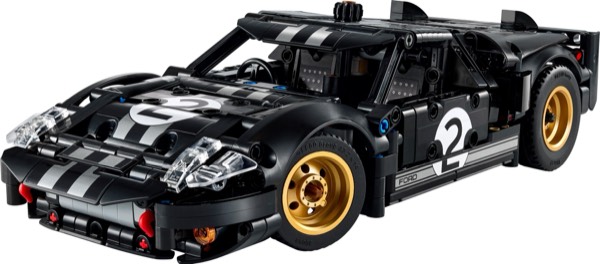
The 1966 Ford GT40 MKII is the kind of LEGO set that carries the weight of motorsport history in every element. This is the car that broke Ferrari's stranglehold on the 24 Hours of Le Mans, finishing 1-2-3 in one of the most famous results in racing history, and LEGO's Technic interpretation treats that legacy with the mechanical respect it deserves. At 793 pieces, the build occupies a comfortable middle ground - substantial enough to deliver a meaningful Technic construction experience, but compact enough to complete in 4-6 hours of focused building. The 18+ age rating reflects the build's mechanical precision demands rather than extreme complexity, and experienced Technic builders will find the pacing well-calibrated for sustained engagement without fatigue.
The chassis phase establishes the GT40's mechanical credentials with a V8 engine assembly and functional steering system. The V8 is a historically accurate powertrain choice - the real GT40 MKII was powered by Ford's legendary 7.0-liter V8, and LEGO's interpretation places eight pistons in a V configuration connected to a crankshaft that cycles when the rear wheels are driven. Building the V8 requires careful attention to connecting rod alignment and crankshaft bearing placement, with each piston bank needing to be precisely positioned to ensure smooth cycling without binding. The steering mechanism routes from a cockpit steering wheel through connecting rods to the front wheels, and the connection path demands the same precision that characterizes the best Technic builds at any scale.
The bodywork phase is where the GT40's iconic shape emerges, and it is a deeply satisfying transformation. The GT40 MKII has one of the most recognizable silhouettes in motorsport - impossibly low, almost absurdly wide, with a long tail and short nose that defined the prototype endurance racing aesthetic of the 1960s. LEGO's Technic panels capture this profile with impressive fidelity, and the blue and orange Gulf-style color scheme adds the visual personality that has made the GT40 one of the most beloved racing cars in history. Watching the bodywork panels transform the mechanical chassis into a recognizable GT40 is a build moment that connects you to six decades of motorsport heritage. The doors, the distinctive cabin shape, and the long rear deck all emerge in sequence, and by the time the last panel is placed, you are looking at a LEGO model that genuinely evokes the spirit of Le Mans 1966.
The V8 engine is the mechanical centerpiece and the feature that most directly connects the model to its historical counterpart. Eight pistons arranged in a V configuration, connected via individual connecting rods to a shared crankshaft, all driven by the rear axle through a gear train. The V8 layout is more complex than the inline engine configurations found in smaller Technic sets, requiring the builder to construct two separate piston banks that must align precisely to share a single crankshaft without interference. When complete, spinning the rear wheels produces a mechanical symphony of eight pistons pumping in sequence - a visual and tactile demonstration of the multi-cylinder engine principle that powered not just the GT40, but the muscle car era that Ford dominated in the 1960s.
The functional steering system provides the primary interactive mechanical feature, connecting the cockpit steering wheel to the front wheels through a linkage that delivers smooth, proportional response. The steering geometry is well-executed for the model's scale, with accurate wheel alignment through the turning range and minimal play in the steering chain. The mechanism demonstrates the fundamental engineering of rack-and-pinion-style steering translation - converting rotational input at the steering wheel into linear motion at the steering rack, and then back into rotational motion at the wheel spindles. For builders who are interested in automotive engineering history, this mechanism is a direct analog to the steering systems used in 1960s racing cars, scaled down but mechanically faithful.
The bodywork construction adds structural engineering value that complements the mechanical systems. The GT40's extremely low profile - the real car stands just 40 inches tall, which gave it its name - creates unique structural challenges at LEGO Technic scale. The roof line must be low enough to capture the car's distinctive squashed profile while maintaining enough internal clearance for the mechanical systems. LEGO's solution uses clever panel angles and beam placement to achieve a profile that is remarkably faithful to the original car's proportions. For builders who appreciate how engineering constraints drive design solutions, the GT40 is a lesson in working within tight dimensional limits to achieve both mechanical function and visual accuracy. It pairs instructively with the Ford Model T Icons set, which demonstrates a completely different era of Ford engineering with entirely different construction challenges.
793 pieces with a distinctive blue and orange color palette that immediately evokes Gulf racing livery - one of the most iconic color combinations in motorsport history. The blue Technic panels and beams are the primary color elements, and they carry meaningful parts value for builders seeking this specific shade for custom racing builds, maritime projects, or display models. The orange accent elements - used for the racing stripe and detail areas - add a vibrant contrast color that is useful for any build requiring warm accent tones against cool primary colors. Together, the blue and orange elements create a color combination that is rarely available in this quantity from a single Technic source.
The V8 engine components represent significant mechanical parts value. The full set of pistons, connecting rods, crankshaft elements, and associated gearing constitutes a complete V8 engine kit that can be repurposed for custom Technic vehicle builds or used as a standalone mechanical demonstration model. The gear collection extends beyond the engine to include the steering mechanism components and drivetrain elements, providing a well-rounded Technic mechanical parts library. Axles, pins, and connectors are represented in practical quantities across useful size ranges, making the GT40 a solid contributor to any builder's Technic parts inventory.
The curved fairing panels that form the GT40's distinctive bodywork are among the most valuable individual parts. The car's organic curves and low profile require panel elements with specific shapes that appear in very few other sets. The long rear deck panels, the curved fender elements, and the distinctive cabin roof pieces are all shapes that would be difficult to source outside this specific set. For builders interested in vintage racing car designs or 1960s automotive aesthetics, these panel shapes are particularly valuable because they capture the design language of an era that is underrepresented in the broader LEGO catalog. At $74.99, the parts-per-dollar value is reasonable for the mid-tier Technic range, with the color rarity and panel exclusivity providing additional value that simple piece counts do not reflect.
The Ford GT40 MKII is one of those rare racing cars that transcends motorsport to become a cultural icon, and LEGO's Technic interpretation captures the qualities that made it legendary. The completed model is approximately 14 inches long, with the impossibly low stance, wide haunches, and long rear deck that define the GT40's unmistakable silhouette. The blue and orange color scheme is one of the most visually appealing palettes in the entire Technic catalog - it is simultaneously sporty and elegant, historic and timeless. From across a room, the model reads as an instantly recognizable classic racing car. From close range, the Technic panel lines and mechanical details visible through bodywork gaps add engineering depth to the visual experience.
The GT40's proportions are genuinely distinctive and set it apart from every other car in the Technic lineup. Modern supercars and F1 cars share certain proportional similarities - aggressive front splitters, prominent rear wings, sculpted sidepods. The GT40 predates all of those design conventions, presenting instead a clean, flowing shape that relies on low frontal area and smooth aerodynamic surfaces rather than wings and diffusers. This visual distinctiveness makes the GT40 the most historically unique display piece in the current Technic vehicle range, and it provides welcome variety for collectors who display multiple automotive Technic sets. No other car on the shelf looks anything like it, which is exactly the kind of visual diversity that elevates a collection from a group of similar objects to a curated display of automotive history.
For builders creating a Ford-themed display, the GT40 Technic pairs magnificently with the Ford Mustang Dark Horse Speed Champions set and the Ford Model T Icons set. Three sets spanning a century of Ford engineering - from the Model T that put America on wheels, to the GT40 that humbled Ferrari at Le Mans, to the Mustang Dark Horse that continues the Blue Oval's performance legacy. That is a display with narrative depth that enriches every individual model within it. The GT40 anchors the collection's motorsport dimension with historical gravitas that few LEGO sets can match. For a broader perspective on the best adult LEGO sets, see our curated guide, and for the complete Speed Champions lineup, check our full Speed Champions review archive.
At $74.99 for 793 pieces, the GT40 MKII sits slightly above the $64.99 price point that anchors the 15-wide Technic range, with the premium reflecting the 18+ designation, the V8 engine complexity, and the historical licensing that the Ford GT40 nameplate carries. The price-per-piece ratio is reasonable within the mid-tier Technic context, and the mechanical content - a working V8 engine plus functional steering - delivers more engineering engagement than many Technic sets at similar or higher price points. The 4-6 hour build time provides substantial entertainment value, and the finished display model earns permanent shelf placement through a combination of visual impact and historical significance.
The historical context adds a dimension of value that transcends brick-counting economics. The Ford GT40 MKII is not just a car - it is a chapter in the greatest rivalry in motorsport history. The story of Ford's campaign to defeat Ferrari at Le Mans is the subject of films, books, and documentaries that continue to captivate audiences decades after the events took place. Owning a LEGO Technic GT40 connects you to that narrative in a tangible way, and the model serves as a physical reference point for one of the most compelling stories in automotive history. This narrative value is real - it enriches the display experience and gives the set conversational depth that brand-new car models simply cannot replicate.
For builders considering the GT40 alongside other mid-tier Technic vehicles, the key differentiator is the combination of historical significance, V8 engine complexity, and visual distinctiveness. No other set in the 15-wide Technic range tells a story as compelling as the GT40's, and no other set delivers a V8 engine at this price point. The blue and orange color scheme is the most visually distinctive palette in the mid-tier range, and the vintage racing proportions provide display variety that modern supercars cannot offer. The $10 premium over the base 15-wide price tier is well justified by the additional mechanical content and historical depth, making the GT40 MKII one of the strongest value propositions in the current Technic catalog for builders who appreciate motorsport heritage alongside mechanical engineering.
Like all Technic sets, the GT40 MKII does not include traditional minifigures. The cockpit area is designed around the steering mechanism rather than driver accommodation, and the car's famously tight cockpit dimensions make driver figure inclusion impractical at any Technic scale. The cockpit detailing includes a printed steering wheel element that references the GT40's period-correct wood-rimmed wheel design, and the simplified dashboard area suggests the analog gauges and toggle switches that characterized 1960s racing car interiors. The cockpit opening is framed by the car's distinctive low roofline, which is one of the GT40's most recognizable design features and is faithfully represented in the Technic interpretation.
The V8 engine is the internal centerpiece, and it rewards examination from every angle. Removing or lifting bodywork sections reveals the full eight-piston assembly with connecting rods, crankshaft, and drive gearing clearly visible and fully functional. The V8's dual-bank configuration creates a visually impressive mechanical display that is denser and more complex than the inline engine configurations found in simpler Technic sets. Spinning the rear wheels activates the entire assembly, with eight pistons pumping in coordinated sequence - a mechanical ballet that communicates the engineering spirit of the 1960s muscle car era in miniature. For builders who appreciate automotive heritage as much as LEGO construction, the GT40's V8 is a tactile connection to the engineering philosophy that defined American high-performance automotive culture. It is the kind of feature that makes you want to learn more about the real car, and that desire to explore beyond the LEGO set is the hallmark of a truly great licensed Technic build.
- ✓ V8 engine assembly is mechanically complex and visually impressive
- ✓ Iconic blue and orange Gulf-style livery is one of the best color palettes in Technic
- ✓ Captures the GT40's legendary low-slung silhouette with impressive accuracy
- ✓ Historical significance adds narrative depth that modern cars cannot match
- ✓ Functional steering with smooth, proportional response
- ✓ Visually distinctive proportions provide display variety
- ✓ 18+ build quality with satisfying precision demands
- ✗ $10 premium over the standard 15-wide Technic price tier
- ✗ Sticker sheet required for racing numbers and livery details
- ✗ Extremely low profile makes some bodywork panels difficult to align
- ✗ Rear bodywork could integrate more seamlessly at panel junctions
Some products may be provided by manufacturers. This page contains affiliate links. All opinions are my own.
- Ford Mustang Dark Horse Speed Champions Review - Ford's modern muscle in LEGO form
- Ford Model T Icons Review - The car that started it all for Ford
- Shelby Cobra Icons Review - Another American racing legend in LEGO form
- Best LEGO Sets for Adults 2026 - Our top picks for grown-up builders
- Every Speed Champions Set Reviewed - The complete Speed Champions guide
Track it in your vault on GameSetBrick - our free collection app. Log your condition, price paid, and watch the real-time market value.
Track in Your Vault →Save it to your wishlist on GameSetBrick. Share your list with friends and family - every set has a buy button so gift givers know exactly where to go.
Add to Wishlist → GameSetBrick is a free app by The Earl of Bricks. See all features. Scan it. Track it. Trade it.