Is the LEGO Police Chase Worth Buying?
7.2/10. Proceed with caution. A classic cops-and-robbers pursuit pack with two vehicles and plenty of play value. 252 pieces of high-speed justice.

The 60449 Police Chase lands in that uncomfortable middle zone where City sets have been living for the past few years, genuinely functional builds that don't pretend to be anything they aren't, but also don't deliver the density or ingenuity that keeps serious builders engaged past the initial assembly. This isn't a bad set. The police car and robber's getaway vehicle both function as intended, the proportions don't embarrass themselves on a shelf, and the minifigure count-to-piece ratio stays reasonable. But it's also the kind of set that makes you acutely aware you're building from a formula that hasn't substantially shifted since 2015.
What matters here is understanding what 60449 *is*: a straightforward vehicle pack designed for play interaction and scene-building rather than structural innovation. The play patterns work, chase mechanics are built into the DNA of these two vehicles, and the piece distribution leans toward visible construction rather than hidden frameworks. If you're buying this expecting breakthrough building techniques or unusual part applications, you'll feel the gap between expectation and reality immediately.
LEGO City Police sets have been a cornerstone of the theme since its inception, and the Police Chase formula is one of the most well-worn templates in the entire LEGO catalog. You get a police vehicle, you get a criminal's vehicle, you get a couple of minifigures with opposing agendas, and you stage a pursuit. It is a formula that has sold millions of sets because it works. The question with any new Police Chase set is not whether the formula works but whether this specific iteration adds anything new to a concept that has been executed dozens of times. With the 60449 Police Chase, the answer is: a little bit, but not as much as you might hope.
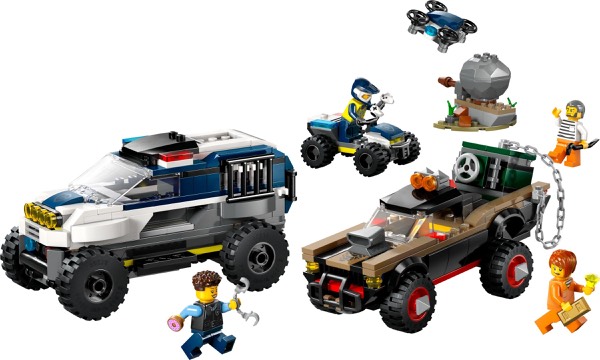
At 252 pieces split between two vehicles, each vehicle is a relatively quick build. The police car takes approximately thirty minutes and follows the standard City police car template: white and blue body, light bar on the roof, printed hood and door details, and a functional interior with steering wheel and seat. The construction is straightforward and produces a clean-looking cruiser that is unmistakably a police vehicle. There are no surprises in the police car build, but there do not need to be. It is a police car. It looks like a police car. It functions as a police car. Mission accomplished.
The criminal's getaway vehicle is the more interesting build of the two. Rather than the typical van or muscle car, LEGO has gone with a modified street racer that uses lowered suspension, wider rear fenders, and a rear spoiler to suggest illegal street racing culture. The build uses some clever angle plate techniques to create the wider rear fender profile, and the spoiler is a separate subassembly that mounts with clip connections for adjustability. The color scheme is black with neon green accents, which effectively communicates "this car belongs to someone who makes questionable life choices" without requiring a printed label. The build takes approximately forty minutes and delivers a vehicle that has more personality than the police car it is running from, which is a dynamic that LEGO has been smart enough to recognize: the criminal's vehicle should always be cooler than the cop's vehicle because that is what drives the narrative tension.
The combined build time is approximately seventy minutes, which feels appropriate for a the retail price set with two vehicles. Neither vehicle overstays its welcome, and the transition from police car to getaway car provides a natural break point and a shift in building style that keeps the experience from becoming monotonous. The police car is orderly and symmetrical. The getaway car is aggressive and asymmetrical. Building them back to back highlights those contrasting design philosophies and makes each vehicle more interesting by comparison. It is not a complex or challenging build by any measure, but it is a well-paced one that serves its target audience effectively.
The technique value here is modest, which is expected for a set at this price and piece count. The standout technique is the wider rear fender on the getaway car, which uses angle plates mounted to the rear quarter panels to create a body line that extends beyond the standard vehicle width. This is a useful technique for any vehicle MOC that needs to suggest aggressive wheel arches or body kit modifications. The specific implementation uses a 1x2 angle plate connected to the side of the rear wheel arch, with a slope element attached to the outboard face to create a smooth fender profile. It is not a revolutionary technique, but it is a practical one that demonstrates how angle plates can modify vehicle proportions without adding bulk to the overall body.
The spoiler construction on the getaway car uses a bar-and-clip mounting system that allows the spoiler to be angled. This is a basic but useful connection type for any external vehicle accessory that needs to be adjustable. Wing mirrors, antennae, roof racks, and other protruding vehicle elements all benefit from bar-and-clip connections because they allow positioning adjustments after the main build is complete. The police car's light bar uses a similar clip-mounted construction that allows the light bar to be removed cleanly for undercover scenarios, which is a play feature but also demonstrates the utility of removable roof accessories in vehicle design.
The lowered suspension effect on the getaway car is achieved through a simple but effective method: the wheel wells are positioned lower on the body than standard City vehicle construction would place them, creating the visual impression of reduced ride height. This is not a technique in the mechanical sense because it does not involve any moving parts or specialized connections. It is a proportional decision: building the body higher relative to the axle centerline so that the wheels appear to sit further up into the body. Understanding how to manipulate apparent ride height through proportion rather than mechanism is a valuable design skill for vehicle MOC builders, and this set demonstrates the principle clearly even if it does not teach a complex construction method.
252 pieces split between two vehicles means neither vehicle contributes a large quantity of any particular element. The police car provides white, blue, and black elements in the standard City police palette. The getaway car provides black and neon green elements in smaller quantities. Neither vehicle's parts haul is individually impressive, but the combined inventory offers a reasonable variety of small vehicle parts including wheels, windscreens, slope elements, and structural plates in useful sizes.
The neon green accent elements from the getaway car are the most interesting parts in the set from a color perspective. Neon green is less common than most City colors, and the small tiles and plates used for the racing accents have utility in any build that needs high-visibility color pops or cyberpunk-style accents. The wheel and tire elements are standard City vehicle fare - you get eight wheels total across both vehicles, which is a useful count if you are building a fleet. The windscreen elements for both vehicles are common City vehicle parts that are readily available elsewhere, so they do not add significant secondary market value to the set.
The printed elements deserve mention. The police car includes printed hood and door elements with police graphics, and these printed parts have value for anyone building custom police vehicles who wants authentic-looking markings without having to source sticker sheets. Whether these are prints or stickers varies by market and production run, so check your local availability if printed police markings are specifically what you are after. The overall parts haul is adequate for a the retail price set but not a reason to buy the set on its own. You buy this set for the play scenario and the vehicles, and you keep the parts as a bonus.
As individual display pieces, neither vehicle in the Police Chase set is going to anchor a collection or draw attention on a shelf. They are small City vehicles that look like what they are: a police car and a street racer. Their display value comes entirely from staging them together in a chase scenario. Position the getaway car in front with the police car close behind, angle the wheels to suggest a high-speed turn, and suddenly you have a vignette with narrative energy that neither vehicle possesses alone. The visual storytelling is built into the product concept, and the display works best when you embrace it.
The getaway car is the more visually interesting of the two vehicles. The black body with neon green accents and the rear spoiler give it a street-racing aesthetic that has more visual personality than the utilitarian police cruiser. The lowered stance and wider rear fenders add a sense of aggressive purpose that makes the car look fast even at rest. The police car, by contrast, is intentionally generic. It is a tool of law enforcement, not a design statement, and its display quality reflects that functional nature. Clean, professional, and entirely forgettable when viewed in isolation.
In a LEGO City layout, the Police Chase vehicles work best as dynamic elements positioned on a road section rather than parked in a static display. They need movement context to tell their story. A straight road with the getaway car ahead and the police car behind is the minimum viable display. A curved road section with the cars angled through a turn is better. Add a sidewalk with a bystander minifigure watching the chase go by, and the display gains a human perspective that elevates the entire scene. These are not standalone display pieces. They are narrative props that need a stage, and the quality of the display depends entirely on the stage you build for them. For builders who enjoy creating City street scenes, the Police Chase vehicles add welcome kinetic energy to otherwise static displays.
The minifigures, when positioned in or near the vehicles with their accessories deployed, add essential visual context. The police officer mid-pursuit with the criminal fleeing ahead creates instant narrative tension that engages viewers regardless of their LEGO literacy. Everyone understands a chase scene, and that universal legibility is the set's greatest display asset. For shelf display without a road or scene context, honestly, these are forgettable. But place them in a diorama and they bring it to life in ways that more expensive, more impressive-looking sets sometimes cannot.
At approximately retail price for 252 pieces, the Police Chase offers acceptable value for a dual-vehicle City set. The price-per-piece ratio is standard for City vehicles, and you get two complete vehicles with four minifigures, which is a generous figure count for this price point. The play value is strong because the chase scenario is inherently replayable. Two vehicles pursuing each other across a table or floor provides the kind of open-ended play that LEGO City has always excelled at, and the the retail price price point makes this an accessible entry point for young builders or a low-commitment impulse buy for collectors.
Compared to other Police Chase sets that LEGO has released in recent years, this iteration is competitive. The getaway car has more design personality than some previous criminal vehicles, and the police car is a solid if unremarkable cruiser. The four-minifigure count is above average for this price point in the City lineup. There is nothing about this set that represents exceptional value, but there is also nothing that feels like a poor deal. Twenty-five dollars for two vehicles and four figures is a fair exchange, and the play scenario adds intangible value that the raw numbers do not capture.
The honest assessment is that you know exactly what you are getting with a LEGO City Police Chase set, and this one delivers on that expectation without exceeding it. It is comfort food LEGO. It is the set you buy for a birthday party gift, a rainy afternoon activity, or a quick build when you want something satisfying without committing to a three-hour project. That utility has genuine value, even if it does not generate the excitement that larger or more innovative sets produce. For twenty-five dollars, you get exactly twenty-five dollars worth of well-designed LEGO. No more, no less, and sometimes parity is perfectly fine.
The set includes four minifigures: two Police Officers and two Criminals. The Police Officers wear the current City police uniform design with dark blue torsos, utility belt printing, badge details, and cap or helmet options. These are standard City police figures that are well-produced and functionally appropriate but not collectible. If you have bought any City Police set in the last three years, you almost certainly own figures that are indistinguishable from these at arm's length. They serve their purpose without distinction, which is both a strength and a limitation. You always know what you are getting with City police figures, and what you get is consistently adequate.
The Criminal figures are more interesting by virtue of being less standardized. One wears a black hoodie with a beanie, and the other wears a leather jacket with a bandana. These character designs communicate "getaway driver" and "accomplice" effectively without being stereotypical or offensive. LEGO has gotten better over the years at designing criminal characters who look like characters rather than caricatures, and these figures reflect that improved approach. The facial expressions are defiant rather than menacing, which strikes the right tone for a children's toy that depicts lawbreaking. The dual-sided heads offer a smirking and a worried expression, which allows the narrative to progress from cocky escape attempt to worried capture.
Accessories include handcuffs, a walkie-talkie, a megaphone, and a crowbar. The crowbar is the criminal accessory that every City Police collection needs, and it remains one of the most useful small accessories for any urban scene. The handcuffs are standard police equipment that rarely see use in non-police contexts but are essential for the arrest scenario that concludes the chase narrative. The megaphone and walkie-talkie provide communication equipment for the officers. I would have appreciated a money bag or jewel element to establish a motive for the chase. Without a stolen item, the narrative is incomplete - they are fleeing, but from what? A small printed tile or a colored gem would have added story context at minimal cost. Despite this narrative gap, the minifigure selection is solid and appropriately sized for a the retail price set.
The Police Chase is exactly what it appears to be: a competent, well-executed iteration of LEGO City's most reliable formula. The police car is a clean cruiser, the getaway car has genuine design personality with its lowered stance and neon accents, and the four-minifigure lineup provides the characters needed to stage an engaging pursuit scenario. The build experience is brisk and well-paced, the play value is strong for the price, and the overall package delivers on the promise of the box art without any unpleasant surprises.
Where the set falls short is in innovation. There is nothing here that a veteran City builder has not seen before. The chase scenario is timeless, but it is also timeworn. The techniques are functional but not educational. The parts haul is adequate but not exciting. If you are looking for a City set that will challenge your building skills or expand your sense of what LEGO vehicles can be, this is not it. But if you want a reliable, affordable, entertaining set that does exactly what LEGO City Police sets have always done - and does it well - then the Police Chase delivers. It is a solid entry in a well-established category, and for twenty-five dollars, that is a fair proposition.
- ✓ Getaway car has genuine design personality with neon accents
- ✓ Four minifigures at this price point is generous
- ✓ Strong play value from the chase scenario
- ✓ Quick, satisfying build for a rainy afternoon
- ✓ Criminal figures have distinct character designs
- ✗ Nothing here is new to the Police Chase formula
- ✗ Police car is entirely generic
- ✗ No stolen item accessory to motivate the chase narrative
- ✗ Limited technique value for experienced builders
Some products may be provided by manufacturers. This page contains affiliate links. All opinions are my own.
- Custom Police Garage Review - The police headquarters build
- Central Train Station Review - The flagship City infrastructure set
- Sports Car Review - Another City vehicle build
The rear spoiler construction on the police car uses a stacked approach that's more rigid than you'd expect from City-scale vehicles, and that actually matters when minifigures are gripping and repositioning it during play. The choice to use clip-hinge combinations rather than standard ball joints creates tension that doesn't deflate after fifty rotations. That detail alone signals the designer was thinking about durability rather than just hitting piece count.
The robber's vehicle, a compact sedan with a printed windshield rather than transparent panes, makes more economic sense than it appears at first glance. The solid hood with printed details substitutes design clarity for build complexity, and the resulting silhouette reads immediately as "getaway car" without requiring interior detail work that would add fifteen pieces and deliver zero visual payoff. That's actually competent restraint.
Track it in your vault on GameSetBrick - our free collection app. Log your condition, price paid, and watch the real-time market value.
Track in Your Vault →Save it to your wishlist on GameSetBrick. Share your list with friends and family - every set has a buy button so gift givers know exactly where to go.
Add to Wishlist → GameSetBrick is a free app by The Earl of Bricks. See all features. Scan it. Track it. Trade it.