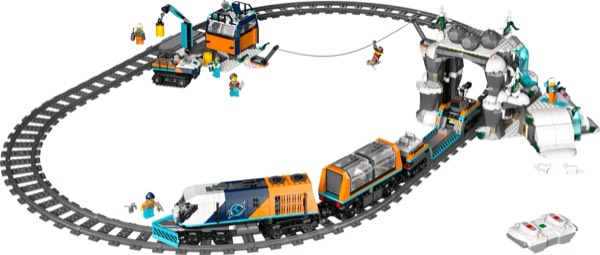
The Explorer Train is a focused, satisfying build at approximately 1,517 pieces. Expect around two and a half hours from first bag to final car, and those hours are well spent. The build divides naturally between the locomotive, the passenger car, and the observation car, with each rolling stock unit offering its own distinct construction experience. The progression from engine to passenger cars creates a natural rhythm that keeps the build engaging from start to finish.
The locomotive comes first and is the most complex section. The green and black color scheme goes on in clean layers, with the cab section featuring a detailed engineer's compartment and the nose tapering to a streamlined front end. The powered-up motor integration happens during the chassis phase, which means by the time you finish the exterior shell, the locomotive is already functional. That is a smart design decision because it lets you test the motor before committing to the cosmetic details. There is a moment of genuine excitement when you connect the battery, press the button, and the locomotive wheels spin for the first time - well before the build is complete. That early payoff is a motivational boost that carries through the remaining construction.
The passenger car and observation car are lighter builds that focus on interior appointments. Windows, seating, luggage racks, and small passenger accessories make these cars feel like functional transport rather than empty shells on wheels. The observation car has an open-air rear platform that is the single most satisfying detail in the entire set. It takes five minutes to build and adds enormous character to the trailing end of the train. The railing, the open deck, and the implied invitation to stand at the back and watch the scenery roll by - it is a small detail that speaks volumes about the design team's understanding of what makes trains romantic. Every other car on this train is enclosed. The observation platform is open to the world, and that contrast gives it outsized emotional impact.
The locomotive nose uses a combination of slope and wedge elements to create a streamlined front end that suggests speed without resorting to oversized specialty molds. The technique is clean and produces a convincing modern train profile. The green curved slope elements on the locomotive body create the rounded roof profile that distinguishes the Explorer from boxier City trains of previous years. The smooth, continuous roof line is achieved through careful selection of curved slope sizes that transition seamlessly from the cab to the nose, and studying how those transitions work teaches valuable lessons about creating flowing contours from discrete elements.
The powered-up motor integration is the key technical feature. The motor block mounts into the locomotive chassis with purpose-built connection points, and the battery compartment is accessible through a removable roof section. The electrical connections are straightforward, and the motor drives the wheels through a simple but effective gear train. For builders new to powered LEGO trains, this set teaches the fundamentals clearly. The gear reduction between the motor and the driving wheels is visible if you look underneath, and understanding that relationship - how motor speed translates to wheel speed through gear ratios - is an important concept for any motorized build.
The observation car's open rear platform uses a railing technique with bar elements and clip connections that creates a believable safety barrier at City scale. The window mounting on the passenger cars uses a recessed technique that gives the windows depth rather than sitting flush with the exterior surface. These window recesses add a shadow line that significantly improves the visual quality of the car sides, turning flat walls into convincing train bodywork. It is a small technique detail with a large visual payoff, and it demonstrates why recessed elements are worth the extra effort in any vehicle build.
1,517 pieces with a strong showing of dark green, black, and light bluish gray elements. The dark green elements are the headline here, as this color is consistently useful for nature-themed MOCs, military builds, and custom vehicles. The curved slope elements in green are particularly valuable - they appear in relatively few sets, and having a fresh supply from the Explorer Train opens up options for any build requiring green curved surfaces. The black chassis and structural elements are standard but always in demand.
The powered-up motor and battery components represent significant value within the set, as these are expensive to purchase separately. Buying the Explorer Train effectively gets you the motorization system at a significant discount compared to sourcing the components individually, with the added bonus of a complete train build wrapped around them. The window panels, wheel assemblies, and track connection elements are specialized for train building but essential if that is your focus. The bogey assemblies and wheel sets are particularly useful for custom rolling stock projects.
The minifigure selection includes an engineer, passengers, and a conductor, providing a complete crew for the train. The printed torso details on the engineer and conductor are specific to this set, which adds minor collectibility. The passenger accessories - luggage pieces, cups, and travel gear - are standard but always useful for populating any City scene. For builders who maintain LEGO City layouts, the entire minifigure complement slots directly into urban and transit scenes without modification.
The Explorer Train looks fantastic whether it is running on a track loop or sitting on a shelf. The green and black color scheme gives it a distinctive identity that separates it from the primary-colored City trains of past years. The three-car consist has good proportional balance, with the locomotive providing visual weight at the front and the observation car creating a charming finishing point at the rear. The proportions are convincingly train-like rather than toy-like, which is a compliment that not every City vehicle earns.
On a track layout, the train moves with satisfying smoothness thanks to the powered-up system. The green body catches light well and the black chassis disappears visually beneath, making the train look like it is gliding rather than rolling. Parked at the Central Train Station, the Explorer Train looks like it belongs there, which is exactly what a good City train should achieve. The green livery suggests a premium service or a scenic route train, which gives it narrative identity within a City layout that goes beyond generic commuter service.
As a static display, the train works best shown from a slight angle that reveals the locomotive nose, the passenger windows, and the open observation platform in a single view. It tells a complete story of a journey about to begin. The three-car length provides enough visual mass to command shelf presence without requiring the extensive display space of a full train layout. For builders who want a train on their shelf but do not have room for a full track loop, the Explorer Train is an excellent choice - it reads as a complete train at a manageable size.
At 1,517 pieces including powered-up motor and battery components, the Explorer Train represents strong value. The motorization alone accounts for a meaningful portion of the price, and you still get three well-detailed rolling stock units, multiple minifigures, and a parts selection that is useful beyond the immediate build. When you factor in the cost of purchasing the powered-up components separately, the effective price for the train itself becomes remarkably competitive.
For LEGO train enthusiasts, this is an easy buy. The Explorer Train fills the core need of having a good-looking, motorized passenger train for a City layout. It is the kind of set that anchors a train collection - the daily service, the mainline express, the train that runs on your layout while you build the rest of the infrastructure around it. For display-only builders, the value is slightly lower since the motorization is less relevant, but the build quality and visual appeal still justify the purchase.
The absence of track in the box is the one value consideration that gives pause. Track must be purchased separately, and a basic oval loop adds meaningful cost to the overall investment. For builders who already have track from previous City train sets, this is a non-issue. For newcomers to LEGO trains, the additional track purchase should be factored into the total budget. LEGO's decision to exclude track keeps the base price accessible, but it means the out-of-box experience is a display model rather than a running train unless you already own compatible track.
Train builders, full stop. If you have a LEGO City layout with track, or you are planning to start one, the Explorer Train is the locomotive that should be on your shopping list. It combines good looks, reliable motorization, and strong build quality into a package that serves as the centerpiece of any City rail system. The green livery differentiates it from every other City train currently available, which means it adds visual variety to any collection.
Beyond dedicated train builders, the Explorer Train appeals to City builders who want a transit system without committing to a full railroad hobby. A single track loop with the Explorer Train running on it transforms a static City layout into a living one - the movement and sound of a train circling your city adds a dynamic element that nothing else in the City range can match. Even a simple oval of track with this train on it elevates the entire display.
Parents building with children will find the Explorer Train an excellent shared project. The locomotive is complex enough to be genuinely engaging for an adult, while the passenger and observation cars are approachable for younger builders. Assembling the train together and then watching it run for the first time is the kind of shared moment that LEGO does better than almost any other toy. The powered-up system adds a "wow factor" to the finished build that keeps children coming back to play with it long after construction is complete.
There is a reason LEGO trains have endured as one of the most beloved subcategories in the entire system. Trains are inherently romantic objects - they promise journeys, they connect places, and they move through the world with a purposeful elegance that cars and planes cannot match. The Explorer Train leans into that romance with its name, its color scheme, and its observation car. This is not a commuter train or a freight hauler. It is an explorer - a train designed to take passengers somewhere beautiful, and to let them watch the scenery from an open platform at the rear. That narrative identity sets it apart from functional City transit and aligns it with the great scenic railways of the real world.
The green and black livery contributes to this positioning. Green suggests nature, wilderness, and the outdoors - this is a train that runs through forests and over mountain passes, not between office buildings and parking garages. Combined with the "Explorer" name and the observation car, the entire package evokes luxury scenic rail travel: the kind of train journey that is its own destination. That thematic coherence gives the set a personality that transcends its parts and makes it feel like more than the sum of its bricks.
For builders who grew up watching model trains circle layouts in hobby shops or grandparents' basements, the Explorer Train taps into that nostalgia while delivering modern build quality and motorization. The powered-up system is vastly more reliable and controllable than the 9V and RC systems that preceded it, and the build quality of the rolling stock reflects decades of refinement in LEGO train design. This is what a LEGO train should be in 2025: beautiful enough to display, functional enough to run, and evocative enough to make you dream about the journeys it represents.
The Explorer Train is a well-rounded LEGO train that nails the essentials. The green and black livery gives it character, the powered-up motor gives it life, and the open observation car gives it charm. At 1,517 pieces, the build is engaging without being overwhelming, and the three-car consist looks proportionally correct on any layout. Pair it with the Central Train Station and you have the foundation for a LEGO City rail network that actually feels like a transportation system. All aboard.
- ✓ Distinctive green and black color scheme stands out
- ✓ Powered-up motor integration is clean and accessible
- ✓ Observation car with open rear platform is a charming detail
- ✓ Three-car consist has excellent proportional balance
- ✓ Dark green parts are genuinely useful for MOC builders
- ✓ Interior detailing makes the cars feel functional
- ✗ Track not included, must be purchased separately
- ✗ 1,517 pieces feels modest for a flagship train set
- ✗ Battery compartment access could be more elegant
Some products may be provided by manufacturers. This page contains affiliate links. All opinions are my own.
- Central Train Station Review - The station for your train
- Union Pacific Big Boy Review - A massive train from LetBricks
- LEGO Display Ideas - Display ideas for train sets
Track it in your vault on GameSetBrick - our free collection app. Log your condition, price paid, and watch the real-time market value.
Track in Your Vault →Save it to your wishlist on GameSetBrick. Share your list with friends and family - every set has a buy button so gift givers know exactly where to go.
Add to Wishlist → GameSetBrick is a free app by The Earl of Bricks. See all features. Scan it. Track it. Trade it.