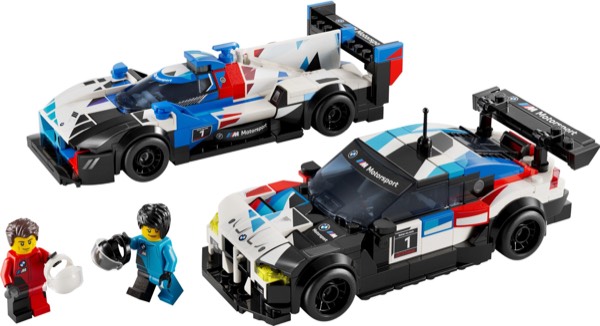
The BMW two-pack is an ambitious set that gives you two fundamentally different race cars - a GT3 endurance racer and an LMDh prototype - in a single box. The M4 GT3 builds first, and it is the stronger of the two experiences. The chassis goes together quickly with a satisfying click-and-layer rhythm, and the bodywork builds up into convincing fender flares and a wide rear wing that immediately communicates GT racing purpose. The proportions feel right throughout - you never hit a stage where the car looks wrong before the next step corrects it. The rear diffuser assembly is particularly well-sequenced, with the flat underside building up to the aggressive splitter in a logical progression that makes structural sense.
The M Hybrid V8 follows with a lower, wider build that reflects the LMDh prototype formula. The cockpit geometry is more complex than the GT3's, with angled windshield elements that create the enclosed prototype canopy effect. The overall build shape is interesting - you are constructing something that sits much closer to the ground with a more streamlined profile, and the contrast with the GT3 you just finished is educational. You begin to understand how different racing regulations produce different car shapes, and LEGO captures that divergence clearly. The M Hybrid has a slightly fiddlier build in places, particularly around the front nose section where several small elements need to align precisely.
Now for the elephant in the room: 71 stickers. LEGO buried this set under an avalanche of decals that interrupts both builds repeatedly. Red and blue sponsor graphics, windscreen details, side panel livery elements, number roundels - nearly every visible surface demands that you peel, align, and place a sticker. For a set aimed at ages 9 and up, the sticker precision required is excessive. Each individual sticker application breaks the building flow, turning what should be a satisfying two-hour session into a stop-start exercise in patience. Compare this to the Mercedes-AMG G63 and SL 63 (#76924), another German two-pack that manages its sticker load more gracefully, and the BMW's approach feels particularly heavy-handed.
Setting the sticker issue aside, the underlying construction of both cars showcases genuine design skill from LEGO's Speed Champions team. The M4 GT3's fender flares use a bracket-and-curve technique where plates mounted at 90 degrees create the wide hip profile that GT3 cars are known for. This is a clean, repeatable approach that MOC builders can adapt for any wide-body vehicle at 8-wide scale. The rear wing mounting uses thin vertical supports with a visible gap between wing and body - aerodynamically correct and visually sharp. The wing angle is adjustable within a small range, a detail that adds interactive play value without compromising the display model.
The M Hybrid V8 contributes a different set of technique lessons. The prototype nose section uses overlapping wedge plates to create a tapering shape that narrows sharply from the wide cockpit area to a pointed front. This layered-wedge approach is the cleanest way to build a prototype race car nose at Speed Champions scale, and it solves the problem elegantly. The cockpit canopy construction is also notable - the windshield sits at a steeper angle than the GT3's, and the surrounding bodywork wraps around it to suggest the enclosed cockpit that LMDh regulations require. For builders interested in endurance prototype MOCs, the M Hybrid provides a solid reference for how to construct an enclosed cockpit that still allows minifigure access.
The contrast between the two cars is itself a technique lesson. Building them back-to-back teaches you how the same basic Speed Champions chassis platform can be adapted to produce radically different silhouettes. The GT3 builds tall and aggressive with pronounced fenders, while the prototype builds low and smooth with integrated bodywork. Understanding that range of adaptation within a single construction system is valuable knowledge for any vehicle MOC builder, and it is the kind of insight you only get from two-pack sets like this one and the Aston Martin Safety Car (#76925).
676 pieces across two cars delivers a strong quantity of usable elements. The color breakdown skews toward blue, red, white, and black - the BMW M Motorsport palette - with enough variety within each color to be genuinely useful for parts-focused builders. The blue and red elements include curved slopes, wedge plates, and tiles that are the essential building blocks of vehicle MOCs. The white elements provide contrast pieces for any build, and the black structural parts are universally applicable. If you part this set out into your bins, you will find the contents spread usefully across multiple color drawers.
The tire and wheel selection is a genuine asset. Both cars use the current-generation Speed Champions wheel molds, giving you four sets of the latest design - enough to build two complete custom vehicles from your parts collection. The windshield elements, particularly the M Hybrid's angled canopy pieces, are less common and fill specialized roles in MOC building. The rear wing elements in both cars are useful for any competition vehicle build, and the diffuser plates can serve as flat panel details on a wide range of projects.
The significant downside to the parts haul is the sticker reliance. Where printed elements retain value and utility across builds, stickered surfaces become single-use parts. The elements that carry stickers in this set are otherwise excellent parts - clean slopes and tiles in BMW's racing colors - but the stickers limit their reuse potential. If you apply every sticker and later disassemble, you have adhesive residue or permanently decorated parts that only work in a BMW context. Printed elements on the Lamborghini V12 Vision GT (#76923) at half the price maintain their value indefinitely. At $44.99, the BMW set should have delivered more prints and fewer decals, especially on the most visible surfaces.
When both cars are finished and every sticker is placed accurately - and accuracy matters here, because misaligned sponsor decals destroy the illusion at display distance - the BMW two-pack creates a strong shelf presence. The M4 GT3 in its blue-and-red M Motorsport livery is the visual star. The aggressive fender flares, tall rear wing, and bold color blocking create a model that demands attention. The proportions are convincing at 8-wide scale, and the car reads unmistakably as a GT3 racer from any angle. Displayed at eye level on a shelf, the M4 GT3 is one of the better-looking GT cars in the Speed Champions range.
The M Hybrid V8 serves as an excellent display companion precisely because it offers visual contrast. Where the GT3 is tall and aggressive, the Hybrid sits lower and smoother, with darker tones and a more streamlined profile. Side by side, the two cars tell a story about BMW's dual motorsport strategy - GT racing and prototype endurance - and that narrative quality adds meaning to the display beyond just two cars sitting next to each other. The color separation between the two builds works in the set's favor. They are clearly related through the BMW M branding but distinct enough that each car maintains its own visual identity. For collectors who appreciate the full breadth of the Speed Champions lineup, having both racing disciplines represented from a single manufacturer is compelling.
The display weakness is the sticker quality under different lighting conditions. Stickers can show edges and reflect light differently than the surrounding brick surfaces, creating a visual inconsistency that printed elements avoid entirely. Under strong direct lighting - the kind used in display cabinets - sticker edges become visible at close viewing distances. This is not a dealbreaker for shelf display, but it is noticeable to anyone who takes the time to examine the cars closely, and it undermines the premium feeling that a $44.99 set should deliver.
676 pieces at $44.99 works out to approximately 6.7 cents per piece, which is competitive for a licensed two-car Speed Champions set. On raw numbers alone, you are getting two complete builds with two minifigures for less than the cost of two individual Speed Champions cars at $29.99 each. That math works in the set's favor, and the build time - roughly two hours for both cars - delivers substantial entertainment value. If you evaluate purely on piece count and build duration, the BMW two-pack is a reasonable purchase.
The value calculation shifts when you factor in the sticker situation. At $44.99, this set is competing against other two-packs like the Mercedes-AMG G63 and SL 63 (#76924), which manages its decoration better. It is also competing against buying two individual Speed Champions sets at $29.99 each, which gives you more total pieces and often more printed elements for only $15 more. The BMW branding carries weight for fans of the marque, but neutral buyers comparing value across the 2024 wave will find stronger options. The sticker count effectively taxes the build experience in a way that deducts from the perceived value of every dollar spent.
For BMW enthusiasts specifically, the value calculation is more favorable. This is the only way to get official LEGO BMW M Motorsport vehicles in the current Speed Champions range, and the M4 GT3 in particular is a car that many BMW fans have been requesting for years. The emotional value of having a specific manufacturer's race cars on your shelf is real, and for those collectors, 71 stickers is a price worth paying. But for the broader Speed Champions audience building a varied collection, this is a wait-for-sale set. At 20-30 percent off, the value equation improves dramatically, and the sticker frustration becomes easier to accept when the financial commitment is lower.
Two driver minifigures are included, each exclusive to this set and designed to match their respective car. The M4 GT3 driver wears a red racing suit with BMW M Motorsport branding, white accents, and sponsor details printed across the torso. The M Hybrid V8 driver wears a blue racing suit with the same M branding in a complementary colorway. Both figures feature printed legs with suit continuation details and racing harness elements, and both include helmets with visor printing. The color coding is smart - you always know which driver belongs to which car, and the red-versus-blue pairing mirrors the M Motorsport brand identity.
The torso printing quality on both figures is strong, with clean lines and crisp sponsor logos that hold up under close inspection. The suits are clearly factory team uniforms rather than generic racing outfits, which adds authenticity to any motorsport display. For minifigure collectors, the pair provides two distinct racing driver variants that fill the BMW slot in a manufacturer-sorted collection. The helmets are standard Speed Champions issue - functional but unremarkable - and alternative hair pieces are included for display without helmets. Both figures seat well in their respective cockpits, with the GT3's more upright seating position being the easier of the two for minifigure placement. The M Hybrid's lower cockpit requires a bit more care to position the driver correctly.
- ✓ Two visually distinct race cars with accurate proportions
- ✓ M4 GT3 rear wing and fender flares look fantastic at display distance
- ✓ Strong color contrast between the two builds on a shelf
- ✓ Exclusive driver minifigures in red and blue M Motorsport suits
- ✓ Solid chassis construction on both models
- ✓ M Hybrid prototype nose is a clean technique reference
- ✗ 71 stickers is excessive and disrupts the build flow repeatedly
- ✗ Too few printed elements for a $44.99 set
- ✗ Sticker precision required will frustrate younger builders
- ✗ Sticker edges visible under display cabinet lighting
Some products may be provided by manufacturers. This page contains affiliate links. All opinions are my own.
- Mercedes-AMG G63 & SL 63 Review - Another German two-car set with a different sticker approach
- Lamborghini V12 Vision GT Review - A GT car with better print-to-sticker ratio
- Aston Martin Safety Car Review - Another race car from the 2024 wave
- Every Speed Champions Set Reviewed - The complete roundup of every SC set we have tested
Track it in your vault on GameSetBrick - our free collection app. Log your condition, price paid, and watch the real-time market value.
Track in Your Vault →Save it to your wishlist on GameSetBrick. Share your list with friends and family - every set has a buy button so gift givers know exactly where to go.
Add to Wishlist → GameSetBrick is a free app by The Earl of Bricks. See all features. Scan it. Track it. Trade it.