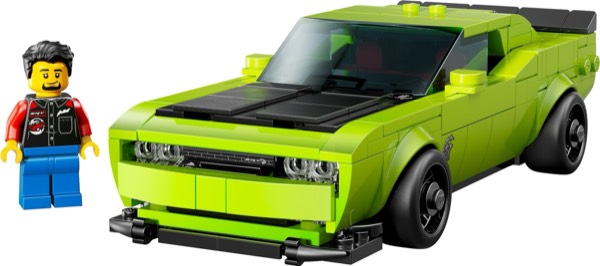
Speed Champions has been dominated by European supercars and F1 machines for years, so snapping together an American muscle car feels genuinely refreshing. The Dodge Challenger SRT Demon build at approximately 390 pieces takes around 40 minutes, and the pacing is distinct from the typical wedge-shaped Speed Champions build. Instead of a low, tapered nose flowing into a narrow cockpit, you're building something broad, blocky, and deliberately aggressive from the first plate up.
The chassis is wide and flat, which gives the Demon its planted, road-hugging stance. The build moves logically from the base plate through the lower body panels, then into the cabin section where LEGO has captured the Challenger's signature long hood and short deck proportions. The hood scoop subassembly is a satisfying moment in the build - it clicks into place and immediately transforms the car from "generic muscle car" to "that's a Demon." The rear end comes together quickly with the tail light detailing and the subtle ducktail spoiler that avoids looking cartoonish at this scale.
What sets this build apart from the European Speed Champions cars is the geometry. There are fewer curves and more deliberate flat surfaces. The Challenger's design language is inherently boxy, and LEGO leans into that rather than fighting it. The result is a build that feels sturdy and confident at every stage.
The boxiness is not a limitation. It is the point. The Challenger SRT Demon is a car that celebrates straight lines, flat surfaces, and unapologetic mass in an automotive world that worships aerodynamic efficiency and lightweight construction. Building it from LEGO bricks, which are themselves rectangular and rigid, creates a natural harmony between the medium and the subject that curved supercars never quite achieve at this scale. The wide body panels go on in satisfying flat sections. The hood is a broad, unbroken plane punctuated by the scoop. The rear quarters are solid slabs of dark red that communicate weight and power. Every step of the build reinforces the car's fundamental design philosophy: more is more. That alignment between the building system and the vehicle's character makes the Demon one of the most satisfying Speed Champions builds in recent memory, not because it is technically complex, but because every piece placed feels like it belongs exactly where it is.
The wide-body fenders are the technique highlight here. LEGO uses bracket-mounted plates on both sides to create the flared wheel arches that define the Demon's aggressive stance. This is a straightforward SNOT application, but it's executed cleanly - the fender flares extend just enough to suggest the real car's widebody kit without creating awkward gaps or visible connection points.
The hood scoop uses a combination of slope bricks and modified plates to create a raised intake that reads correctly from multiple angles. Study how the 1x2 slopes layer to create the tapered scoop shape - this technique translates directly to any custom muscle car or hot rod MOC. The front grille area uses dark tiles recessed behind a frame of plates, which gives the correct shadowed depth that the real Challenger's crosshair grille demands.
Compared to the curved, aerodynamic techniques in the F1 Speed Champions sets, the Demon teaches a different vocabulary: how to make flat surfaces look intentional, how to suggest power through proportion rather than streamlining, and how to capture a car's identity through stance rather than detail density.
The stance engineering is the most transferable technique in this set, and it deserves closer attention. The Demon's visual presence comes primarily from its width relative to its height, and LEGO achieves this through a combination of the bracket-mounted fender flares and a deliberately low ride height created by the wheel well construction. The wheel wells are built just deep enough to accept the tire diameter with minimal clearance, which pushes the body panels closer to the ground and gives the car its aggressive, hunkered-down posture. This relationship between wheel well depth, tire size, and visual ride height is the single most important factor in making any Speed Champions car look correct, and the Demon demonstrates it with textbook clarity. Builders who study how the fender width, wheel well clearance, and overall body height interact in this model will understand why some Speed Champions cars look right and others look slightly off, and that understanding will improve every custom car build they attempt afterward.
390 pieces delivers a strong haul focused on black, dark red, and dark grey elements. The black plates and tiles are always useful, but the real value here is the collection of dark red curved slopes and wedge plates that make up the Demon's distinctive paint scheme. These are versatile parts for any builder working on custom vehicles or display builds that need deep, rich color accents.
The wider rear tires are a welcome inclusion and differ from the standard Speed Champions tire set, making them useful for custom builds that need a staggered tire look. The driver minifigure comes with a printed racing suit and helmet that captures the drag racing aesthetic. The sticker sheet covers the sponsor and Dodge branding elements - removable if you prefer a cleaner look for MOC reuse.
For Speed Champions collectors who also build custom vehicles, the dark red elements in this set are particularly valuable because dark red is one of those colors that LEGO uses sparingly across the broader catalog. Accumulating a working stock of dark red slopes, plates, and wedge elements typically requires purchasing multiple sets from different themes, and the Demon concentrates a useful selection in a single affordable package. The black elements are universally useful and arrive in the sizes most commonly needed for vehicle construction: 1x4 plates, 2x4 plates, 1x2 tiles, and 2x2 tiles. The dark grey structural elements add to the always-needed stock of chassis-building parts. Taken together, the parts haul punches above the 390-piece weight class in practical utility for builders who work in the vehicle space.
This is where the Demon earns its keep. On a shelf full of Ferraris, Porsches, and McLarens, the Challenger stands out immediately - it's wider, more aggressive, and visually heavier. The proportions are excellent for the 8-wide format: the long hood, the set-back cabin, and the muscular rear haunches all read correctly. From across the room, this is unmistakably a Dodge Challenger.
The dark red and black color scheme photographs well and looks particularly good under warm lighting. The hood scoop creates a focal point on the top-down view, and the slightly raised rear with the integrated spoiler gives the profile a forward-leaning aggression. Displayed at desk level, the stance is the star - the wide-body fenders and staggered wheel sizes give the Demon a presence that the narrower European cars simply don't have.
If you're building a diverse Speed Champions collection, this car adds visual variety that the lineup desperately needed. Not every great car is a mid-engine European supercar, and the Demon proves that muscle car design language translates beautifully to brick form.
The Demon also brings something to a Speed Champions shelf that no European car can: attitude. Ferraris are elegant. Porsches are precise. McLarens are technical. The Dodge Challenger SRT Demon is angry. It sits on the shelf like it is daring the car next to it to say something. That personality comes through in the proportions, the color weight, the hood scoop that announces the supercharged engine beneath, and the wide-body stance that says this car does not care about lap times because it was built to win quarter-mile wars. That emotional character makes it a display piece that tells a story, and stories are what make collections interesting. A shelf of identical-looking European exotics is technically impressive but emotionally flat. Add the Demon, and suddenly there is tension, contrast, and narrative. The American outlier among the European thoroughbreds. That contrast alone justifies its place in any collection.
At around 390 pieces, the Demon sits comfortably in the standard Speed Champions price bracket. The value proposition is straightforward: a licensed American muscle car with a quality minifigure, solid parts selection, and excellent display appeal. The piece count is competitive with other single-car Speed Champions releases from 2025.
The real value here is uniqueness. There are dozens of European supercar Speed Champions sets to choose from, but American muscle car representation has been limited. If you want a Dodge Challenger on your Speed Champions shelf, this is the one - and LEGO has done it justice. The build quality and display presence justify the price without hesitation. Paired with the Ford Mustang Dark Horse (#76920) and the NASCAR Camaro ZL1 (#76935), you get the complete American motorsport trifecta on one shelf. For the full Speed Champions picture, see our comprehensive roundup.
Speed Champions sets occupy a unique value position in the LEGO catalog because their primary competition is not other LEGO sets but other small-scale model cars. Against a die-cast model at a similar price, the Demon offers the building experience, the customization potential of individual brick components, and the integration into a broader LEGO display ecosystem. Against other Speed Champions sets at the same price, the Demon offers the rare American muscle car representation, the dark red color palette, and the distinctive display presence that sets it apart from the European supercar majority. In both comparisons, the Demon holds its value proposition firmly, and the 40-minute build time means you are enjoying the set within an hour of opening the box. For a set at this price point, that immediate satisfaction combined with long-term display appeal is exactly the value equation Speed Champions is designed to deliver, and the Demon delivers it with conviction.
A single driver minifigure is included wearing a racing-adjacent casual outfit that fits the Dodge muscle car context. The torso printing features a dark jacket with automotive detailing - no formal race suit here, which is appropriate for a street car that is more at home on a drag strip than a circuit. The casual styling makes this figure versatile for display beyond just the Challenger, working in urban, automotive show, or lifestyle diorama contexts.
The figure includes a hair piece rather than a helmet, reinforcing the street car identity. A wrench accessory suggests the hands-on, DIY culture that surrounds American muscle cars - these are cars that owners work on, not just drive. The figure is exclusive to this set and provides a different character archetype from the uniformed racing drivers in the F1 and GT Speed Champions sets. For American car enthusiasts building a muscle car display alongside the Mustang Dark Horse, having both casual-attire driver figures creates a cohesive crew that feels authentically American.
The Dodge Challenger SRT Demon is for the car enthusiast whose heart beats to the sound of a supercharged V8 rather than a turbocharged flat-six. If your automotive interests lean American, if you appreciate straight-line speed over cornering grip, and if you have ever felt that the Speed Champions lineup was missing something essential by ignoring the muscle car tradition, this set is the correction you have been waiting for. It brings a distinctly American energy to a product line that has been overwhelmingly European, and it does so without compromise or apology.
For the Speed Champions collector, the Demon fills a visual and thematic gap that improves the entire collection. The dark red and black color scheme, the wide-body stance, and the unmistakable Challenger silhouette create contrast against the low, sleek European cars that dominate most Speed Champions shelves. For the younger builder who is learning about automotive diversity, the Demon introduces a completely different design philosophy from the mid-engine supercars that Speed Champions typically features. And for the adult builder who remembers the era when American muscle cars ruled the roads and the drag strips, the Demon is a brick-built tribute to that heritage that sits proudly on any desk, shelf, or display cabinet. LEGO got this one right, and the Speed Champions lineup is better for it.
- ✓ American muscle car brings welcome variety to Speed Champions
- ✓ Wide-body stance is perfectly captured at 8-wide
- ✓ Hood scoop detail is a build highlight
- ✓ Dark red and black color scheme looks premium on shelf
- ✓ Staggered tire sizes add authenticity
- ✗ Sticker reliance for grille and body graphics
- ✗ Rear end could use slightly more tail light detail
- ✗ No drag strip or starting line accessory
Some products may be provided by manufacturers. This page contains affiliate links. All opinions are my own.
- Every Speed Champions Set Reviewed - The complete roundup of every SC set we have tested
- Ford Mustang Dark Horse Review - American muscle showdown in Speed Champions
- Bugatti Centodieci Review - European supercar excellence at the same scale
Track it in your vault on GameSetBrick - our free collection app. Log your condition, price paid, and watch the real-time market value.
Track in Your Vault →Save it to your wishlist on GameSetBrick. Share your list with friends and family - every set has a buy button so gift givers know exactly where to go.
Add to Wishlist → GameSetBrick is a free app by The Earl of Bricks. See all features. Scan it. Track it. Trade it.