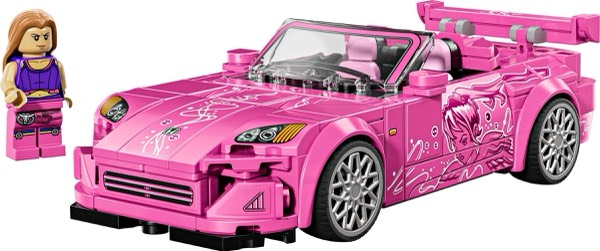
The Honda S2000 is a breath of fresh air in the Speed Champions lineup. After years of hypercars and F1 machines, building a lightweight Japanese roadster feels genuinely different. At approximately 300 pieces, the build takes around 40 minutes and delivers a construction experience that prioritizes curves over aggression and elegance over raw visual impact. There is a subtlety to this build that you do not often find in Speed Champions - a restraint that mirrors the car itself.
The chassis is lower and more compact than the typical Speed Champions supercar, reflecting the S2000's real-world proportions as a small, driver-focused sports car. The build starts with the flat floor pan and quickly moves into the distinctive body lines. The front end captures the S2000's subtle nose with its integrated headlight housings, and the fender lines sweep backward with a grace that most Speed Champions builds do not attempt. The open-top cockpit section is the centerpiece of the build, with the windshield frame and roll bar defining the S2000's convertible silhouette. Building the cockpit feels different from building a closed-roof car - there is an openness to the construction that lets you see the interior take shape in a way that roofed vehicles hide.
The rear end comes together with the signature round tail lights and the clean trunk line that made the S2000 one of the most elegant sports cars of its era. The build feels cohesive throughout. Every section contributes to a shape that is unmistakably an S2000, and the pacing never stalls on repetitive steps. For a 40-minute build, the S2000 delivers a surprising amount of satisfaction - largely because every piece contributes to a recognizable shape rather than filling space. There is no filler here. Every element earns its place, which is exactly what you want from a car that was famous for doing more with less.
The S2000 presents LEGO with a different challenge than the usual Speed Champions subject. Instead of angular supercar wedges or aerodynamic F1 shapes, the S2000 is all about smooth, flowing curves on a compact body. The fender technique is the highlight here. LEGO uses curved slope elements mounted on brackets to create the rounded wheel arches that define the S2000's profile. The transition from fender to door to rear quarter is handled with careful plate and slope sequencing that produces a surprisingly smooth body line at 8-wide scale. If you study this technique closely, you will see how the designers used element thickness to create subtle surface changes that suggest the gentle curves of the real bodywork.
The open cockpit is well engineered. The windshield frame uses a combination of bar elements and small plates to create the thin A-pillar look, and the roll bar behind the seats is a neat subassembly that adds structural rigidity to the model while capturing the AP1 generation's signature hoop. The front bumper and headlight area uses recessed tile elements to suggest the S2000's flush headlight design, which is a subtle but effective detail that distinguishes the front end from other Speed Champions builds that tend to use protruding headlight elements.
For MOC builders, the techniques here translate directly to any compact sports car or roadster project. The S2000 teaches you how to suggest curves and elegance at a scale where most builds default to angular aggression. The open cockpit construction is particularly valuable - building a convertible that looks right with the top down requires different structural approaches than a closed car, and the S2000 handles this challenge with solutions you can adapt for any open-top vehicle. This is the kind of set where the technique lessons are more valuable than the parts themselves.
Approximately 300 pieces with a color palette centered on silver and light bluish gray elements, accented with dark blue and black. The silver and gray elements are versatile and useful for any builder working on vehicles, architecture, or mechanical MOCs. The curved slope elements in silver are particularly valuable, as these pieces see less circulation than their more common color variants. Silver curved slopes are the kind of elements you always need one more of, and the S2000 contributes several to your inventory.
The driver minifigure comes with a casual racing outfit rather than a full fire suit, which fits the S2000's road car character. The wheels are road car specification rather than racing slicks, adding to the everyday sports car authenticity. The sticker sheet is minimal, covering Honda badges and a few accent details - a welcome restraint that keeps the build clean and reduces the frustration factor that heavier sticker sheets introduce.
At the Speed Champions price point, the parts-per-dollar ratio is standard for the category. What elevates the S2000's parts value is the specificity of the silver elements - if you build a lot of vehicles, silver is a color you chronically lack, and the S2000 provides a useful injection of curved and flat elements in that shade. The Honda-specific printed elements are collector pieces rather than general-purpose parts, but the structural elements are immediately useful across a wide range of projects.
The Honda S2000 is one of the most attractive Speed Champions models in recent memory. The low, clean profile with the open cockpit creates a silhouette that is immediately recognizable to any car enthusiast. The silver color scheme catches light beautifully and gives the model a premium, sophisticated appearance that stands apart from the bold primary colors typical of Speed Champions. Where a Ferrari or McLaren Speed Champions screams for attention, the S2000 earns it quietly through proportional accuracy and elegant restraint.
On a shelf, the S2000 brings a completely different energy than the supercars and race cars around it. It is smaller, quieter, and more refined, which makes it a perfect complement to the louder models in a collection. The open cockpit invites closer inspection and adds visual interest from above, where most Speed Champions present a solid roof. The convertible profile also means the S2000 casts different shadows and interacts with light differently than closed cars, giving it a distinctive display presence that varies with viewing angle.
For JDM enthusiasts, this is a grail piece. The S2000 is one of Honda's most beloved designs, and LEGO has captured its essence with the right proportions, the right stance, and the right attitude. Displayed at desk level, the convertible profile and smooth fender lines make this one of the most photogenic Speed Champions ever released. The silver catches natural light in a way that brings the model to life, and the lack of aggressive aero elements gives the S2000 a timeless quality that will age better on the shelf than more era-specific race cars. This is a car you will still want on display years from now.
At the standard Speed Champions price point with approximately 300 pieces, the S2000 delivers excellent value for what it represents. This is a car that has never been done in official LEGO form before, and the execution justifies the purchase for Honda fans and JDM enthusiasts without hesitation. The novelty factor alone - a proper JDM roadster in the Speed Champions lineup - makes this a noteworthy release that expands the category's identity.
Beyond the sentimental value, the build quality and display appeal are genuinely strong. The S2000 earns its place on the shelf through design excellence rather than brute visual impact. For builders who appreciate automotive elegance over horsepower bragging rights, this is one of the most satisfying Speed Champions purchases you can make.
The S2000 pairs beautifully with the Ford Mustang Dark Horse (#76920) for a Japan-vs-America display, or alongside the DeLorean Time Machine (#77256) for a movie car pairing since both the S2000 and DeLorean have appeared in iconic films. For the full Speed Champions picture, see our complete roundup. Within the 2025 Speed Champions range, the S2000 represents one of the best individual purchases available - a set that satisfies on build experience, display quality, and cultural significance simultaneously.
The Honda S2000 is for the car enthusiast who knows that speed is not everything. If you are the type who appreciates a perfectly balanced chassis over raw horsepower, who values driver engagement over straight-line acceleration, who understands why the S2000's 9,000 RPM redline made it one of the most thrilling naturally aspirated engines ever put in a road car - this set was made for you. It appeals to the enthusiast's enthusiast, the builder who wants their Speed Champions collection to represent the full spectrum of automotive culture rather than just the fastest and most expensive cars on the planet.
JDM culture devotees will find this essential. The S2000 is a cornerstone of Japanese car culture, immortalized in The Fast and the Furious and on every "greatest roadsters ever built" list that matters. Its inclusion in Speed Champions validates JDM alongside the European exotics and American muscle that have dominated the lineup. If you drive a Miata, browse r/JDM, or have strong opinions about the relative merits of VTEC, the S2000 belongs in your collection.
For parents buying gifts, the S2000 is an excellent choice for teens and adults who care about cars but are not necessarily into Formula 1 or supercars. The casual driver minifigure, the road car wheels, and the everyday sports car aesthetic make this more approachable and relatable than a hypercar that costs more than a house. It is a car that feels possible, which gives it a charm that exotic Speed Champions sometimes lack. And at 40 minutes of build time, it is perfect for a single-sitting weekend project.
The Honda S2000's arrival in the Speed Champions lineup marks a significant shift in how LEGO approaches car culture. For years, Speed Champions has focused on aspirational vehicles - Ferraris, Lamborghinis, Porsches, and Formula 1 cars that most people will never drive. The inclusion of the S2000 acknowledges that car culture is broader and deeper than the supercar showroom. There is an entire world of enthusiasts who worship at the altar of lightweight, driver-focused machines, and the S2000 is their patron saint.
The S2000 joins a slowly growing JDM contingent in the LEGO universe. The set demonstrates that LEGO's designers understand what makes JDM cars special - it is not about extravagance or raw power. It is about precision, balance, and the pursuit of a perfect driving experience within reasonable parameters. The S2000's build reflects this philosophy: no excess, no unnecessary complexity, just clean execution of a clear design vision. Every piece serves the shape, and the shape serves the car's character.
For the future of Speed Champions, the S2000 sets a precedent that enthusiast community cars deserve the same design attention as seven-figure supercars. If LEGO follows this thread - and the overwhelming positive response to JDM entries suggests they will - we could see a golden age of Speed Champions releases that represent the full diversity of global car culture. The S2000 did not just earn its place in the lineup. It expanded the definition of what Speed Champions can be.
A single driver minifigure is included wearing a casual racing-adjacent outfit appropriate to the S2000's street car and tuner culture context. The torso printing features a jacket-over-shirt design that reflects the JDM car culture aesthetic rather than formal racing attire. This casual approach is the correct design choice - the S2000 is a car driven by enthusiasts on canyon roads and at track days, not by professional racing drivers in fire suits. The casual styling makes this figure versatile for display in urban, car meet, or automotive lifestyle diorama contexts.
The figure includes a hair piece rather than a helmet, consistent with the street driving context. A wrench or tool accessory is included, nodding to the hands-on modification culture that surrounds the S2000 in the real world. The figure is exclusive to this set and fills the JDM enthusiast character slot in the Speed Champions minifigure lineup - a different character archetype from the suited F1 drivers, the casual American muscle car owners, and the glamorous European supercar pilots. For minifigure collectors who value character diversity, the S2000 driver adds a distinctly Japanese car culture personality that no other Speed Champions figure provides.
- ✓ Finally, a JDM legend in Speed Champions form
- ✓ Curved fender technique captures the S2000's flowing lines
- ✓ Open cockpit adds visual interest and display variety
- ✓ Silver color scheme looks premium and photographs beautifully
- ✓ Compact proportions are accurate to the real car
- ✓ Minimal sticker reliance for the main body
- ✗ May look small next to supercar Speed Champions on the shelf
- ✗ Roll bar is slightly oversized relative to the real car
- ✗ No hardtop option included for alternate display
Some products may be provided by manufacturers. This page contains affiliate links. All opinions are my own.
- Every Speed Champions Set Reviewed - The complete roundup of every SC set we have tested
- Ford Mustang Dark Horse Review - Another sports car legend in Speed Champions form
- Dodge Challenger Review - Classic American muscle at the same scale
Track it in your vault on GameSetBrick - our free collection app. Log your condition, price paid, and watch the real-time market value.
Track in Your Vault →Save it to your wishlist on GameSetBrick. Share your list with friends and family - every set has a buy button so gift givers know exactly where to go.
Add to Wishlist → GameSetBrick is a free app by The Earl of Bricks. See all features. Scan it. Track it. Trade it.