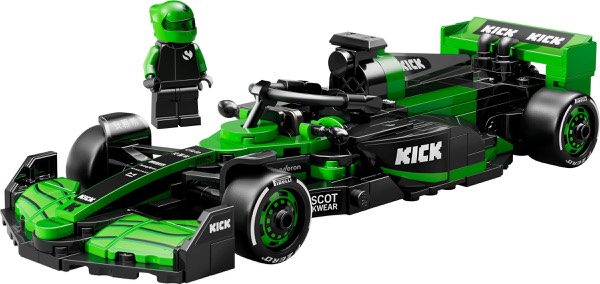
The Sauber C44 arrives at an interesting moment in F1 history. This is the last car to carry the Sauber name before the team's full transition to Audi, making it a transitional machine in both the real world and the LEGO catalog. The build itself runs the standard Speed Champions 30-40 minute course at approximately 259 pieces, taking you through chassis, cockpit, bodywork, and aero in a sequence that has become second nature for repeat Speed Champions builders.
The green and white livery creates a clean, modern aesthetic as the bodywork comes together. The Stake F1 Team's color scheme translates well to the 8-wide format, with the green elements forming the primary body color and the white sections providing contrast that defines the panel lines and aero surfaces. The nose section has a distinctive profile that the LEGO designers have captured with an effective combination of wedge plates and curved slopes. The build is straightforward and satisfying, delivering a complete F1 car without unnecessary complexity or frustrating steps.
There is an emotional undertone to building this car that distinguishes it from other Speed Champions F1 entries. As you place each green element, you are constructing the final chapter of a story that started in 1993 when Peter Sauber first brought his team to the F1 grid. That kind of narrative weight is unusual for a 259-piece set, but it is there for anyone who knows the history. The build itself does not acknowledge this directly - it is simply a well-executed Speed Champions F1 car - but the knowledge that you are building the last Sauber adds a layer of meaning that elevates an otherwise standard construction experience. For newer builders unfamiliar with the team's history, it remains a sharp-looking car in an attractive color scheme that builds cleanly and quickly.
The Sauber C44 relies on clean execution rather than novel techniques. The green and white color blocking is the primary design challenge, and LEGO's approach uses precise element selection to maintain clear livery boundaries without relying on stickers for the core color transitions. The result is a model where the livery is structurally integrated rather than surface-applied, which gives it a more solid, permanent feel than sticker-heavy alternatives.
The sidepod construction shows some variation from other 2024-era Speed Champions F1 cars, reflecting the Sauber's specific aerodynamic choices. The air inlet shape and the sidepod profile use slightly different slope element combinations than the Aston Martin AMR24 (#77245) or the VCARB 01 (#77246), demonstrating how small changes in element selection create meaningfully different silhouettes at this scale. The printed elements handle the Stake sponsorship graphics and team branding with the clarity that Speed Champions fans expect. The helmet print captures the driver's identity cleanly.
For builders who collect multiple Speed Champions F1 sets, the C44 offers a valuable comparative study. Placing the build sequence of this car alongside the Ferrari or Red Bull builds reveals how LEGO's designers solve the same fundamental problem - representing a modern F1 car at 8-wide scale - with different element choices dictated by each team's unique livery and aerodynamic package. The green bodywork uses slope elements of different depths compared to the darker-liveried cars, because green requires more careful surface management to read correctly at this scale. The white accent panels are positioned to break up the green in ways that mirror the real car's graphic design, which is a lesson in how livery influences structural decisions even in a simplified format. It is not groundbreaking technique, but it is refined and educational technique.
Approximately 259 pieces with green and white as the dominant colors. The green elements are the primary draw for parts utility, as green slopes and wedge plates have applications in nature scenes, military builds, and any number of vehicle MOCs. The white elements are universally useful. The combination of the two colors in the quantities provided makes a practical addition to most builders' inventories.
The printed elements carry the Stake F1 Team branding and are set-specific collector pieces. The standard Speed Champions base plate, wheels, tires, and driver minifigure are all present and consistent with the rest of the range. The parts count is typical for a single-car Speed Champions set, and the spread delivers exactly what the format requires. No excess, no shortage. The green elements are the standout for builders looking to expand their color options.
The green element selection deserves a closer look because green is genuinely one of the harder colors to accumulate in bulk through normal LEGO purchasing. Outside of seasonal sets and the occasional Creator build, large green slopes and wedge plates do not appear with the frequency of red, black, or white equivalents. The C44 provides a concentrated dose of these elements in shapes that are directly useful for vehicle customization, landscape work, and architectural accents. If you are the kind of builder who maintains sorted color bins, the green haul from this set will fill a noticeable gap. The white elements are less exciting individually but always welcome in quantity, and the dark structural pieces that form the chassis and floor are the universal building blocks that every project needs.
The Sauber C44's green and white livery reads as fresh and modern on the shelf. The color scheme has a clarity that translates well to the 8-wide scale, with the green providing visual weight and the white panels creating definition that helps the eye track the car's aerodynamic surfaces. In a grid display alongside darker cars like the VCARB 01 (#77246), the Sauber provides a welcome brightness that balances the overall color palette.
The historical significance of this model adds intangible display value. This is the last Sauber. The name that has been part of Formula 1 since 1993 transitions to Audi after this car, making the C44 a bookmark in F1 history. For collectors who understand that context, having this specific car on the shelf carries meaning beyond its physical appearance. The model itself is well proportioned and accurately detailed, with the Stake livery graphics adding the sponsor authenticity that grounds it as a representation of a specific car from a specific season. It is a solid grid member with a story behind it.
Display context matters enormously for this set. Positioned next to the Audi F1 R26 (#77259), the C44 creates one of the most compelling two-car stories in the entire Speed Champions catalog. The green Sauber and the silver Audi represent the same team separated by a name change and a complete visual identity overhaul. That before-and-after narrative is immediately readable to anyone who understands F1, and it adds a storytelling dimension to your shelf that purely aesthetic displays cannot match. Even without the Audi alongside it, the C44 holds its own through color contrast - in a lineup of predominantly red, blue, and orange cars, the green and white Sauber provides a visual breathing point that makes the entire grid look better balanced. The proportions are clean, the stance is correct, and the livery reads accurately at arm's length.
Standard Speed Champions value at the standard Speed Champions price. The C44 does not attempt to exceed the boundaries of the format, and it does not need to. A licensed F1 car with printed elements and a driver minifigure at this price point is a proposition that works every time. The historical angle of the last Sauber adds collector interest that may appreciate over time, particularly once the Audi transition is complete and this car becomes the final chapter of a long story.
For grid completists, the C44 is a required purchase. For selective buyers, the decision depends on team loyalty and the appeal of the green and white color scheme. Compared to the Audi F1 R26 (#77259) that represents the team's future, the C44 represents its past. Both have a place on the shelf. At the Speed Champions price point, there is room for both past and future on any collector's grid. Displaying them side by side - the last Sauber and the first Audi - creates a visual handoff that tells a story spanning decades of F1 history. For the full context of where the C44 sits among every LEGO F1 set, see our definitive ranking guide.
The collector value proposition for this set is stronger than its raw build metrics might suggest. Speed Champions sets that represent final editions - last cars before a team rebrand, final liveries before a regulation change - have historically held their value better than mid-cycle releases. The C44 as the last-ever Sauber F1 car in LEGO form is the kind of historical marker that collectors seek out years after retirement. Whether that secondary market appreciation matters to you depends on whether you are building a collection or building for parts, but it is worth noting that the C44 carries a significance that most 259-piece sets simply do not. At the current price point, you are paying for a solid Speed Champions build and potentially gaining a collector piece that marks the end of an era.
The set includes a single KICK Sauber F1 Team driver minifigure wearing the team's green racing suit with white accent details. The torso printing features the Stake F1 Team branding, sponsor logos, and the green-to-white color blocking that defined the team's 2024 livery. The leg printing continues with sponsor graphics and the green suit design. The overall color scheme is lighter and more vibrant than the Aston Martin AMR24 driver, making the two green-suited figures clearly distinguishable in a grid lineup.
The driver's helmet features a printed design in the Sauber green color scheme with white and accent graphics. The 2025 Speed Champions helmet mold gives it a modern profile. An alternate hair piece is included for helmetless display. This figure is exclusive to the C44 set, and its significance extends beyond the plastic. As the last driver figure to carry Sauber branding in any LEGO set, it represents the end of an era. Once this set retires and Audi takes over completely, the Sauber-branded minifigure becomes a piece of LEGO F1 history that can only be sourced on the secondary market. For collectors who value that kind of historical bookmarking, the minifigure alone justifies the purchase.
The Sauber C44 speaks most directly to two audiences: F1 historians and grid completists. If you follow Formula 1 closely enough to understand what the Sauber name means to the sport - over three decades of independent racing, driver development, and competitive survival against manufacturers with far deeper pockets - this set carries emotional weight that transcends its piece count. It is a farewell in brick form, and for fans of the team, owning the last Sauber F1 car in any format is a quiet act of respect for a story well told.
Grid completists will need this set regardless of team allegiance. A 2024 F1 grid display without the Sauber has a visible gap, and the green and white livery fills a color niche that no other car in the range covers. The set is also well suited to newer Speed Champions builders looking for a reliable, frustration-free F1 build that delivers a clean result in under an hour. The green parts are a genuine bonus for anyone maintaining a diverse color library.
If you are choosing just one or two F1 Speed Champions sets from the 2024 wave, the C44 might not be your first pick unless you have a personal connection to the team. The Ferrari and Red Bull carry more mainstream recognition. But if you are building a comprehensive collection, the C44 is the one you will be glad you bought five years from now, when the Sauber name is a memory and this little green car is the only way to bring it back.
- ✓ Clean green and white livery translates well to 8-wide scale
- ✓ Historical significance as the last Sauber F1 car
- ✓ Printed elements avoid sticker reliance for core graphics
- ✓ Green parts add a useful color to builder inventories
- ✓ Accurate proportions and aerodynamic detailing
- ✗ No standout technique innovations over other Speed Champions F1 sets
- ✗ Green and white livery may lack visual drama compared to bolder schemes
- ✗ Single driver minifigure with minimal accessories
Some products may be provided by manufacturers. This page contains affiliate links. All opinions are my own.
- Best LEGO F1 Sets Ranked - Where every F1 set stacks up in our definitive ranking
- Every Speed Champions Set Reviewed - The complete roundup of every SC set we have tested
- Audi F1 R26 Review - The next chapter for this team as Audi enters F1
Track it in your vault on GameSetBrick - our free collection app. Log your condition, price paid, and watch the real-time market value.
Track in Your Vault →Save it to your wishlist on GameSetBrick. Share your list with friends and family - every set has a buy button so gift givers know exactly where to go.
Add to Wishlist → GameSetBrick is a free app by The Earl of Bricks. See all features. Scan it. Track it. Trade it.