Is the Lumibricks Izakaya Worth Buying?
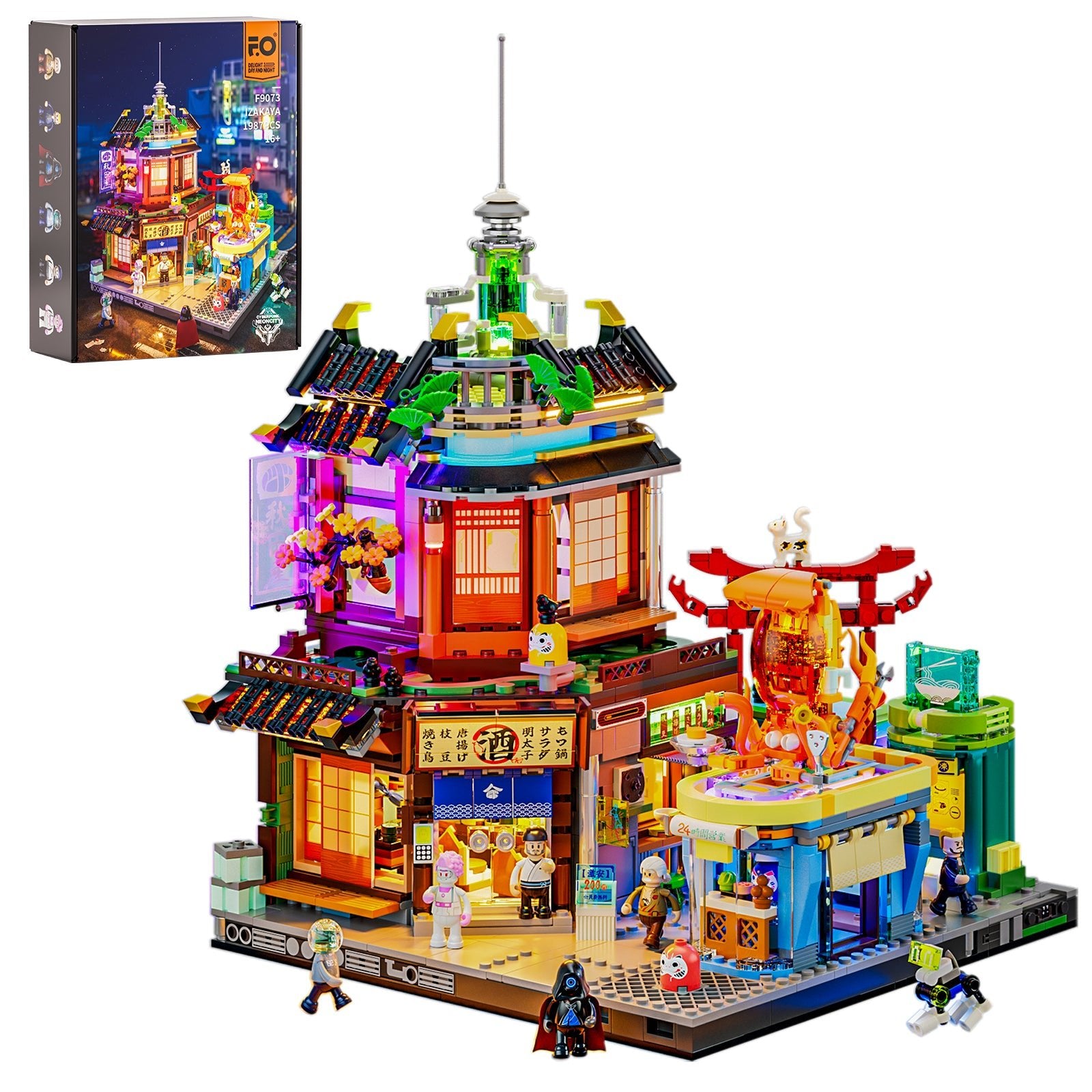
8.7/10. Worth buying. 1,987 pieces of glowing lanterns, neon kanji, and late-night ramen - a back-alley Japanese tavern that never closes.

The Izakaya breaks Lumibricks' pattern in ways that matter to serious builders. This isn't another neon storefront with light-up elements bolted onto standard architecture. The set commits to an underground aesthetic, cramped, layered, deliberately cluttered, where the lighting doesn't rescue poor design but becomes inseparable from the structure itself. After 25 years of building, I've seen countless light kits feel grafted on. This one was designed around the glow first, which changes how the geometry works and what you actually enjoy looking at after the novelty fades.
What caught me was the unapologetic commitment to a specific mood over traditional display balance. The Izakaya doesn't want to be the centerpiece of your shelf. It wants to be discovered in low light, nestled in a cramped corner of your city, the kind of set you keep coming back to because the details reveal themselves differently depending on viewing angle and time of day. That's a design philosophy, not just a product feature. It shapes every decision from part selection to build sequence.
The Izakaya is a deeply satisfying 5-6 hour build that pulls you straight into a rain-slicked Tokyo side street. Lumibricks breaks the construction into three distinct phases - the ground-floor tavern interior with its bar counter and kitchen, the narrow multi-story facade with its layered signage and balcony details, and the rooftop mechanical clutter that sells the urban density. The pacing is excellent: you spend the first couple of hours on the tavern interior, carefully placing tiny sake bottles behind the bar, building out the kitchen grill station, and assembling the noren curtain entrance. Then the build shifts outward to the facade, where neon sign brackets and LED channel bricks start threading through the walls.
This is where the set really comes alive - watching the exterior take shape with its stacked signage, exposed pipes, and air conditioning units feels like assembling a miniature film set. The LED wiring integrates seamlessly into the wall construction, running through purpose-built channels so you never feel like you are fighting cables. Every floor has its own personality: the bustling kitchen with its grill hood and utensil racks, the narrow stairway connecting the levels, the balcony with its drying laundry and potted plants. You are not just building a structure. You are building a story, one layer at a time.
Clutch quality is solid throughout, and the instruction manual handles the complexity well with clear color separation between steps. The numbered bag system keeps things manageable despite the nearly 2,000 pieces, and I never found myself hunting for a specific element in a sea of similar colors. The only moments that demand real patience are the LED cable routing steps through the narrow walls, where you need to follow the manual precisely to avoid pinching wires between plates. Take your time there and the rest of the build flows like a conversation with an old friend.
The Izakaya teaches you a few tricks worth remembering. The facade layering technique - where multiple planes of signage, awnings, and structural detail stack at slightly different depths - creates a sense of visual density that flat-wall builds simply cannot achieve. Lumibricks uses offset plate mounting to angle neon signs at realistic tilts, and the rooftop section employs SNOT (studs not on top) construction to create convincing mechanical equipment and water tanks from minimal parts. If you have ever looked at a real Tokyo alley and wondered how to capture that feeling of organized chaos in brick form, the Izakaya gives you a working template.
The LED routing is the real education here: thin fiber-optic style cables run through dedicated channel bricks embedded in the walls, splitting to feed multiple neon signs on the exterior and the warm interior glow separately. If you have ever wanted to learn how to wire lighting into a MOC without visible cable runs, this set is a practical masterclass. The interior bar construction uses some clever half-stud offset techniques to create a curved counter that feels organic rather than blocky. The kitchen hood assembly uses bracket connections at unusual angles to create a sloped canopy over the grill, which is a technique I have already adapted for other urban-themed MOC interiors.
Where it falls slightly short is in the structural engineering - the narrow, tall form factor means the building technique is mostly stacking rather than complex interlocking, and experienced builders may find the core structure straightforward despite the decorative complexity. The real technique value here is in the detailing, not the engineering. But for anyone interested in how to pack visual information into a small footprint, the Izakaya is one of the most instructive sets in the Lumibricks catalog.
At 1,987 pieces, the Izakaya delivers a generous piece-per-dollar ratio - and the parts themselves lean heavily toward the useful and interesting. The LED package is the headline: multiple color modules including pink, electric blue, warm white, and amber for different neon signs and the interior ambiance, plus the USB power brick and wiring harnesses. Beyond the lights, the color palette is a cyberpunk builder's dream. You get a serious haul of trans-pink, trans-blue, and trans-purple elements for neon effects, alongside dark grey, black, and dark tan for the urban architecture.
The printed tile elements - kanji signage, menu boards, and decorative panels - are specific to this set and add enormous character. These are the kind of pieces that can anchor an entire MOC. Drop one of those kanji tiles into any urban diorama and it immediately establishes a Japanese context that would take a dozen generic elements to approximate. Small detail parts like miniature bottles, plates, bowls, and kitchen equipment are plentiful and perfect for any Japanese-themed MOC or diorama. The rooftop mechanical parts (small turbines, pipes, antenna elements) transfer well to any urban or industrial build.
Compatible with LEGO and other major-brand bricks, so everything slots right into your existing collection. The trans-color elements alone justify serious interest from MOC builders working in cyberpunk, neon noir, or urban nightscape themes. The only limitation is that the printed tiles are so aesthetically specific that they work best in Japanese contexts - but within that niche, they are irreplaceable. If you build a lot of city scenes, the Izakaya's parts inventory will pay dividends across multiple future projects.
This is the set's knockout punch. With the LEDs off, the Izakaya is already an impressive display piece - the layered facade, the dangling lantern elements, the cluttered rooftop, and the detailed interior visible through the open back all tell a story of a lived-in, late-night corner of a city that never sleeps. The details reward close inspection: the sake bottles behind the bar catching light through the window, the laundry drying on the upper balcony, the tangle of pipes and vents on the roof. Every surface has something to discover.
But turn the lights on and it becomes something else entirely. The neon signs glow in hot pink and electric blue against the dark facade, the interior casts a warm amber haze through the entrance curtain and windows, and the whole piece suddenly looks like a frame pulled from a Blade Runner side street. At 11.1" × 10.3" × 15.2", the vertical form factor gives it serious shelf presence without eating up horizontal space - it is a tower of atmosphere. The 4.9/5 rating from 179 buyers on the Lumibricks site is well earned.
This is the kind of display piece that makes people stop and stare, especially in a dimly lit room. On a bookshelf, on a desk, on a nightstand - plug it in after dark and it transforms whatever space it sits in. If you are building a cyberpunk or Japanese street diorama, this is the centerpiece you start with. I have it on a floating shelf in my office, and it is the single most-commented-on piece in my entire collection. The vertical format also makes it one of the most shelf-friendly Lumibricks sets - it takes up the footprint of a paperback book but commands the visual presence of a full modular.
the retail price for nearly 2,000 pieces with full integrated LED lighting is competitive, though not quite the bargain-bin steal that some Lumibricks sets deliver. The value proposition here is really about what you are getting beyond the raw brick count: a complete lighting system with multiple color zones, printed decorative tiles you cannot get anywhere else, and a display piece that genuinely rivals sets at twice the price when lit. A comparable LEGO modular building in this piece range would is retail-priced-180 and include zero lighting - add a the retail price-50 aftermarket LED kit and you are well past the retail price for a similar end result.
The Izakaya also packs more visual density per square inch than most modulars, thanks to the narrow vertical design and the sheer amount of surface detail. Every face of this building tells a story, which means you are getting display value from all four sides plus the roof and interior. That is an unusual amount of surface interest for a single set. When you factor in the entertainment value of the build itself - 5-6 hours of engaging, varied construction - the cost per hour of enjoyment is excellent.
Where it loses a fraction of a point is the niche appeal - this is a deeply specific aesthetic, and if cyberpunk Japanese street culture is not your thing, the premium over simpler Lumibricks sets may not feel justified. But for its target audience, the price-to-atmosphere ratio is outstanding. If this set even mildly interests you, it will exceed your expectations. The Izakaya is not competing with other brick sets. It is competing with art prints and neon signs and desk lamps - and it wins.
The Izakaya speaks loudest to builders who appreciate atmosphere over raw size. If you are the type who watches lo-fi study streams with animated Tokyo rain backgrounds, if you have a Blade Runner poster on your wall, if you have ever wandered a Japanese city at night and wanted to bottle that feeling - this set was designed with you in mind. It is also an excellent choice for display-focused collectors who want a set that genuinely transforms a room when lit. The vertical footprint makes it ideal for apartment dwellers and anyone working with limited shelf space who still wants a showstopper piece.
For MOC builders, the Izakaya is a goldmine if you work in urban, cyberpunk, or Japanese themes. The trans-color elements, the printed tiles, and the LED components all have direct applications beyond this specific set. And if you are new to Lumibricks and want a single set that demonstrates everything the brand does well - integrated lighting, printed details, atmospheric design, strong build pacing - the Izakaya is the best introduction under the retail price. It is not the biggest set in the catalog, but it might be the most complete expression of what Lumibricks is trying to achieve.
Parents buying for older teens with an interest in anime, Japanese culture, or sci-fi will also find this set lands perfectly. The build is engaging enough to hold attention for a full afternoon, the result is impressive enough to display proudly, and the LED feature adds a "wow factor" that pure brick sets cannot match. This is a gift that earns its place on the shelf for years.
The Izakaya sits within Lumibricks' Cyberpunk Neoncity collection, which is arguably the most visually cohesive product line in the alternative brick market. While LEGO has dabbled in neon aesthetics with Ninjago and a few Creator sets, no one else has committed to the cyberpunk genre with this kind of depth and consistency. The Neoncity line treats neon as a design language, not a novelty - and the Izakaya is the most refined expression of that language available today.
What makes the Izakaya stand out even within its own product line is the focus on a single, intimate space rather than a broad streetscape. You are not building a city block. You are building one corner of one alley - and that focus allows for a density of detail that wider sets cannot match. Every element has been considered in the context of that specific atmosphere: the warm glow through the noren curtain, the cold blue neon against dark brick, the mechanical clutter of real urban infrastructure. It is not trying to represent cyberpunk as a genre. It is trying to capture a specific moment in a specific place, and it succeeds.
If you already own other Cyberpunk Neoncity sets, the Izakaya slots in beautifully as a street-level anchor. Its narrow footprint means it can sit alongside other buildings without overwhelming a diorama. If the Izakaya is your first Neoncity purchase, be warned: it will almost certainly not be your last. The aesthetic is that compelling, and the build quality sets a standard that makes you want to see what else the line has to offer.
- ✓ Multi-zone LED lighting with pink, blue, amber, and warm white creates jaw-dropping neon atmosphere
- ✓ Layered facade technique delivers incredible visual depth and urban density
- ✓ 1,987 pieces At retail price with full LED kit is strong value vs. LEGO + aftermarket lights
- ✓ Trans-color parts haul (pink, blue, purple) is a goldmine for cyberpunk MOC builders
- ✓ Printed kanji tiles and Japanese decor elements are unique and full of character
- ✓ Tall vertical form factor commands shelf presence without hogging horizontal space
- ✓ USB powered with clean internal cable routing - no battery swaps, no visible wires
- ✓ 4.9/5 from 179 reviews on Lumibricks - buyers love this one
- ✗ Narrow vertical build means the core structure is mostly stacking rather than complex interlocking
- ✗ Niche cyberpunk Japanese aesthetic may not appeal to all collectors
- ✗ LED cable management through narrow walls requires patience and careful attention to instructions
- ✗ Some printed tiles are so specific they have limited reuse outside Japanese-themed builds
- Lumibricks Overview - Everything about the Lumibricks brand
- Lumibricks vs LEGO Modulars - How Lumibricks compares to official modulars
- Gelato Store Review - Another food-themed Lumibricks treat
The internal layout is where builders will either love or resent this set. Lumibricks packed the functional depth, kitchen counter, prep areas, seating nooks, in ways that create genuine visual separation without walls. The transparent dark-tan and black slope pieces used for the overhang create sightline breaks that trick the eye into perceiving more space than actually exists. That's intermediate architecture thinking, and it's not explained in the manual. You build it, step back, and realize the proportions work because the designer understood layering, not just footprint.
The kanji panels warrant specific mention because they're not waterslide decals over printed bricks. Lumibricks commissioned actual custom-molded pieces with the characters sunk into the studs. Replacement cost is steep if you lose one, but the tactile authenticity changes how the facade reads under side-lighting. This is the kind of detail that separates sets built for Instagram from sets built for people who spend actual hours staring at them in their own spaces.