LEGO Art is the theme that confuses people. When you tell a non-builder that you spent an evening assembling a LEGO set, they picture a spaceship or a castle. When you tell them you assembled a Van Gogh painting out of LEGO studs and hung it on your wall, the conversation shifts. LEGO Art exists in a category of its own - not quite a traditional LEGO set, not quite wall decor, but something genuinely novel that borrows from both.
The concept is straightforward: instead of building a three-dimensional model, you assemble a two-dimensional image from small, colored studs on a series of baseplates. The result is a pixelated artwork that, from a few feet away, resolves into a recognizable image with surprising clarity. Think of it as pointillism with plastic. Up close, it's a field of colored dots. Step back, and a painting appears.
The theme has evolved significantly since its launch. Early sets focused on pop culture portraits - Iron Man, the Beatles, Star Wars Sith. The current lineup has shifted toward fine art reproductions and original compositions that appeal to builders who want something on their wall that reads as art first and LEGO second. That shift is what makes the current sets worth serious attention.
We've reviewed three LEGO Art sets, and this guide ranks them, explains how they build and display, and helps you decide whether this unusual theme belongs in your collection.
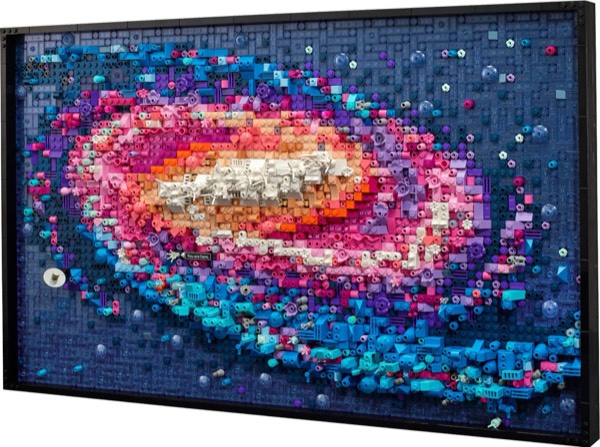
The Milky Way Galaxy is LEGO Art at its most ambitious and its most effective. At 3,091 pieces, it builds into a large panel that depicts our galaxy in a swirl of purple, blue, white, and black studs that, from display distance, creates a genuinely stunning representation of the Milky Way as seen from an imagined external vantage point.
What makes this set extraordinary is the way it solves the fundamental challenge of LEGO Art: making a field of uniform studs read as something with depth and movement. The Milky Way design uses color gradients - subtle transitions from deep purple to pale blue to white - that create a convincing sense of galactic structure. The spiral arms emerge naturally from the stud pattern, and the contrast between the bright galactic core and the dark void of space gives the piece genuine visual drama.
The build is meditative in the best sense. You're placing studs one at a time, following a pattern, and the repetitive nature of the process is exactly the kind of focused, low-stress activity that makes building therapeutic. There's a podcast-listening quality to Art builds that differs from the problem-solving engagement of a complex Technic model. Both are valuable. This one quiets the mind.
On the wall, the Milky Way Galaxy is the LEGO Art set most likely to prompt a visitor to ask "Wait, that's LEGO?" The subject matter, the scale, and the color work combine into something that reads as a piece of space art first and a brick build second. That's the goal, and this set achieves it.
Buy on LEGO Shop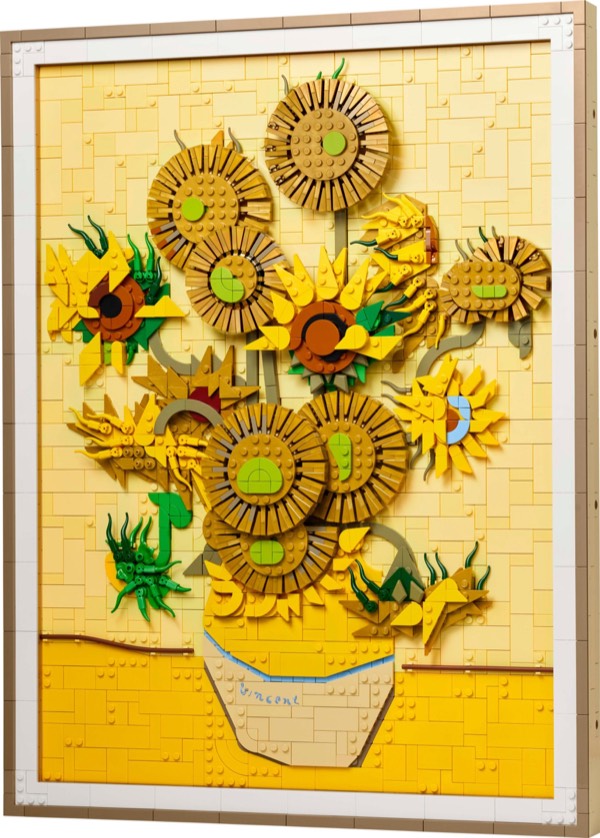
Reproducing a Van Gogh painting in LEGO studs is an audacious idea. Van Gogh's work is defined by visible brushstrokes, thick impasto texture, and a vibrancy of color that comes from oil paint applied with aggressive confidence. A medium made of uniform plastic circles would seem to be the worst possible canvas for recreating that energy. And yet, the Sunflowers set works.
The design team made a crucial choice: instead of trying to recreate the painting with photographic accuracy (impossible at stud resolution), they captured its essence. The yellows range from bright to golden to olive. The background uses a deliberate gradient that suggests the original's color field. The sunflowers themselves are rendered in enough detail that the composition reads correctly - you see the drooping heads, the upright blooms, the vase - without any individual stud pretending to be more than it is.
At 800 pieces, this is the most accessible Art build we've reviewed. A single focused session will see it completed, and the finished piece is compact enough to hang in spaces where the larger Milky Way wouldn't fit. It's also the most recognizable subject - everyone knows Van Gogh's Sunflowers, and that instant recognition gives the piece a conversational quality that more abstract Art sets lack.
The limitation is in the resolution. At 800 pieces, the stud grid is coarser than the Milky Way's, and the image resolves best from further away. In a small room where viewing distances are short, the pixelation is more apparent. In a hallway, a living room, or an office where you'll primarily see it from five feet or more, it looks excellent.
Buy on LEGO Shop
The World Map is the outlier in this ranking - not because it's the weakest set, but because it serves a fundamentally different purpose than the other two. At a staggering 11,695 pieces, it's one of the largest LEGO sets ever produced by piece count, and the finished product is a massive wall-mounted map of the world that spans over 40 inches wide.
The build is an endurance event. Where the Milky Way takes an evening and the Sunflowers take an afternoon, the World Map takes days. The repetitive stud placement that's meditative in a 3,000-piece set becomes a genuine test of commitment at nearly 12,000 pieces. It's the kind of build where you need to break it into continental sessions - do the Americas one night, Europe and Africa the next, Asia the night after - or risk stud-placement fatigue.
The payoff, though, is undeniable. The finished World Map on a wall is a statement piece in the truest sense. It dominates whatever room it's in, it reads correctly as a world map from any reasonable viewing distance, and the raised stud texture gives it a tactile, three-dimensional quality that a printed map or poster can't match. The customization options - you can mark countries visited, pin routes traveled, personalize it with different ocean colors - add an interactive element that keeps the set relevant long after the build is complete.
It ranks third not because of quality but because of accessibility. The build time, the wall space requirement, and the sheer commitment involved make it a niche product even within the already-niche Art theme. For the right builder in the right space, it's extraordinary. For most people, the Milky Way or Sunflowers will deliver a better experience-to-effort ratio.
Buy on LEGO ShopLEGO Art sets are designed to hang on walls, and they come with mounting hardware for exactly that purpose. But there's a difference between hanging a set on a wall and displaying it effectively. Here's what we've learned from living with these sets on our own walls.
The stud texture is both the charm and the challenge of displaying LEGO Art. From the right distance with the right lighting, the texture adds a dimensionality that flat prints can't match. From too close or under flat lighting, it reads as a grid of plastic dots. Controlling the viewing distance and light angle is the key to making LEGO Art look intentional rather than gimmicky.
One practical consideration: dust. The stud surface collects dust more aggressively than a flat surface, and a dusty LEGO Art panel looks noticeably worse than a clean one. A soft brush or compressed air every few weeks keeps the colors vibrant and the image sharp. It's a minor maintenance commitment that pays dividends in long-term display quality.
LEGO Art builds are nothing like traditional LEGO builds, and it's worth setting expectations before you open the box. There are no structural engineering challenges, no clever connection techniques, no satisfying click of complex assemblies coming together. What there is, instead, is repetitive, rhythmic stud placement that occupies your hands while freeing your mind.
The closest comparison is coloring - adult coloring books, specifically. The same meditative, low-cognitive-load activity that makes coloring books popular for stress relief applies to LEGO Art. You follow a pattern, you place studs, and the image gradually emerges. The process is calming, almost hypnotic, and dramatically different from the problem-solving engagement of building a Technic set or the spatial reasoning required by a complex Architecture model.
This is either exactly what you want or exactly what you don't. Some builders find Art builds boring. Others find them deeply satisfying. There's no middle ground. If you've ever enjoyed a long, repetitive craft project - knitting, cross-stitch, pixel art, mosaic work - you'll likely enjoy LEGO Art. If you build LEGO primarily for the engineering challenge, Art sets will leave you cold.
For more on the therapeutic side of building, see our piece on LEGO and Mindfulness.
LEGO Art sets are for builders who want their hobby to produce something that integrates into their home decor rather than competing with it. A LEGO Technic car on a shelf is clearly a LEGO product. A LEGO Art panel on a wall can be ambiguous - is it art or is it LEGO? That ambiguity is the point, and it's what makes the theme appealing to a specific audience.
The Art theme isn't for everyone, and that's fine. LEGO's catalog is vast enough to serve every type of builder. But for the right person - someone who wants to combine the satisfaction of building with the satisfaction of having genuine wall art in their home - this theme delivers something no other LEGO line can. The Milky Way Galaxy on a wall in a dimly lit room is one of the most striking LEGO displays we've ever seen. It just doesn't look like LEGO. And that's the highest compliment the Art theme can receive.
The Starry Night (reviewed here) takes a different approach to Van Gogh, rendering the painting as a three-dimensional Ideas set rather than a flat Art panel. If you're choosing between the Sunflowers Art set and the Starry Night Ideas set, the Starry Night offers a more traditional LEGO build experience while the Sunflowers offers a wall-mounted display piece. Different products for different purposes, both excellent.