The Only F1 Debate That Matters in Brick
LEGO has built Formula 1 cars across four product lines -- Speed Champions, Technic, City, and the upcoming Helmet Editions. But the Icons line is where F1 gets the respect it deserves. Larger scale. Historical context. Named drivers. Display stands with plaques. These aren't toys. They're tributes.
Two F1 cars currently exist in the Icons lineup: the Ferrari F2004 carrying Michael Schumacher's legacy, and the Williams FW14B representing Nigel Mansell's dominant 1992 championship season. Both scored above 9.0 in our reviews. Both earned the EARL APPROVED badge. Both are exceptional builds.
But if your shelf only has room for one, or your budget only stretches to one, which one do you choose? That's what this comparison is for. Five rounds. Two cars. One verdict.
The Specs
| Spec | Ferrari F2004 (11375) | Williams FW14B (10353) |
|---|---|---|
| Pieces | 735 | 799 |
| Our Score | 9.40 | 9.30 |
| Verdict | EARL APPROVED | EARL APPROVED |
| Driver | Michael Schumacher | Nigel Mansell |
| Season | 2004 | 1992 |
| Championship | 7th title (record at time) | 1st and only title |
| Primary Color | Rosso Corsa (red) | Camel Yellow/Blue/White |
| Era | V10 (peak downforce) | Active suspension (banned after) |
Round 1: Build Experience
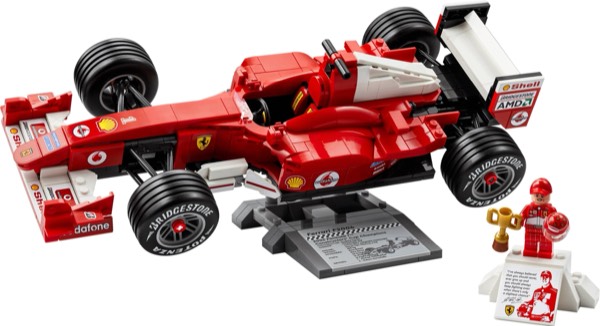
Both cars build in phases that mirror how a real F1 car comes together: monocoque first, then mechanical internals, followed by bodywork, and finished with livery details and the display stand. The sequence is satisfying in both cases because each phase produces visible progress.
The Ferrari F2004 has a slightly more streamlined build. The 2004-era bodywork is smoother and more aerodynamically refined, which translates to longer, flowing panels in brick. The build feels fast and confident. There are fewer fiddly connections and more moments where large sections snap together with satisfying clicks.
The Williams FW14B has more mechanical complexity under the bodywork. The active suspension system -- the defining technology of the 1992 car -- is represented through a more intricate internal structure. The build asks more of you in terms of precision, particularly around the sidepods and the rear wing assembly. Some builders will find this more engaging. Others will find it slightly more frustrating when small connections need adjustment.
The FW14B also has 64 more pieces than the F2004, and you feel that difference in build time. Not dramatically, but noticeably. Expect an extra 30-45 minutes.
Winner: Ferrari F2004. More fluid build. Fewer points of friction. Both are excellent, but the F2004 flows better.
Round 2: Display Presence
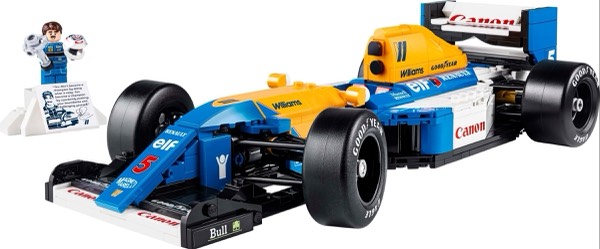
This is where personal taste matters more than objective measurement, but there are real differences in how these two cars occupy a shelf.
The Ferrari F2004 is red. That's the single most important display fact. Red commands attention in any room. On a dark shelf, it glows. On a white shelf, it pops. Against other LEGO sets of any theme, the eye goes to the red car first. The Rosso Corsa shade LEGO chose is accurate and deep -- it doesn't look toyish or overly bright.
The Williams FW14B has a more complex livery. The Camel yellow, Canon blue, and Renault white create a multi-color scheme that is historically accurate and visually interesting in a way the monochromatic Ferrari isn't. For F1 historians, this livery is iconic. For casual observers, it reads as "colorful race car" rather than "Ferrari."
Both include display stands with driver nameplates. The stands are functionally identical -- black bases with printed plaques. They hold the cars at a slight rake that shows off the aerodynamic profile from a viewing angle that works at desk or shelf height.
The Ferrari is the better standalone display piece. The Williams is the more interesting piece to look at closely. From across a room, red wins. From arm's length, the FW14B's livery detail rewards closer inspection.
Winner: Tie. Different display personalities. Ferrari for impact. Williams for detail.
Round 3: Historical Significance
Both cars represent peak moments in Formula 1 history, but they tell fundamentally different stories.
The Ferrari F2004 was the final act of the most dominant era in F1 history. Michael Schumacher won his seventh championship driving this car -- a record that stood for sixteen years until Lewis Hamilton equaled it in 2020. The F2004 won 15 of 18 races that season. No team has come close to that win percentage since. The car represents perfection: the culmination of Ferrari's technical program under Ross Brawn and Rory Byrne, with the most successful driver in history at the wheel.
The Williams FW14B tells a story of technological revolution. The 1992 car featured active suspension, traction control, and semi-automatic gearbox technology that was so advanced the FIA banned most of it the following year. Nigel Mansell drove it to his first and only championship, winning nine of sixteen races. The FW14B is the car that proved technology could be as decisive as driver talent -- a debate that continues in F1 to this day.
For historical weight, the Ferrari F2004 carries more global recognition. Schumacher's name transcends F1 in a way Mansell's does not, particularly outside Europe. The red Ferrari is the universal symbol of motorsport excellence.
But for the F1 purist, the Williams FW14B represents something rarer: a car so technologically advanced that the sport had to change its rules in response. That's a distinction shared by very few machines in racing history.
Winner: Ferrari F2004. Greater global recognition and the driver legacy gives it the edge. But the Williams story is more fascinating for those who know it.
Round 4: Technique and Engineering
As LEGO builds, both cars showcase clever brick engineering, but in different ways.
The Ferrari F2004 excels in bodywork shaping. The nose cone, sidepods, and engine cover use curved slope elements and wedge plates to create the smooth, flowing lines of a V10-era car. The aerodynamic surfaces feel organic rather than blocky. The front wing endplates and rear wing assembly are particularly well-done -- thin and delicate-looking without being structurally fragile.
The Williams FW14B tackles a harder problem. The 1992 car had a more angular, boxy aesthetic by modern standards, but it was mechanically more complex. The active suspension representation under the bodywork uses Technic-style elements integrated into a System build, which is an interesting hybrid approach. The sidepod intake geometry is different from the Ferrari, requiring some unconventional building angles to get the shape right.
Both cars include steering that connects to the front wheels. Both have representational engine details visible from the rear. The level of mechanical fidelity is comparable.
The one area where the FW14B clearly leads is in the rear diffuser design. The undertray and diffuser detail is more prominent on the 1992 car, reflecting the era's emphasis on ground effect aerodynamics. It's a subtle touch that most viewers won't notice, but builders will appreciate during construction.
Winner: Williams FW14B. Marginally more technically interesting. The hybrid Technic-System approach and the challenging bodywork geometry give it the edge for builders who value engineering over aesthetics.
Round 5: Investment Outlook
Both sets are currently available at retail, so neither has an aftermarket track record yet. But we can make informed assessments based on historical patterns.
Ferrari LEGO sets consistently outperform other brands in post-retirement appreciation. The Ferrari name carries a licensing premium that translates directly to collector demand. Previous Ferrari Technic sets (42125 488 GTE, 42143 Daytona SP3) have shown strong appreciation curves. The Schumacher association adds a layer of personal legacy that transcends the car itself.
Williams sets have less brand heat in the collector market. Williams as a team is respected but does not carry the aspirational weight of Ferrari. Mansell is beloved in Britain and among F1 historians but is less globally recognized than Schumacher. The FW14B's appeal is narrower but potentially deeper within its audience.
The Ferrari F2004 is the safer investment pick. The Williams FW14B is the contrarian pick -- less obvious demand could mean less competition for sealed units after retirement, and the set's unique technical story may drive sustained interest among a dedicated audience.
Winner: Ferrari F2004. Stronger brand, more recognizable driver, broader collector base.
Final Score
| Round | Ferrari F2004 | Williams FW14B |
|---|---|---|
| Build Experience | Win | - |
| Display Presence | Tie | Tie |
| Historical Significance | Win | - |
| Technique/Engineering | - | Win |
| Investment Outlook | Win | - |
| Overall Score | 9.40 | 9.30 |
The Verdict
If you're buying one: The Ferrari F2004 (11375). It wins three of five rounds, carries the stronger brand, the more globally recognized driver, and the safer investment outlook. The 9.40 score is the highest of any F1 set we've reviewed outside the Technic line. On a shelf, the red commands the room.
The case for the Williams: If you're a builder who values engineering over brand appeal, or an F1 historian who finds the active suspension story more compelling than another Ferrari championship, the FW14B is the more interesting set. Its multi-color livery is more visually complex. Its build demands more from you. And in a world where everyone buys the Ferrari, owning the Williams says something different about your taste.
If you can afford both: Buy both. They look extraordinary displayed side by side -- the red of the 2004 car against the yellow and blue of the 1992 car creates a color contrast that spans twelve years of F1 evolution. Two eras. Two champions. Two philosophies of racing. Together, they tell a bigger story than either one tells alone.
Track prices on both sets at GameSetBrick.
Full Reviews
- Ferrari F2004 Michael Schumacher (11375) - Full Review
- Williams FW14B Nigel Mansell (10353) - Full Review
See the complete F1 lineup: Best LEGO F1 Sets Ranked 2026 | Technic F1 3-Way Comparison
Where These Fit in the Bigger F1 Picture
The Icons F1 cars exist at the top of a pyramid. Below them sit the 1:8 Technic builds (McLaren MCL39, Red Bull RB20, Ferrari SF-24) which offer mechanical complexity at larger scale. Below those are the Speed Champions 8-wide cars -- the full 2025 grid of ten teams plus the 2026 Audi R26. At the base, the City F1 playsets offer entry-level F1 builds for younger builders.
Coming May 1, the LEGO Editions F1 helmets (Lewis Hamilton and Charles Leclerc) add a completely new dimension to the collection. These 884+ piece display sculptures sit alongside the cars rather than competing with them. A helmet on a stand next to a car on a stand creates a driver-and-machine pairing that no other display approach can match.
For collectors building a comprehensive F1 display, the two Icons cars serve as the historical anchors. They represent eras that no other LEGO line covers. The Technic cars are modern. The Speed Champions are current season. But only the Icons line reaches back to Schumacher's seventh title and Mansell's active suspension revolution. They give the collection depth and context that pure modernity cannot provide.
If you're building that comprehensive display, the order of acquisition matters. Start with whichever Icons car speaks to you more -- Ferrari for most people, Williams for the contrarians. Add Technic next for scale variety. Fill in with Speed Champions for breadth. Save the helmets for when they arrive in May. The result is a display that spans thirty-four years of Formula 1 history, from Mansell's 1992 technology revolution through Schumacher's 2004 dominance to the current hybrid era, all rendered in brick at scales that complement rather than compete with each other.
We're also running a giveaway right now for the LEGO Speed Champions Audi F1 R26 -- the newest car on the F1 grid. Free to enter: Enter the giveaway.