
Lumibricks has spent the last few years positioning itself as the thinking builder's alternative to LEGO modulars, and the secondary market has noticed. Sets that retail for $80 to $150 are moving fast enough that availability becomes a real problem. The pitch is straightforward: comparable or better build quality, original designs that don't echo existing LEGO archetypes, and a price structure that rewards serious collectors. But here's what gets glossed over in most Lumibricks discussions: they're not LEGO modulars with different packaging. They're a fundamentally different product category with different strengths, different weaknesses, and different reasons to own them. Mixing these two brands means understanding what each does well rather than assuming one is simply cheaper.
Twenty-five years of building has taught me that switching between LEGO and third-party systems on the same shelf creates more problems than solutions. Not because of brand purity, but because they handle compatibility, structural integrity, and display cohesion differently. This comparison matters because the decision isn't about which company makes better bricks. It's about whether you're building a collection that feels intentional or one that's just accumulating sets. Both Lumibricks and LEGO modulars have earned their place in serious collections, but for completely separate reasons.
The Question Everyone Asks
Every time we publish a Lumibricks review, the same question appears: how does it compare to LEGO? It's the inevitable comparison for any alternative brick brand, and it deserves a thorough answer rather than a dismissive one.
We've reviewed over 100 Lumibricks sets and 20+ LEGO modular buildings. We've built both brands extensively. We've displayed them side by side. And the honest answer is more nuanced than "LEGO is better" or "Lumibricks is cheaper." Both statements contain truth, but neither tells the full story.
This comparison breaks the question into ten specific categories. For each one, we'll explain what we found, show examples from both brands, and declare a winner. At the end, we'll give you a clear recommendation based on what you're actually looking for in a modular building.
The Contenders
LEGO Modulars: The Creator Expert / Icons modular building line. Annual releases since 2007. Standard 32x32 stud baseplate footprint. Prices range from $199 to $299 for current sets. One new building per year. Nineteen buildings released to date.
Lumibricks: An alternative brick manufacturer producing modular-scale buildings across multiple themes. Releases multiple buildings per month. Prices range from $30 to $120 for most sets. Over 100 distinct buildings across Old West, Medieval, Steampunk, City Life, Nature, Coastal, Fantasy, and Casual themes.
We're comparing these two specifically because they occupy the same display niche: detailed buildings designed for adult collectors who want to assemble and display a miniature streetscape or village.
Round 1: Brick Quality
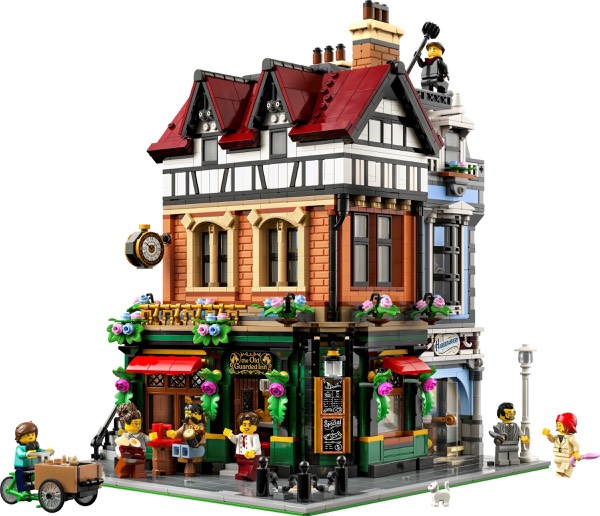
Winner: LEGO
This is where the price difference shows most clearly. LEGO bricks have tighter tolerances, more consistent clutch power, and a surface finish that alternative brands haven't fully matched. When you connect two LEGO bricks, the click is precise and the hold is firm without being difficult to separate. The color consistency across thousands of pieces in a single set is essentially perfect.
Lumibricks bricks are good. Noticeably better than many budget alternatives. The clutch power is adequate for display builds, and the color accuracy has improved significantly in recent production runs. But side by side with LEGO, you can feel the difference. Connections are slightly looser on some elements. Occasional color variation appears across large single-color surfaces. Transparent elements don't have quite the same clarity.
For display purposes, the difference is less impactful than it sounds. Once a building is assembled and sitting on a shelf, the brick quality gap is difficult to detect visually from normal viewing distance. The gap matters more during construction, where LEGO's superior clutch makes the building process smoother and more satisfying.
Round 2: Design Variety
Winner: Lumibricks, by a landslide
This is Lumibricks' greatest competitive advantage and it's not close. LEGO releases one modular building per year. One. If you want to build a medieval village, a western town, a steampunk district, or a coastal harbor, LEGO's modular line cannot help you. The modulars are exclusively contemporary urban architecture -- shops, restaurants, hotels, museums.
Lumibricks offers entire themed collections:
- Old West: 14 buildings including a saloon, sheriff's office, general store, gold mine, blacksmith, and train station
- Medieval: 12 buildings including a castle banquet hall, apothecary, tailor shop, market, watchtower, and forge
- Steampunk: 12 buildings with mechanical workshops, flying clubs, time rift libraries, and ore factories
- City Life: Apartments, bus stops, dance studios, garages, and modern urban builds
- Nature: Cabins, farms, lighthouses, greenhouses, and rural retreats
- Coastal: Beach lifeguard towers, surf shops, and seaside builds
- Fantasy: Haunted mansions, alchemist castles, and otherworldly structures
If you want to build an entire themed village rather than a single urban street, Lumibricks is the only option that delivers at scale. A complete Old West town of fourteen buildings costs less than three LEGO modulars.
Round 3: Price Per Piece
Winner: Lumibricks
The math is straightforward. LEGO modulars run roughly $0.08-0.10 per piece at retail, with premium pricing that reflects the brand, the licensing (where applicable), and the quality standard. A typical LEGO modular at $249.99 for 2,500 pieces works out to about $0.10 per piece.
Lumibricks sets typically run $0.03-0.05 per piece. A 2,500-piece Lumibricks building might retail for $80-120. That's a 50-70% savings on a per-piece basis.
This matters enormously for builders who want to create large displays. Building a ten-building LEGO modular street at retail would cost $2,000-3,000. Building a ten-building Lumibricks themed village costs $400-800. The cost difference is the difference between "I'll add one building per year" and "I'll build the entire town this month."
The caveat: you're comparing premium to mid-range. The price difference reflects a real quality difference (Round 1). Whether that quality difference justifies a 3x price multiplier is a personal decision.
Round 4: Build Experience
Winner: LEGO
LEGO's instruction manuals are the industry standard for a reason. Every step is clear. The color coding on instruction pages distinguishes new pieces from existing structure with precision. The bag numbering system ensures you're never hunting through a pile of 3,000 random bricks for a single 1x2 plate.
Lumibricks instructions have improved significantly but still lag behind LEGO in clarity. Color differentiation between similar shades (dark grey vs black, dark blue vs dark brown) can be ambiguous in printed instructions. Bag sorting is less consistent -- some sets are well-organized, others dump you into larger mixed bags that require sorting before you begin. The build sequence occasionally introduces structural vulnerabilities that require careful handling during later stages.
For experienced builders, the Lumibricks instruction challenges are minor inconveniences. For newcomers to brick building, they can be genuinely frustrating. If this is someone's first modular-scale build, start with LEGO.
Round 5: Interior Detail
Winner: LEGO
LEGO modulars are designed to open. The interiors are furnished, detailed, and often contain hidden elements that reward exploration. The Tudor Corner has a fireplace you can practically feel. The Bookshop has individual printed book tiles. The Detective's Office has clues scattered across every floor that tell a narrative.
Lumibricks interiors vary widely. The best sets -- the Steampunk Watch Tower, the Old West Inn, the Brick Art Gallery -- have meaningful interior detail with furniture, accessories, and room layouts that make the building feel occupied. But many Lumibricks sets prioritize facade design over interior space, with interiors that are sparse or purely structural.
If opening your building and looking inside is part of the experience for you, LEGO wins this category consistently.
Round 6: Facade Design
Winner: Tie
This is where Lumibricks genuinely competes on equal footing. The best Lumibricks facades are creative, detailed, and architecturally distinct. The Steampunk buildings use gear elements, copper-colored accents, and industrial detailing that create a visual language LEGO has never attempted. The Medieval buildings use stone textures, timber framing, and organic shapes that evoke period architecture convincingly.
LEGO facades benefit from superior brick quality -- sharper edges, more consistent colors, better transparency in window elements. But the design creativity is comparable. Some of our highest-scoring Lumibricks sets earned those scores primarily on the strength of their facades.
When viewed from the front at shelf distance -- which is how most modular buildings are displayed -- a well-designed Lumibricks facade holds its own against a LEGO facade. The gap narrows when the design is strong enough to compensate for the material difference.
Round 7: Minifigures
Winner: LEGO
LEGO minifigures are the gold standard for brick-based character figures. The printing quality, face expressions, accessory detail, and overall personality of LEGO minifigures are unmatched. Each modular building comes with characters that feel like they belong in the building -- the barber in the barbershop, the detective in the detective's office, the baker in the bakery.
Lumibricks includes minifigures with most sets, and they're functional. But the printing quality is noticeably lower. Faces are less expressive. Accessories are less detailed. The characters don't carry the same personality. For builders who display with minifigures visible, this difference matters.
For builders who display buildings only (no figures visible), this category is irrelevant.
Round 8: Display Compatibility
Winner: Depends on your goal
LEGO modulars connect to each other via a standardized baseplate system. Every modular since Cafe Corner uses the same footprint. Line them up and they form a continuous street with aligned sidewalks and consistent scale. The standardization is the entire point of the series.
Lumibricks buildings don't follow LEGO's modular standard. They vary in footprint, scale, and baseplate size. You can't seamlessly connect a Lumibricks building to a LEGO modular and expect aligned streets. However, Lumibricks buildings within the same theme are designed to work together. An Old West collection of fourteen buildings creates a cohesive town. A Steampunk collection creates a cohesive industrial district.
If you're extending an existing LEGO modular street: LEGO wins, no contest. If you're building a standalone themed display: Lumibricks wins on variety and cost. If you're mixing brands on the same shelf with some space between them: both work fine.
Round 9: Resale and Investment Value
Winner: LEGO
LEGO modulars have one of the most predictable appreciation curves in the brick aftermarket. Retired modulars routinely sell for 2-3x their original retail price within three years. The brand recognition, the collector demand, and the one-per-year scarcity model all contribute to strong long-term value.
Lumibricks sets do not appreciate in the same way. The alternative brick aftermarket is smaller, less organized, and less predictable. Lumibricks sets that go out of production don't generate the same collector frenzy. If investment return is part of your decision, LEGO is the clear choice.
If you're building to display and never plan to resell, this category carries zero weight in your decision.
Round 10: Overall Collection Satisfaction
Winner: Depends entirely on what you're building
A LEGO modular collector who adds one building per year and slowly grows a street over a decade experiences a particular kind of satisfaction -- patience rewarded, consistency maintained, investment preserved. Each January release is an event. The collection tells a story about commitment over time.
A Lumibricks collector who builds an entire Old West town in a month experiences a different kind of satisfaction -- immersion achieved, vision realized, creativity expressed. The themed collections enable display ambitions that LEGO's one-per-year cadence cannot serve. Building fourteen buildings in a cohesive theme creates a scene that a single LEGO modular never can.
Neither satisfaction is superior. They're different experiences for different goals.
The Scorecard
| Category | LEGO | Lumibricks |
|---|---|---|
| Brick Quality | Win | - |
| Design Variety | - | Win |
| Price Per Piece | - | Win |
| Build Experience | Win | - |
| Interior Detail | Win | - |
| Facade Design | Tie | Tie |
| Minifigures | Win | - |
| Display Compatibility | Depends on goal | |
| Investment Value | Win | - |
| Collection Satisfaction | Different experiences | |
LEGO wins 5, Lumibricks wins 2, 1 tie, 2 contextual.
The Verdict
Buy LEGO modulars if: You want the best possible brick quality. You're building a single continuous street. You care about interior detail. You view your collection partly as an investment. You prefer one premium purchase per year over frequent smaller purchases. You want the social currency of a recognized brand on your shelf.
Buy Lumibricks if: You want themed variety that LEGO doesn't offer. You're building a western town, medieval village, steampunk district, or rural landscape. You want to build an entire display scene this month rather than this decade. Your budget is fixed and you want maximum buildings for your money. You display buildings facade-forward without opening them.
Buy both if: You recognize that different goals require different tools. A LEGO modular street in your living room and a Lumibricks Old West town in your office are two different collections serving two different display ambitions. They don't compete. They coexist.
We review both brands with the same scoring framework and the same editorial standard. Browse our full collections: LEGO Reviews | Lumibricks Reviews
For modular rankings specifically: Best LEGO Modulars Ranked | Best Lumibricks Medieval Sets Ranked
The single biggest error builders make is treating this as a cost comparison first and a quality comparison second. Online forums light up with price-per-piece calculations, and Lumibricks wins almost every time. But those numbers hide the actual dynamic: LEGO modulars are priced for secondary market staying power. A 2024 Creator Expert modular hasn't lost value; many have gained it. Lumibricks sets, by contrast, are holding their own but without the long-term appreciation track record. You're not just buying building experience, you're making an investment decision disguised as a product choice.
The second mistake is assuming structural compatibility equals aesthetic compatibility. Lumibricks studs are LEGO-compatible by specification, and that's technically true. But their brick proportions, color ranges, and design language create visual discord when mixed directly. Buildings sit next to each other on a shelf, and the moment you see a Lumibricks corner parcel adjacent to a Creator Expert modular, the difference becomes obvious. Builders who planned around this ahead of time look deliberate. Builders who didn't look like they ran out of one brand and grabbed another.