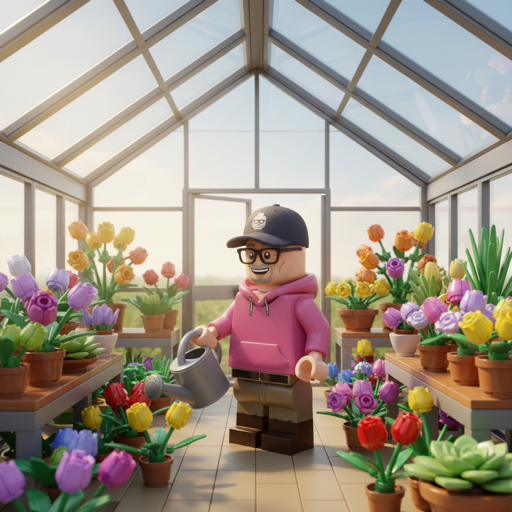
The comeback story gets oversold. Guys tell themselves they're rediscovering a childhood passion, but most of the time what's actually happening is different, more honest, and worth naming straight up: they're experiencing permission. Permission to make something with their hands again. Permission to own a shelf full of sets without justifying it to anyone. Permission to spend three hours sorting bricks by color because the work itself feels good. The LEGO dark ages weren't really about losing interest in LEGO, they were about losing the space to admit you still cared. A specific set, a life moment, a pandemic, sometimes just scrolling past an image online, that's the permission slip. That's when the door cracks open.
Here's what I've watched happen across two decades of this community: the returning builders aren't chasing nostalgia. They're chasing competence. They're chasing the feeling of building something that matters, even if it's made of plastic studs. The sets that bring people back aren't random, they're the ones that demand real attention, that turn building into something closer to craft. They're permission wrapped in cardboard.
If you are reading this, you probably lived through it. You were ten, maybe twelve. The LEGO bins that had been the center of your world started gathering dust. School got harder. Friends got cooler. Video games got better. And one day, without any formal farewell, you just stopped building. The bricks went into a box. The box went into a closet.
In the AFOL community, they call this the Dark Ages - the stretch of years between your childhood LEGO phase and your adult rediscovery. Almost every adult fan has one. "How long were your Dark Ages?" is one of the first questions any returning builder gets asked. The answers range from five years to thirty. The stories are almost always the same.
Nobody quits LEGO in anger. Nobody decides they are finished with bricks. It just fades. Adolescence convinces you that the things you loved as a child are things you need to leave behind. LEGO, with its bright colors and its associations with Saturday mornings, feels like something that belongs to a younger version of yourself. So you set it aside. Not forever, you think. Just for now. And "for now" becomes a decade.
What makes the Dark Ages worth talking about is the coming back. The thing about LEGO - the real, structural thing - is that it was never just for children. The system scales infinitely in complexity and creative reward. The same bricks that taught you spatial reasoning at six can provide meditative focus and genuine stress relief at thirty-six. The only thing that changes is you. And eventually, something pulls you back. Almost always, it starts with a set.
Some LEGO sets are specifically built for grown-up sensibilities - sophisticated subjects, display-worthy aesthetics, building experiences that reward patience. These are the ones that catch your eye in a bookstore or stop your scrolling on social media. They are responsible for millions of adult conversions.
The Bonsai Tree might be the most effective gateway set LEGO has ever made. Small enough to not feel like a commitment. Beautiful enough to display anywhere. The interchangeable canopy - green leaves or pink cherry blossoms, each built from unexpected elements like frogs and crab claws - delivers the kind of "they used THAT piece for THAT?" moment that hooks people immediately. I have seen more "this is what got me back into LEGO" stories about this set than any other.
The Titanic works at the opposite end. It is enormous and demanding. It does not gently invite you back - it dares you. For adults who need to justify their purchases with scale and seriousness, the Titanic provides cover. Building it is not playing. It is an experience. That distinction matters to adults who have not yet made peace with the fact that playing is exactly what they need.
The Starry Night brought in people who had never considered LEGO as adults because it spoke the language of art, not toys. It sits on a wall. It references a masterpiece. For the crowd with gallery memberships and coffee table books, this was the set that made LEGO make sense in their adult life.
Hogwarts Castle weaponizes nostalgia. The generation that grew up reading Harry Potter under the covers with a flashlight is now in their late twenties and thirties. They have disposable income and an emotional connection to Hogwarts that borders on the spiritual. Give them a 6,020-piece castle and they will build it in a fever dream of childhood memories. Many of them stay. Many discover that the building itself was what they needed, and Hogwarts was just the excuse.
The UCS Millennium Falcon occupies its own category. 7,541 pieces, nearly three feet across. It is the set people buy before they have anywhere to put it. The set that turns a curious adult into an adult with a LEGO room. If the Bonsai Tree is a gentle invitation, the UCS Falcon is a declaration of intent.
Returning builders generally arrive through one of two doors. The first is nostalgia. These are the builders who come back for Castle, Space, Pirates, Star Wars. They haunt BrickLink looking for 6086 Black Knight's Castle or 6990 Monorail Transport System. They want to rebuild their childhood, and LEGO lets them do it because the bricks have not changed. A 2x4 from 1985 clicks into a 2x4 from 2026.
The second door is discovery. These builders come back not for what LEGO was but for what it has become. They see the Starry Night or the Architecture series and think, "LEGO makes THAT now?" No childhood memories to chase. They gravitate toward display sets and the Ideas line. They care more about how a set looks on a shelf than how it plays on a floor.
Neither path is better. But the tension between nostalgia and discovery shapes the adult LEGO community. Nostalgia builders keep the classic themes alive. Discovery builders push LEGO toward sophistication. The healthiest returning builders eventually find both - they rebuild their childhood castle AND display the Bonsai Tree. The hobby is big enough for all of it.
When the world locked down in 2020, millions of adults found themselves trapped at home with nothing but time and anxiety. They needed something to do with their hands. Something that was not a screen. LEGO was there.
The numbers tell the story. LEGO Group revenue grew 21% in 2020 while most consumer brands contracted. The Botanical Collection launched in January 2021 and sold out immediately. The Bonsai Tree became a cultural phenomenon. Social media filled with adults displaying completed builds, many captioned with "I haven't built LEGO since I was a kid." The pandemic did not just bring people back. It brought them back publicly, stripped of the embarrassment that had kept many adults quiet about missing it.
The therapeutic angle was real. Building during lockdown was genuine self-care. The repetitive, focused act of connecting bricks provides what psychologists call a flow state - complete absorption that quiets anxious mental chatter. For people dealing with isolation and grief, those hours of focused building were lifelines. When the lockdowns ended, many pandemic builders did not stop. They had found something that worked.
LEGO recognized the moment and accelerated its adult product line - the 18+ branding, the black-box packaging, the sophisticated subjects. Whether that was genuinely inclusive or cleverly commercial depends on your cynicism level. Either way, it worked. The pandemic created a generation of adult fans who came straight from no LEGO to adult LEGO, skipping childhood entirely.
Ask any returning builder about the exact moment they knew they were back, and you will get a story so specific it sounds rehearsed. It is not the purchase. It is not even the first few bags. It is the moment during the build when something shifts - when the bricks stop being a novelty and start being a need.
For some, it is a technique revelation. "I was building the Bonsai Tree and they used pink frogs as cherry blossoms. I actually said 'oh my God' out loud. That was it. I ordered three more sets that night." For others, it is sensory. "I opened the first bag and the smell hit me. That LEGO smell. I was seven years old again." For still others, it is the flow state. "I sat down to build after work, thinking I would do an hour. I looked up and it was 2 AM. I had not felt that focused in years."
The pattern is always the same: encounter, resistance, surrender. You see a set. A voice says "you are a grown adult, this is a toy." Then that voice goes quiet because the building is too good. After that, you start looking at LEGO Instagram accounts. You discover the terminology. You learn what MOC means and what SNOT stands for. You find your people. You are, whether you planned it or not, an AFOL.
"I bought the Titanic to build with my son. He lost interest after bag four. I finished it alone over six nights and I have never been happier about a kid quitting something."
That quote captures the whole thing. You come back for one reason and stay for another. You buy a set as a gift and keep it. You start building with your kids and end up building after they go to bed. You tell yourself it is a one-time purchase and then you sign up for VIP rewards.
There is a mechanical moment, too. The first time you connect two bricks as an adult, something happens in your hands that your brain remembers before your conscious mind does. The clutch power. The satisfying resistance followed by the precise snap. Your fingers know this. They have always known this.
Adult hands are better at LEGO than child hands. Children struggle with tight connections and small pieces. Adults, with developed fine motor skills and longer fingers, find building physically easier. Techniques that frustrated you at nine - attaching tiny clips, threading axles through Technic beams, placing 1x1 tiles - are effortless at thirty-five. The building experience gets better with age.
This physical satisfaction compounds with cognitive satisfaction. When you realize the curved hull of the Titanic is achieved through offset bracket connections and angled plates, that requires adult knowledge to appreciate. When you see how the Starry Night uses round plates at varying angles to create Van Gogh's swirling sky, you are seeing mechanical ingenuity translated into art. These moments belong exclusively to adult builders.
One of the most daunting parts of returning is the sheer volume of what you have missed. If your Dark Ages lasted fifteen years, you are looking at hundreds of themes and thousands of sets. The temptation is to buy everything, chase every retired set on the secondary market, and build a collection that compensates for lost time. Do not do it. That way lies financial ruin and shelf space crisis.
Start with one set that genuinely excites you, build it, and sit with it. Do not order the next one until you have finished the first. Let the build tell you what kind of builder you are now. You might discover you love Architecture sets and could not care less about Star Wars. You might find Technic is your thing, even though you were a Castle kid. You might realize you do not want sets at all - just a pile of loose bricks and your own imagination. All of these are valid.
The Reviews hub covers dozens of sets across every category and budget. The AFOL 101 guide covers everything from set selection to storage. And if the jargon is overwhelming, you are not alone - every returning builder has googled "what does MOC stand for" at some point.
One piece of advice I hear from experienced AFOLs constantly: do not compare your collection to anyone else's. Social media is full of people with dedicated LEGO rooms and collections worth more than their cars. Those took years to build. Start where you are. Build what you love.
Many returning builders discover something unexpected: LEGO is genuinely therapeutic. Following instructions, sorting pieces, assembling a model - it engages the mind in a way that crowds out anxiety and rumination. The science backs it up. Building LEGO activates the same neural pathways as meditation: focused attention, present-moment awareness, incremental progress.
For returning builders dealing with stress, grief, or mental health challenges, this can be transformative. You cannot fail at LEGO. You can build slowly or quickly, follow instructions or ignore them. The complete absence of stakes is what makes it effective. In a world that evaluates everything you do, LEGO asks nothing of you except presence.
"LEGO saved my marriage." "Building got me through chemotherapy." "I started building after my dad died and it was the only time I could breathe." These are not exaggerations. The Bricks & Therapy section of this site exists because these stories deserve to be told, and because someone reading this might need to hear that it is okay to find solace in colored plastic bricks.
If you are hovering on the edge - curious but uncertain, interested but embarrassed - here is what the millions of builders who came before you want you to know.
- You are not too old. LEGO's fastest-growing demographic is adults 25-45. You are the trend.
- Start small. You do not need the 9,000-piece Titanic. A Botanical set or a Speed Champions car is enough.
- It is not just nostalgia. You are not trying to be a child again. You are discovering an adult hobby that uses a medium you already know.
- The community is real. Online forums, local LUGs, conventions - full of people who went through exactly what you are going through.
- Following the instructions is enough. You do not have to MOC. You do not have to start a YouTube channel. Building and displaying is a completely valid way to enjoy this.
- The embarrassment fades. Every returning builder spends about two weeks worrying about what people will think. Then they stop, because the building is too good.
The sets that brought us back matter because they opened the door. But we stayed because building LEGO as adults is genuinely good. It is creative, calming, and exactly what you need it to be.
"You never actually stop being a LEGO fan. You just take a really long break."
Welcome back. For more on the cultural forces driving this, read Why Adults Are Buying More LEGO Than Ever. The LEGO Shop has everything you need to start again, and the Reviews hub can help you figure out what to build first.
The returning builder represents something the hobby industry hasn't figured out how to replicate: genuine customer recovery. Not acquisition, recovery. Someone who already loved LEGO, who already spent money on it, who already has the accumulated knowledge. When a Titanic or a Van Gogh's Starry Night pulls someone back in, it's not creating demand, it's reopening a channel that costs nothing to maintain. The LEGO Company gets this now, which is why the accessibility and art sets started multiplying around 2020. They weren't chasing kids who'd never built before, they were fishing for adults who'd already made their choice once.
What most returning builders don't realize is that the set itself doesn't matter nearly as much as the moment attached to it. The Bonsai Tree works as a comeback set not because of the pieces but because someone can point to it and say: this is serious enough to spend time on. This is acceptable. This is building, not playing. The real trick isn't finding the right set, it's finding the permission structure that makes building feel earned rather than juvenile. That permission comes from better sets, sure, but more importantly it comes from knowing other adults are doing the exact same thing.