Is the LEGO Titanic Worth Buying?
9.12/10. Worth buying. 9,090 pieces. The largest set LEGO has ever produced. And it earns every single one.

The Titanic isn't a display piece that happens to be big. It's big because the ship *is* the build. At 4 feet 3 inches long, this set occupies physical space in a way that forces a real decision: Where does this actually go? That's not academic, it's the first question any builder needs to answer before opening the box. LEGO didn't pad the piece count with filler sections or repetitive modules. The 9,090 pieces map directly to hull plating, internal structure, deck detailing, and the ship's actual proportions. Building it takes 40+ hours of focused work, and that's not a marketing exaggeration; it's a legitimate time investment that separates casual interest from committed builders.
The build also sits in an unusual position within LEGO's catalog. It's neither the straightforward gratification of a smaller technical set nor the modular flexibility of Architecture. The Titanic demands respect for what it represents, a historically specific object with consequences. Some builders will find that weight meaningful. Others will bristle at it. Either way, understanding that tension before you commit matters more than any individual score.
The LEGO Titanic is not a set you build. It is a project you undertake. At 9,090 pieces, this is the second-largest set LEGO has ever produced, and the build experience reflects that ambition in every phase. Expect to invest 20 to 30 hours of focused building time across multiple sessions, spread over days or weeks depending on your pace. This is not an afternoon project. This is a commitment that demands its own calendar entry.
The construction is divided into four major hull sections that are built independently and then joined at the end. Each section has its own distinct building character. The bow section introduces the hull curvature technique that defines the entire build -- a graduated system of SNOT (Studs Not On Top) connections that creates a smooth curve approximating the shape of an ocean liner at 1:200 scale. The midship sections focus on interior detail, revealing cross-sections of the passenger decks, the grand staircase, the first-class dining room, the swimming pool, and the engine room. The stern section completes the hull and adds the distinctive counter-stern profile.
What makes the build experience exceptional rather than merely long is the variety. Every session introduces new techniques, new interior spaces, and new structural challenges. The first few hours teach you the hull curvature system. The middle sessions reward you with detailed interior vignettes that break up the repetition of hull plating. The final assembly -- connecting the four sections into one continuous ship -- is one of the most satisfying moments in all of LEGO building. Watching the Titanic take its full 135cm (53-inch) shape for the first time is the kind of moment that justifies the entire investment of time and money.
The instruction manual deserves mention. It is one of the most thoughtfully sequenced manuals LEGO has produced, with clear phase breaks, bag numbering that prevents searching, and occasional historical notes that contextualize what you're building. The pacing is deliberate -- LEGO designed this build to be enjoyed slowly, and the manual reflects that intention.
The hull curvature technique is the engineering achievement that defines this set and arguably represents the most sophisticated large-scale curve technique LEGO has ever published in an official instruction manual. Each tier of the hull uses alternating SNOT brick orientations to create a compound curve that reads as smooth from any viewing distance. The technique is repeated hundreds of times across the four hull sections, and by the time you've completed the build, you'll have internalized a structural approach that applies to any large-scale organic shape in brick.
Beyond the hull, the Titanic is a catalog of advanced building techniques presented in a single set. The grand staircase interior uses compound-angle tile placement to create the sweeping curves of the balustrade. The four funnels are cylindrical builds that demonstrate how to create round shapes at large scale using standard bricks and plates. The promenade deck uses a tile-and-bracket system that creates the appearance of continuous railing along the ship's length. The engine room features representational pistons and connecting rods that suggest mechanical function without using Technic elements.
For MOC builders, the Titanic is essentially a graduate-level course in advanced LEGO construction. The techniques learned here -- hull curves, cylindrical construction, interior framing, compound angles -- transfer directly to any ambitious build involving ships, architecture, or large-scale display models. The educational value of the build alone justifies the price for serious builders.
Nine thousand and ninety pieces in a color palette dominated by black, dark red, dark grey, white, and light grey. The volume alone makes this one of the most significant parts hauls available in a single purchase. The black hull pieces represent one of the deepest single-color collections you can acquire without buying bulk -- hundreds of black plates, slopes, and modified bricks in sizes that are useful across any dark-toned architectural or vehicle build.
The large curved hull pieces are among the most valuable individual elements in the set. Several of these curved slope elements are unique to the Titanic or appear in very few other sets, giving them elevated secondary market value for builders working on custom ship or vehicle designs. The dark red elements used for the lower hull waterline band are similarly scarce in other sets.
The deck fittings contribute hundreds of small detail elements -- tiles in various sizes, grille pieces, railing elements, and window frames -- that are universally useful. The interior sections add furniture elements, staircase pieces, and decorative tiles that work in any architectural context. The funnel construction uses large cylinder elements that are difficult to source individually.
Parting out a Titanic would be a heartbreaking decision given the display value of the completed model, but the BrickLink value of the individual elements comfortably exceeds the retail price. This is a set where the parts are worth more disassembled than assembled, which is a rare distinction that speaks to the quality of the element selection.
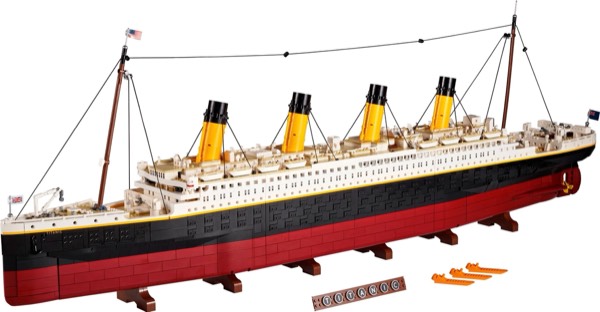
At 135cm (53 inches) long, the Titanic does not share a shelf. It demands its own surface -- a dedicated table, a wide mantelpiece, a custom display stand, or a prominent position on a sideboard. This is not a set that fits into an existing display arrangement. It creates its own arrangement and everything else in the room adjusts around it.
The display impact is extraordinary. The hull profile reads correctly at every distance. From across a room, you see the iconic silhouette -- four funnels, raked bow, three-class deck hierarchy, the distinctive counter-stern. From midrange, the detail emerges: lifeboat davits, ventilator cowls, deck furniture, and the promenade railings. Up close, the interior cross-sections reveal furnished rooms, the grand staircase, and the engine room machinery.
Lighting transforms the Titanic. Under warm directional light -- a desk lamp angled from the bow, for example -- the black and dark red hull develops a subtle sheen that reads as painted steel. The white superstructure glows against the dark hull. The four buff-colored funnels catch light at their tops. The effect is museum-quality presentation using nothing more than a well-positioned lamp.
The ship can be displayed with the hull intact (showing the exterior profile) or with the hull panels removed to reveal the interior cross-sections. Both configurations are valid display approaches, and the ability to switch between them adds long-term display versatility. Most visitors will want to see the interiors at least once, so building the exterior-first display with the option to open it up for guests is the approach we recommend.
One practical note: at 135cm and several kilograms, the Titanic requires a surface that is both long enough and sturdy enough to support it. IKEA Kallax shelves are too shallow. Most standard bookshelves are too narrow. Measure your intended display location before you build, not after.
The Titanic retails at a price-per-piece ratio that is competitive with other D2C flagship sets. At over nine thousand pieces, the raw volume is unmatched by anything else in the catalog except the World Map mosaic (which is a fundamentally different building experience). The price is substantial in absolute terms, but the per-piece economics work.
More importantly, the Titanic is a set that has demonstrated strong aftermarket appreciation. Sealed copies command premiums on the secondary market, and the trajectory suggests continued appreciation as the set moves further into its lifecycle. For collectors who view their purchases partly through an investment lens, the Titanic offers both the display satisfaction of a built model and the financial security of a set that holds its value.
At retail price, this is a straightforward recommendation for any builder ready for a flagship project. Above retail, the calculus shifts -- you're paying a premium for the privilege of owning it, which is a personal decision rather than a financial one. If you encounter it at or near retail, don't hesitate. Sets of this scale and significance do not stay available indefinitely.
The Titanic is for the builder who has worked their way up through smaller sets and is ready for the ultimate challenge. It assumes competence with SNOT techniques, comfort with multi-session builds, and the physical space to display a 135cm model. This is not a beginner set, and gifting it to a novice builder would be overwhelming rather than exciting.
It is for the collector who wants a centerpiece -- a single set that defines a room and anchors a collection. It is for the maritime enthusiast who wants the most accurate LEGO representation of the most famous ship in history. And it is for the builder who values the journey as much as the destination, because 20-30 hours of building is a significant portion of a life spent with bricks in hand.
If you have the budget, the space, and the patience, the Titanic earns every hour and every dollar you invest in it.
The Titanic is typically displayed alone due to its scale, but it pairs well with a few other sets if you have the space. The LEGO Eiffel Tower (10307) creates a transatlantic travel theme -- the ship that crossed the ocean and the tower that symbolized the European destination. The LEGO Statue of Liberty (21042) offers a New York arrival scene on the opposite end of the shelf. Either pairing adds narrative context that transforms a single display piece into a story about movement, departure, and arrival -- the great themes of early twentieth century travel rendered in brick.
For builders interested in maritime themes, the LetBricks Carnival Cruise Celebration offers a modern cruise ship at a different scale and price point. The contrast between historical and contemporary ocean travel makes for an interesting shelf conversation. Our Carnival Cruise review covers the build in detail.
Track the current market value of the Titanic and compare it to other flagship sets on GameSetBrick.
- Most technically advanced hull curvature technique in any LEGO set
- 9,090 pieces delivering a genuinely monumental build experience
- 135cm display presence that commands any room
- Interior cross-sections reveal furnished rooms and mechanical spaces
- Strong aftermarket appreciation trajectory
- Multi-session build that rewards patience and skill
- Significant financial investment at flagship pricing
- Requires dedicated 135cm+ display surface
- Build complexity is demanding and not suited for novice builders
- Weight requires a sturdy display surface
- Titanic vs Hogwarts Castle - Head-to-head comparison of two flagships
- LEGO Investing 101 - Is the Titanic a good investment piece?
- Retiring Sets Tracker - Which flagship sets are leaving shelves in 2026
- Flow State Building Guide - How marathon builds like Titanic create deep focus
- LEGO Maersk Container Vessel Review - Another iconic maritime build worth the time
The hull construction reveals something most builder don't anticipate: LEGO's engineering solution for scale forces you to confront how a ship actually stays rigid. The internal frame uses Technic beams and cross-bracing that would be invisible at minifigure scales, but here they're essential. You'll spend more time understanding structural load distribution in this single set than in most Creator Expert builds combined. That's not busywork, it's genuine engineering literacy embedded in the instructions.
What also stands out is the parts breakdown for builders planning MOCs. The set includes roughly 500+ white and light gray slope pieces across multiple angles, along with substantial quantities of black cylinders, gray Technic beams, and connection points that weren't designed with future projects in mind but absolutely function as serious parts reserves. Parting these slopes individually remains expensive on the secondary market, making this set unexpectedly valuable for builders with specific hull or architectural projects in development.
Track it in your vault on GameSetBrick - our free collection app. Log your condition, price paid, and watch the real-time market value.
Track in Your Vault →Save it to your wishlist on GameSetBrick. Share your list with friends and family - every set has a buy button so gift givers know exactly where to go.
Add to Wishlist → GameSetBrick is a free app by The Earl of Bricks. See all features. Scan it. Track it. Trade it.