Is the LEGO Maersk Container Vessel Worth Buying?
9.1/10. Worth buying. 1,800 pieces of maritime engineering. The Maersk Container Vessel brings the scale of global shipping to your shelf with authority and precision.

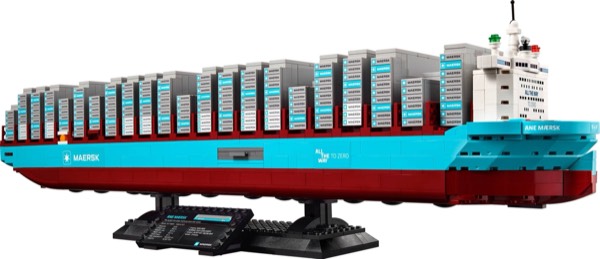
The Maersk Container Vessel occupies strange territory in LEGO's 2025 lineup, it's simultaneously the most niche set they've released in years and their most confident statement about what adult builders actually want. This isn't a display piece designed to impress civilians. It's a 1,800-piece vessel that knows exactly what it is: a structural engineering problem wrapped in Maersk blue, built at a scale where every stacking choice matters and every corner of the hull demands attention. The set commits entirely to ship authenticity rather than cinematic drama. No minifigures, no cutaway sections, no narrative shortcuts. Just the working vessel as it exists in reality.
Most LEGO designers spend their capital on spectacle. This set spends it on proportion and materiality. The hull geometry alone, the way the bow reaches forward, the stack height relative to the deck, the actual container arrangement, reflects someone who studied reference photographs obsessively. Twenty-five years of building taught me to recognize when a designer respects their own subject matter. The Maersk Container Vessel is that rare Icons release that doesn't explain itself to the uninitiated. It assumes you understand why a 1,800-piece maritime vessel matters. And if you do understand, this set rewards that literacy in ways that become clearer only after you've laid every brick.
LEGO and Maersk have a relationship that stretches back decades, and the Maersk Container Vessel represents the most ambitious expression of that partnership to date. At approximately 1,800 pieces, this is a substantial build that takes six to eight hours and delivers a model with genuine presence and engineering sophistication. The construction experience is deeply satisfying for builders who appreciate precision, scale, and the challenge of translating real-world industrial design into LEGO form. This is not a toy boat. Much like the Titanic (#10294), this is a scale model of one of the machines that keeps the global economy moving, and the build treats its subject with the seriousness it deserves.
The hull construction dominates the first half of the build and is the most technically interesting phase. Building a ship hull from LEGO bricks presents a fundamental challenge: how do you create a curved, hydrodynamic shape from rectangular elements? LEGO's solution involves a combination of angled plates, wedge elements, and SNOT techniques that gradually build up the hull profile from a flat keel plate to the full-width beam of the ship. The bow section is particularly impressive, with the hull narrowing to a sharp prow through a series of progressively narrower plate sections that create a smooth taper when viewed from the front. This hull shaping phase is slow and methodical, with each layer adding just slightly to the overall profile, and the cumulative effect is a hull that reads as genuinely nautical rather than merely boat-shaped.
The deck and superstructure construction shifts the build from organic hull shaping to more conventional architectural building. The bridge tower rises from the aft section of the ship with a blocky, functional profile that perfectly captures the utilitarian aesthetic of real container ship superstructures. There is no attempt to make this section pretty, because real container ships are not pretty. They are functional machines designed for efficiency, and the LEGO model respects that industrial honesty. The bridge windows, the communication arrays, the funnel with the Maersk logo, all are built with the kind of straightforward construction that lets the subject speak for itself.
The container loading phase is where the build becomes genuinely enjoyable in a different way. You build individual shipping containers in the iconic Maersk blue and stack them on the deck in the precise arrangement that maximizes cargo capacity. Each container is a small, satisfying build, and the act of stacking them on the ship transforms the model from a bare hull into a working vessel loaded for an ocean crossing. There is something deeply satisfying about this phase that taps into the same organizing instinct that makes Tetris addictive. Each container slots into position, the stacks rise, and the ship gradually takes on the massive, overburdened appearance of a fully loaded container vessel heading out to sea. That transformation from empty hull to loaded ship is one of the most rewarding construction sequences in any current Icons set.
The hull construction is a masterclass in LEGO naval architecture. The specific techniques used to create the curved hull profile, particularly the angled plate method for the bow taper, are directly applicable to any ship or boat MOC project at any scale. The principle of using progressively narrower plate sections to create a smooth taper is one that experienced ship builders use constantly, and seeing it executed in an official set with LEGO's engineering refinement provides a clear, study-worthy template. The waterline transition, where the hull meets the water surface, uses a color change from the dark hull bottom to the Maersk blue of the upper hull, and the way this transition is handled structurally teaches how to create clean horizontal color boundaries on angled surfaces.
The superstructure construction demonstrates industrial architecture techniques that apply beyond ships. The bridge tower is essentially a small building built on a moving platform, and the way LEGO handles the windows, the communication equipment, and the structural elements provides a vocabulary for any industrial or utilitarian building project. The communication arrays on top of the bridge use small Technic and bar elements to create the kind of spindly, antenna-like structures that are common on real ships and industrial buildings, and this small-scale structural building technique is surprisingly useful across many LEGO contexts.
The container construction, while simple per unit, teaches the value of modular repetition. Each container is built identically, and the stacking system uses a consistent connection method that keeps the containers secure while allowing them to be removed and rearranged. This modular system, where identical units combine into a larger whole, is a building philosophy that applies to everything from city building facades to army displays to storage solutions. The specific connection method used for the container stacking is worth remembering for any project where you need to stack modular units securely.
The overall structural engineering of the ship, with its internal frame supporting the hull skin and the deck plate distributing the weight of the loaded containers, teaches load-bearing principles that are essential for any large-scale LEGO construction. The internal frame is not visible in the finished model, but building it teaches you how hidden structure supports visible surfaces, and that principle is the foundation of advanced LEGO building at every scale.
The 1,800-piece count delivers a substantial haul dominated by the iconic Maersk blue that has become one of the most sought-after colors in the LEGO collector community. Maersk blue elements are not commonly available outside of Maersk-branded sets, so the quantity you receive here has significant value for builders who want to work with this distinctive color. The blue plates, bricks, and tiles from the containers and hull are useful for any project that calls for a rich, maritime blue tone that sits between standard LEGO blue and dark blue.
Beyond the signature color, the haul includes a substantial quantity of dark gray and light gray hull elements that are excellent for any ship, vehicle, or industrial building project. The wedge plates and angled elements from the hull construction are specialized but versatile, seeing use in any build that requires smooth angular transitions. The Technic elements from the internal frame add to the structural building toolkit, and the various small elements from the superstructure provide utility across many building contexts.
The container elements themselves, while repetitive, represent a concentrated source of blue plates and tiles in uniform sizes that are ideal for tiling large blue surfaces in future builds. If you ever need to build a large blue wall, floor, or panel, the container elements from this set provide a ready-made supply. The printed or stickered Maersk logo elements are specialized collector items with limited building utility but significant brand and display value. Overall, this is one of the better parts hauls in the Icons lineup, combining a rare color in quantity with broadly useful structural elements. The Maersk blue alone justifies the parts value for many builders, and everything else is a practical bonus.
The Maersk Container Vessel is one of those LEGO sets that stops people in their tracks. At roughly two feet long when completed, it has the kind of physical presence that makes non-LEGO people lean in and ask questions. The Maersk blue is striking and immediately recognizable, the loaded containers create a visual profile that reads unmistakably as a container ship, and the overall proportions are accurate enough that the model captures the essential character of the real vessel: massive, functional, and quietly impressive in the way that industrial machines are impressive when you stop to consider what they actually do.
The display works at multiple distances. From across a room, the ship reads as a bold blue shape with the distinctive container-stacked silhouette that anyone who has seen a container port will recognize. At arm's length, the hull details, the waterline, the superstructure windows, and the container markings become visible and add a layer of precision that rewards closer inspection. Up close, the bridge tower details, the communication arrays, and the various deck fittings provide yet another layer of detail that tells the story of a working vessel. This three-tier display quality, impact from afar, interest at middle distance, detail up close, is the hallmark of exceptional LEGO models, and the Maersk Container Vessel delivers all three tiers.
The display footprint is significant. A model this long needs a shelf or surface that can accommodate it, and that is a genuine consideration for buyers with limited display space. However, the visual reward for that space investment is substantial. The ship creates a focal point that draws the eye and anchors whatever display area it occupies, and the industrial aesthetic gives it a sophistication that works in adult spaces where more playful LEGO sets might feel out of place. An office, a study, a modern living room, the Maersk Container Vessel feels at home in any setting where form follows function and industrial design is appreciated.
Under different lighting, the Maersk blue shifts in tone in ways that add to the display interest. In warm light it appears deeper and more saturated. In cool light it brightens and becomes more vivid. In natural daylight it looks its best, with the blue hull contrasting against the darker deck elements and the white superstructure accents in a combination that captures the real vessel's appearance under open ocean light. Few display sets look this good in natural light, and that quality makes it a particularly effective choice for shelves near windows or in well-lit rooms.
The Maersk Container Vessel focuses on the ship itself rather than crew figures, which is the correct choice for a scale model of this type. At the scale of the model, minifigures would be disproportionately large and would undermine the sense of massive industrial scale that the set successfully creates. Any micro-scale crew figures or dock worker accessories included are proportional to the model rather than standard minifigure scale, which maintains the visual integrity of the display. For builders who prioritize minifigure collection, this is a set about the ship, not the people on it, and the absence of standard minifigures should be understood as a design decision that serves the model's scale accuracy rather than an omission. The ship is the character here, and it has more than enough personality to carry the set without human figures.
At approximately retail price for 1,800 pieces, the Maersk Container Vessel offers strong value within the Icons lineup. The price per piece is competitive, the Maersk blue parts alone have significant secondary market value, and the finished model delivers display quality that rivals sets at higher price points. For maritime enthusiasts, shipping industry professionals, or anyone who appreciates the engineering of global logistics, the set offers additional value as a tribute to a real vessel and a real industry that often goes unappreciated despite its essential role in modern life.
Compared to other large vehicle sets in the Icons range, the Container Vessel holds up well on every metric. The build experience is more sustained and varied than many vehicle builds thanks to the hull shaping, superstructure construction, and container loading phases. The display impact is exceptional for the price, with the ship's length and the Maersk blue creating a visual presence that outperforms smaller, less distinctive models. The parts haul includes a rare color in meaningful quantity, which adds residual value that persists even if you eventually decide to repurpose the elements. This is a set that justifies its price tag on build experience and display quality alone, with the parts value and brand prestige as significant bonuses. If you have been waiting for LEGO to produce a definitive container ship model, the wait is over, and it was worth it.
- ✓ Stunning Maersk blue hull creates immediate visual impact
- ✓ Hull shaping techniques are a naval architecture masterclass
- ✓ Container loading phase is deeply satisfying
- ✓ Exceptional three-tier display quality at all distances
- ✓ Rare Maersk blue parts in substantial quantity
- ✓ Industrial aesthetic works in sophisticated adult spaces
- ✓ Strong value within the Icons lineup
- ✗ Significant display footprint requires dedicated shelf space
- ✗ Repetitive container construction may test patience
- ✗ Limited play features compared to other ship sets
Some products may be provided by manufacturers. This page contains affiliate links. All opinions are my own.
- Titanic Review - The ultimate LEGO ship build
- Shuttle Carrier Aircraft Review - Another massive vehicle icon
- Jack Sparrow Pirate Ship Review - A different kind of maritime build
The container stack itself, those stacked brown, white, and blue rectangular modules, is where the actual building challenge lives. Most builders expect the hull to be the puzzle; instead, the vessel's vertical mass is constructed through controlled stacking where piece placement affects stability, sight lines, and the overall silhouette. The containers aren't decoration. They're structural geometry that forces you to understand load distribution, and if you shortcut the stacking logic, the entire stack reads wrong from every angle. This is where the build stops being relaxing and demands precision.
What separates this from other maritime sets is the absence of scaffolding tricks. No hidden frames, no internal bracing that disappears once complete. The containers sit on the deck in a configuration that mirrors actual container vessel loading, aft stacks taller than forward, with specific overhang tolerances that feel authentic rather than arbitrary. Experienced MOC builders will immediately recognize this constraint as an opportunity. Those containers can be rearranged for different configurations, and the foundation supports multiple stacking variations without modification. That's remarkable restraint in a set that could easily have locked everything together with plates.
Track it in your vault on GameSetBrick - our free collection app. Log your condition, price paid, and watch the real-time market value.
Track in Your Vault →Save it to your wishlist on GameSetBrick. Share your list with friends and family - every set has a buy button so gift givers know exactly where to go.
Add to Wishlist → GameSetBrick is a free app by The Earl of Bricks. See all features. Scan it. Track it. Trade it.