Is the LetBricks Carnival Celebration Cruise Worth Buying?
8.7/10. Worth buying. 7,379 pieces and nearly a meter long - a cruise ship LEGO would never dare to make.

LetBricks doesn't build sets LEGO would greenlight, and the Carnival Celebration Cruise is the clearest evidence yet. At 7,379 pieces and nearly a meter long, this isn't a licensed product designed for compromise, it's a builder's manifesto against the sanitized cruise ship aesthetic that would never survive Billund's approval process. The minifigure scale is honest. The structural ambition is uncompromising. The design leans into actual naval architecture instead of pretending a ship can be a perfect rectangular box. Built this over two weeks, and the engineering decisions forced me to reconsider how LEGO structures handle longitudinal stress across spans this long.
What matters most: this set exposed exactly how conservative official LEGO ship design has become. The Carnival's three-deck interior, the functional promenade structure, the way the superstructure actually sits proportional to a real hull, these aren't innovations. They're baseline expectations for anyone who's studied actual cruise ships. LetBricks simply refused to shrink the ambition down to a price point. That restraint, or rather the absence of it, defines whether this lands for you or doesn't.
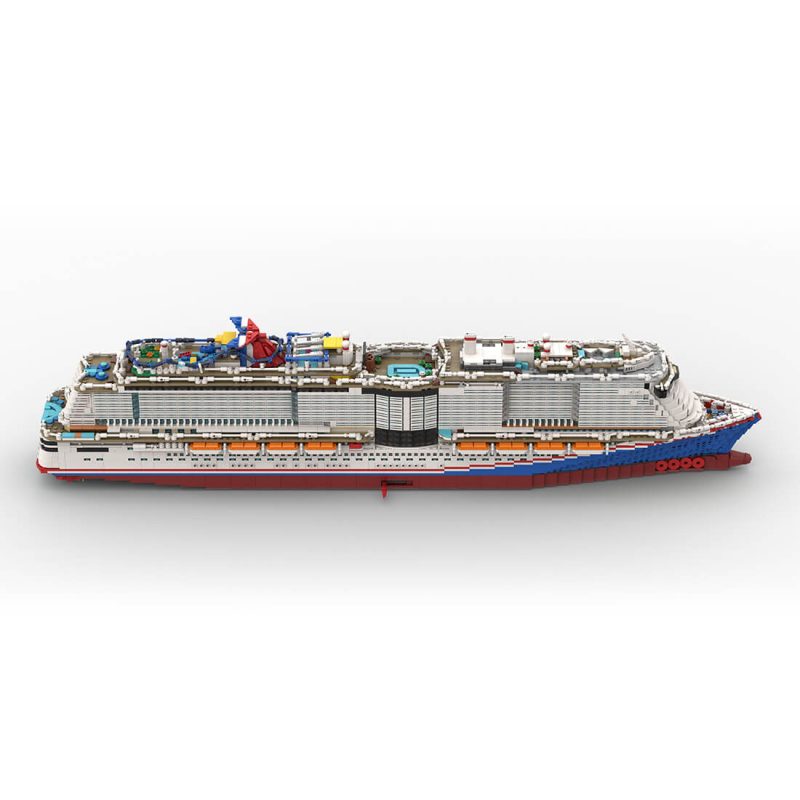
Building a nearly meter-long cruise ship from 7,379 pieces is an undertaking that demands patience, but the payoff is enormous. The build is structured around the hull first - a massive internal skeleton of plates and Technic beams that establishes the curvature and waterline of the real Carnival Celebration. From there, you layer on decks one by one, each bringing new details: pool areas, the funnel whale tail, passenger cabin rows, and the distinctive blue-and-white livery. The pacing is surprisingly well-managed for a MOC of this scale; each deck feels like a self-contained sub-build that clicks into the superstructure. At 4.5 kilograms and over 37 inches long, the final assembly steps require careful handling - you are essentially managing a structural engineering problem as much as a brick-building one. This is a multi-session build that will keep you engaged across several evenings or a dedicated weekend.
The hull construction phase is where you earn your stripes as a builder. The internal Technic framework is not glamorous to look at, but it is the engineering backbone that makes everything else possible. You are building a spine that must support 4.5 kilograms of bricks across 37 inches of horizontal span without sagging, flexing, or breaking at any connection point. The Technic beams run the full length of the hull, connected by cross-bracing that distributes load evenly. Building this phase teaches you more about large-scale structural engineering than most official LEGO sets will ever require, and the knowledge transfers directly to any big MOC project you attempt in the future.
The upper deck construction is where the build transforms from engineering exercise to creative experience. Each deck adds recognizable cruise ship features that reward your attention. The pool deck with its waterslides, the Bolt roller coaster track winding across the top deck, the rows of cabin windows along the hull sides, the distinctive Carnival funnel with its whale tail shape - these details emerge one by one as you work through the instructions, and each one makes the model look more like the real ship. By the time you reach the final deck and the funnel construction, you are looking at something that is unmistakably the Carnival Celebration, and the sense of accomplishment is proportional to the effort invested. This is not a quick build. It is a project, and it feels like one in the best possible way.
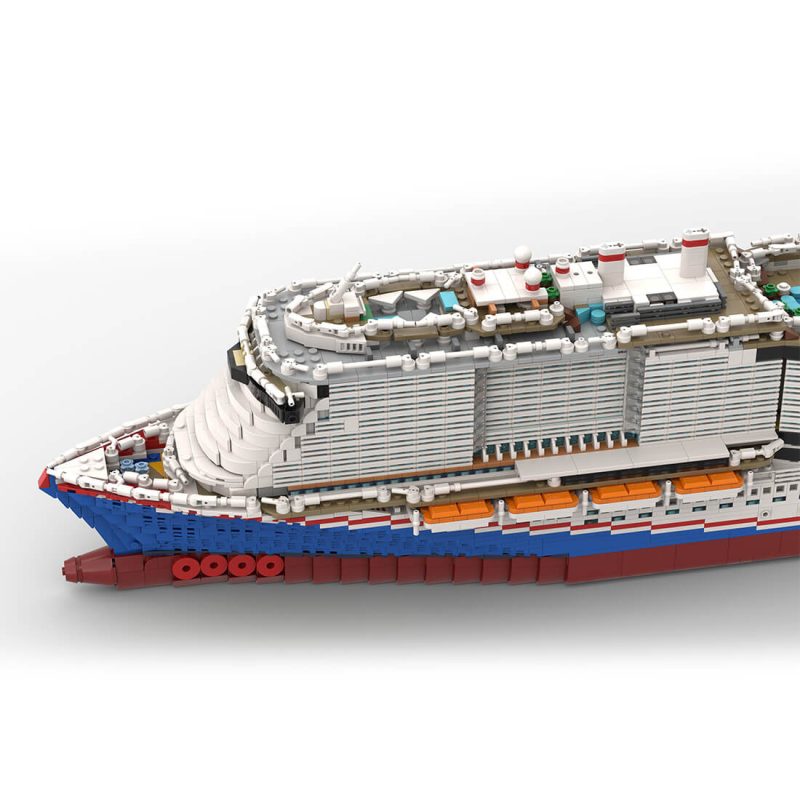
The engineering challenge of building a ship hull at this scale is where bru_bri_mocs really earns the "licensed MOC designer" title. The hull uses a combination of SNOT (studs-not-on-top) techniques and angled plate work to create the curved bow and tapered stern that define the Carnival Celebration's silhouette. Internally, a Technic-reinforced spine runs the full length of the model to prevent sag - a critical design decision when your finished build weighs 4.5 kilograms. The upper decks showcase tiered plate stacking to create the recessed balcony effect seen on real cruise ships. The Bolt roller coaster track, the world's first at-sea coaster on the real ship, is represented through clever curved element usage on the top deck. There are real lessons here in large-scale structural integrity, smooth hull shaping, and how to manage weight distribution across a long horizontal model.
The SNOT techniques used on the hull sides deserve closer examination. The hull curves in two dimensions simultaneously - it narrows from midship to bow and from waterline to keel. Achieving this compound curve in bricks requires SNOT brackets that redirect stud orientation by 90 degrees, allowing plates to be placed vertically along the hull sides. The result is a smooth surface that curves convincingly at the bow without the stepped, blocky appearance that top-stud-only construction would produce. This technique is standard in advanced ship building, but the scale at which it is applied here - across the full length of a 37-inch model - makes it particularly instructive. You see how the same principle scales up, and you learn where additional internal support is needed to keep SNOT panels secure under their own weight.
The deck layering system is another technique worth studying. Each deck sits on the one below it using a standardized connection method that provides both structural stability and easy disassembly for the builder who wants to access internal layers. The connections are tight enough to hold under the weight of upper decks but accessible enough that you can separate layers with reasonable effort. Achieving that balance between structural integrity and serviceability is a design challenge that many MOC builders struggle with, and this set demonstrates an effective solution. The tiered balcony construction on the outer hull is particularly clever, using small plate overhangs at each deck level to suggest the recessed balconies visible on the real ship's exterior. It is a simple technique - each deck extends slightly beyond the hull wall below it - but the cumulative visual effect of multiple tiers is surprisingly convincing.
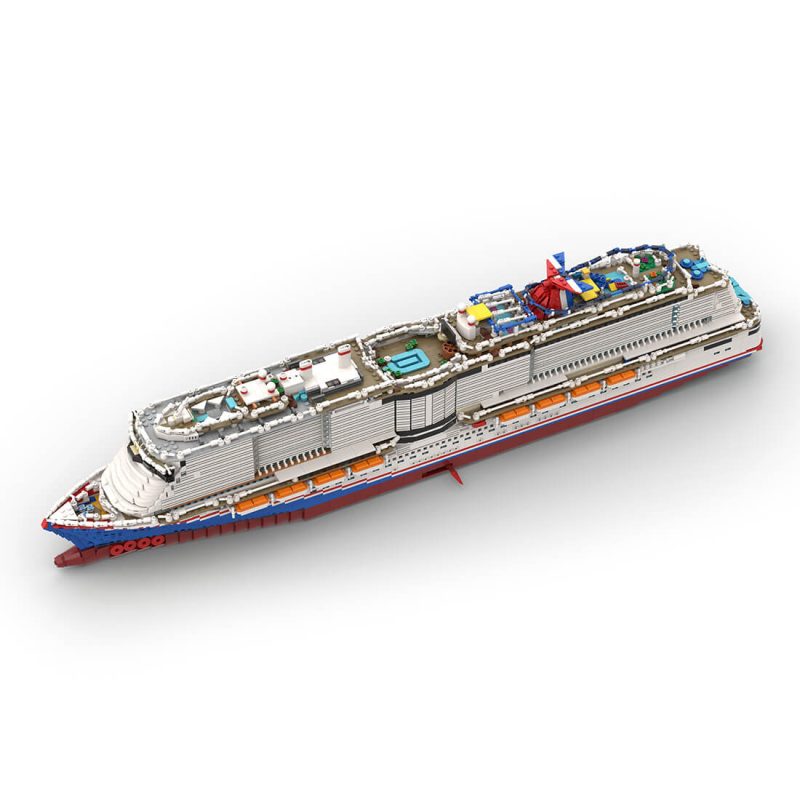
7,379 pieces is a massive parts count by any standard. The bulk of the inventory is plates, tiles, and slopes in white, blue, dark blue, and light grey - all highly reusable colors for architectural or vehicle MOCs. You get a significant number of curved slope elements and wedge plates needed for the hull shaping, which are genuinely useful if you build ships, aircraft, or any streamlined vehicles. The Technic beams and pins used in the internal framework add structural pieces to your inventory that transfer directly to any large-scale MOC project. The sheer volume of 1x2 and 2x4 plates in neutral colors makes this set a legitimate parts pack on top of being a display model. Where it falls slightly short is in specialty or unique elements - this is a MOC built primarily from common parts used in clever ways, which is actually a strength for parts reuse.
The white elements dominate the haul and deserve specific mention. Modern cruise ships are overwhelmingly white, and the Carnival Celebration is no exception. The result is that you receive an enormous quantity of white plates, tiles, bricks, and slopes in sizes ranging from 1x1 to 2x8 and larger. White is the most universally useful LEGO color, and having a deep supply of it in varied element types is genuinely valuable for any future build project. The blue and dark blue elements used for the hull below the waterline and for accent details provide a strong maritime palette. The light grey Technic elements add structural hardware. Together, these four color families - white, blue, dark blue, and light grey - represent perhaps the most versatile and reusable color distribution you could ask for in a large parts haul.
The curved and wedge elements warrant their own discussion. Ship hulls consume curved slopes and wedge plates in large quantities, and this set provides them generously. These are the same elements that aircraft builders, car builders, and anyone working on streamlined forms need in volume. Accumulating them from standard retail sets is slow and expensive because most sets include only a few curved elements as accent pieces. A 7,379-piece ship build, by necessity, includes them as structural elements, which means you get them in the quantities that actual projects demand. If you have a large vehicle or ship MOC on your to-do list, the Carnival Celebration's parts haul gives you a meaningful head start on the curved elements that will define your model's silhouette.
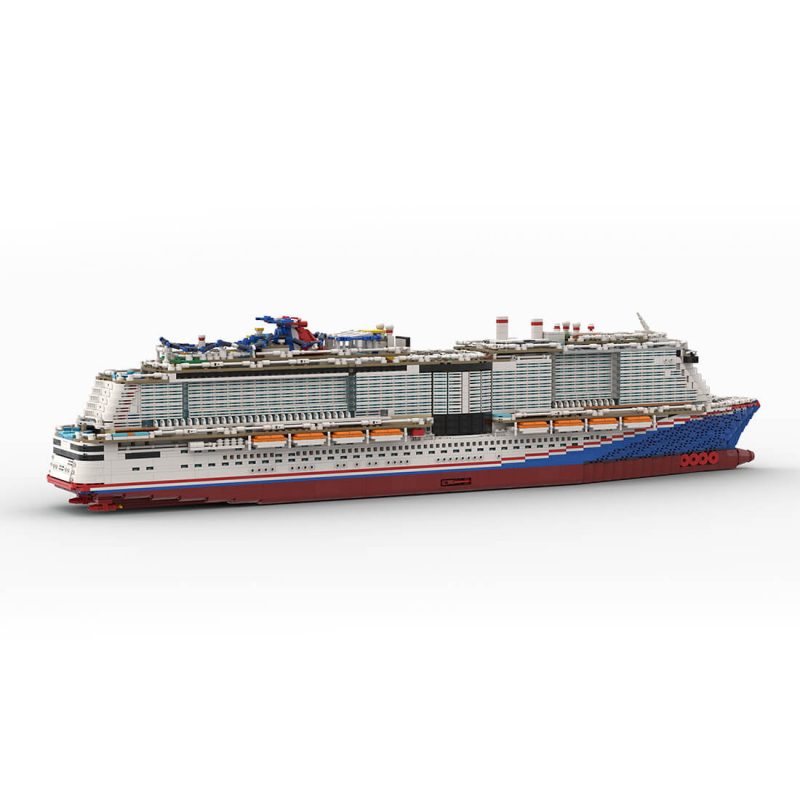
At 37.5 inches long, this model does not sit on a shelf - it commands one. The Carnival Celebration is the kind of display piece that stops people mid-conversation and forces them to walk over for a closer look. The proportions faithfully capture the Excel-class profile: the distinctive whale tail funnel, the tiered upper decks with their balcony detailing, and the sweeping bow that defines modern mega-cruise ships. From a normal viewing distance, the white-and-blue color blocking reads as unmistakably "cruise ship" in a way that smaller models simply cannot achieve.
Compare this to LEGO's own Titanic (set 10294) at 53 inches - the Carnival Celebration is shorter but arguably more visually complex thanks to the modern cruise ship's multi-level deck structures, pool areas, and waterslide features. The Titanic's beauty is in its clean lines and historical gravitas. The Carnival Celebration's beauty is in its complexity - every deck has something happening, every surface has detail, and the overall impression is of a floating city rather than a floating vessel. The two ships make excellent companions on a large display shelf, representing the past and present of ocean liner design. If you have the space, displaying them side by side creates a timeline of maritime engineering that is genuinely impressive.
The only challenge is finding display space for something this large, but that is a problem worth having. At 37.5 inches, you need a dedicated shelf, a mantel, or a display table. Standard bookshelves are too shallow unless you have an unusually deep unit. A console table, a wide windowsill, or a purpose-built display shelf are better options. The model's height is manageable - the funnel is the tallest point and it does not reach unreasonable heights - but the length demands planning. Once placed, though, it becomes the centerpiece of whatever room it occupies. Guests will comment on it. Children will want to touch it. Cruise enthusiasts will want to examine every deck. It is a display piece that earns its space through sheer visual impact and conversation-generating power.
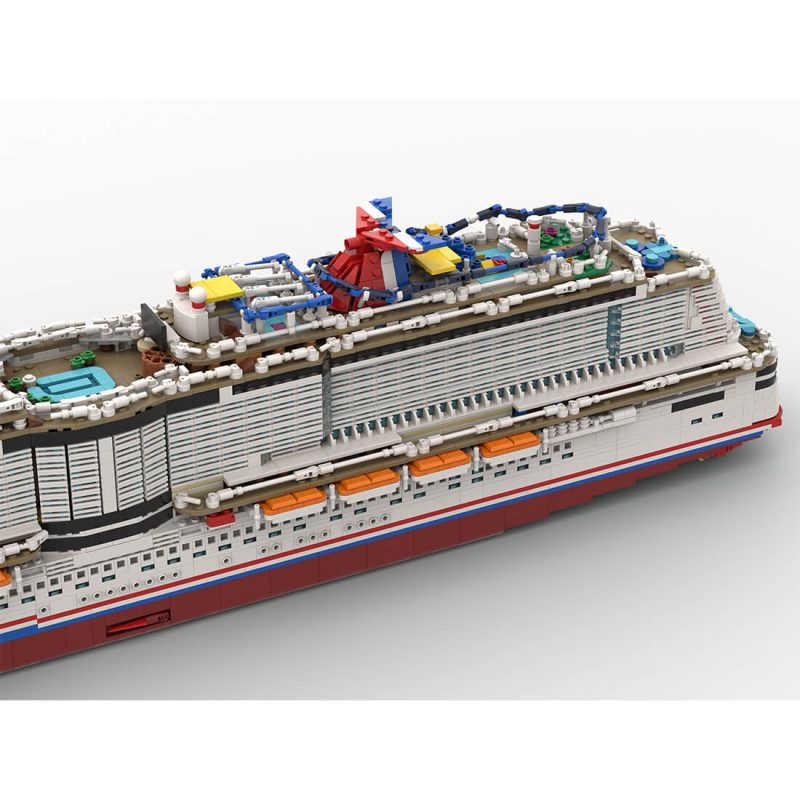
The Carnival Celebration is for the builder who wants a project, not a set. If you enjoy multi-session builds that unfold over days rather than hours, if you appreciate engineering challenges as much as aesthetic results, and if you have the shelf space to display something nearly a meter long, this build will satisfy you deeply. The scale alone sets it apart from virtually every other building set on the market, and the engineering required to achieve that scale at this weight teaches techniques that no smaller build can replicate. This is a builder's build - demanding, educational, and enormously rewarding.
Cruise enthusiasts are the other obvious audience, and they are perhaps the most underserved collector group in the building block world. LEGO has never made a modern cruise ship at display scale, and their Titanic, while magnificent, represents a historical vessel from a different era of maritime design. If you sailed on the Carnival Celebration, if you are a cruise fan who wants a model of a ship you have actually experienced, this is currently the only option at this quality level. The MOC design by bru_bri_mocs faithfully captures the Excel-class profile, and the level of detail - from the Bolt coaster to the whale tail funnel - demonstrates genuine familiarity with the source material. This is not a generic cruise ship with Carnival branding. It is the Carnival Celebration, and it looks like the Carnival Celebration.
For builders who primarily collect official LEGO, a LetBricks set represents a departure from the norm. The brick quality is compatible but not identical to LEGO, and the instruction format differs from what LEGO builders are accustomed to. These are reasonable considerations, and they are worth acknowledging before purchase. But the product itself - the design, the engineering, the finished display - delivers at a level that justifies the venture into third-party territory. Sometimes the MOC community produces designs that official manufacturers cannot or will not make, and the Carnival Celebration is a prime example. If you limit yourself exclusively to official LEGO, you will never own a modern cruise ship at this scale. If you are willing to explore beyond that boundary, this is one of the best reasons to do so.
The Carnival Celebration exists because of a gap in the official LEGO catalog that is unlikely to be filled. LEGO has shown willingness to produce historical ships (Titanic, various Pirates vessels) and small-scale modern boats (City harbor sets, Creator yachts), but a large-scale modern cruise ship sits in a category LEGO has never entered. The licensing complexity, the enormous piece count required, and the niche audience for cruise ship models make it commercially unlikely that LEGO will produce a set like this. Third-party builders like bru_bri_mocs and platforms like LetBricks fill that gap by serving enthusiast audiences that official manufacturers cannot justify targeting.
This dynamic is healthy for the building block hobby as a whole. When enthusiasts can get the specific models they want - whether that is a modern cruise ship, a specific airline livery, or a regional landmark that LEGO would never produce - the hobby becomes more inclusive and more personal. The Carnival Celebration is a perfect example of this principle in action. It exists because a talented MOC designer saw an underserved audience and created something for them, and a third-party manufacturer made it accessible at a reasonable price point. The result is a product that makes cruise enthusiasts and ship builders genuinely happy in a way that no official product currently can.
For collectors considering their first third-party build, the Carnival Celebration is a strong choice because the category it fills - large-scale modern ship - is so clearly unserved by official LEGO. You are not buying a third-party version of something LEGO already makes. You are buying something that only exists because the third-party ecosystem made it possible. That distinction matters psychologically for builders who feel loyal to the LEGO brand, because it removes the comparison anxiety. There is no official LEGO Carnival Celebration to compare against. This is the definitive version by default, and it stands on its own merits.
A 7,379-piece set at this scale represents a significant investment, but you need to evaluate it against what else exists in this space. LEGO has never made and likely will never make a modern cruise ship at this scale - the Titanic is the closest comparison, and that is a historical vessel with a very different aesthetic. This is a licensed MOC design from bru_bri_mocs, a well-regarded designer in the community, which adds credibility to the engineering. The piece-per-dollar ratio is competitive with other large-scale third-party sets.
Where the value proposition gets interesting is in the uniqueness factor: if you are a cruise enthusiast, a Carnival fan, or simply someone who wants a display model that nobody else in your building group will have, this delivers something genuinely one-of-a-kind. The sheer volume of reusable parts also offsets the cost if you ever decide to disassemble. At 7,379 pieces in predominantly white, blue, and grey, the residual parts value is substantial. The Technic framework elements alone represent a meaningful inventory of structural hardware, and the hundreds of curved slopes and wedge plates are among the most expensive element categories on the secondary market.
The investment is easiest to justify for builders who will display the finished model long-term. A display piece this large, this detailed, and this unique provides daily visual enjoyment that amortizes the cost over months and years of ownership. If you have the display space and the appreciation for maritime design, the cost-per-day of enjoyment drops to negligible levels within the first few months. For builders who might disassemble after a few weeks, the value equation is less favorable because the build-to-display ratio is less efficient. Know your building style and display commitment before purchasing, and the value will match your expectations.
- ✓ 7,379 pieces at nearly a meter long - genuine showstopper display presence
- ✓ Faithful replica of the real Carnival Celebration Excel-class ship
- ✓ Bolt roller coaster and pool deck details included
- ✓ Technic-reinforced internal structure prevents sag at 4.5kg
- ✓ Licensed MOC design by respected builder bru_bri_mocs
- ✓ Massive parts haul in versatile white, blue, and grey colors
- ✓ A cruise ship LEGO would never produce - truly unique
- ✗ At 37.5 inches, finding display space is a real challenge
- ✗ 4.5kg weight requires careful handling during final assembly
- ✗ No interior cabin detail - the focus is entirely on exterior accuracy
- ✗ Build demands patience across multiple long sessions
- LetBricks - The Alternative MOC Site - Everything you need to know about LetBricks
- Large Luxury Yacht Review - Another LetBricks vessel to explore
- LEGO Titanic Review - The ultimate ship build from LEGO
The hull interior is built as solid as the exterior, which seemed wasteful until the model hit full length and the unsupported span would've sagged without it. Every deck has actual internal bracing, not filler, not decoration, but load-bearing structure. Builders accustomed to official LEGO ship hollow cores will struggle with this discipline; LetBricks treats the interior build quality as foundational architecture, not an afterthought. The parts count reflects genuine complexity, not piece padding. Disassembly revealed zero redundant elements.
The funnel stack assembly is where the design philosophy crystallizes. Rather than printing or stickering graphics onto plain studs, LetBricks committed to color-separated funnel sections using actual painted elements and panel techniques. This extends build time significantly but prevents the visual flatness that plagues even premium official ships at this scale. That decision, choosing correctness over efficiency, separates MOCs designed by collectors from those designed by accountants.