Is the LEGO Assembly Square Worth Buying?
9.62/10. All-time great build. The 20th anniversary modular. Retired, beloved, and still one of the finest builds in the line.

Assembly Square landed in 2017 as LEGO's 20th anniversary modular, and that weight matters, it was supposed to prove the line still had fresh ideas after two decades of corner shops and townhouses. The build doesn't apologize for its ambition: 4,002 pieces across five floors of genuine architectural complexity, including a working elevator mechanism that actually functions without feeling like a gimmick. This isn't a set that coasts on nostalgia or plays it safe. It swings for something genuinely difficult to execute at this scale.
What makes this set polarizing, and worth understanding before you commit, is that it demands something most modulars don't: patience with mechanical integration. The elevator isn't decoration. It's woven into the structural logic of the building itself, which means the build sequence matters, the stability depends on understanding how forces distribute through the mechanism, and mistakes compound. For 25+ years of building, I found that refreshing. For builders who want to assemble, step back, and admire, this set can feel overcomplicated. Retired sets often become legendary because people remember them selectively. Assembly Square earned its reputation because the building itself is genuinely intricate.
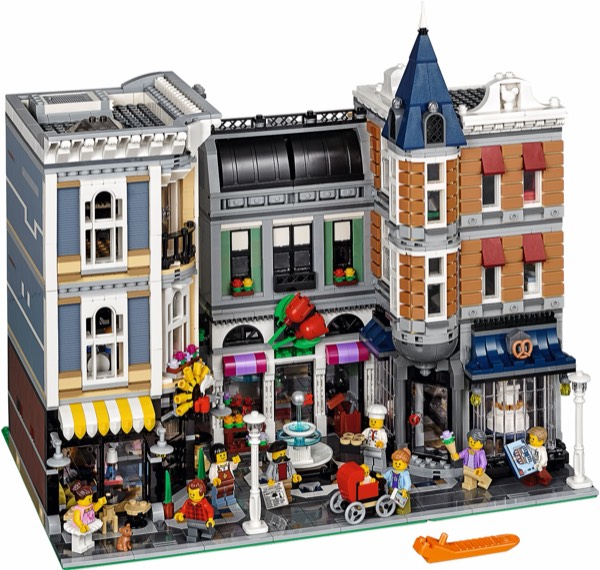
Assembly Square is the 20th anniversary modular building - 4,002 pieces across a three-section facade with ground-floor shops, residential apartments, and a rooftop garden. The build celebrates LEGO building craft with unusual technique cameos: a curved staircase, a jazz club, a dental office with functional chair, a bakery with oven. Each floor is a vignette, each room a miniature diorama. Expect 10-15 hours of building that rewards careful attention to each room.
What separates this from other large sets is the pacing. You are not stacking bricks for hours to create structural walls. Every bag opens a new room, a new business, a new living space with its own personality. The bakery on the ground floor has a working oven door, bread loaves on the counter, and a display case that actually looks like a display case. Upstairs, the music store has a guitar, a drum kit, and sheet music on a stand. The dental office - complete with reclining chair and overhead lamp - is one of those rooms that makes you stop building and just look at it for a minute.
The three-section structure means you build each third as a standalone unit before connecting them on the baseplate. This makes the build feel like three medium sets rather than one marathon, and it gives you natural stopping points. By the time you reach the rooftop terrace with its garden furniture and tiled patio, you have assembled something that feels handcrafted rather than manufactured. That is the hallmark of a great modular build, and Assembly Square delivers it across every single bag.
The curved balcony railings on the second floor use a clip-and-bar arch construction that was innovative for its time and remains a referenced technique in AFOL communities. The way the curved elements attach at slight angles to create a smooth arc is something builders still reverse-engineer for their own MOCs. It is a technique that looks deceptively simple in the finished model but requires precise spacing and connection points to hold together.
The interior room detail - cabinetry, furniture, functional props - is a showcase of compact scene-building within tight spatial constraints. Every room teaches a different interior detailing technique. The flower shop uses small plant elements and tile pieces to create product shelves that read as a real retail space. The photography studio upstairs uses a printed backdrop piece and a camera build that is only five pieces but instantly recognizable. These are the kinds of micro-builds that teach you how to suggest reality at minifigure scale without needing custom parts or massive piece counts.
The facade itself is a masterclass in layered depth. The ground floor storefronts use large window panels set back from the front plane, creating actual window depth rather than flat glass-on-wall construction. The second-floor balconies project forward, the third-floor windows are recessed, and the roofline has its own silhouette. This push-and-pull across the vertical face gives Assembly Square a sense of architectural weight that flat-fronted modulars simply cannot match. If you want to learn how to make a building facade look real, study this set before you design anything of your own.
4,002 pieces across tan, dark red, medium azure, white, and dark green. The printed shopfront tiles and internal detail prints are unique to this set. The medium azure and tan facade elements are plentiful and distinctive. The color palette alone makes this a worthwhile parts source for anyone building European-style architecture or period storefronts. You get bricks and plates in tan by the handful, and the dark red accent pieces add warmth that most modulars lack.
The unique prints deserve special mention. The bakery sign, the music store decals, the photography studio backdrop, and the dental office details are all printed rather than stickered. In 2017, LEGO was more generous with prints than they are today, and Assembly Square benefited from that era. These printed pieces have become increasingly desirable on the secondary market precisely because they cannot be reproduced from standard inventory. If you are parting out a damaged or incomplete set, the prints alone carry significant value on BrickLink.
Beyond the specialty elements, the structural parts are broadly useful. Standard 1x2, 1x4, and 2x4 bricks in tan and white make up much of the interior walls. The windows, doors, and railing elements are versatile across multiple architectural styles. 14 minifigures round out the haul, and while the figures are not the primary draw here, several have unique torso prints tied to their professions. A strong haul for any modular or architectural MOC work, and even stronger if you value prints over stickers.
Modular standards are simply the finest display sets in all of LEGO - and Assembly Square, as the anniversary celebration, is the finest of the fine. The three-section facade, the rooftop garden, the period-accurate street lamps, the ground-floor detail visible through large windows - it is the standard against which all building sets are measured. Put this on a shelf and it anchors everything around it. The height, the width, the color palette - it commands attention without shouting.
The real display magic is the interior. Most modulars look impressive from the front but offer limited interest from the back or sides. Assembly Square rewards a full 360-degree view. Remove the rear wall panels and every room is a fully decorated diorama. The jazz club has a stage, instruments, and seating. The apartments have kitchens, bedrooms, and living spaces with actual furniture. Visitors to your display will spend five minutes looking at the facade and then fifteen minutes peering into rooms from the back. That ratio tells you everything about this set's display depth.
Paired with other modulars on a street layout, Assembly Square functions as the anchor building - the one that draws the eye first and sets the standard for the rest of the row. Its rooftop garden creates a natural visual peak that shorter modulars can play against. The medium azure and tan color scheme is distinctive enough to stand out but neutral enough to harmonize with the red, green, and sandstone tones of other sets in the line. It was designed as a celebration of everything modular, and on display, it fulfills that role completely.
Retired in 2019, now consistently selling for the retail price-400 depending on condition. Used complete copies run the retail price-200. At those prices the value math depends on your intentions. For display: buy used complete, you will not regret it. For parts: better value sets exist. For the build experience alone: hunt a complete used set. The original retail was the retail price, which at 4,002 pieces was already strong value for a set of this complexity and detail level.
The secondary market trajectory is worth understanding. Assembly Square held its value steadily after retirement, then climbed sharply as modular collecting grew through 2023-2025. It has not experienced the dramatic spikes of some retired modulars like Cafe Corner or Green Grocer, but it has maintained a reliable floor price that keeps rising. New sealed copies are now investment-grade pieces that regularly sell above the retail price. If you are buying to build and display, sealed is a waste of money - a used complete set delivers the identical experience at half the price.
For current market pricing and availability, check eBay listings for LEGO 10255 to see what complete sets are going for right now. Prices fluctuate week to week, but patient buyers who watch listings for a few weeks can often find deals below the average. Also keep an eye on our Retiring Sets Tracker for current sets that may follow a similar appreciation path after they leave shelves.
Assembly Square includes 14 minifigures, and while that number alone is impressive for a single set, the real value is in the variety. You get a full cast of characters tied to the businesses and residences inside the building. The baker wears a white chef's coat and comes with a croissant and bread accessories. The barista has an apron and coffee cup. The dentist has a white lab coat and dental tools. The florist, the music store employee, the photographer - each one is dressed for their specific role, and several feature unique torso prints that were exclusive to this set.
Beyond the shop workers, you get residents and visitors that bring the building to life. A baby figure in a stroller was a relatively new addition to the LEGO minifigure lineup when this set released, and it adds a domestic touch that most modulars lack. There is a couple having coffee at the outdoor cafe table, a child visiting the flower shop, and a ballerina practicing in an upstairs studio. The mix of ages, occupations, and activities gives Assembly Square the feeling of a real neighborhood rather than a collection of storefronts.
None of these figures are going to rival licensed theme minifigures on the secondary market, but that is not the point. They serve the build. Place the dentist in the dental office, the baker behind the counter, the musician on the jazz club stage, and the building transforms from architecture into a living scene. That is what modular minifigures should do, and Assembly Square's cast does it better than almost any other set in the line. If you are buying a used set, make sure all 14 figures and their accessories are included - missing minifigures will affect both the display value and the resale value of the set.
If you collect modular buildings, you already know you need this set. It is the anniversary piece, the one that references and celebrates everything that came before it in the line. Skipping Assembly Square in a modular collection is like owning every Beatles album except Abbey Road. You can do it, but why would you? For modular collectors, the only question is sealed versus used, and unless you are treating it purely as an investment, used complete is the right answer every time.
For builders who have never tried a modular before, Assembly Square is an outstanding entry point. It teaches you the baseplate connection system, the interior detailing philosophy, and the facade construction principles that define the entire line. It is complex enough to challenge experienced builders but structured enough that newer AFOLs will not get lost. The bag-by-bag room construction gives you constant variety and a sense of completion at each stage. If someone asked me to recommend a single set that demonstrates what LEGO can do at its best, this would be in my top three answers.
Display-focused collectors who may not care about the build process should still consider this set. A completed Assembly Square on a shelf is one of the most impressive single LEGO displays you can own. It photographs well, it sparks conversation, and it holds its visual appeal over years of display without fading into background furniture the way some sets do. Parents looking for a shared build project will also find this rewarding - the room-by-room structure makes it easy to trade off sections, and the interior details give younger builders (10+) something to engage with beyond pure construction.
Assembly Square was designed to sit on a modular street, and it looks best when it has neighbors. The most natural companions are other retired modulars from the same era: the Parisian Restaurant (10243) shares the European architectural flavor, and the Detective's Office (10246) brings a complementary dark color scheme that contrasts well with Assembly Square's lighter tones. If you are building a street layout, these three together create a varied and visually rich block face.
Among currently available or recently retired modulars, the Boutique Hotel (10297) and Jazz Club (10312) are strong pairings. The Boutique Hotel's Art Deco facade provides architectural contrast, while the Jazz Club echoes the musical theme that Assembly Square's own jazz room introduces. For a ranked breakdown of how every modular stacks up and which ones to prioritize for your street layout, check our Best LEGO Modular Buildings Ranked guide.
Outside the modular line, smaller display pieces can complement Assembly Square without competing with it. A Bonsai Tree (10281) or Flower Bouquet (10280) placed nearby adds organic texture that softens the architectural lines. Street-level Creator 3-in-1 buildings scaled to match can fill gaps in a modular layout without the price tag of a full modular set. The key is keeping Assembly Square as the anchor - it is the tallest, widest, and most detailed piece on the shelf, and everything else should support that rather than fight it for attention.
- ✓ 20th anniversary modular - a milestone set
- ✓ 14 minifigures and rich interior detail
- ✓ Curved balcony railing technique is widely referenced
- ✓ Tan/azure facade is one of LEGO's best colorways
- ✓ Strong secondary market resilience
- ✗ Retired - secondary prices are high
- ✗ New sealed copies command significant premium
Find on BrickLink → Find on eBay →
Affiliate link. Some products may be provided by the manufacturer. All opinions are my own.
- Best LEGO Modular Buildings Ranked - Every modular rated and ranked for collectors
- Modular Buildings as Investments - Are modular buildings worth collecting?
- Modular Building Standards - The design rules behind LEGO modulars
- Retiring Sets Tracker - Know which sets are leaving shelves soon
- Bonsai Tree Review - A popular display companion piece
The elevator mechanism uses a surprisingly elegant solution: no motors, no electronics, just gravity and strategic friction points that let you turn a small crank and watch the cabin rise and fall through all five floors. Most builders expect this to feel fragile or require constant adjustment, but the engineering holds. What genuinely surprised me was how much the mechanism's existence changes the interior design, entire rooms have to accommodate the shaft, which means dead space that other modulars simply don't have. This forced limitation actually makes the floor plans feel more authentic to real architecture than the standard rectangular layouts.
The parts distribution reveals LEGO's confidence in this set: surprisingly few corner bricks, which means you can't easily cannibalize this into MOCs without rebuilding significant sections. That's not a flaw, it's intentional. The modular line thrives when sets retain structural integrity rather than becoming parts donors. The minifigure selection is restrained (only 5), which initially felt cheap until you realize the building's visual weight carries the set, not packed minifigure variety. Anniversary sets are supposed to define a moment. This one does.
Track it in your vault on GameSetBrick - our free collection app. Log your condition, price paid, and watch the real-time market value.
Track in Your Vault →Save it to your wishlist on GameSetBrick. Share your list with friends and family - every set has a buy button so gift givers know exactly where to go.
Add to Wishlist → GameSetBrick is a free app by The Earl of Bricks. See all features. Scan it. Track it. Trade it.