Is the LEGO Concorde Worth Buying?
9.5/10. Worth buying. Supersonic speed, timeless design, and 2,083 pieces of aviation history. The fastest commercial aircraft ever built, now in LEGO form.

The Concorde sits in a strange place in the LEGO Icons lineup, it's a set that demands you care about something most people under 40 have never experienced. This isn't a pop culture IP or a universally recognized building challenge like the Titanic. It's a monument to a specific era of optimism about technology, to British-French cooperation, and to the idea that speed itself could be beautiful. Building it feels less like assembling a toy and more like reconstructing a piece of aviation mythology that crashed out of commercial service in 2003. The model respects that gravity.
What caught me during the build was how Lego handled the fundamental problem: making something actually supersonic-shaped work at display scale without sacrificing structural integrity. The fuselage tapers in ways that feel counterintuitive for a brick system, and there are moments where you'll second-guess the design. Then the nose comes together. Then the delta wings lock in. And you understand the choice wasn't laziness, it was restraint. This set knows exactly what it's trying to say, and it doesn't apologize for being niche.
The Concorde builds into a model that is 41 inches long. Three and a half feet of supersonic jet on your table. At 2,083 pieces, I spent about nine hours on it over two evenings and a Saturday morning, and every stage taught me something about both LEGO engineering and the actual aircraft.
You start with the nose section, which means you are immediately building the droop-nose mechanism - the Concorde's most famous feature. The real aircraft had a hydraulic nose that tilted down during takeoff and landing so pilots could see over the extreme angle, then retracted flush for supersonic cruise. LEGO replicated this with a gear-and-hinge system that clicks through three positions: up, intermediate, and fully drooped. Building it is the first real engineering moment of the set. Feeling it click through the positions for the first time is excellent.
The fuselage construction is where you learn to make curved surfaces from rectangular pieces. The Concorde's cross-section is basically an elongated tube, which is not a shape LEGO does naturally. The solution is layered SNOT construction - white curved slopes on the outside, structural Technic elements on the inside. The result actually looks aerodynamic. You build the fuselage in sections and connect them, and it gives you real appreciation for what the LEGO designers pulled off here.
The delta wings are the longest phase and arguably the most impressive. Building them is completely different from any conventional LEGO aircraft. You build each wing flat, then attach it at the correct sweep angle using a combination of plate stacking, hinge connections, and structural reinforcement. What starts as a floppy assembly becomes a surprisingly rigid wing surface. When you attach the completed wings to the fuselage, the model transforms. It goes from an interesting white tube to an unmistakable Concorde.
This is one of the most technically sophisticated sets in the catalog, and the techniques transfer to basically anything you might build afterward. The smooth-surface construction on the fuselage is a complete education in SNOT building - every panel and transition demonstrates a different approach to hiding studs and getting clean lines. I would honestly recommend building this set with a notebook handy.
The droop-nose mechanism is the technical star. Standard LEGO gears, Technic axles, and custom linkages translate rotational input into controlled angular movement. Simple enough to understand once you have built it, complex enough to be impressive. It works smoothly and holds position at each stop. The approach is directly applicable to any MOC that needs controlled articulation - animal heads, crane booms, doors that open and close.
The delta wing geometry forces you into angular building techniques that rarely come up in standard sets. Elements meeting at acute angles, hinge plates, strategic flex in the plate layers to hit the correct sweep. Learning to build a large flat surface at an angle and then reinforce it for rigidity is valuable for ship hulls, rooflines, vehicle panels - anything with an angled surface at scale.
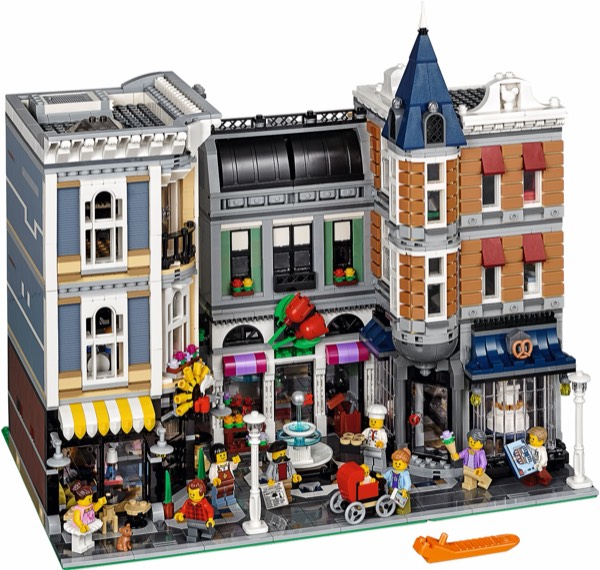
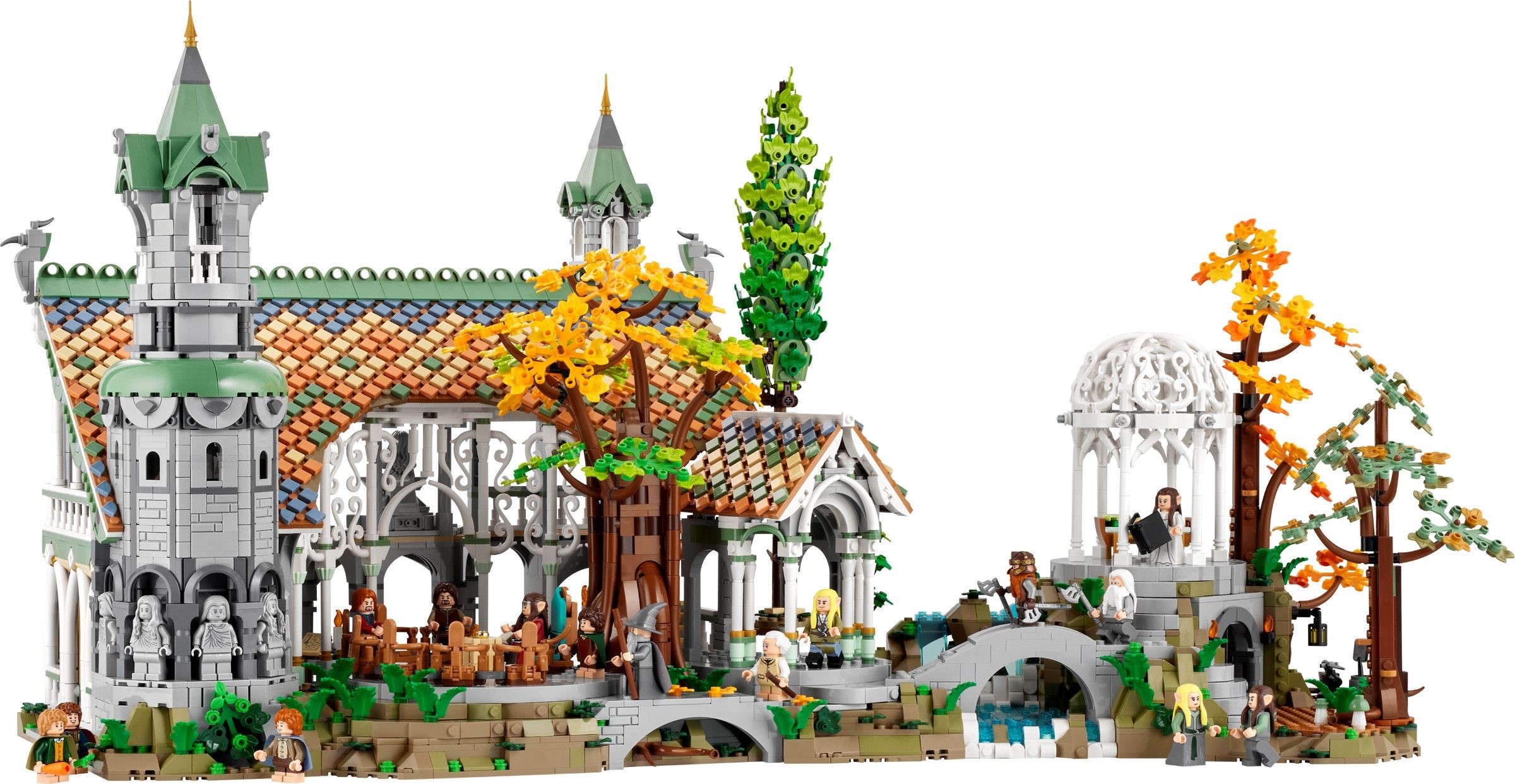
The engine nacelles are underappreciated. Four Olympus engines, built individually and mounted in paired pods under the wings. Radial construction for the intake rings and exhaust nozzles, rectangular cross-sections that require yet another approach to smooth surfaces. They look convincingly mechanical and proportionally correct. The techniques complement what you learn building organic shapes in sets like The Shire - different problems, similar creative thinking.
Mostly white. That is both the strength and the limitation. White curved slopes, plates, tiles, and bricks in quantities that will make you very happy if you build vehicles, modern architecture, or anything with a clean light palette. The variety of white curved elements alone - 1x2, 2x4, 3x4, inverse curves - is a comprehensive toolkit for smooth white surfaces.
Inside the fuselage and wings, there is a solid collection of structural Technic elements - long beams, axles, pins, connectors. Invisible in the finished model but essential to its rigidity. When you eventually take this apart (if you take it apart), those Technic pieces are fully reusable for structural MOC work. Two categories of useful parts from one build.
Transparent elements are limited - cockpit windscreen, navigation lights, a few cabin windows. Dark blue and dark grey from the landing gear and wheel wells add some color variety. The gears from the droop-nose mechanism are reusable in any mechanical build, and the hinge plates from the wings are consistently useful connectors.
retail price for 2,083 pieces works out to about 9.6 cents per piece. Competitive for Icons and below the theme average. The element size skews toward medium and large pieces - substantial wing plates rather than tiny detail elements - so the weight-per-dollar is favorable even if the piece count is not the highest. If you value usable elements over raw count, this delivers.
At 41 inches, this is one of the largest single-model LEGO sets you can buy, and the delta wing silhouette is recognizable from across any room. The all-white color scheme reads as aviation art, not toy. It earns its shelf space on visual impact alone.
The included display stand holds the model at an angle that suggests flight - nose up, landing gear retracted. The angle shows off the wing planform perfectly while keeping things stable. The stand itself is a simple black structure with a printed information plaque. Unobtrusive, museum-quality touch.
Two display modes, and they create genuinely different impressions. Flight configuration is sleek and purposeful - every line flows nose to tail. Landing configuration with the drooped nose and deployed gear gives it an almost predatory look, like a bird of prey scanning the ground. Both are worth displaying. Swapping between them keeps things fresh.
Fair warning on the footprint: 41 inches is substantial, and the delta wings add serious width. This does not fit on a standard bookshelf. You need a deep shelf, a mantle, or a dedicated surface. Measure your display space before you buy, because plenty of people are surprised by the finished dimensions. Once you find it a home, though, this is one of the most impressive conversation pieces in the catalog. See our best LEGO sets for adults for where it ranks overall.
the retail price is the sweet spot of premium LEGO pricing. Serious enough to feel like a real purchase, not so much that you need approval from anyone. Eight to ten hours of build time puts the cost-per-hour at roughly the price range comparable to dinner and a movie but with a permanent display piece at the end.
The technique education alone is worth a big chunk of the price. Smooth surfaces, mechanical articulation, angular geometry, structural reinforcement - skills you will use on every MOC project going forward. You are not just building a model. You are learning how to build better.
Display value is durable. The Concorde has cultural weight that goes way beyond LEGO fandom. Visitors do not need to care about bricks to appreciate this - they just need a passing interest in aviation or engineering. It starts conversations. It invites close inspection. That kind of display piece holds its value indefinitely.
Investment-wise, the Concorde as a cultural icon has staying power, and LEGO sets with strong brand recognition appreciate well after retirement. The size, display quality, and droop-nose mechanism all drive collector demand. Whether you build and display it, hold it sealed, or eventually part it out for the white element haul, it delivers on the the retail price.
The Concorde was not just an airplane. It was proof that humans could build something absurdly ambitious just because they wanted to. Developed jointly by British Aircraft Corporation and Aerospatiale, it entered commercial service in 1976 and flew for 27 years at Mach 2.04 - twice the speed of sound. London to New York in three and a half hours. Thanks to the time zones, you technically arrived before you departed. Nothing before or since has matched that.
The engineering was extraordinary. The delta wing - faithfully captured in this LEGO model - was critical for both supersonic efficiency and low-speed handling. The droop nose was not decorative; at the extreme nose-up angles required for takeoff and landing, pilots literally could not see the runway over the fuselage. The four Olympus turbojets with afterburners pushed through the sound barrier and held cruise at 60,000 feet, where passengers could see the curvature of the Earth out the cabin windows.
It retired in 2003 - economics, a tragic accident in 2000, and the post-9/11 aviation world all played a part. No replacement has flown. Supersonic commercial aviation lasted exactly one aircraft type and 27 years. This LEGO set is a tribute to that era. People once routinely flew faster than a rifle bullet while drinking champagne, and we just stopped doing it. The model captures not just the shape but the ambition, and keeping one on display feels like a small act of remembrance.
- ✓ Droop-nose mechanism with three positions is a genuine engineering highlight
- ✓ 41-inch finished model has commanding display presence
- ✓ Smooth-surface construction techniques are educational and applicable to MOCs
- ✓ Delta wing geometry introduces unique angular building approaches
- ✓ Two display modes - flight and landing - offer visual variety
- ✓ Cultural significance of the Concorde adds display depth beyond LEGO fandom
- ✓ Competitive price-per-piece ratio for the Icons theme
- ✗ All-white color scheme limits parts haul versatility for some builders
- ✗ Large display footprint requires dedicated shelf space with depth
- ✗ No interior cabin detail visible without disassembly
- ✗ Wing tips can be slightly fragile during handling
Some products may be provided by manufacturers. This page contains affiliate links. All opinions are my own.
- Rivendell Review - Another Icons masterpiece at the top of its class
- The Shire Review - Tolkien's peaceful heart of Middle-earth in brick form
- Best LEGO Sets for Adults 2026 - Our picks for the year's top builds
- LEGO Pricing Hot Take - Which sets deliver real value for your money
- LEGO Gift Guide 2026 - The best sets at every price tier
The stand deserves its own paragraph. Most display sets treat the stand as an afterthought, something to keep the model from toppling. This one treats it as part of the experience, the black base, the minimal nameplate, the angle that forces you to view the Concorde the way you'd see it on a runway. It's how LEGO signals that this is a museum piece, not a toy. That matters when you're defending a 2,083-piece purchase to someone who asks why you'd build a plane that doesn't fly.
The other reveal: this set generates legitimate MOC potential for specialist builders, not because the parts selection is "versatile," but because the construction techniques solve real problems. The fuselage engineering, how the tapering integrates with the internal structure, gives you a masterclass in using slope bricks for organic curves at scale. Anyone serious about building streamlined spacecraft, aircraft, or vehicles with non-rectangular profiles will mine this build for approaches. That's not filler. That's architectural knowledge baked into a licensed product.
Track it in your vault on GameSetBrick - our free collection app. Log your condition, price paid, and watch the real-time market value.
Track in Your Vault →Save it to your wishlist on GameSetBrick. Share your list with friends and family - every set has a buy button so gift givers know exactly where to go.
Add to Wishlist → GameSetBrick is a free app by The Earl of Bricks. See all features. Scan it. Track it. Trade it.