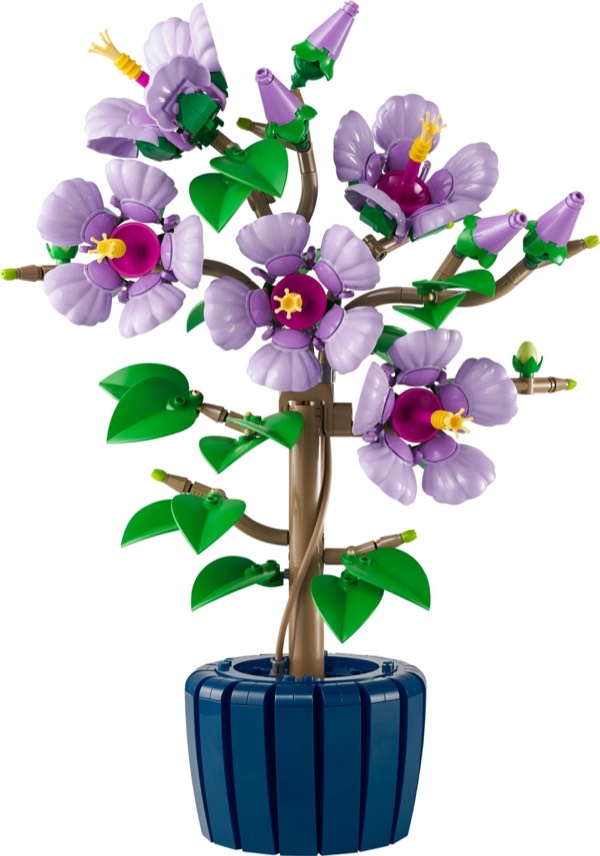
The LEGO Hibiscus (10372) arrives with the confident packaging that has become the signature of the Botanical Collection - a dark box with the finished model photographed against a complementary background that makes it look like something you would find in a home decor catalog rather than a toy aisle. Inside you will find five numbered bags containing 660 pieces, a detailed instruction booklet, and enough vibrant red, orange, and green elements to fill your building tray with tropical color before you even start assembly. There are no minifigures in this set.
The parts immediately announce what this set is about: bold, saturated color. The reds and oranges for the hibiscus petals are vivid in a way that few LEGO sets achieve, and the various shades of green for the stems and leaves range from bright green to dark green with some olive tones mixed in. The vase elements in a warm terracotta-inspired color complete the tropical palette. LEGO has clearly studied real hibiscus plants, and the color choices reflect the kind of bold, unapologetic vibrancy that defines tropical flora.
At 660 pieces, this is a mid-weight Botanical set that promises a substantial build without the marathon commitment of the largest models in the line. The box contents suggest roughly two hours of building, which hits the sweet spot for an evening project - enough time to achieve flow state without losing an entire weekend. Everything inside is precisely what you need to build a convincing tropical flower arrangement that belongs in any room of your home.
The Hibiscus build begins with the vase - a warm-toned vessel that uses a combination of curved bricks and standard plates to create a shape that suggests hand-thrown pottery. The vase construction is satisfying in its own right, establishing a solid foundation both literally and experientially. You know from the first ten minutes that this set cares about the details. The weight and proportions of the vase feel balanced before you even add the first stem, which is a good sign for the display quality to come.
The stems and leaves occupy the middle portion of the build, and this is where the meditative quality kicks in. Each stem is built individually using a spine of Technic elements wrapped in green plates and tiles, then topped with leaf assemblies that angle outward at naturalistic positions. The repetition is intentional and welcome - you are building the same core structure multiple times with slight variations, which creates the kind of rhythmic construction that quiets mental noise and lets you focus entirely on the task in front of you. The Orchid achieves a similar meditative pacing, and the Hibiscus matches it step for step.
The flower heads are the grand finale and the most rewarding portion of the build. Each hibiscus bloom is constructed from large curved petal elements arranged around a central stamen structure, and watching these flowers take shape is genuinely exciting. The petals overlap and curve in a way that captures the characteristic ruffled edge of a real hibiscus, and the color graduation from deep red at the base to orange at the tips is achieved through careful part selection rather than printing. When you attach the completed flowers to their stems and step back, the visual payoff is immediate and striking. The entire build takes approximately two hours at a relaxed pace, and the satisfaction curve climbs steadily throughout. This is a set that rewards patience with beauty, which is exactly what a botanical build should do.
The petal construction is the technical centerpiece of the Hibiscus set, and it introduces a technique that advanced builders will find immediately useful. Each petal uses a combination of curved slope elements and standard plates arranged at compound angles to create the characteristic wide, ruffled shape of a hibiscus flower. The connection method relies on a central hub with multiple attachment points that allow each petal to sit at a slightly different angle, breaking the symmetry just enough to read as natural rather than mechanical. This is the same design philosophy that makes real hibiscus flowers so visually interesting - no two petals are exactly alike.
The stamen construction is another noteworthy technique. The central column that extends from each flower uses small Technic elements and bar connections to create a tall, thin structure that supports tiny anther elements at the top. Building a convincingly delicate botanical feature at LEGO scale is challenging because the medium naturally tends toward bulk, and the designers have solved this elegantly. The technique translates directly to any MOC that requires thin vertical elements - antennae, flagpoles, or decorative architectural details.
The stem flexibility is the third technique worth studying. By using Technic axles as internal spines, the stems can be gently curved after construction to adjust the angle and spread of the arrangement. This is not a new technique in the Botanical Collection - the Pretty Pink Flower Bouquet uses a similar approach - but the Hibiscus implementation is particularly clean. The green outer shell hides the Technic core completely, so the finished stems look like solid botanical forms rather than engineering structures. For MOC builders working on any kind of flexible organic element, this is a masterclass in hiding your structural skeleton. The Japanese Maple Tree uses a related approach for its branches, and studying both sets together gives you a complete toolkit for organic LEGO construction.
660 pieces in a tropical color palette makes the Hibiscus a valuable parts haul for builders who work with vibrant colors. The red and orange curved elements used in the petals are the headline items - these specific shapes and colors are uncommon in standard LEGO sets, and having a concentrated supply opens up possibilities for flame effects, sunset-colored architecture, or custom flower MOCs. The quantity of curved slopes in this set alone justifies the purchase for some parts-focused builders.
The green elements are equally valuable, spanning multiple shades that are essential for any botanical or landscape MOC. Dark green plates, bright green slopes, and olive-toned tiles provide the kind of color depth that makes vegetation look realistic rather than flat. The Technic spine elements - axles, connectors, and pins - are universal building components that serve double duty as structural support in the set and general-purpose connectors in your parts collection. You can never have too many Technic pins, and the Hibiscus contributes a healthy supply.
The vase pieces deserve special mention. The curved bricks and slopes in warm terracotta tones are useful for architecture, pottery, and any MOC that requires earth-toned curved surfaces. These elements appear less frequently in LEGO sets than their grey or white counterparts, which makes them genuinely valuable additions to a parts library. At 660 pieces for $69.99, the per-piece cost of approximately 10.6 cents is competitive for the Botanical Collection and reasonable for the specialized nature of the elements. The parts haul alone does not justify the purchase, but combined with the build experience and display quality, it adds meaningful secondary value.
The Hibiscus is one of the most visually impactful sets in the Botanical Collection, and it achieves this through sheer chromatic confidence. Where other botanical sets rely on subtle natural tones, the Hibiscus embraces bold tropical color with the kind of fearlessness that makes it impossible to overlook on a shelf. The large red and orange blooms create focal points that draw the eye immediately, while the green stems and leaves provide enough visual contrast to keep the arrangement feeling balanced rather than overwhelming. This is a set that announces itself from across the room.
The display footprint is moderate - the arrangement fits comfortably on a standard bookshelf or side table without demanding excessive space. The height of the tallest stems gives the model vertical presence that reads as elegant rather than imposing, and the vase provides a stable, grounded base that makes the display feel intentional. Partner-friendliness is strong here because hibiscus flowers are universally recognized and appreciated as home decor. You are not displaying a toy - you are displaying a tropical flower arrangement that happens to be made from LEGO bricks. The maintenance-free aspect is particularly appealing for the kind of person who loves the look of fresh flowers but does not want to replace a bouquet every week.
Under natural light, the red petals glow with warmth that photographs beautifully. Under warm artificial lighting, the orange tones come forward and the whole arrangement takes on a sunset quality that transforms the mood of a room. This is a set that changes character depending on the light, which gives it a dynamism that static displays rarely achieve. For display ideas and placement tips, the Hibiscus pairs particularly well with the Orchid for a pink-and-red botanical shelf, or stands alone as a statement piece in a minimalist room. If you are looking for a botanical set that makes a visual impact, few in the collection can match the Hibiscus. For more display-worthy sets, see our ranking of the best LEGO sets for adults in 2026.
At $69.99 for 660 pieces, the Hibiscus sits at approximately 10.6 cents per piece - a competitive ratio within the Botanical Collection and reasonable for a display-grade set with specialized elements. The price positions it in the mid-range of the line, above the smaller entry-level sets but below the premium large-scale builds. For what you get - two hours of meditative building, a stunning tropical display piece, and a useful parts haul - the asking price feels fair.
The comparison to real floral arrangements puts the value in perspective. A quality artificial hibiscus arrangement from a home decor retailer costs $50 to $100 and arrives pre-assembled with no interactive value. The LEGO version costs $69.99 and provides the building experience, the customization options, the parts for future projects, and the conversation-starting novelty of being constructed from bricks. When you consider that real fresh hibiscus flowers last about a week before wilting, the permanence of the LEGO version becomes its own form of value. You buy it once and it stays beautiful on your shelf indefinitely.
The main value concern is that $69.99 puts the Hibiscus in direct competition with other excellent sets at the same price point, both within and outside the Botanical Collection. Buyers need to genuinely want a tropical flower display to choose this over, say, a Speed Champions multi-pack or a Creator 3-in-1 set with more pieces. But for builders who are specifically shopping the Botanical line, the Hibiscus offers one of the best combinations of build quality, display impact, and color boldness available. It fills a niche that no other set in the collection occupies, and for tropical plant lovers, that specificity is worth the premium.
- ✓ Bold tropical color palette unlike anything else in the line
- ✓ Petal construction technique is genuinely impressive
- ✓ Strong display presence with room-changing visual impact
- ✓ Meditative two-hour build with steady satisfaction curve
- ✓ Useful haul of rare red, orange, and terracotta elements
- ✗ $69.99 faces stiff competition at the same price point
- ✗ Bold colors may not suit every room's aesthetic
- ✗ Stem repetition may feel monotonous for some builders
Affiliate link. Some products may be provided by the manufacturer. All opinions are my own.
- Orchid Review - The Botanical Collection's most therapeutic build and a perfect shelf partner
- Pretty Pink Flower Bouquet Review - Another vibrant floral arrangement in the line
- Japanese Maple Tree Review - A tree sculpture with equally bold autumn colors
- LEGO Display Ideas - Creative ways to showcase your botanical collection
- Best LEGO Sets for Adults 2026 - Our full ranking of the best adult builds this year
Track it in your vault on GameSetBrick - our free collection app. Log your condition, price paid, and watch the real-time market value.
Track in Your Vault →Save it to your wishlist on GameSetBrick. Share your list with friends and family - every set has a buy button so gift givers know exactly where to go.
Add to Wishlist → GameSetBrick is a free app by The Earl of Bricks. See all features. Scan it. Track it. Trade it.