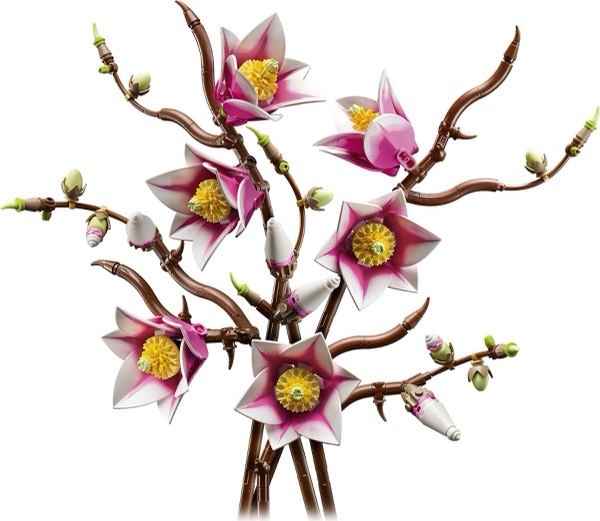
The Magnolia Branches set represents a deliberate departure from the bouquet-style Botanicals sets that have dominated the line since its inception, sets like the Orchid (#10311) and the Pretty Pink Flower Bouquet (#10342). Rather than building individual flowers and arranging them in a vase, you are constructing branches, complete with bark-textured limbs, carefully positioned blossoms, and the subtle asymmetry of a tree limb that grew toward the light. At roughly 400 pieces, this is a compact build that takes about ninety minutes to two hours, and the pacing is noticeably different from other Botanicals. You spend more time on structural branching and less time on individual flower construction, which gives the build a more architectural quality that I found genuinely refreshing within the Botanicals lineup.
The branch construction is the backbone of this build, literally and figuratively. LEGO uses a combination of brown and dark brown elements in varying textures to create limbs that have visual depth and irregularity. The primary branches connect to a central trunk section via Technic pin connections that allow you to set each branch at a specific angle, and the secondary branches extend from these using clip and bar connections that provide further positional flexibility. The result is a framework that looks organic and natural rather than geometric, which is the essential challenge of any botanical branch build. Getting this right required careful part selection on LEGO's part, and they have succeeded. The branches look like branches, not like brown sticks with flowers glued to them.
The magnolia blossoms themselves are smaller and more delicate than the flowers in most Botanicals sets, which is appropriate for the species. Each bloom uses soft pink and white petal elements arranged around a yellow-green center, and the construction is simpler per flower but multiplied across many blooms that dot the branches. Some blossoms are fully open while others are still in bud form, and this variety in bloom stage adds realism that experienced gardeners will notice and appreciate. The bud construction is particularly clever, using a few curved elements folded inward to suggest a flower that has not yet opened, and the visual difference between buds and full blooms gives the arrangement temporal depth, as if you are seeing the branch at a specific moment in its spring flowering cycle.
The build concludes with the vase and final arrangement, and here the set asks you to make aesthetic decisions about branch angle and bloom positioning that personalize your display. This participatory finishing step has become a hallmark of the better Botanicals sets, and LEGO executes it well here. The vase is a simple cylindrical form in a muted neutral tone that lets the branches be the visual focus, and the overall arrangement has a Japanese ikebana quality that feels intentional and sophisticated. There is restraint in this set that I admire. It does not try to overwhelm you with volume. Instead, it presents a few branches with quiet confidence and trusts that the elegance of the subject will carry the display.
The branching structure is the technique to study in this set. Building a convincing tree branch from LEGO elements is one of the perennial challenges in MOC construction, and the Magnolia Branches set offers a masterclass in solving that problem at a manageable scale. The primary technique involves using Technic connections at the branch junctions to set specific angles, then transitioning to clip and bar connections for the thinner secondary branches. This two-tier approach gives you both structural strength at the major joints and fine positioning control at the extremities. Anyone building tree MOCs, dioramas with natural elements, or even just trying to add a tree to a LEGO city layout should study how this set handles the transition from thick trunk to thin twig.
The bark texture technique is worth noting separately. Rather than leaving the branches as smooth brown surfaces, LEGO uses a combination of different brown shades and textured elements, including log bricks, modified bricks with side studs, and plates with varying surface profiles, to create a surface that reads as rough bark from viewing distance. This multi-element texturing approach is fundamental to realistic organic building, and seeing it applied at this scale provides a template that scales up or down depending on your project needs. The same principle applies to stone walls, rocky terrain, and any other surface where visual texture matters more than structural function.
The petal attachment method for the magnolia blossoms uses a radial clip system where each petal connects to a central hub at a slightly different angle. This is similar to other Botanicals flower techniques but adapted for the cup-shaped profile of a magnolia bloom rather than the flat or daisy-like profiles used in other sets. The difference is in the angle of attachment, with magnolia petals curving upward and inward to create the characteristic cup shape. Builders who work with the full range of Botanicals sets will notice how LEGO modifies this basic radial technique to produce very different flower profiles simply by adjusting attachment angles and petal element selection. That adaptability is the real lesson here.
The bud construction technique is deceptively simple but worth internalizing. Curved elements arranged in a closed or nearly closed configuration to suggest an unopened flower bud is a technique that applies to any botanical project where you want to show plants at different growth stages. The visual storytelling potential of mixing buds and blooms on the same branch is something that can elevate any botanical MOC from static display to implied narrative, and this set teaches that principle through example.
At 400 pieces, this is a more modest haul than the larger Botanicals sets, but the parts you get are well suited for botanical and organic building projects. The brown and dark brown elements for the branches include several useful brick and plate types in sizes that are always in demand for tree-building and terrain projects. The textured elements, particularly the log bricks, are the kind of specialized pieces that are expensive to acquire individually on the secondary market, so getting several of them in a set at this price point is a genuine bonus for builders who work with natural scenes.
The pink and white petal elements are delicate and specific to floral construction, but within that category they are highly versatile. The particular shades of pink in this set lean toward the soft, pastel end of the spectrum, which is useful for cherry blossoms, apple blossoms, and any other light-pink floral project beyond magnolias. White petal elements are always useful as they appear in virtually every flower species, so the quantity you receive here adds meaningfully to any botanical builder's inventory.
The bar and clip elements that form the branch skeleton are among the most versatile parts in the LEGO system. They see use in everything from mechanical linkages to custom display stands to poseable figures, and having a handful of extras from this set is never a waste. The Technic pins used at the major branch junctions are similarly universal, and the green leaf elements are standard Botanicals fare that integrate with any plant-based project. Overall, this is a focused haul that serves botanical builders well and provides enough general-purpose elements to maintain value for builders with broader interests. The per-piece utility is high even if the total volume is relatively low.
The Magnolia Branches set produces one of the most sophisticated displays in the current Botanicals lineup. Where other Botanicals sets aim for cheerful abundance, this one aims for refined elegance, and it hits the mark. The branching structure creates an asymmetric silhouette that has genuine artistic quality, with the main branches extending in different directions and the smaller branches and blossoms filling the space between them with careful restraint. There is negative space in this arrangement, areas where the branches do not reach and the background shows through, and that negative space is as important to the display as the branches themselves. It gives the arrangement breathing room and prevents it from looking cluttered or heavy.
The color palette is muted and refined. The brown branches, soft pink blossoms, and pale green leaves create a combination that works with virtually any interior color scheme, from warm neutrals to cool grays to bold accent walls. This is a set that does not demand attention from its surroundings but rewards it when given. Place it on a bookshelf between leather-bound volumes and it looks like it belongs there. Set it on a minimalist white desk and it becomes the focal point. The versatility of this display comes from the restrained color choices and the organic silhouette, both of which adapt naturally to different contexts in ways that more colorful or geometric displays cannot.
The viewing angle matters with this set more than most Botanicals. From the front, you see the full spread of branches with the blossoms facing you. From the side, the depth of the arrangement becomes apparent, with branches extending toward and away from the viewer. There is no bad angle, but there are angles that emphasize different qualities of the display, and finding your preferred viewing angle is part of the pleasure of living with this set on your shelf. Under soft lighting, the pink petals take on a warm glow that is genuinely beautiful, and the shadows cast by the branching structure add a layer of visual interest that changes throughout the day as natural light shifts. Few LEGO sets interact with their lighting environment this gracefully.
I will say this directly: the Magnolia Branches is one of the most beautiful Botanicals sets LEGO has produced, not because it is the biggest or the most colorful, but because it demonstrates the power of restraint. Sometimes less truly is more, and this set proves it with quiet authority.
As with all Botanicals sets, no minifigures are included, and none are needed. The Magnolia Branches exists in a different register than minifigure-scale LEGO, and the absence of any human element is part of what gives it its decorative purity. This is a display piece that occupies the boundary between toy and art object, and minifigures would pull it firmly back into toy territory. The decision to keep Botanicals minifigure-free remains one of the smartest choices LEGO has made with the line, and it applies with particular force to a set like this one where the elegant, minimalist aesthetic would be disrupted by even a single plastic figure standing at the base.
At approximately $39.99 for 400 pieces, the Magnolia Branches sits at a price point that is reasonable but not exceptional within the Botanicals line. The price per piece is typical for the theme, and the display value you receive justifies the expenditure for anyone who appreciates the more understated end of the Botanicals spectrum. A real magnolia branch arrangement from a florist would cost a comparable amount and last perhaps a week, so the LEGO version offers dramatically better longevity for a similar upfront investment.
The value question for this set is really about whether you respond to its particular aesthetic. If you want volume, color, and visual impact, other Botanicals sets like the Bonsai Tree (#10281) offer more per dollar. If you want elegance, sophistication, and a display piece that works in settings where more obviously toy-like sets would feel out of place, the Magnolia Branches delivers exceptional value for its specific purpose. It is a set for adults who want their LEGO to look like interior design rather than interior decoration, and within that niche, it is one of the best options available. The build experience is satisfying, the techniques are genuinely educational for organic construction, and the display piece you get at the end is something you will be happy to see on your shelf every single day. That daily satisfaction is the truest measure of value in any display set, and the Magnolia Branches earns it consistently.
- ✓ Sophisticated, elegant display with genuine artistic quality
- ✓ Excellent branching techniques for tree and organic building
- ✓ Mixed bloom stages add realism and temporal depth
- ✓ Versatile display that complements any interior style
- ✓ Beautiful interaction with natural light and shadows
- ✓ Adjustable branch positions allow personalized arrangement
- ✗ Smaller piece count may feel light for the price
- ✗ Less visual impact than larger, more colorful Botanicals
- ✗ Branch structure requires careful handling during dusting
Some products may be provided by manufacturers. This page contains affiliate links. All opinions are my own.
- Sunflower Bouquet Review - Bold botanical sunshine
- Orchid Review - The Botanicals classic
- Japanese Maple Tree Review - Another branch-based botanical
Track it in your vault on GameSetBrick - our free collection app. Log your condition, price paid, and watch the real-time market value.
Track in Your Vault →Save it to your wishlist on GameSetBrick. Share your list with friends and family - every set has a buy button so gift givers know exactly where to go.
Add to Wishlist → GameSetBrick is a free app by The Earl of Bricks. See all features. Scan it. Track it. Trade it.