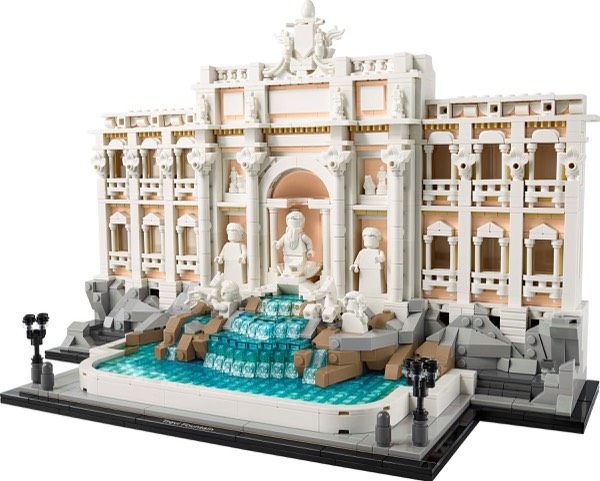
The Trevi Fountain represents a fascinating challenge for the LEGO Architecture line: how do you capture a building that is essentially a sculpture? The real Trevi Fountain is less about architecture in the structural sense and more about ornamental stonework, flowing water, and theatrical composition. At approximately 1,880 pieces, LEGO's answer is one of the most creatively satisfying Architecture builds in recent memory. This is not a building you assemble - it is a sculpture you compose, and the distinction matters from the very first bag.
The build takes roughly 4-6 hours and progresses from the base pool upward through the facade. The pool construction comes first, establishing the water feature that defines the fountain. LEGO uses transparent blue and clear elements layered over a white and light blue base to create a convincing water surface effect - and the technique is more sophisticated than simply laying flat blue tiles. Curved elements at the pool edges suggest the irregular, natural-looking stone rim of the real basin. The layering of transparent elements at different heights creates a sense of depth in the water that flat surfaces cannot achieve - you can almost see the coins on the bottom.
The facade build is where things get interesting. The curved central section uses a combination of hinge plates and angled connections to create the concave sweep that gives the Trevi its theatrical embrace. Building a curved wall in LEGO is always a challenge, and the solution here is elegant: segmented flat panels connected at slight angles that, taken together, read as a smooth curve from display distance. The columns, niches, and sculptural elements layer onto this curved base, building up the ornamental density that defines Roman baroque style. Each column feels like a small victory, each sculptural figure is a moment of creative problem-solving.
The statuary figures are necessarily simplified at this scale, but LEGO has made smart choices about which details to suggest and which to abstract. The central Neptune figure and the flanking sculptures are recognizable through careful use of small elements that capture pose and proportion rather than attempting realistic detail. This restraint is the right call - the figures work because they know what they can and cannot achieve at microscale, and they lean into silhouette and gesture rather than fighting for fidelity they cannot win.
The curved facade is the technique centerpiece, and it's worth studying in detail. The concave wall construction uses hinge plates at calculated angles to create a smooth arc from straight segments. This is a foundational technique for any builder working on curved Architecture MOCs - amphitheaters, colonnades, curved building facades, or any structure that needs to suggest a radius. The Trevi Fountain executes it at a scale where the technique is clearly visible and learnable, and the result is convincing enough to justify the approach for any future project requiring curved walls.
The water effect technique is equally valuable. Rather than a simple flat surface, the pool uses layered transparent and opaque elements at slightly different heights to create depth and movement. White round plates beneath transparent blue tiles suggest foam and turbulence near the rock formations, while calmer areas use flat transparent blue for still water. This technique transfers directly to any MOC involving water features - harbors, rivers, fountains, or waterfalls. It is one of the most practical water-building lessons available in any official LEGO set.
The column construction throughout the facade uses a refined stacking technique: alternating between round bricks and round plates at different diameters creates a fluted column effect that reads correctly at display distance. The Corinthian capitals at the top of each column use small flower or leaf elements to suggest the ornate carved capitals of the real structure. These are micro-scale sculptural techniques that reward careful observation. If you build Architecture MOCs with any regularity, the column techniques alone justify close study.
The rocky base beneath the statuary uses a controlled-chaos approach: irregular plate and slope placement that looks natural but is carefully engineered to support the figures above. Building something that looks random while remaining structurally sound is harder than building something orderly, and the Trevi Fountain teaches that skill well. The contrast between the organized facade architecture and the organic rock formations below demonstrates how to blend formal and natural elements in a single build - a skill that applies to castle bases, cliff-side buildings, and any architecture that interacts with landscape.
At roughly 1,880 pieces, the Trevi Fountain delivers a focused parts haul in a warm stone palette. White, tan, and light bluish grey dominate, with accents of dark tan, gold, and transparent blue. The white and tan elements are primarily slopes, arches, and modified plates - the building blocks of classical architecture MOCs. The arch brick selection is particularly strong, with multiple sizes represented. If you build anything in the classical, Renaissance, or Mediterranean style, these arch elements are perpetually in demand and the Trevi Fountain provides a solid stock in one purchase.
The transparent blue elements for the water feature are useful for any build involving water effects. The range includes flat tiles, round plates, and curved elements in trans-blue and trans-clear, giving you a versatile starter kit for water scenes. The gold accent pieces used for decorative details are always in demand and difficult to source cheaply. The round bricks and plates used for columns provide a solid stock for anyone building classical or Renaissance-inspired MOCs. The column elements alone represent a meaningful inventory of round elements in white and tan that would take multiple sets to accumulate otherwise.
The small sculptural elements - modified plates, bar-and-clip connections, and small slope bricks used to suggest statuary - are versatile pieces that serve well beyond this specific model. Builders who work on detailed facades, interior decorations, or microscale sculptures will find these elements immediately useful. The stone-tone color palette means virtually every structural element in this set is useful for other architectural projects, which gives the Trevi Fountain one of the highest parts-reuse ratios in the Architecture line.
The Trevi Fountain is one of the most photogenic Architecture sets LEGO has produced. The curved facade creates natural shadows and depth that change with lighting angle, making the model look different - and equally impressive - throughout the day. The water feature at the base adds a cool blue accent that contrasts beautifully with the warm stone tones above. This is a model designed to be looked at, and it rewards every glance with new details and shifting perspectives.
At microscale, the Trevi Fountain captures the grandeur of the original through proportion and composition rather than detail replication. From a few feet away, the curved colonnade, the central sculptural group, and the cascading water feature tell the complete story. Moving closer reveals the ornamental details - the column capitals, the niche sculptures, the cornice elements - that reward inspection without being necessary for the overall impression. This dual-resolution quality - impressive from afar and detailed up close - is the hallmark of the best Architecture sets, and the Trevi Fountain achieves it effortlessly.
Display this one where it can catch some natural light. The transparent blue water elements come alive with backlighting or side lighting, and the white facade elements cast subtle shadows that enhance the three-dimensional depth of the curved structure. On a bookshelf against a dark background, the Trevi Fountain looks genuinely elegant. The concave curve of the facade creates a natural focal point that draws the eye inward, which means the set generates its own visual gravity - it does not need to compete with its neighbors for attention.
For Architecture collectors, this fills the Roman baroque slot that the line has needed. Alongside the Colosseum and the Parthenon, the Trevi Fountain completes an Italian architectural trilogy that displays beautifully as a group. The warm stone palette harmonizes with both sets while the water feature adds a cool accent that none of the other Italian Architecture sets provide. As a standalone display piece or as part of a curated Architecture collection, the Trevi Fountain earns its shelf space through sculptural beauty that transcends the brick medium.
At approximately 1,880 pieces, the Trevi Fountain sits in the mid-range of Architecture pricing. The piece count is solid, and the build experience justifies the investment with 4-6 hours of engaging construction. The technique education alone - curved walls, water effects, microscale sculpture - has lasting value for builders who apply these methods to future projects. You are not just buying a display piece. You are buying a collection of transferable skills wrapped in a beautiful model.
For display-focused buyers, the Trevi Fountain offers one of the strongest visual-impact-per-dollar ratios in the Architecture line. It's large enough to command shelf presence, detailed enough to reward close inspection, and distinctive enough to stand out in any collection. The curved facade gives it a sculptural quality that flat-fronted Architecture sets simply cannot match. In terms of display impact per dollar spent, the Trevi Fountain competes with sets at significantly higher price points.
Whether you're an Architecture collector, a technique student, or someone who wants a beautiful LEGO display piece that happens to be one of the world's most iconic landmarks, the Trevi Fountain delivers convincingly at its price point. The only consideration is whether you have the display space to let the curved facade breathe - this set looks best when it is not crowded by neighbors on a tight shelf. Give it room and it will reward you with one of the most elegant LEGO displays available.
The Trevi Fountain is for builders who see LEGO as a sculptural medium, not just a construction system. If you have ever stood in front of the real Trevi Fountain and felt the pull of its theatrical grandeur, this set recreates that experience at a scale you can hold in your hands. The curved facade, the flowing water, and the baroque ornamentation create a display piece that transcends the typical Architecture set - this is closer to a shelf sculpture than a building model.
Architecture collectors will find this essential. The Trevi Fountain fills a gap in the line that has been waiting for a truly sculptural subject, and it pairs beautifully with the Colosseum, Notre-Dame, and the Parthenon for a European landmark display. The warm stone palette ensures visual harmony with other Architecture sets while the water feature adds a unique element that none of the others provide.
For technique-focused builders, the curved wall construction, water effect methods, and microscale sculpting approaches make the Trevi Fountain a practical investment in skills that apply to countless future projects. This is one of those rare sets where the build teaches you as much as it entertains you, and the finished model serves as a permanent reference for the techniques it contains. Gift buyers will also find this set reliably impressive - the combination of recognizable landmark, elegant display presence, and satisfying build experience makes it a safe choice for anyone who appreciates beauty in physical form.
Baroque architecture presents unique challenges for the LEGO medium. Where Renaissance buildings rely on symmetry, clean lines, and mathematical proportion - qualities that translate naturally into rectilinear brick construction - baroque design embraces curves, organic ornamentation, and theatrical composition. The Trevi Fountain is perhaps the most baroque subject the Architecture line has attempted, and its success demonstrates that LEGO's design capabilities have evolved beyond the straight-line constraints that limited earlier Architecture sets.
The key insight behind the Trevi Fountain's design is that baroque grandeur comes from composition, not from individual detail resolution. At microscale, you cannot reproduce the carved marble figures of Nicola Salvi's original design. But you can reproduce the sweeping concave facade, the vertical rhythm of columns and niches, the dramatic interplay of architecture and water, and the theatrical framing that makes the Trevi Fountain feel like a stage set rather than a building. LEGO's designers have focused on the compositional elements that create the emotional experience of the fountain rather than attempting a literal transcription of every carved detail.
This approach has implications for the Architecture line's future. If LEGO can successfully capture baroque curves and sculptural compositions at this scale, the door opens for subjects that would have seemed impossible a few years ago - Bernini's colonnade at St. Peter's, the Sagrada Familia's organic facades, or Gaudi's undulating apartment buildings. The Trevi Fountain proves that LEGO can sculpt, and that proof expands the entire horizon of what the Architecture line might attempt next. For collectors and builders alike, that is an exciting precedent.
- ✓ Curved facade technique is a masterclass in LEGO architecture
- ✓ Water effect at the base is convincing and visually striking
- ✓ Sculptural elements capture baroque grandeur at microscale
- ✓ Photographs beautifully under natural and warm lighting
- ✓ Strong parts haul in classical stone-tone colors
- ✗ Statuary figures are necessarily simplified at this scale
- ✗ Curved sections can be delicate during construction
- ✗ No interior detail behind the facade
Some products may be provided by manufacturers. This page contains affiliate links. All opinions are my own.
- Best LEGO Architecture Sets Ranked - Our definitive ranking of every Architecture set
- Notre-Dame de Paris Review - Another European Architecture masterpiece
- Italy Postcard Review - More Italian LEGO at a smaller scale
Track it in your vault on GameSetBrick - our free collection app. Log your condition, price paid, and watch the real-time market value.
Track in Your Vault →Save it to your wishlist on GameSetBrick. Share your list with friends and family - every set has a buy button so gift givers know exactly where to go.
Add to Wishlist → GameSetBrick is a free app by The Earl of Bricks. See all features. Scan it. Track it. Trade it.