Is the LEGO Italy Postcard Worth Buying?
8.4/10. Worth buying. Venice, Rome, and the Leaning Tower of Pisa. Italy in 189 pieces.

The postcard sets landed quietly in January, and my initial reaction was skepticism, another impulse buy designed to look good next to the checkout. But 40818 demands reconsideration. This isn't LEGO playing at tourism; it's three distinct, recognizable landmarks compressed into 189 pieces without sacrificing legibility. The Leaning Tower's angle reads immediately. The Colosseum's arches actually arch. Venice's buildings stack with proportion. That's the mechanical problem this set solves that casual builders might miss: how to make iconic architecture iconic at this scale without relying on stickers or printed elements to carry the design weight.
What stuck with me after building wasn't the set itself, but the question it raises about LEGO's current strategy. These postcard sets sit between the impulse-buy Architecture line and proper set building, closer to a gift item than a collector's piece. Yet the engineering underneath proves someone serious designed this. The parts economy is ruthless. Every piece justifies itself. That tension between accessibility and craft is worth examining before deciding if this belongs on your shelf or in a gift bag.
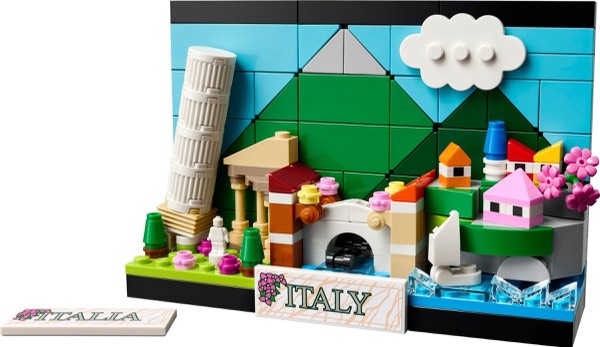
Italy is the newest entry in the Postcard series and takes the most ambitious geographic approach - covering three distinct Italian landmarks rather than one city: Venice (canal with gondola), Rome (Colosseum ruins), and Pisa (the Leaning Tower). The trade-off is piece count - at 189 pieces it's the smallest of the four Postcards reviewed here - but LEGO has used the reduced canvas intelligently.
Where the other Postcard sets focus on a single city skyline, Italy takes a greatest-hits approach to an entire country. This is a bold design decision and it works precisely because Italy's most famous landmarks are spread across multiple cities. Cramming Venice, Rome, and Pisa into one postcard frame captures the way most people actually experience Italy - as a multi-city itinerary rather than a single destination. The postcard becomes a trip diary in miniature, which is a clever conceptual upgrade from the earlier entries in the series.
Arriving in 2025, Italy also represents the newest design sensibility in the Postcard lineup. LEGO's micro-scale techniques have evolved since the 2022 originals, and you can see the improvement in how efficiently each landmark is rendered. The Leaning Tower uses fewer pieces than you'd expect to achieve a convincing silhouette. The Colosseum arches capture the essential shape in just a few curved elements. Every piece earns its place here, which is what good design at limited scale demands.
189 pieces means a quicker build than the others - closer to 15 minutes. The three landmark vignettes each snap into the shared baseplate: the Venice canal section with a tiny gondola, a Colosseum arch section in tan, and the Leaning Tower in white with its characteristic lean built into the construction angle. The leaning tower angle is achieved with a wedge plate offset - a simple but satisfying build moment when it clicks into place.
The three-landmark format gives the build a distinct rhythm that the other Postcards don't have. You're essentially constructing three micro-scale models in sequence, each with its own character. The Venice section is all about the horizontal - flat water, a low canal wall, the elongated shape of the gondola. Then Rome shifts to structural arches and vertical columns. Then Pisa goes full vertical with the tower. This variety keeps the build feeling fresh despite the short overall duration. You never settle into a repetitive pattern because the design language changes every few minutes.
The instruction booklet deserves mention here. Like the other Postcards, it includes cultural context about each landmark, but with Italy you get three separate blurbs rather than one. For families building together, this turns the set into a lightweight geography lesson - where is Pisa relative to Venice? Why does the tower lean? What were the Colosseum arches for? These aren't deep dives, but they add educational texture to what is already a satisfying build experience. Fifteen minutes well spent, especially for younger builders encountering these landmarks for the first time.
The Leaning Tower angle is the key technique moment: using a 1x2 wedge plate under the tower base to create the lean, then building straight up from the angled base so the lean is structurally honest rather than cosmetic. It's a principle directly applicable to any LEGO build that requires an off-vertical element - lean the base, not the individual bricks.
The Colosseum section introduces another useful micro-scale approach: using arch elements and curved slopes to suggest a ruined structure. Rather than building a complete ring of arches (impossible at this scale), LEGO's designers built a partial section that implies the full circle through careful placement. This is a fundamental diorama-building principle - show enough of a structure to let the viewer's brain complete the rest. MOC builders can apply this same logic to any historical ruin or partial building in a micro-scale scene.
The Venice canal is the subtlest technique in the set but perhaps the most transferable. The water surface uses transparent blue plates laid over a dark blue base to create the illusion of depth and reflectivity. The gondola is a masterpiece of micro-scale vehicle design - its distinctive curved shape captured in just a few pieces, with a nanofig gondolier standing at the stern. Building recognizable vehicles at this scale is one of the hardest challenges in LEGO design, and the gondola here is a textbook example of how to solve it: focus on silhouette and proportion, not detail.
189 pieces - the smallest haul of the four, but Italy-appropriate colors make up for it: tan (Colosseum), white (Leaning Tower), terracotta red, and canal blue for Venice. The tan and white elements are useful for Mediterranean-style architectural work. A nanofig (nano-scale figure) is included in the gondola, which is a delightful micro-detail.
The tan parts alone justify interest from MOC builders working on anything Mediterranean, desert, or historical. Tan is one of those colors that accumulates slowly across random set purchases - you rarely get a concentrated supply of it unless you specifically seek it out. The Italy Postcard provides a small but focused injection of tan plates and slopes that will integrate into any warm-climate architectural scene. The white elements from the Leaning Tower section are similarly versatile, useful for anything from winter scenes to modernist buildings.
At 189 pieces for approximately fifteen dollars, the per-piece cost is slightly higher than the earlier Postcards in the series. This reflects the broader LEGO pricing reality of 2025, but it's worth noting that you're also getting the nanofig gondolier, which is a specialized element with collectible appeal. The piece count shouldn't be the only metric - what matters is whether the finished product justifies the price, and in the Italy Postcard's case, the three-landmark design and the Leaning Tower technique deliver sufficient value to make the math work comfortably.
Three distinct landmarks in one frame gives Italy a diorama quality that single-city postcards don't achieve. The green-white-red color read is distinctly Italian and the Leaning Tower silhouette is immediately recognizable. At 189 pieces it feels slightly less substantial than the others when held, but displays with the same impact. The gondolier nanofig on close inspection is charming.
The multi-landmark composition creates an interesting visual effect that the other Postcards don't offer. Where New York and London present a unified skyline that you take in as a whole, Italy invites your eye to move between three distinct focal points. There's the Leaning Tower drawing attention with its off-axis angle, the Colosseum arches grounding the composition with their weight, and the Venice canal adding a horizontal flow at the base. It's a more dynamic visual experience than a single-city skyline, and it rewards close inspection - every time you look at it, you notice the gondolier or a particular arch detail you missed before.
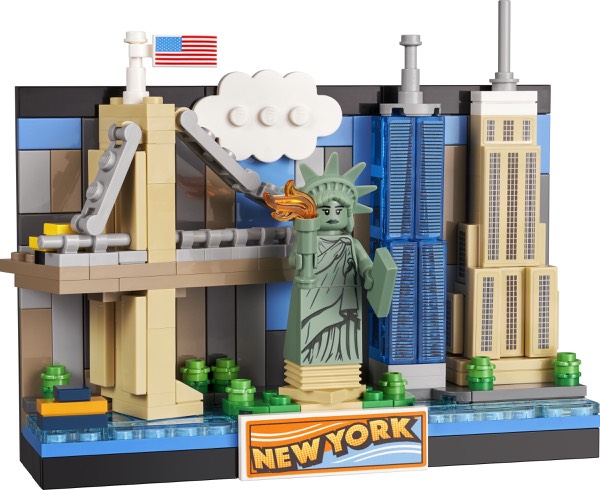
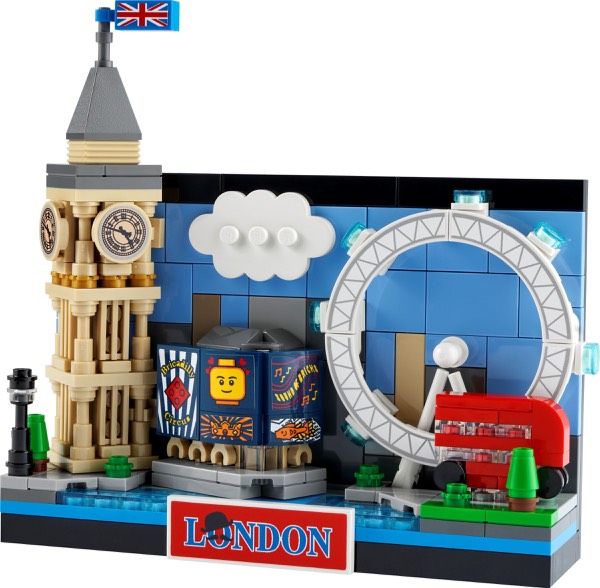
In the context of the full Postcard series display, Italy brings a warmth that complements the cooler palettes of the other entries. London is bold reds and blues, New York is urban greys and Liberty green, Japan is soft pinks and mountain whites. Italy arrives with warm tan, terracotta, and canal blue - Mediterranean colors that suggest sunshine and slow afternoons. Placed at either end of the lineup, it provides a warm bookend. Placed in the middle, it creates a color bridge between the cooler entries. However you arrange them, Italy earns its shelf space through sheer aesthetic charm.
189 pieces - higher cost per piece than the earlier Postcards in the series, reflecting the 2025 pricing reality. But the three-landmark ambition and the Leaning Tower technique keep the value case strong. The series completion value (buying all four) also applies - Italy rounds out the set beautifully.
The value proposition for Italy is slightly different from the other Postcards because of its role as the newest and potentially final entry in the first wave. If you already own New York, London, and Japan, the Italy Postcard completes your collection - and collection completion has its own value that transcends per-piece math. A shelf with three postcards looks incomplete. A shelf with four looks intentional. That completion premium is real, and it makes the Italy Postcard a straightforward purchase for anyone already invested in the series.
For first-time buyers considering which Postcard to start with, Italy is not the strongest entry point - Japan and New York both offer more pieces and slightly more impressive builds for the same price. But if you have a personal connection to Italy, if you've walked through Venice or stood in the shadow of the Colosseum, none of that per-piece analysis matters. The emotional resonance of a set that captures your travel memories is worth more than any price comparison can quantify. At fifteen dollars, it's a small investment for a permanent shelf-top reminder of a trip that mattered to you.
The LEGO Postcard series launched in 2022 and has quietly become one of the most charming product lines LEGO has ever produced. The concept is deceptively simple: take the traditional souvenir postcard - a flat image of a famous destination - and rebuild it as a three-dimensional brick vignette that can stand on your shelf. Each entry follows the same format: a postcard-sized frame, a collection of micro-scale landmarks, a built-in display stand, and a price point that makes impulse buying feel responsible.
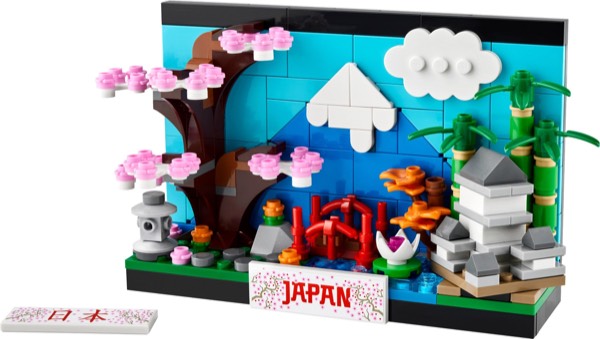
The series currently includes four entries - New York, London, Japan, and Italy - each bringing its own personality while maintaining visual consistency. The shared dimensions and border treatment mean they display beautifully as a group, while the wildly different color palettes and landmark selections ensure each one stands on its own. New York brings the urban energy and a Lady Liberty minifigure. London brings the most vivid color palette. Japan brings the most refined composition. Italy brings the most geographic ambition. Together they form a brick-built travelogue that looks better than it has any right to at this price point.
What makes the Postcard series special in the broader LEGO landscape is its accessibility. These aren't sets that demand dedicated display cases or hours of building time. They're quick, affordable, and designed to integrate into everyday spaces - desks, shelves, mantlepieces. They appeal to LEGO veterans and complete newcomers alike. A person who hasn't touched a LEGO brick in twenty years can pick up a Postcard set, build it in fifteen minutes, and have something genuinely worth displaying. That kind of low-barrier, high-reward experience is rare in the LEGO catalog, and the Postcard series delivers it consistently across all four entries.
The Italy Postcard speaks most directly to anyone with Italian travel memories - or Italian travel aspirations. If you've taken the classic Rome-Florence-Venice itinerary, this set will feel like a brick-built souvenir from that trip. The three-landmark format mirrors the way most travelers experience Italy: not as a single city, but as a journey through multiple destinations. Every landmark on this postcard corresponds to a real memory for millions of travelers, and that personal connection transforms a small LEGO set into something genuinely meaningful.
Beyond the travel connection, this set works beautifully for anyone building a Postcard collection. If you already have one or two of the other entries, Italy is the natural next addition. It's also a strong choice for Italian-heritage families looking for a small cultural touchstone to display at home - something that acknowledges their roots without being heavy-handed about it. A tiny gondola on a shelf says "we remember where we come from" in the gentlest possible way.
For LEGO beginners and younger builders, Italy offers the shortest build time in the series, which can be either a pro or a con depending on the builder's preferences. Younger kids who might lose patience with a longer build will appreciate the quick completion. Adult beginners who want a taste of the Postcard experience before committing to the full series can start here and decide if the format appeals to them. And for desk display enthusiasts, the compact 189-piece footprint means this is the least space-demanding entry in the lineup - perfect for tight shelves or crowded desks.
The series lineup remains the premier display option: all four Postcards arranged on a shelf at eye level, creating a continuous band of international landmarks. In this lineup, Italy's warm Mediterranean palette provides essential color variety - without it, the display skews too cool with London's blues, New York's greys, and Japan's whites. Italy brings the warmth, and the display needs it. Arrange them in geographic order (New York, London, Italy, Japan) for a west-to-east global journey, or group the European entries together for a continental pairing.
For a more thematic display, consider pairing the Italy Postcard with other Italian-themed LEGO sets. The Architecture Trevi Fountain sits beautifully beside it, creating a scale contrast that highlights both sets. If you have any LEGO City or Creator vehicles in Italian colors - red Ferraris, yellow Lamborghinis, or classic Fiats - parking one in front of the postcard creates a charming vignette. The postcard serves as a backdrop, the vehicle as a foreground element, and together they tell a story about Italian culture and design.
The Italy Postcard also works in non-LEGO display contexts. Prop it on a kitchen shelf beside an olive oil bottle and a small Italian flag. Set it on a home office desk next to a photo from your Italian vacation. Place it on a bookshelf between Italian cookbooks or travel guides. The postcard format is inherently versatile because it's designed to complement rather than dominate its surroundings. It plays well with other objects in a way that most LEGO sets simply don't, and that flexibility is one of the Postcard series' greatest strengths.
Italy may be the strongest gift candidate in the entire Postcard series, and the reason is simple: Italy is one of the world's most popular travel destinations, and nearly everyone either has an Italian travel story or wants one. Giving someone the Italy Postcard before their trip is a thoughtful bon voyage gesture. Giving it after their trip is a perfect souvenir substitute. Giving it to someone who dreams of visiting Italy someday is a gentle encouragement to start planning. The emotional range of this set as a gift is remarkably broad.
At the fifteen-dollar price point, the Italy Postcard fits comfortably into every gifting occasion. It works as a stocking stuffer at Christmas, a small birthday present, a thank-you gift, a housewarming token, or a just-because surprise. It's particularly effective as a host gift when visiting someone's home for dinner - more interesting than wine, more personal than flowers, and guaranteed to start a conversation. For Italian-American families, it's a natural addition to any holiday gift exchange - small, affordable, and culturally resonant.
The Postcard series also opens up a gifting strategy that works across multiple occasions: give one Postcard at a time, building toward a complete collection over several holidays or birthdays. Start with the recipient's favorite destination, then fill in the rest over the following months. By the time they have all four, you've created a coordinated shelf display that tells a story about your relationship and their interests. At fifteen dollars per installment, it's one of the most affordable ongoing gift strategies available - and the recipient gets something displayable and meaningful each time rather than something disposable.
- ✓ Three landmarks in one postcard - ambitious design
- ✓ Leaning Tower tilt technique is satisfying
- ✓ Nanofig gondolier is a delightful detail
- ✓ Italian color palette is strong
- ✓ Completes the first wave of the Postcard series
- ✗ Smallest piece count of the four Postcards
- ✗ Highest cost-per-piece in the series
- ✗ Less depth/layering than the Japan Postcard
Affiliate link. Some products may be provided by the manufacturer. All opinions are my own.
- London Postcard Review - Another European postcard to collect
- Japan Postcard Review - The Japan entry in the postcard series
- Trevi Fountain Review - The full Architecture-scale Italian landmark
The color blocking caught me off guard. Rather than chasing photorealism, this set commits to readable color zones, earth tones for the Tower's stonework, clean whites and tans for Venice's facades. It's a design choice that prioritizes clarity over accuracy, and it works harder than expected because it makes each building instantly distinguishable when they're grouped together. Most builders would expect more printed tiles or transparent elements to add detail; instead, the restraint becomes the strength.
The build sequence matters here in ways it doesn't on larger sets. With only 189 pieces across three structures, the rhythm of assembly becomes part of the experience, you're cycling through three entirely different construction logics without repetition or fatigue. The Leaning Tower uses a core stacking method that the other landmarks avoid entirely. That variety in build methodology, unusual at this piece count, keeps hands engaged and prevents the mental autopilot that kills smaller sets.
Track it in your vault on GameSetBrick - our free collection app. Log your condition, price paid, and watch the real-time market value.
Track in Your Vault →Save it to your wishlist on GameSetBrick. Share your list with friends and family - every set has a buy button so gift givers know exactly where to go.
Add to Wishlist → GameSetBrick is a free app by The Earl of Bricks. See all features. Scan it. Track it. Trade it.