Is the LEGO New York City: The Big Apple Worth Buying?
8.64/10. Worth buying. Six landmarks, one skyline, and a black apple-shaped silhouette that turns Manhattan into a single unified piece of shelf art.
Comparing your options? See where it lands in our best LEGO Architecture sets, ranked.

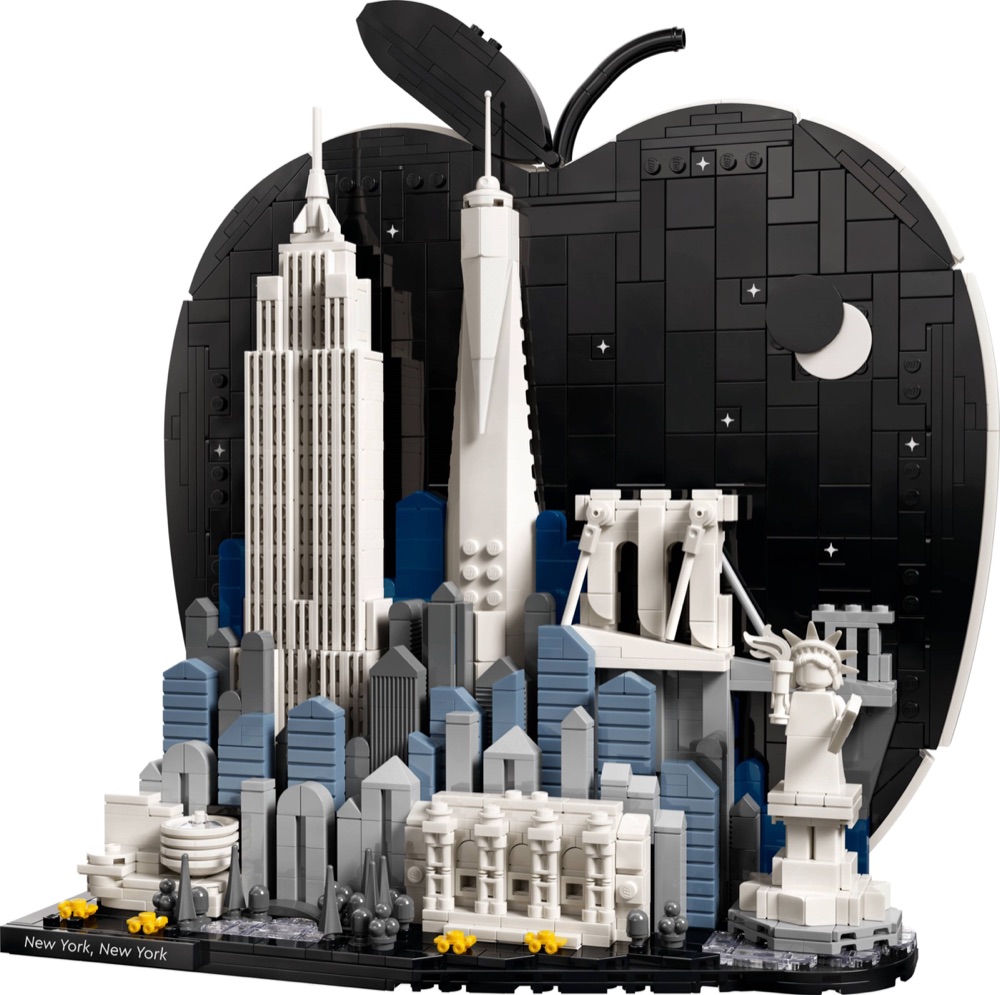
The LEGO Architecture team has done city skylines before, but they have never done it quite like this. Instead of a horizontal skyline strip, they built the entire concept around the apple, the actual nickname's actual fruit, with the whole model rendered inside that iconic silhouette against a starry night backdrop. It is a genuinely clever piece of graphic design translated into three dimensions, and it is the kind of idea that could have easily gone gimmicky in lesser hands.
It did not go gimmicky. What you get instead is six real landmarks, the Empire State Building, One World Trade Center, the Brooklyn Bridge, the Statue of Liberty, and the Guggenheim and Metropolitan museums, all rendered at a consistent microscale that somehow makes them read as a coherent single skyline rather than six separate models glued together. That consistency is the hardest part of any multi-landmark Architecture set to get right, and this one nails it.
New York City: The Big Apple packs 1,465 pieces into a build that constructs six architectural icons in white against a black apple-shaped background, complete with a starry sky, a city skyline layer, and a Central Park section anchored by yellow taxi cabs. It is one of the more layered builds in the Architecture line's recent history, moving between distinct construction techniques as it works through each landmark.
The build opens with the apple-shaped base and backdrop, establishing the black silhouette and starry sky that everything else will sit against. From there, you move landmark by landmark: the Empire State Building's tapering art deco spire, One World Trade Center's sleek glass-tower profile, the Brooklyn Bridge's suspension cables rendered in miniature, and the Statue of Liberty's torch held aloft in careful microscale detail.
Each landmark introduces its own construction logic. The Empire State Building relies on stacked, gradually narrowing sections to capture its stepped art deco silhouette. The Brooklyn Bridge uses thin connecting elements strung between two towers to suggest suspension cables without literal string, a classic Architecture-line trick that still impresses every time it is deployed well. The Guggenheim's distinctive spiral form is picked out using curved and angled pieces that manage to suggest Frank Lloyd Wright's famous rotunda in a footprint smaller than a coffee mug.
Central Park and the small yellow taxi cabs arrive toward the end, adding a welcome dose of street-level color and life to what is otherwise a monochrome, moody presentation. Building the app-enhanced instructions in, LEGO's Builder app lets you zoom, rotate, and track your progress digitally, which is a genuinely useful addition for a build with this many small, easy-to-misplace microscale elements.
Plan for a focused four to five hour session. The build stays engaging throughout thanks to the constant shift between landmarks, though the smallest microscale elements demand a steady hand and good lighting, standard for the Architecture line but worth planning around if you are building in the evening.
The central design conceit here, framing the entire New York skyline inside a black apple silhouette, is what elevates this from a good Architecture set to a genuinely striking one. It transforms what could have been a straightforward skyline strip into a piece of conceptual art that reads clearly even to someone with no architecture background. You see the apple shape before you consciously register the individual buildings, and that immediate legibility is a real design achievement.
At 29 by 28 by 12 centimeters, the set holds a compact, roughly square footprint that works well leaned against a wall or displayed on a stand, more like a framed piece of art than a traditional model. The white-on-black color scheme does a lot of heavy lifting here, giving the landmarks a crisp, almost architectural-blueprint quality against the starry night backdrop, and it photographs exceptionally well under almost any lighting condition.
The inclusion of Central Park and the small yellow taxi cabs is a smart touch that keeps the piece from feeling purely monumental and cold. Those small human-scale details, along with a printed New York, New York tile and a hidden easter egg somewhere in the build, give people a reason to look closer rather than just admiring the silhouette from across the room.
Displayed on a shelf or leaned against a wall, this set commands attention without demanding a huge footprint, which makes it one of the more versatile large-scale Architecture releases in recent memory. It works equally well as a centerpiece or as part of a broader city-themed display.
At 1,465 pieces, the price-per-piece lands at roughly 9.6 cents, a strong figure for the Architecture line and notably better value than several sets in this batch that carry a heavier licensing premium. Architecture sets built around real, publicly recognizable landmarks avoid the character or franchise licensing costs that inflate price-per-piece elsewhere in the LEGO catalog, and that value shows up clearly here.
The parts selection is dominated by white elements in a wide range of shapes: microscale windows, tapered spire pieces, curved Guggenheim elements, and thin suspension bridge connectors. Many of these white architectural pieces have excellent crossover value for other microscale or white-and-black MOC projects, giving this set stronger secondary parts value than most licensed character sets can offer.
Architecture sets built around enduring, universally recognized landmarks like these have historically held their value well in the secondary market, since the subject matter never really goes out of style the way trend-driven licensed IP sometimes does. A skyline built around the Statue of Liberty and the Empire State Building is not chasing a temporary cultural moment. Worth watching through our retiring sets tracker as it moves through its retail lifecycle, and a strong candidate for our LEGO investing guide given the Architecture line's consistently strong aftermarket track record.
Each of the six landmarks featured here carries its own significant architectural history. The Empire State Building, completed in 1931 in just over a year of construction during the Great Depression, held the title of world's tallest building for nearly four decades and remains one of the most recognized art deco structures on earth. One World Trade Center, completed in 2013 as the centerpiece of the rebuilt World Trade Center site, stands as both a modern engineering achievement and a deliberate symbol of resilience following the September 11 attacks.
The Brooklyn Bridge, completed in 1883, was the longest suspension bridge in the world at the time of its construction and remains a marvel of 19th century engineering, its stone towers and steel cables becoming as much a symbol of New York as any building. The Statue of Liberty, dedicated in 1886 as a gift from France, has stood as the first glimpse of America for millions of immigrants arriving by ship, making it arguably the most symbolically loaded structure of the six included here.
The Guggenheim Museum, designed by Frank Lloyd Wright and completed in 1959, remains one of the most distinctive museum buildings ever constructed, its spiral rotunda a deliberate rejection of the traditional rectangular gallery format. The Metropolitan Museum of Art, one of the largest art museums in the world, anchors the eastern edge of Central Park and has been expanding and evolving since its 1870 founding. Together, these six structures span nearly a century and a half of American architectural history, and seeing them united within a single coherent skyline silhouette is a genuinely effective piece of curation.
Architecture enthusiasts and anyone who has spent real time in New York City are the clear core audience. The set rewards familiarity with the actual skyline, recognizing the specific silhouette of each landmark, appreciating how the designers compressed each one into microscale without losing its defining character. If you have stood at the base of the Empire State Building or walked across the Brooklyn Bridge, this model will resonate on a personal level beyond its craftsmanship.
Interior designers and anyone building a display around city or travel themes will find this set works exceptionally well as a piece of graphic wall art rather than a traditional tabletop model, thanks to its compact, leanable format and striking black and white color scheme. It fits naturally into modern, minimalist display spaces in a way that bulkier Architecture sets sometimes struggle to.
Collectors building out the full Architecture Skylines and Landmarks sub-line will want this one as a strong, cohesive addition, particularly given how effectively it balances multiple famous structures into a single unified composition rather than the more common single-building format the line typically favors.
Within the Architecture line, this pairs naturally with other landmark-focused sets that share a similar white-toned microscale approach, building toward a shelf that celebrates real-world architecture and engineering across multiple cities. The consistent scale and color language across the Architecture line makes assembling a multi-city display straightforward.
For a broader large-format display shelf, this set contrasts beautifully with the LEGO Disney Main Street, U.S.A. set. Where Main Street is whimsical, colorful, and rooted in fantasy Americana, this New York skyline is monochrome, precise, and rooted in real-world engineering history. Displayed together, the contrast highlights just how differently LEGO can approach large-format display sets depending on the subject matter.
If your shelf leans further into real-world engineering and transportation history, this piece also complements sets that celebrate real machines and structures rather than fictional universes, giving your display a throughline built around genuine human achievement rather than licensed franchises.
Pros
- The apple silhouette concept elevates this well beyond a standard skyline strip
- Six landmarks rendered at a consistent, coherent microscale
- Strong price-per-piece value with no heavy licensing premium
- Compact, leanable format works beautifully as graphic wall art
- White-on-black color scheme photographs exceptionally well
- Central Park and taxi cab details add welcome human-scale texture
- Excellent crossover value for microscale MOC parts
- Real, enduring subject matter with strong long-term aftermarket track record
Cons
- Smallest microscale elements demand a steady hand and good lighting
- Monochrome palette, while striking, offers less color variety than other display sets
- Only one minifigure included, minimal for buyers who value figure count
- Compressing six landmarks means individual buildings sacrifice some detail depth
New York City: The Big Apple earns a strong Excellent rating by turning a familiar skyline-set formula into something genuinely distinctive. The apple silhouette concept is the kind of idea that sounds simple on paper and is much harder to execute well in practice, and the design team clearly nailed it here.
The build experience stays varied and engaging across six distinct landmarks, the technique value is high thanks to the consistent microscale discipline required throughout, and the display quality benefits enormously from the striking black and white composition. Value is excellent, with a favorable price-per-piece and real, enduring subject matter that should hold appeal well beyond any single trend cycle.
Available now, and a strong pick for anyone who loves New York, architecture, or simply wants a piece of striking monochrome shelf art that happens to be built entirely from LEGO bricks.
- Disney Main Street, U.S.A. Review - A very different large-format display set worth comparing
- Best LEGO Architecture Sets Ranked - See where this skyline lands against the rest of the line
- LEGO Investing 101 - Why real-landmark Architecture sets tend to hold value well
- Best LEGO Art Sets - More sets that double as genuine wall or shelf art
- Retiring Sets Tracker - Know when to buy before it leaves the catalog
I want to dwell on the apple silhouette one more time, because I think it is easy to undersell just how good a design decision it was. Skyline sets are a well-worn format at this point, and the temptation to just do another horizontal strip of buildings must have been strong. Instead, the team leaned into the actual nickname behind New York's most famous moniker and built the whole composition around it, which does two things at once: it gives the piece an instantly recognizable shape from across a room, and it gives the individual landmarks a frame that makes them feel curated rather than arbitrarily selected.
That is a genuinely smart piece of design thinking, translating a verbal nickname into a visual structure, and it is the reason this set will stand out on a shelf next to more conventional Architecture releases. Sometimes the best way to represent a city is not to build it literally, but to build the idea people already have of it in their heads.
Track it in your vault on GameSetBrick - our free collection app. Log your condition, price paid, and watch the real-time market value.
Track in Your Vault →Save it to your wishlist on GameSetBrick. Share your list with friends and family - every set has a buy button so gift givers know exactly where to go.
Add to Wishlist → GameSetBrick is a free app by The Earl of Bricks. See all features. Scan it. Track it. Trade it.