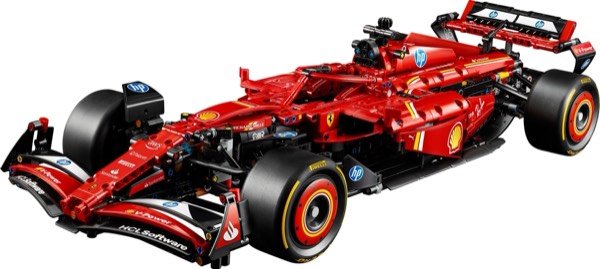
The Ferrari SF-24 joins LEGO Technic's 1:8 Formula 1 lineup as the Scuderia's latest representative, and it carries the weight of the Prancing Horse badge with mechanical confidence. At 1,361 pieces, the SF-24 is slightly more compact than some of its grid rivals in the Technic series, but that reduced piece count should not be mistaken for reduced complexity. Every element in this build serves a structural or mechanical purpose, and the build experience is dense with engineering milestones that keep you engaged from the first pin connection to the final bodywork panel. Expect 7-10 hours of focused building time for experienced Technic constructors, with newcomers potentially stretching into the 12-hour range.
The build opens with the chassis and drivetrain assembly, which is the foundation upon which every other system depends. The V6 engine takes shape early, with six pistons connected to a crankshaft assembly that rotates smoothly when driven by the rear axle. The connecting rods, crankshaft bearings, and gear interfaces all require precise alignment - there is no room for casual pin placement in this phase. LEGO's instruction sequencing guides you through the critical alignments with clear callouts, but the responsibility for execution rests entirely with the builder. Getting this phase right is essential, because every mechanical system that follows builds upon the drivetrain's foundation. When the engine first cycles smoothly under rear wheel rotation, you know the hardest technical work is behind you.
The bodywork phase is where the SF-24 transforms from a mechanical framework into Ferrari's unmistakable Formula 1 silhouette. Red Technic panels and curved fairings snap into place over the chassis, and the car's proportions emerge with surprising speed after the slow precision of the drivetrain build. The nose cone assembly requires careful panel alignment to achieve the SF-24's distinctive narrow nose profile, and the sidepod intakes demand attention to ensure the curved panels sit flush without gaps. The rear wing assembly completes the build with a satisfying final flourish - mounting the wing and seeing the full car for the first time is a moment that rewards the hours of patient construction that preceded it. Ferrari builds always carry extra emotional weight, and seeing that red silhouette take shape piece by piece is genuinely special.
The SF-24 delivers a comprehensive suite of working mechanical systems that demonstrate genuine engineering principles at accessible scale. The V6 engine is the headline feature - six pistons connected via individual connecting rods to a shared crankshaft, all driven by the rear axle through a gear train that maintains smooth rotation without binding. Watching the pistons cycle through their strokes while spinning the rear wheels is both visually satisfying and educationally valuable. The engine teaches the fundamental relationship between rotational input and reciprocating motion, a principle that underpins every internal combustion engine ever manufactured. For builders who previously encountered piston engines only in diagrams, the SF-24 makes the concept tactile and immediate.
The functional steering system connects the cockpit steering wheel to the front wheels through a chain of universal joints and connecting rods that route through the tight confines of the chassis. The steering response is smooth and proportional, with the front wheels tracking the steering wheel input through a convincing range of motion. The geometry maintains proper wheel alignment through the turning arc, ensuring that the model looks correct at any steering angle - a detail that separates well-engineered Technic vehicles from simpler approximations. The steering feel in the SF-24 is comparable to the best in the 1:8 F1 series, and the mechanism itself is a compact demonstration of how rotational input at one point can be transmitted and converted to a different axis of rotation at another point.
The suspension system provides the final mechanical layer, with working front and rear suspension that compresses visibly under load. The spring rates are calibrated to allow noticeable travel without excessive softness, giving the car a realistic weighted feel when pressed downward. For builders who also own the Technic MCL39, comparing the Ferrari's suspension implementation against the McLaren's dual pull-rod and push-rod system reveals how the same engineering problem - absorbing vertical forces while maintaining wheel contact - can be solved with different mechanical approaches. These side-by-side comparisons are one of the great hidden benefits of collecting multiple entries in the 1:8 F1 series, and the SF-24 holds its own in any such comparison.
1,361 pieces anchored by a dominant red and black color palette with subtle dark grey structural elements throughout. Red Technic panels and beams are the defining elements of the parts inventory, and they carry meaningful secondary market value. Ferrari red - specifically the dark red shade LEGO uses for Rosso Corsa representation - is a color that builders consistently seek for custom vehicles, architectural accents, and display models. The SF-24 provides a generous supply of these elements in various sizes and configurations, making it a valuable color source even for builders who never intend to build an F1 car of their own.
The gear collection, while smaller in total count than the larger Technic flagships, covers the essential range of Technic gearing: bevel gears for axis-changing connections, spur gears for direct drive ratios, and the specialized elements that make the V6 engine and steering system function. These gears are the fundamental building blocks of any mechanical Technic creation, and having a reliable supply from a single set simplifies the process of prototyping and building custom mechanisms. The axle and pin inventory is similarly comprehensive, with lengths and configurations that cover most common Technic building scenarios.
The curved fairing panels that form the SF-24's bodywork are among the most valuable individual elements. These large, organically curved pieces are difficult to source outside of Technic flagship sets, and their smooth profiles make them useful for any build requiring aerodynamic surfaces - custom vehicles, aircraft models, or sculptural displays. The nose cone fairing, sidepod panels, and engine cover elements are all shapes that appear in very few other sets, giving the SF-24 genuine parts exclusivity. For builders comparing the parts value between the SF-24 and its competitors, the Ferrari's slightly lower piece count is offset by the rarity and desirability of its red Technic elements and curved fairings.
Ferrari red is arguably the most iconic color in motorsport, and the SF-24 translates it into Technic construction with striking visual impact. The completed model stretches approximately 23 inches long and presents a low, aggressive profile that captures the essence of a modern F1 car from every viewing angle. The red bodywork dominates the visual impression, with black accent elements and sponsor branding stickers adding the detail layers that distinguish a Ferrari from a generic red race car. From across a room, the SF-24 reads as unmistakably Ferrari - the proportions, the color, and the aggressive stance all communicate the brand identity that has defined Formula 1 for seven decades.
The sticker sheet handles sponsor branding and livery details, and the application quality directly impacts display presentation. Well-applied stickers elevate the model's realism considerably, adding the Shell, Ray-Ban, and other partner logos that make the SF-24 look like a scaled replica rather than a generic Technic vehicle. Poorly applied stickers, however, can undermine the visual precision that the structural design achieves. Take your time with sticker placement - use a flat-edged tool for alignment and work in good lighting. The effort invested in sticker application pays dividends in display quality that lasts as long as the model occupies its shelf. This is one area where the Ferrari F2004 Icons set has an advantage, with its printed tiles delivering permanent livery details without application risk.
For collectors building a Ferrari-themed display, the SF-24 Technic sits beautifully alongside the Speed Champions SF-24 at the smaller scale. The two sets represent the same car at dramatically different scales and construction philosophies, and displaying them together creates a compelling visual narrative about how design translates across LEGO building systems. Add the Ferrari F2004 Icons set for historical context, and you have a three-generation Ferrari display that spans decades of F1 excellence and three distinct LEGO construction approaches. The Technic SF-24 anchors any such display with its size, mechanical depth, and the sheer visual magnetism of that Rosso Corsa red at 1:8 scale.
At $229.99, the SF-24 matches the price point of its 1:8 Technic F1 competitors despite carrying a lower piece count of 1,361. This raises a legitimate question about value-per-piece, but that metric alone does not capture the full picture. The SF-24's pieces include a high proportion of large panel elements, structural beams, and specialized Technic components that carry more material and design value per unit than small connector pins or standard-length axles. The build complexity per piece is high, meaning the SF-24 delivers more engineering engagement per element than sets that pad their piece counts with small, simple parts. The result is a build that feels proportionate to its price despite the seemingly unfavorable piece-count comparison.
The Ferrari brand adds emotional and collector value that transcends brick-counting economics. Ferrari is the most recognized name in motorsport, and LEGO sets bearing the Prancing Horse badge consistently command premium secondary market prices after retirement. The SF-24 represents the 2024 season car - a competitive machine that played a central role in one of F1's most dramatic championship battles. That narrative context gives the set historical significance that appreciates over time as the 2024 season recedes into motorsport legend. For collectors who view LEGO sets as both building experiences and investment assets, the Ferrari badge alone provides a meaningful margin of confidence in long-term value retention.
The philosophical choice between the SF-24 and the other 1:8 Technic F1 cars comes down to brand allegiance, color preference, and display context. The Ferrari delivers everything you expect from the 1:8 Technic F1 tier - working mechanical systems, a substantial display model, and a championship-caliber build experience. It does so wrapped in the most emotionally charged livery in motorsport, which for many builders tips the scale decisively. For those building the complete grid of Technic F1 cars, the SF-24 is an obvious inclusion. And for those choosing a single 1:8 F1 car for their collection, the Ferrari's combination of brand prestige, mechanical depth, and display impact within the broader F1 LEGO landscape makes it one of the strongest candidates on the shelf - and a worthy addition to any adult LEGO collection.
As with all 1:8 Technic F1 sets, the SF-24 does not include traditional minifigures. The cockpit space is occupied by steering mechanism linkage rather than a driver figure, and the 1:8 scale places the car well beyond minifigure proportions. The cockpit is detailed with a printed steering wheel element that replicates the complex multifunction wheel design used in modern F1 cars, and the halo safety device frames the cockpit opening with structural accuracy. Removing the engine cover reveals the full V6 engine assembly in clear detail - six pistons, connecting rods, crankshaft, and the gear train that links it all to the rear axle.
The mechanical interactivity of the SF-24 gives it a dimension that static display models cannot match. Spin the rear wheels to watch the pistons cycle. Turn the steering wheel to see the front wheels respond with proportional movement. Press down on the body to test the suspension travel. Each interaction reveals another layer of the engineering hidden beneath the bodywork, and each one invites the builder to spend another moment examining how the mechanical systems connect and interact. This is the fundamental appeal of Technic construction - it rewards curiosity with mechanical truth, and the SF-24 delivers that reward generously. For Ferrari fans who have also built the F2004 Icons set, the contrast between the two construction approaches is illuminating: the Icons set prioritizes visual accuracy and display perfection, while the Technic SF-24 prioritizes mechanical depth and interactive engagement. Both are excellent. They are simply excellent at different things.
- ✓ Working V6 engine with six reciprocating pistons visible under removable cover
- ✓ Smooth functional steering with accurate Ackermann geometry
- ✓ Ferrari Rosso Corsa red translates powerfully into Technic elements
- ✓ Iconic brand identity elevates display and collector value
- ✓ Working suspension front and rear with visible compression
- ✓ 23-inch display model with commanding shelf presence
- ✓ High proportion of rare red Technic panels and curved fairings
- ✗ Lower piece count than grid rivals at the same price point
- ✗ Sticker sheet required for all sponsor branding details
- ✗ Some visible panel gaps along sidepod transitions
- ✗ Rear wing mounting could be more rigid under handling
Some products may be provided by manufacturers. This page contains affiliate links. All opinions are my own.
- McLaren MCL39 Technic Review - The papaya orange rival at 1:8 scale
- Ferrari SF-24 Speed Champions Review - The same car at the 8-wide scale
- Ferrari F2004 Icons Review - Schumacher's legendary car in LEGO Icons form
- Every LEGO F1 Set Ranked - The definitive 2026 F1 guide
- Best LEGO Sets for Adults 2026 - Our top picks for grown-up builders
- Ferrari FXX K Technic Review - Ferrari's track-only hypercar at Technic scale
Track it in your vault on GameSetBrick - our free collection app. Log your condition, price paid, and watch the real-time market value.
Track in Your Vault →Save it to your wishlist on GameSetBrick. Share your list with friends and family - every set has a buy button so gift givers know exactly where to go.
Add to Wishlist → GameSetBrick is a free app by The Earl of Bricks. See all features. Scan it. Track it. Trade it.