Is the LEGO McLaren MCL39 F1 Car Worth Buying?
9.36/10. Worth buying. The 2025 championship car in 1:8 Technic. Working DRS, gearbox, V6 engine. This is the one.
Comparing your options? See where it lands in our best LEGO F1 sets, ranked for 2026.

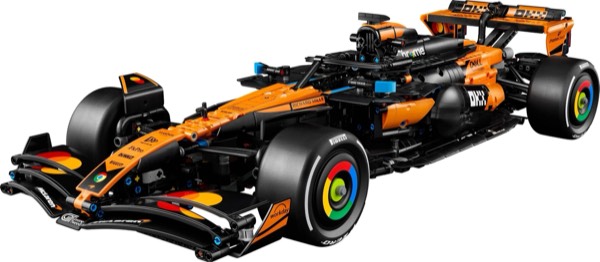
This isn't just another Technic supercar sitting between the Bugatti and Ferrari on the shelf. The 42228 is the first time LEGO has built a current-season F1 car in Technic scale, not a retro livery, not a generic speedster, but the actual McLaren MCL39 that fought for wins in 2024. That specificity matters because it means the engineering team had to solve real problems: How do you model a hybrid power unit in plastic? How do you capture DRS in a way that actually articulates like the real thing? How do you make a 1:8 scale car feel like an instrument instead of a display piece? The answers are here, and they're not compromises.
The gearbox is sequencing through six speeds on a dual-clutch system that mirrors what's bolted into Norris and Piastri's actual machinery. The V6 engine block has functional pistons. The suspension geometry follows McLaren's real setup closely enough that someone who watches qualifying would recognize the proportions instantly. This set demanded precision that goes beyond what most builders expect from Technic, which is exactly why it matters, and why it took 1,675 pieces to get it right.
The McLaren MCL39 is the fifth entry in LEGO Technic's 1:8 scale Formula 1 series, and it benefits from years of iterative refinement. At 1,675 pieces, this is a substantial build that demands a full weekend of dedicated building time - expect 8-12 hours spread across multiple sessions for an experienced builder, potentially longer for those new to Technic construction. The build is divided into clearly defined phases that mirror how a real F1 car is assembled: chassis and drivetrain first, then suspension systems, followed by bodywork and aerodynamic surfaces, and finally the livery details and finishing elements.
The chassis phase occupies the first several hours and is the most technically demanding portion of the build. You are constructing a functional drivetrain with a differential, a two-speed gearbox with gear ratios that visibly change piston cycling speed, and a V6 engine assembly with moving pistons that are driven by the rear axle. Every gear mesh, every axle alignment, and every pin connection matters here. A misplaced bush or a reversed gear will propagate errors through subsequent build stages. This phase requires patience and precision, and it rewards both. The moment you first spin the rear wheels and watch the pistons cycle in synchronization with the drivetrain is one of the most satisfying engineering moments in any LEGO set.
The suspension phase follows, and it is the technical highlight of the entire build. The MCL39 features a pull-rod front suspension and push-rod rear suspension - two different mechanical systems that replicate the actual suspension philosophy used in modern F1 cars. Building these systems requires threading Technic links through tight spaces, connecting them to rocker assemblies, and testing the range of motion to ensure smooth travel without binding. When complete, pushing down on the nose of the car produces visible front suspension compression with proper geometry, while loading the rear produces a different compression pattern that reflects the rear suspension's distinct mechanical linkage. This dual-suspension approach has never been better executed in a LEGO Technic F1 set.
The technique density in this set is extraordinary. Five distinct mechanical systems compete for the title of most impressive feature, and each one teaches genuine engineering principles that translate directly to real-world mechanical design. The two-speed gearbox is operated by a small lever near the cockpit, and shifting between ratios visibly changes the piston cycling speed when the car is pushed forward. This is not a gimmick - it demonstrates the fundamental relationship between gear ratios, rotational speed, and mechanical advantage that governs every transmission in every vehicle on the road.
The DRS (Drag Reduction System) mechanism is activated by rotating an element near the rear of the car, which adjusts the angle of the rear wing's upper flap. In a real F1 car, DRS reduces aerodynamic drag on straights by opening the rear wing element, and the Technic MCL39 replicates this function faithfully. The mechanism uses a Technic worm gear connected to a lever arm that tilts the wing flap through approximately 15 degrees of rotation. It is a compact, elegant mechanical solution that demonstrates how rotational input can be converted to angular displacement - a principle used in everything from camera gimbals to satellite dish positioning systems.
The steering system connects the cockpit steering wheel to the front wheels through a series of universal joints and connecting rods. The refined gear train in the MCL39 is noticeably smoother than in previous Technic F1 sets - turning the steering wheel produces immediate, proportional front wheel movement without the slop or resistance that plagued earlier iterations. The steering geometry maintains accurate Ackermann angles through the turning range, meaning the inner and outer wheels turn at slightly different angles during cornering, just as they do on a real car. This level of geometric accuracy is not visible to casual observers, but it reflects LEGO's Technic team's commitment to engineering authenticity that rewards builders who understand what they are looking at.
1,675 pieces with a distinctive papaya orange, black, and dark grey color palette. The Technic-specific elements - beams, panels, axles, gears, pins, and connectors - represent a significant investment in parts that are difficult to source individually. Technic beam elements in papaya orange are rare outside this set and its McLaren predecessors, making them uniquely valuable for builders who want to incorporate the McLaren color into mechanical builds. The gear collection alone, including the worm gear, bevel gears, clutch gears, and spur gears used across the five mechanical systems, constitutes a comprehensive Technic gear starter set.
The large curved fairing panels that form the bodywork are among the most valuable individual pieces. These elements appear in very few sets, and their organic curved profiles make them useful for any build requiring smooth, flowing surfaces - aircraft, boats, concept vehicles, or architectural models. The sidepod panels, engine cover, and nose cone fairing are all unique or near-unique shapes that command premium prices on the secondary market. For parts-focused builders, the MCL39 delivers more high-value Technic elements per dollar than almost any other set in the current catalog.
The model measures 61cm (24 inches) long when complete, and the individual elements reflect this scale. Structural beams, long axles, and large panel elements dominate the parts list, which means storage requires more space than an equivalent piece count in a System set. This is not a set you disassemble for parts lightly - the build investment is significant enough that most builders will display it permanently. But for those who do eventually disassemble, the parts haul is genuinely excellent for Technic and large-scale vehicle projects.
At 24 inches long and approximately 10 inches wide, the McLaren MCL39 is a shelf anchor. It dominates any surface it occupies and commands attention from across a room. The papaya orange livery is one of the most recognizable in motorsport, and LEGO's element selection translates it faithfully at 1:8 scale. The color blocking between orange bodywork, black chassis elements, and the team's sponsor branding (applied via sticker sheet) creates a visual complexity that rewards examination at multiple distances. From ten feet away, the car reads as a convincing McLaren silhouette. From two feet away, the mechanical details, panel lines, and aerodynamic surfaces reveal themselves. From inches away, the gear trains and suspension linkages are visible through gaps in the bodywork, adding a fourth layer of visual interest.
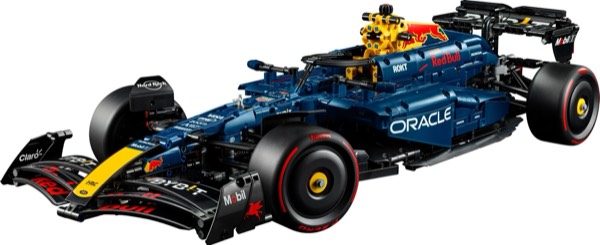
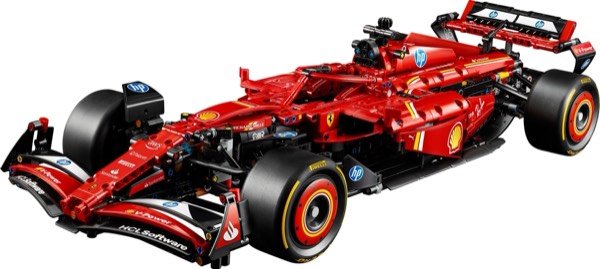
The proportions are the most refined in the Technic 1:8 F1 lineup to date. Previous iterations - including the Ferrari SF-23, Mercedes W14, and Red Bull RB18 - each had minor proportion issues that Technic's pin-and-beam construction introduces. The MCL39 addresses several of these through revised panel geometry and a lower overall ride height that gives the car a more authentic ground-hugging stance. The nose-to-tail flow is smoother than any predecessor, and the rear wing assembly sits at the correct height and angle relative to the engine cover, creating a visual finish line for the car's aerodynamic profile.
The one display limitation is inherent to Technic construction: pin holes, panel gaps, and visible structural elements are part of the aesthetic. The MCL39 minimizes these more effectively than previous Technic F1 cars, but it cannot eliminate them entirely. Compared to the clean surface finishes of the Ferrari F2004 Icons set (#11375) or the Williams FW14B Icons set (#10353), the Technic MCL39 sacrifices surface perfection for mechanical depth. This is not a flaw - it is a design philosophy choice. The Technic aesthetic communicates engineering in a way that smooth System surfaces cannot, and for builders who value visible mechanism over visual polish, the MCL39 is the superior display piece.
The MCL39 sits at the flagship end of LEGO's pricing spectrum, which means the investment is significant. But the return on that investment is equally significant. 1,675 pieces, five working mechanical systems, a championship-winning car identity, 8-12 hours of engaged building time, and a 24-inch display model that anchors any shelf it occupies. The price-per-piece is competitive with other Technic flagships and more favorable than most large licensed sets, where the brand premium often inflates cost beyond brick value.
The championship context adds emotional and collector value. The MCL39 represents McLaren's 2025 season car - the car that delivered the team's first Constructors' Championship since 1998 and their first Drivers' Championship since 2008. That historical significance gives the set a gravitas that extends beyond its physical content. LEGO Technic F1 sets tend to appreciate in value after retirement, and championship-winning cars historically command the highest premiums on the secondary market. The Ferrari SF-23 Technic set, which represented a competitive but non-championship car, has already appreciated substantially since its retirement. A championship-winning McLaren is likely to follow an even steeper trajectory.
For builders deciding between the Technic MCL39 and the Icons F1 sets, the choice comes down to philosophy. The MCL39 offers a longer, more technically demanding build with visible mechanical systems and a larger finished model. The Ferrari F2004 (#11375) and Williams FW14B (#10353) offer smoother display surfaces, historical significance, and the clean aesthetic that System construction delivers. There is no wrong answer. But if you want the build that teaches you the most about how an F1 car actually works, the MCL39 is the only choice. And if you want to see McLaren represented at every scale, pair it with the Speed Champions MCL38 (#77251) and the City McLaren (#60442) for a three-tier display that shows the same team at three different levels of complexity.
Unlike Speed Champions and City sets, the Technic MCL39 does not include traditional minifigures. This is standard for the 1:8 Technic F1 series - the scale does not accommodate minifigure-sized drivers, and the cockpit area is occupied by the steering mechanism linkage that connects the steering wheel to the front wheel geometry. What you lose in minifigure personality, you gain in mechanical authenticity. The cockpit is detailed with a printed steering wheel element and instrument panel graphics, and removing the engine cover reveals the full V6 engine and gearbox assembly in impressive detail.
The Technic approach means the car functions as a mechanical demonstrator as much as a display model. Each of the five systems can be activated and observed independently: spin the rear wheels to watch the pistons cycle, shift the gearbox lever to change gear ratios, rotate the DRS activator to see the wing flap move, turn the steering wheel to see the front wheels respond, and press down on the body to test the dual suspension systems. These interactive elements give the MCL39 a dimension that static display models lack - it is a toy in the best sense of the word, a machine that invites touch and experimentation alongside visual appreciation.
- ✓ Five working mechanical systems: DRS, gearbox, V6 pistons, steering, dual suspension
- ✓ Pull-rod front and push-rod rear suspension replicates real F1 engineering
- ✓ Championship-winning car identity (2025 Constructors' and Drivers')
- ✓ Papaya orange livery translates excellently into Technic elements
- ✓ Most refined proportions in the 1:8 Technic F1 lineup to date
- ✓ 24-inch display presence anchors any shelf
- ✓ Rare Technic elements with high secondary market value
- ✗ Front and rear tire widths are identical - real MCL39 has wider rears
- ✗ Minor sidepod panel gaps visible on close inspection
- ✗ Flagship price point represents a significant investment
- ✗ Sticker sheet required for sponsor branding details
Some products may be provided by manufacturers. This page contains affiliate links. All opinions are my own.
- McLaren MCL38 Speed Champions Review - McLaren at the 8-wide scale
- McLaren F1 City Review - McLaren at the entry-level City scale
- Ferrari F2004 Icons Review - The Icons alternative for F1 display collectors
- Williams FW14B Icons Review - Another legendary F1 car in premium LEGO form
- Every LEGO F1 Set Ranked - The definitive 2026 F1 guide
Most Technic cars feel rear-heavy once built, struggling with balance on flat surfaces. This one doesn't. The weight distribution across the gearbox assembly and the front end engineering creates stability that's genuinely satisfying to handle. Rotating the DRS wing flap while the car sits on a table creates this unexpected moment where the engineering logic clicks, the hydraulic cylinders actually have resistance, actual tension, not loose play. It's a small detail that separates sets designed by engineers from sets designed by designers.
The other thing: the cockpit. Rather than cramming a figure into an oversized capsule, LEGO built an actual racing seat profile with harness detailing molded in. The steering wheel connects to visible linkage that actually moves the front wheels. Most builders won't tinker with the gearbox after day one, but everyone will rotate the wheels by hand and watch that steering column work. That feedback loop, action triggering visible mechanical response, is what keeps this from feeling like sculpture.
Track it in your vault on GameSetBrick - our free collection app. Log your condition, price paid, and watch the real-time market value.
Track in Your Vault →Save it to your wishlist on GameSetBrick. Share your list with friends and family - every set has a buy button so gift givers know exactly where to go.
Add to Wishlist → GameSetBrick is a free app by The Earl of Bricks. See all features. Scan it. Track it. Trade it.