Is the LEGO F1 McLaren Race Car Worth Buying?
8.42/10. Worth buying. Papaya orange is one of LEGO's best livery matches. This punches above its weight class.
Comparing your options? See where it lands in our best LEGO F1 sets, ranked for 2026.

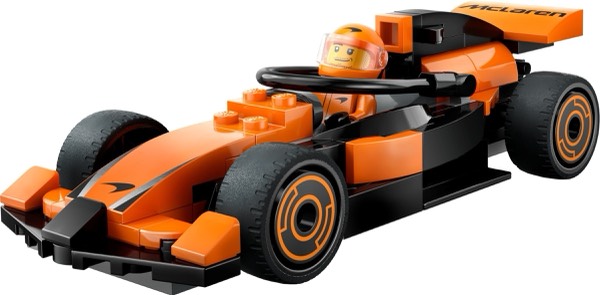
The McLaren F1 race car occupies strange territory at 86 pieces, too small to be taken seriously as a display model by most collectors, yet too expensive to be a casual impulse buy. LEGO's licensed F1 sets always walk this line awkwardly, caught between the speed championship's massive factory builds and the budget constraints that make every piece count. What matters here is execution. This isn't trying to be the definitive McLaren; it's trying to nail a specific moment: the 2024-2025 season livery in a format that doesn't require a second mortgage.
Built it in stages, actually, one sitting to frame the chassis, another to dial in the cockpit and bodywork. The orange hits different on orange, which sounds obvious until you're holding it under actual light and realizing LEGO nailed the papaya tone from first production run to last. That level of consistency on a licensed livery matters more than builders typically admit. The proportions aren't stretched or distorted to accommodate a minifigure; they're tight, aggressive, correct.
---
At 86 pieces and a 6+ age rating, the McLaren City F1 car sits at the entry point of LEGO's Formula 1 lineup. The build takes around 15-20 minutes for an experienced builder, perhaps 30-40 minutes for the target age group. But speed is not the point here. What makes this build genuinely interesting for its size is the curved hood assembly - a 2x2 curved slope positioned over a 1x2 brick that creates a smooth aerodynamic taper from the cockpit forward to the nose. It is a simple technique, three pieces working together, but it captures the essence of an F1 car's nose profile at a scale where most designers would resort to a single molded piece.
The build progression moves from a flat wide chassis plate through wheel arch assembly, bodywork stacking, and finally the rear wing and driver placement. There is a logical flow to it that mirrors how a real car is assembled: structure first, then surfaces, then details. For a child building their first vehicle, this sequencing is educational without being instructional. For an adult builder, it is a quick palate cleanser between larger projects - the kind of build you can complete during a coffee break and feel a genuine moment of satisfaction when the last piece clicks into place. The instructions are clear and straightforward, with each step adding visible progress to the model, which keeps younger builders motivated through to completion.
The papaya orange color is the star of the build experience. McLaren's signature hue is one of the most distinctive in motorsport, and LEGO's orange elements match it closely enough that the car reads as McLaren from the first few pieces. Watching that orange accumulate across the body panels, piece by piece, is disproportionately satisfying for such a small set. Color does emotional work in LEGO that piece count cannot. There is a visceral thrill to seeing that particular shade of orange take shape under your hands, and it connects you to the broader McLaren story - the team's heritage, its recent resurgence, and the electric atmosphere of Lando Norris leading a race in papaya. That connection is what separates this from a generic orange racing car, and it is why the McLaren branding matters at every scale LEGO offers.
The technique ceiling on an 86-piece City set is necessarily low, but the McLaren F1 car makes the most of its constraints. The curved nose assembly mentioned above is the headline technique - it demonstrates how a curved slope element, angled correctly against a standard brick, creates the illusion of aerodynamic shaping without requiring specialized molded parts. This is the foundational principle behind every Speed Champions and Technic car nose in LEGO's catalog, reduced to its simplest possible expression. For newer builders learning to read how LEGO approximates curves, this set is a clean, accessible case study. It strips away the complexity of larger builds and shows you the essential trick in isolation.
The rear wing construction uses two small plate elements mounted on a single clip to create the distinctive F1 rear aerofoil profile. It is rudimentary compared to the multi-element wing assemblies in the McLaren MCL38 Speed Champions set (#77251), but it demonstrates the same principle: horizontal plates at an angle suggest an aerodynamic surface. The cockpit area uses a windscreen element that establishes the halo structure in silhouette, keeping the build recognizable as a modern F1 car rather than a generic racer. Across the entire 86-piece build, there are enough deliberate design choices to justify examining how LEGO's designers prioritized which visual elements to preserve and which to simplify at City scale. The lesson here is one of hierarchy: when you have limited pieces, spend them on the details that define the subject. For an F1 car, that means the nose profile, the rear wing, and the color.
There is also a useful lesson in proportions that this set teaches by example. The wheelbase-to-body ratio, the height of the rear wing relative to the bodywork, and the width of the front nose relative to the rear - all of these proportional relationships are maintained even at this tiny scale. LEGO's designers have not just shrunk the car; they have distilled it to its essential geometric relationships. For builders who want to create their own small-scale vehicles, studying how those proportions hold up at 86 pieces is more valuable than studying a 1,500-piece Technic model where complexity obscures the fundamentals.
86 pieces is not going to transform your parts collection, but what you get is more useful than the count suggests. The papaya orange elements - curved slopes, standard plates, and wheel arch pieces - are genuinely valuable for any builder working in warm orange tones. Orange is one of LEGO's less common colors in bulk, and the curved 2x2 slopes in this set are the same elements used across the Speed Champions range. Having extras in your collection means you can experiment with orange vehicle designs without raiding a more expensive set. The orange plates are also useful for accent work on larger builds where a pop of warm color can bring a monotone model to life.
The black wheel arches and dark grey structural pieces are universally useful, appearing in virtually every vehicle MOC context. The tire and wheel assemblies are standard City scale, compatible with every other City vehicle in your collection. The printed nose element is McLaren-specific and unlikely to find use outside an F1 build, but the cockpit windscreen element is a versatile piece that appears across racing, aviation, and sci-fi builds. For builders who track cost-per-useful-piece rather than raw price-per-piece, this set performs reasonably well. It is not a parts pack, but every element earns its place in the build and most earn their place in the bin afterward.
The minifigure driver adds a small but meaningful contribution to the parts inventory. The printed torso and legs in McLaren livery are exclusive to this set, and the updated helmet mold is a piece that every F1 collector will want multiples of. The hair piece included as an alternate display option is standard but useful. At this price point, getting a unique minifigure with team-specific printing is a genuine bonus that adds collector value beyond what the car itself provides. The parts haul is modest in absolute terms, but proportional to the set's size and cost, it delivers efficiently.
Here is where the McLaren City car genuinely surprises. At roughly 14cm long, it is small - smaller than a Speed Champions car, smaller than most display-oriented LEGO vehicles. But the papaya orange livery does something that no other color in the F1 palette achieves at this scale: it pops. Place this car on a dark desk, on a bookshelf, on a windowsill, and the orange demands attention. McLaren's color choice is inherently photogenic, and LEGO's element selection translates it faithfully enough that the car reads as McLaren from across a room. It functions as a tiny beacon of motorsport energy wherever you put it, and that kind of visual presence from a sub-100-piece set is remarkable.
The low, wide stance helps. The chassis plate creates a ground-hugging profile that looks planted and purposeful even at City scale. The rear wing adds a vertical element that breaks the horizontal silhouette and keeps the car from looking like a generic wedge shape. From three feet away, which is the typical viewing distance for a desk display piece, the McLaren City car presents a clean, recognizable F1 silhouette in a color that catches light beautifully. It is not competing with the McLaren MCL38 (#77251) for Speed Champions-level detail, or with the massive McLaren MCL39 Technic (#42228) for engineering showcase status. It occupies a different niche entirely: the casual display piece, the desk companion, the set that sits next to your monitor and makes you smile when you notice it.
For scale collectors, the McLaren City car creates an interesting three-tier display when positioned alongside the MCL38 Speed Champions and MCL39 Technic models. City, Speed Champions, Technic - the same team represented at three different scales and three different levels of complexity. That progression tells a story about LEGO's design philosophy that is worth showcasing. It also makes for an excellent social media photo - line up all three McLarens from smallest to largest, and the visual impact is immediate. The City car anchors the small end of that scale with a confidence that belies its piece count, proving that good design communicates at any size.
The price-per-piece calculation on this set is higher than the LEGO average, which is typical of small licensed sets where the brand premium and specialized elements inflate the per-piece cost. At roughly 15 cents per piece, you are paying more per brick than you would in a 500-piece City set. But price-per-piece is a misleading metric for impulse-buy sets. The correct question is: does it deliver satisfaction proportional to its cost? And the answer is yes. The emotional return on investment here is disproportionately high for the dollar amount, which is the real measure of value at this price tier.
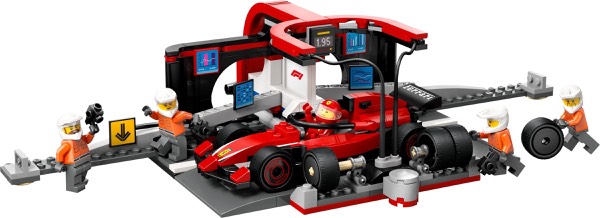
For the price of a fast-food meal, you get a licensed McLaren F1 car with a driver minifigure, a 20-minute build session, and a display piece that will sit on your desk for months. As a gift, it is perfectly priced for a stocking stuffer, a birthday party favor, or a reward for a young F1 fan. As a self-purchase for an adult builder, it is the kind of impulse buy you make at the LEGO store checkout and never regret. The Williams and Haas two-pack (#60464) offers better per-car value if you want quantity, and the Ferrari Pit Stop (#60443) offers more build substance if you want depth. But for a single car with maximum visual impact at minimum cost, the McLaren City car is the best individual purchase in the City F1 lineup.
There is also the gateway value to consider. This set is the lowest-cost entry point into LEGO's F1 ecosystem. A child who builds this McLaren and falls in love with the papaya orange might graduate to the Speed Champions MCL38, then eventually to the Technic MCL39. That progression represents hundreds of dollars in future LEGO purchases, all seeded by an impulse buy at the checkout counter. LEGO knows this, of course, and the quality of this tiny set reflects their understanding that first impressions at every price tier matter. Even at the entry level, the McLaren delivers an experience that earns loyalty.
The set includes a single McLaren F1 driver minifigure wearing the team's distinctive papaya orange racing suit. The torso printing features the McLaren logo, team sponsor graphics, and the characteristic orange-to-black color transition that mirrors the real-world race suit design. The legs continue the racing suit printing with additional sponsor detail on the thighs. It is a well-executed figure that communicates McLaren identity clearly despite the small canvas of a minifigure torso. The printing quality is sharp, with clean lines and accurate color matching that holds up under close inspection.
The driver wears a McLaren-branded helmet with a printed visor design. The helmet uses the updated mold that LEGO introduced for the 2025 F1 wave, which features a slightly more aerodynamic profile than older helmet designs. A separate wig hairpiece is included for helmetless display. The figure does not represent a specific real-world McLaren driver, but the suit and helmet printing are accurate enough to the team's branding that it integrates seamlessly into any McLaren display alongside the MCL38 Speed Champions car or the MCL39 Technic model. This is a unique figure - the City-scale McLaren driver does not appear in any other set, which gives it genuine exclusivity despite the set's modest price point.
For minifigure collectors building a comprehensive F1 driver lineup, this City-scale McLaren driver fills a slot that the Speed Champions and Technic figures cannot. The proportions of the printed suit differ slightly due to the different figure scale, and the helmet printing is unique to this release. Whether displayed in the car, standing beside it, or lined up alongside other F1 team drivers from the City range, the figure holds its own with confidence. It is a complete, well-executed minifigure that would have been impressive at twice the price point.
The McLaren City F1 car has a broader audience than its small size suggests. The most obvious buyer is a young F1 fan who is just entering the LEGO hobby. At 86 pieces with an age rating of 6+, this is an accessible build that delivers instant gratification and introduces the fundamental techniques of vehicle construction. It does not overwhelm, it does not frustrate, and the papaya orange result is exciting enough to generate the kind of enthusiasm that leads to asking for the Speed Champions version next. If you have a child who watches F1 races and is starting to show interest in building, this is the perfect first purchase.
The second audience is adult collectors who are building a comprehensive McLaren or F1 display. If you already own the MCL38 and the MCL39 Technic, the City car completes the scale trilogy. It is a small investment that adds a third tier to your display and creates a visual narrative about LEGO's approach to the same subject at different levels of complexity. Some collectors dismiss City-scale sets as beneath their attention, and they are missing out. The City McLaren is a display enhancer that punches far above its weight class when positioned alongside its larger siblings.
The third audience is anyone looking for a quick, satisfying build that costs less than lunch. Sometimes you want to build something in fifteen minutes, enjoy the result, and get back to your day. The McLaren City car scratches that itch perfectly. It is also an ideal gift for F1 fans of any age - compact enough to fit in a Christmas stocking, impressive enough to earn genuine appreciation, and priced low enough that you can buy several without second-guessing the expense. If you are attending a child's birthday party and the guest of honor likes cars, this is the gift that gets opened and played with immediately.
- ✓ Papaya orange livery is instantly recognizable and photographs beautifully
- ✓ Curved nose technique is a clean design lesson in miniature
- ✓ McLaren driver minifigure with team-accurate suit printing
- ✓ Perfect impulse buy and stocking stuffer price point
- ✓ Low, planted stance looks purposeful even at City scale
- ✓ Creates a compelling three-tier McLaren display with MCL38 and MCL39
- ✗ 86 pieces is a slim build that ends quickly
- ✗ Higher per-piece cost typical of small licensed sets
- ✗ Limited detail compared to Speed Champions equivalent
Some products may be provided by manufacturers. This page contains affiliate links. All opinions are my own.
- McLaren MCL38 Speed Champions Review - McLaren at the detailed 8-wide scale
- McLaren MCL39 Technic Review - McLaren at massive 1:8 Technic scale
- Ferrari F1 Pit Stop Review - The best build in the City F1 range
- Williams & Haas Two-Pack Review - Best value in City F1
- Every LEGO F1 Set Ranked - The definitive 2026 F1 guide
The chassis structure uses a stud-less technique on the underside that doesn't look like filler, it's deliberate engineering. Suspension pieces anchor to a reinforced frame that actually distributes stress, which means this car survives being picked up and displayed without parts separating at the seams. For a small set, that's not guaranteed. The cockpit is sealed enough that dust won't accumulate like it does in open-cockpit builds, a practical detail that separates something meant to sit on a shelf from something meant to get knocked around.
The rear wing assembly deserves specific mention. Rather than a flat slope, LEGO angled the supports to create visual depth, it reads as aggressive from every angle, not just the front. That detail costs almost nothing in piece count but changes how the entire model photographs. Builders upgrading this toward MOC territory will find the wing structure absolutely ripe for reinforcement and modification without rebuilding the whole base.
Track it in your vault on GameSetBrick - our free collection app. Log your condition, price paid, and watch the real-time market value.
Track in Your Vault →Save it to your wishlist on GameSetBrick. Share your list with friends and family - every set has a buy button so gift givers know exactly where to go.
Add to Wishlist → GameSetBrick is a free app by The Earl of Bricks. See all features. Scan it. Track it. Trade it.