Is the LEGO McLaren F1 Team MCL38 Worth Buying?
8.2/10. Worth buying. The Earl now has three McLaren F1 sets reviewed. At 8-wide, this is the sweet spot for papaya on the shelf.
Comparing your options? See where it lands in our best LEGO F1 sets, ranked for 2026.

Three McLaren F1 sets in, and this one finally nails the proportion problem that's plagued the Speed Champions line for years. The MCL38 sits at 8-studs wide, not the cramped 6-wide that makes modern F1 cars look like wedges, not the bloated 10-wide that eats shelf space. This width matters more than you'd think, because it's the difference between a car that *looks* like the actual 2024 challenger and one that looks like a toy approximation. After building the MP4-12C and the 76919, standing this alongside them makes clear how much LEGO's learned about fitting contemporary aerodynamics into their constraints.
What makes this set worth discussing isn't the novelty, it's the refinement. The papaya orange is back to that deep, saturated plastic we've come to expect from modern McLaren sets, and the build process respects both the constructor's experience and the casual builder's timeline. No wasted pieces, no tedious repetition, no structural shortcuts that feel cheap. This is what happens when a designer has three previous attempts under their belt and actually knows what worked and what didn't.
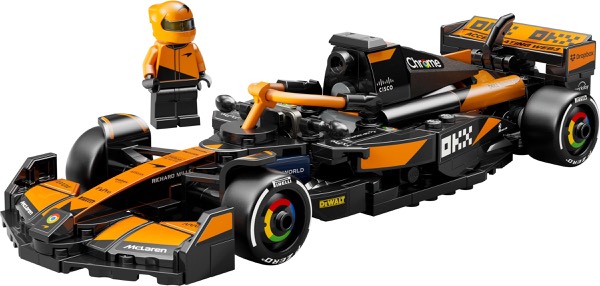
Speed Champions at 8-wide has become the gold standard for miniature F1 cars, and the MCL38 is a strong example of why. At 285 pieces, this is a 30-45 minute build that hits a satisfying rhythm. You start with the chassis plate - the wide base that gives 8-wide cars their planted, proportional stance - and layer upward through cockpit, sidepods, and that distinctive halo.
The build is sequential and logical, which is exactly what you want from Speed Champions. There's no fiddly sub-assembly that threatens to collapse as you attach it. The sidepod construction is the most interesting phase: angled plates create the undercut that defines the MCL38's real-world aerodynamics, and LEGO has managed to suggest that shape without overcomplicating the part count. The front wing assembly clicks together cleanly, and the rear wing - always the trickiest element at this scale - uses a bracket-and-plate combination that feels solid.
If you've built other 8-wide Speed Champions F1 cars, you know the formula. That's not a criticism. The formula works. LEGO has refined the 8-wide F1 build to a science, and the MCL38 benefits from all that iteration. The papaya orange elements have a warm, inviting quality that makes the build feel cheerful in a way that darker-liveried cars do not. There is something genuinely pleasant about watching an orange race car take shape on your building table, and the MCL38 capitalizes on that emotional warmth from the first bodywork element to the last wing attachment. The build ends with a clean sense of completion - the car looks finished, not like something that needs additional work.
The 8-wide format gives designers just enough room to employ real techniques without the luxury of Technic-scale complexity. The MCL38 uses angled bracket connections to create the sidepod undercuts - a technique that newer builders should pay attention to, because it demonstrates how LEGO approximates curves and angles using rectangular parts.
The nose cone section uses a combination of curved slopes and modified plates that taper convincingly. Study how the 1x2 curved slopes layer over the 1x2 plates with side rails - this is a reusable technique for any streamlined vehicle MOC. The halo element is a single molded piece at this scale, which is the pragmatic choice. You can't build a convincing halo from standard parts at 8-wide without it looking chunky.
Compared to the Technic MCL39 (#42228), the technique here is obviously simpler - that's the nature of the scale difference. But compared to the City McLaren (#60442), the 8-wide format gives you meaningfully more design vocabulary to work with. It's the Goldilocks zone for technique-to-simplicity ratio.
285 pieces at the Speed Champions price point is a reasonable haul. The standout elements are the papaya orange parts - LEGO's orange has been consistently good for McLaren builds, and this set contributes curved slopes, plates, and tiles in that distinctive warm tone. If you're building any orange-themed MOC or expanding a McLaren collection, these parts are immediately useful.
You also get a solid selection of dark blue elements (for the lower bodywork), black plates and tiles for the floor and detailing, and the usual Speed Champions wheel-and-tire combination in the smaller racing format. The driver minifigure comes with a printed McLaren helmet, which is a nice collector piece even if you never use it in another build.
The sticker sheet is present but not excessive. Key sponsor logos and the McLaren branding rely on stickers, which is standard for Speed Champions. The underlying parts are clean without them, so if you're a sticker-averse builder, you still get a good-looking car - just a less race-specific one. Builders accumulating orange parts across multiple McLaren sets - the 76919, this MCL38, and the W1 - will find their orange inventory growing to genuinely useful levels. Three McLaren Speed Champions sets provide enough papaya orange elements to start serious custom vehicle work in this distinctive color, which is one of the strongest arguments for collecting the full McLaren lineup.
This is where the MCL38 earns its score. Papaya orange is one of the most visually distinctive liveries in motorsport, and at 8-wide it reads perfectly. The color pops on a dark shelf. From across the room, you immediately know this is a McLaren - the proportions are right, the color is right, and the silhouette captures the essence of a modern F1 car.
At approximately 7 inches long, it sits beautifully alongside other Speed Champions cars. If you're building an F1 grid shelf, the MCL38 is essential. The stance is low and wide, the front wing has appropriate complexity, and the rear wing adds the right visual punctuation at the back. It looks like a serious model, not a toy.
Here's what makes this interesting for The Earl: I now have three McLaren F1 sets reviewed across three scales. The City #60442 is a charming desk ornament at 6-wide. This MCL38 is the definitive shelf display at 8-wide. And the Technic MCL39 #42228 is the centerpiece-scale model. Lined up together, they tell the story of how LEGO interprets the same car across formats - and honestly, all three hold up. But if you're picking just one McLaren for your shelf, the 8-wide MCL38 is the one I'd recommend for the balance of size, detail, and price.
Speed Champions sets generally deliver good value, and the MCL38 continues that trend. For the price of a decent lunch, you get a licensed F1 car with a driver minifigure, a satisfying build, and a display-quality result. The price-per-piece is in line with the Speed Champions average, and the 8-wide format gives you noticeably more car than the older 6-wide sets that cost nearly the same.
Compared to the Technic MCL39, this is obviously a fraction of the price for a fraction of the complexity. That's not a fair comparison - they're different products for different audiences. But if you're deciding between multiple McLaren F1 sets and budget is a factor, the Speed Champions MCL38 delivers the best display-quality-per-dollar in the McLaren F1 lineup.
The only value concern is the sticker reliance for branding details. At this price point, printed elements would push the value proposition from "good" to "excellent." But that's a complaint I have about the entire Speed Champions line, not this set specifically. For the full McLaren experience at every scale, pair this with the massive Technic MCL39 (#42228) and the pocket-sized City McLaren (#60442). Three scales of papaya, one shelf of orange glory.
The set includes a single McLaren F1 Team driver minifigure wearing the team's papaya orange racing suit. The torso printing features the McLaren speedmark logo, team sponsor branding, and the distinctive orange-to-black color transition that characterizes the 2024 race suit. The leg printing continues with sponsor details on the thighs. The papaya orange printing is vibrant and accurately represents the suit color that has become synonymous with McLaren's modern identity. This is arguably the most visually striking driver figure in the Speed Champions F1 range - the orange simply pops harder than any other team color at minifigure scale.
The driver's helmet is printed with McLaren branding in the papaya orange and black scheme, using the updated 2025 Speed Champions helmet mold. An alternate hair piece is included for helmetless display. The figure does not represent Lando Norris or Oscar Piastri specifically, but the McLaren suit printing is instantly recognizable. This figure is exclusive to the MCL38 set and complements the McLaren driver figures from the City McLaren (#60442) and the engineering-focused cockpit of the Technic MCL39 (#42228). Collecting all three gives you the McLaren story at every LEGO scale.
The McLaren MCL38 is for anyone who wants the definitive Speed Champions F1 experience. Among the three McLaren F1 sets The Earl has reviewed, this 8-wide version occupies the Goldilocks position: more detailed than the City-scale McLaren, more accessible than the massive Technic MCL39, and perfectly sized for desk or shelf display. If you are buying exactly one McLaren F1 LEGO set, this is the recommendation - it delivers the best balance of build satisfaction, display quality, and everyday display footprint.
McLaren fans specifically will find the MCL38 essential. The papaya orange livery is one of the most recognized color schemes in modern motorsport, and the Speed Champions version captures it with a fidelity that makes the car instantly identifiable from across a room. Paired with the Technic MCL39 for scale contrast or the City McLaren for a complete brand overview, the MCL38 is the middle chapter of a three-part papaya story.
For builders new to Speed Champions, the MCL38 is an ideal introduction. The 30-45 minute build time is accessible, the papaya orange result is visually rewarding, and the construction teaches the fundamental Speed Champions vocabulary - chassis, sidepods, wings, halo - in a format that prepares you for every other F1 car in the range. If you enjoy the MCL38 build, you will enjoy the entire Speed Champions F1 lineup, and this set gives you the confidence to know that before investing further.
McLaren's papaya orange is one of the most recognizable colors in motorsport, and the MCL38 wears it proudly. The color originated with Bruce McLaren's personal preference in the 1960s, was abandoned for decades of sponsor-driven liveries, and was revived in 2018 as a declaration of brand identity. In Speed Champions form, that papaya reads beautifully at 8-wide scale -- it is warm, distinctive, and immediately identifiable from across a room. Among the ten F1 team cars in the 2025 grid, the McLaren's color alone gives it display advantage. Dark shelving makes the orange glow. White shelving makes it pop. The visual confidence of the livery elevates a solid build into a display piece that earns its position on any shelf. The Audi F1 R26 is another standout from the grid -- read our full review.
- ✓ Papaya orange livery looks stunning at 8-wide scale
- ✓ Solid build with good pacing and no frustration points
- ✓ Best McLaren display-per-dollar in the current lineup
- ✓ Proportions capture the MCL38 silhouette convincingly
- ✓ Driver minifig with printed McLaren helmet
- ✗ Stickers for key livery details
- ✗ Rear wing assembly could be slightly more refined
- ✗ No pit wall or garage accessory at this price point
Some products may be provided by manufacturers. This page contains affiliate links. All opinions are my own.
- Best LEGO F1 Sets Ranked - Where every F1 set stacks up in our definitive ranking
- McLaren MCL39 Technic Review - The massive Technic-scale McLaren experience
- McLaren F1 City Review - McLaren at City scale for younger builders
The MCL38's chassis structure opens up real possibilities if you're thinking about extended builds. The frame is solid enough to support a motorized base, and the 8-wide proportions mean you've got actual room for technic integration without compromising the model's integrity. The sponsorship stripe placement, that clean black-and-silver split down the body, was modular enough in my build that substituting alt-color elements or even remixing the panel arrangement doesn't destabilize anything. Several builders in the secondary market have already posted MOC extensions that use the MCL38 as a foundation for 1:20 scale pit garage setups, which speaks to how well the proportions anchor to other Speed Champions standards.
The windscreen assembly here is also noteworthy. Unlike earlier F1 sets that used that fused, one-piece canopy, the MCL38 separates the main and side windows in a way that feels authentic but also gives you options if you want to swap in custom transparent elements or even leave it fully open. For someone thinking about photographing or modifying, that modularity is the difference between a display piece and something that actually invites experimentation.
Track it in your vault on GameSetBrick - our free collection app. Log your condition, price paid, and watch the real-time market value.
Track in Your Vault →Save it to your wishlist on GameSetBrick. Share your list with friends and family - every set has a buy button so gift givers know exactly where to go.
Add to Wishlist → GameSetBrick is a free app by The Earl of Bricks. See all features. Scan it. Track it. Trade it.