Is the LEGO F1 Williams & Haas Race Cars Worth Buying?
8.62/10. Worth buying. Two cars, two drivers, two liveries. This is the best pure value in the City F1 wave.
Comparing your options? See where it lands in our best LEGO F1 sets, ranked for 2026.
The Williams-Haas pairing is a calculated move by The LEGO Group, and honestly, it works. Rather than dump both cars into a bloated the retail price+ set, splitting them across two separate boxes at this price point forces a genuinely difficult choice, but that friction is exactly why this set matters. You're looking at legitimate race car engineering in miniature form, not cartoon vehicles. The proportions feel correct. The liveries are instantly recognizable to anyone who actually follows F1, not just casuals browsing shelves.
What caught me off guard was how much personality each build carries despite the stripped-down piece count. The Williams is leaner, more vulnerable, the car's actual 2025 direction reflected in its construction. The Haas sits heavier, more aggressive. You build them back-to-back and they don't feel like copies of the same mold. That's discipline in design. For the secondary market, this set has already shown staying power because completionists need both cars to have the full grid narrative. It's not generous, it's strategic, but the build experience justifies the compartmentalization.
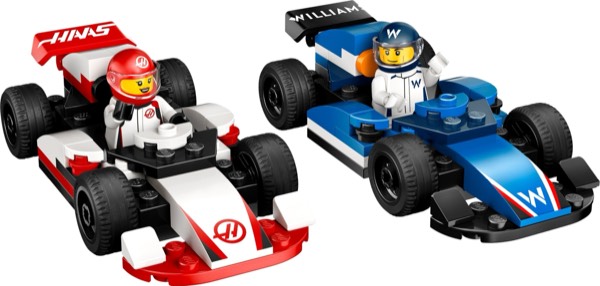
The Williams and Haas two-pack is the only multi-car set in the LEGO City F1 range, and that distinction shapes the entire build experience. At 92 pieces split across two cars, each individual build is compact - roughly 15 minutes per car for an experienced builder, maybe 25 minutes for the target audience of ages 4 and up. But the real satisfaction here is not in the complexity of either individual car. It is in the comparison. Building two F1 cars back to back using the same simplified City chassis, then seeing how dramatically different they look through livery and color alone, teaches a fundamental lesson about how design communicates identity at any scale.
The Williams car goes together first in most builders' hands, simply because the dark blue pieces are more visually striking in the bag. The construction is straightforward: a wide 4-stud chassis plate, wheel arches, a printed nose section, and the distinctive Williams Racing blue bodywork that wraps around the cockpit area. There are no complex connections here, no SNOT techniques, no bracket assemblies. This is pure plate-on-plate stacking designed for small hands and short attention spans. And it works.
The Haas car follows the identical structural pattern but delivers a completely different visual result. The white-and-red Haas livery against the same chassis silhouette creates an immediate contrast that makes both cars more interesting than either would be alone. The red stripe placement on the Haas bodywork is handled through a single printed element that does heavy lifting - it communicates the entire Haas identity in one piece. For a set rated 4+, the engineering behind making two visually distinct cars from essentially the same parts architecture is quietly impressive. This is LEGO at its most efficient.
At the 4+ difficulty level, technique value in the traditional sense is limited. There are no half-stud offsets, no Technic pin connections, no curved slope assemblies creating aerodynamic profiles. The cars are built from large, chunky elements designed for durability and ease of assembly. But dismissing this set's technique value entirely would be a mistake. The real technique lesson here is in livery design - how LEGO's designers communicate two completely different racing identities using the same underlying structure and a minimal number of printed elements.
The Williams car uses printed slope elements to suggest the racing blue livery with white accents that has defined Williams Racing's modern identity. The Haas car uses a contrasting approach - white base with red graphic elements that capture the American team's branding. Both cars achieve instant recognition at arm's length, which is the fundamental challenge of minifigure-scale automotive design. For younger builders, this is an accessible introduction to how color and print placement communicate brand identity. For adult builders studying LEGO's design language, it is a reminder that the simplest solutions often read the clearest. The Williams FW46 Speed Champions set (#77249) achieves the same livery recognition at 8-wide scale through more complex brick-built methods, and comparing the two approaches side by side is genuinely instructive.
92 pieces across two cars is a modest haul by any measure, but the two-car format means you are getting parts in two distinct color palettes rather than one. The Williams car contributes dark blue plates, slopes, and wheel arch elements that are always useful in automotive and architectural MOC work. Dark blue is one of LEGO's more versatile colors, and any opportunity to accumulate it at a low price point is worth noting. The Haas car adds white structural pieces and the red accent elements that, while limited in quantity, provide contrast pieces for custom builds.
The wheel and tire assemblies are standard City scale - four matching sets across both cars, totaling eight wheels. These are smaller than Speed Champions wheels but compatible with any City-scale vehicle project. The printed nose elements are set-specific and unlikely to find use outside an F1 context, but the base plates, standard slopes, and connector pieces are universally applicable. The real parts value here is not in any single rare element but in the breadth of colors you get for a low entry price. Two palettes for the cost of one set makes this the most color-diverse parts buy in the City F1 range, ahead of the single-car McLaren (#60442) and even the larger Ferrari Pit Stop (#60443) on a per-dollar basis for color variety.
The display story for this set is entirely about the pair. A single City-scale F1 car on a shelf is forgettable - it is too small to command attention and too simple to reward close inspection. But two cars displayed side by side transform both into something more compelling. The Williams dark blue against the Haas white-and-red creates an immediate visual contrast that communicates "racing" to anyone who glances at your shelf, even if they cannot identify the specific teams. The silhouettes are identical, which makes the color differences pop even harder.
The optimal display configuration is the two cars angled slightly toward each other, as if battling for position into a corner. This creates a dynamic visual that tells a story, rather than two static models sitting in parallel. For builders collecting the full City F1 range, the Williams and Haas pair fills two grid positions at once, and they look excellent flanking the McLaren (#60442) for a three-wide City F1 display. Add the Ferrari Pit Stop (#60443) and you have four teams represented at City scale - a miniature paddock that works on a bookshelf or a child's desk.
Scale context matters here. These are not competing with the Speed Champions Williams FW46 or the Speed Champions Haas VF-24 for display supremacy. Those 8-wide models are more detailed, more accurate, and more visually impressive individually. The City two-pack serves a different purpose: it is the gateway display, the first F1 shelf, the set that starts a collection. And for that role, two cars in contrasting liveries is the perfect starting point.
The value calculation on this set is simple and compelling. For a modest price, you get two licensed Formula 1 cars representing two real-world constructors, plus two unique driver minifigures in team-accurate racing suits. That works out to roughly half the cost per car compared to buying two individual City F1 sets. No other set in the City F1 range delivers this kind of per-unit value, and no other set gives you two different teams in one box.
The per-piece price is higher than average for LEGO overall, which is typical of licensed sets at the 4+ level where larger, specialized elements drive up the cost relative to piece count. But piece count is the wrong metric for this set. The correct metric is cost-per-display-unit, and by that measure - two distinct F1 cars with two drivers for less than the price of a single Speed Champions car - this is the best value entry point in LEGO's entire F1 lineup. If you are buying a gift for a young F1 fan, this is where to start. If you are an adult collector filling out a City-scale grid, this is the most efficient purchase available. And if you already own the Speed Champions Williams or Haas, having the City-scale versions adds a charming scale-comparison element to any F1 display.
The set includes two driver minifigures, one for each team. The Williams Racing driver wears a dark blue racing suit with white and light blue accent printing that matches the team's 2024-2025 livery. The helmet features a dark blue base with the Williams Racing logo printed on the visor area. The overall look is clean and immediately identifiable as a Williams driver, even at the simplified 4+ level of detail.
The Haas F1 Team driver wears a white racing suit with red and black accent printing, reflecting the American team's branding. The helmet is white with red graphic elements. Both figures use the standard City-scale racing suit torso and leg printing, and both include the newer style helmet mold that LEGO introduced for the 2025 F1 wave. Neither figure represents a specific real-world driver, but the team-accurate suit printing means they slot convincingly into any F1 display context. For collectors, these are unique figures - neither the Williams nor Haas City-scale driver appears in any other set.
The Williams and Haas two-pack is the definitive gateway set for young Formula 1 fans. If you have a child who has caught the F1 bug through Netflix's Drive to Survive, through watching races with family, or through the sheer cultural momentum that F1 has built over the past few years, this is the set that converts that enthusiasm into something they can hold, build, and display. Two cars means instant racing scenarios, and the simplified 4+ construction means the build itself does not become a barrier between enthusiasm and satisfaction. They will have both cars built and racing across the carpet within an hour of opening the box.
For adult collectors building a comprehensive LEGO F1 display across all available themes, this two-pack fills two grid positions at the City scale for less than the price of one Speed Champions car. It is the most efficient way to add Williams and Haas representation to your collection, and the City-scale versions provide an interesting contrast when displayed alongside their more detailed Speed Champions counterparts. The scale comparison itself tells a story about how LEGO approaches the same subject at different complexity levels, and that design narrative is part of what makes collecting across themes rewarding.
Gift-givers will find this set exceptionally easy to recommend. The price is accessible, the dual-car format doubles the perceived value, and the F1 branding carries immediate recognition and excitement. It works for birthdays, holidays, rewards, or simple impulse purchases. And because it includes two different teams, it works for siblings who can each claim a car, for friends who want to race against each other, or for solo builders who want the visual contrast that two liveries provide. It is a set designed to please, and it succeeds at that mandate across a remarkably wide audience.
- ✓ Two licensed F1 cars for the price of one
- ✓ Williams and Haas liveries are both instantly recognizable
- ✓ Two unique driver minifigures in team-accurate suits
- ✓ Best per-unit value in the entire City F1 range
- ✓ Contrasting color palettes make the pair more compelling than either car alone
- ✓ Perfect gateway set for young F1 fans starting a collection
- ✗ 4+ scale means simplified construction with less build challenge
- ✗ Individual cars lack the detail of Speed Champions equivalents
- ✗ No pit crew, garage, or accessory elements included
Some products may be provided by manufacturers. This page contains affiliate links. All opinions are my own.
- Williams FW46 Speed Champions Review - Williams at the detailed 8-wide scale
- Haas VF-24 Speed Champions Review - Haas at the detailed 8-wide scale
- Williams FW14B Mansell Icons Review - Williams at premium Icons scale
- Ferrari F1 Pit Stop Review - The best single set in the City F1 range
- Every LEGO F1 Set Ranked - The definitive 2026 F1 guide
- F1 Grid with VCARB & Sauber Review - More City F1 cars to complete the grid
This isn't the set for someone building a casual LEGO F1 collection. This is for the builder who owns the larger flagship sets and sees this 92-piece box as tactical filler, the missing pieces of a broader universe. You're the person with the McLaren and the Ferrari already on the shelf, and you've been irritated by the gaps in your grid. That specificity matters. The set rewards patience and contextualization; build it in isolation and it's competent but forgettable.
The other audience is MOC builders who understand that authentic Formula 1 proportions are brutally hard to nail. These chassis are reference material. The wheel guards, the nose cone geometry, the cockpit depth, they're all correct enough to study. Strip them for parts and they become foundation pieces for custom builds that don't look like toy cars. That's a different kind of value than "fun to display."
Track it in your vault on GameSetBrick - our free collection app. Log your condition, price paid, and watch the real-time market value.
Track in Your Vault →Save it to your wishlist on GameSetBrick. Share your list with friends and family - every set has a buy button so gift givers know exactly where to go.
Add to Wishlist → GameSetBrick is a free app by The Earl of Bricks. See all features. Scan it. Track it. Trade it.