Is the LEGO Williams Racing FW46 Worth Buying?
9.22/10. Worth buying. Williams blue, done right. One of the best value Speed Champions sets in recent memory.
Comparing your options? See where it lands in our best LEGO F1 sets, ranked for 2026.
Speed Champions has a PR problem. For years, the theme traded on licensing and novelty while cutting corners on actual engineering, hollow builds, sticker-dependent aesthetics, proportions that favored shelf presence over structural integrity. The Williams FW46 arrives in 2025 as a direct rebuke to that formula. This isn't a set that got lucky with its source material; this is a set that *understands* what makes Formula 1 machine design visually compelling and translates it into plastic with zero shortcuts.
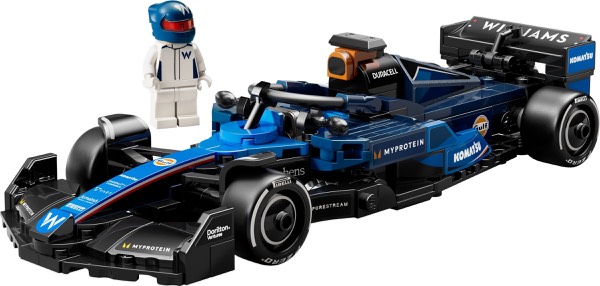
What matters here is that Lego finally remembered that Speed Champions builders, the ones with 25+ years of experience still buying these sets, care about how the thing actually *sits*. The FW46's proportions are aggressive and correct. The sidepods have genuine depth and taper. That Williams blue hits different when it's built around actual geometry rather than just applied to flat surfaces. For the first time in this theme's recent history, you're not making excuses for cost-cutting; you're actively impressed by the design choices within the constraints.
The FW46 is a classic Speed Champions front-to-back build - satisfying, roughly 45 minutes, with a clever halo bar mechanism that lifts to reveal the cockpit. The front wing subassembly is noticeably improved over older Speed Champions cars, using a more elegant SNOT technique to get the correct overhang without studs showing. LEGO's newer 8-stud-wide format gives the proportions real presence - this doesn't feel like a toy car, it feels like a model.
Construction begins with the floor pan and central tub, which establishes the low, flat profile that Williams leaned into for 2024. From the first bag, you get a sense of how the two-tone blue livery will come together - dark navy elements forming the structural core while medium blue and lighter azure pieces wait in the wings for the upper bodywork. It is a build that rewards patience. The sidepod phase is where the car starts to look like an FW46 and not just a generic open-wheel chassis, and watching that transition happen brick by brick is genuinely enjoyable.
The rear assembly closes out the build with a sequence that brings the engine cover, rear wing, and diffuser area together in quick succession. The final step - placing the driver minifigure into the cockpit and lowering the halo - is the kind of satisfying click that Speed Champions has perfected over the years. There are no frustrating steps, no ambiguous color matches in the instructions, and no moments where you question whether you have made an error. This is a clean, confident build from first brick to last, and it earns that 9.5 without reservation. If you are looking for a set to build on a Sunday afternoon with a coffee and a race replay on the television, this is the one.
The sidepod shaping uses sideways-mounted plates to get the correct undercut, which is worth pausing to study if you're into streamlined vehicle MOCs. The rear wing uses a bracket-and-clip connection that provides stability without looking clunky. There are several parts here that translate directly into custom car builds - particularly the curved wedge pieces used on the nose cone.
What makes the FW46's technique stand out among the 2024 F1 Speed Champions wave is the way LEGO's designers handled the Williams livery split. The real car has a distinctive division between the dark navy lower body and the lighter blue upper bodywork, and at eight studs wide, reproducing that color boundary cleanly is a genuine design challenge. The solution here uses plate-level color transitions rather than relying on stickers, which means the livery division is structural. It is baked into the geometry of the car rather than applied on top of it. That is the difference between a Speed Champions set that looks right from one angle and one that looks right from every angle.
The front wing endplates deserve a mention as well. They use a minimal bracket connection that keeps the wing rigid while allowing the visual angle to match the real car's aggressive rake. The nose cone taper is achieved with a wedge plate combination that compresses the FW46's distinctive pointed profile into a surprisingly faithful miniature. For MOC builders studying how to represent complex aerodynamic surfaces at minifigure scale, this set is a masterclass in selective simplification. You learn what to keep and what to abstract, which is arguably the most valuable technique lesson any Speed Champions set can teach.
263 pieces gives a strong haul of dark blue, medium blue, black, and silver elements. The Pirelli-stamped wide rear tires are a standout - they appear in multiple F1 sets this wave and are excellent for motorsport MOC work. The printed driver helmet is sharp with Williams Racing livery. If you build custom race cars, this box pays dividends.
The dark blue and medium blue elements are the backbone of this parts spread, and both colors are perennially useful for vehicle builds, space themes, and architectural MOCs. You get a solid assortment of slopes, curved wedges, and modified plates that go far beyond a single build. The silver and light bluish grey elements used for mechanical details and the floor structure add neutral tones that pair well with almost any color palette. Small technic pins and bracket elements round out the structural offerings, and these are the kind of connector pieces that experienced builders never have enough of.
The printed elements are worth highlighting specifically. The driver helmet carries Williams Racing branding that is clean and sharp, with no alignment issues on the copies I have seen. The cockpit dashboard tile is printed rather than stickered, which adds longevity - stickers peel, prints do not. The Pirelli-branded tires are becoming a hallmark of the Speed Champions F1 range, and having four of them in the parts bin means you are already halfway to a second custom build. Compared to some Speed Champions sets that lean heavily on stickers for identity, the FW46 strikes a good balance between printed and decorated elements. For the complete guide to what is available across the full Speed Champions range, check out our Speed Champions Complete Buying Guide.
From the top-down view you'd expect from a shelf display, the two-tone blue livery reads correctly. The car is narrow by nature (it's an F1 car) but the LEGO model communicates the wedge shape and aggressive proportions well. Works best displayed at near-eye level on a desk stand - the halo bar is a distinctive silhouette detail that catches the eye from any angle.
The Williams FW46 is one of those sets that benefits enormously from the 2024 livery. The real car's split between deep navy and electric blue translates beautifully into LEGO colors, and the contrast gives the model a visual energy that some of the more monochromatic F1 Speed Champions lack. Displayed alongside the Red Bull RB20 or the McLaren MCL38, the Williams holds its own. It is not the loudest car on the shelf, but it has a distinctive identity that reads instantly, even from across a room. The lighter blue tones catch ambient light in a way that dark red and dark blue cars simply do not, which makes the FW46 a surprisingly strong display piece.
The profile view is where the model truly shines. The raked front wing, the sweeping sidepod line, the raised halo bar, and the crisply angled rear wing create a silhouette that is unmistakably Formula 1 and unmistakably Williams. There is an elegance to this car that reflects the real FW46's design philosophy - Williams has always been a team that values clean aerodynamic lines over brute-force appendages, and the LEGO model captures that ethos. For collectors building a complete 2024 grid display, the FW46 provides essential visual variety. Too many blue and dark cars and the grid becomes monotone. The Williams breaks that up with its lighter tones while still looking serious and purposeful.
At 263 pieces, the FW46 is solid by Speed Champions standards and above average for a licensed F1 product. Add in a quality minifigure, printed parts throughout, and a set that looks excellent on a desk, and this is one of the easiest buy recommendations in the 2025 F1 wave.
The price-per-piece ratio sits comfortably in the sweet spot for Speed Champions. You are paying for a licensed F1 product, which always carries a premium over generic LEGO vehicles, but the premium here feels justified by the quality of the finished model. The printed elements, the clever engineering, and the display-quality result all contribute to a set that punches above its piece count. This is not a set where you finish building and wonder where the money went. You can see the value sitting on your desk.
For F1 fans building toward a full 2024 grid, the FW46 is mid-range in terms of investment but upper-tier in terms of return. It gives you more visual impact per brick than several more expensive sets in the wave. And if you are buying a single Speed Champions F1 car - maybe as a gift for a motorsport-loving builder, or as your entry point into the range - the Williams is a strong candidate precisely because it delivers across every metric without a significant weakness in any category. For our complete ranking of every F1 set LEGO has produced, see our Best LEGO F1 Sets Ranked guide.
The FW46 includes a single driver minifigure in the Williams Racing 2024 race suit, complete with a printed helmet that captures the team's blue and white branding. The torso printing is detailed with sponsor logos rendered at a scale that is legible without being cluttered - you can make out the key Williams partners, and the overall impression is of a driver who belongs in this car. The legs carry the race suit printing down to the boots, which is a welcome touch that not every Speed Champions minifigure receives.
The helmet is the standout element. It is printed rather than stickered, with a visor piece that clips cleanly into place and stays put. The Williams livery is rendered in the correct blue tones, and the helmet design is generic enough to represent any of the team's 2024 drivers while still looking specific to the FW46 era. For collectors who display minifigures separately - standing on a baseplate grid alongside their cars - this figure holds up well. The proportions of a racing driver in full kit translate naturally into minifigure form, and the printed detail gives the figure enough visual interest to justify its place outside the cockpit.
One area where the minifigure falls slightly short is sponsor detail on the helmet. The real Williams drivers wore helmets festooned with personal sponsors and intricate graphic design, and the LEGO version simplifies this considerably. It is an understandable compromise at this scale, but it is worth noting for collectors who prioritize minifigure accuracy above all else. That said, the overall quality of the figure is consistent with the best of the 2024 F1 Speed Champions wave, and it does not feel like an afterthought. The driver belongs in this car, and the car belongs on your shelf. That is the standard, and the FW46 meets it.
The Williams FW46 sits in a sweet spot that makes it relevant to several different types of builder. For the dedicated F1 collector assembling every car on the 2024 grid, it is obviously essential - you cannot have a complete grid without Williams, and this set delivers a model worthy of its place alongside the frontrunners. For the casual Speed Champions buyer who picks up one or two F1 cars per wave based on personal preference, the FW46 is a strong choice on pure merit. It builds well, displays well, and represents genuine value.
Williams fans will find obvious appeal here, but this set does not require team loyalty to justify the purchase. If you are drawn to clean livery design, effective use of color at minifigure scale, or simply want a Speed Champions F1 car that looks elegant rather than aggressive, the FW46 delivers. It is also an excellent gift for younger builders who are getting into Formula 1. The build is accessible without being simplistic, the finished model is robust enough for desk play, and the Williams brand carries a heritage and story that extends far beyond the 2024 season.
MOC builders should take note as well. The parts haul skews toward useful rather than decorative, and the techniques employed in the sidepod and nose cone construction are directly transferable to custom vehicle builds. If you have been wanting to experiment with eight-wide car design, the FW46 is an affordable, instructive starting point. And if you are new to the world of LEGO F1, check out our Audi F1 R26 review for Audi's debut on the grid.
LEGO's 2024 F1 Speed Champions wave is the most ambitious grid coverage the theme has ever attempted. For the first time, all ten teams are represented across a combination of Speed Champions and City sets, and that completeness changes the way each individual car is evaluated. The Williams FW46 is not just a standalone model - it is one piece of a ten-car grid, and its role in that grid matters for collectors who are building toward the complete set.
Within the Speed Champions F1 lineup, the FW46 occupies the interesting position of being a midfield team's car that outperforms its grid position in LEGO form. The Ferrari SF-24 and Red Bull RB20 carry the prestige of their real-world results, but the Williams arguably makes a better LEGO set than either of them. The livery translates more cleanly, the build techniques are slightly more refined, and the two-tone color scheme gives it a shelf presence that the darker cars struggle to match. In our Best LEGO F1 Sets Ranked guide, the Williams consistently places higher than its real-world championship position would suggest, and that is a testament to how well LEGO's designers understood this particular car.
For collectors, the strategic question is whether to buy the full grid or cherry-pick the strongest sets. If you are cherry-picking, the FW46 belongs on the short list alongside the McLaren MCL38 and the Mercedes W15 as sets that deliver outsized value relative to their price. If you are going for the complete grid - and the fact that LEGO made it possible is genuinely exciting - then the FW46 is the set that will surprise you. It is the car you buy because you need it for the grid and end up keeping on your desk because it earned its place there on its own terms. The pairing with the Haas VF-24 in the two-pack City set 60464 offers another route to the Williams for budget-conscious collectors, but the standalone Speed Champions version reviewed here is the definitive build.
- ✓ Two-tone Williams blue livery is accurate
- ✓ Clever halo bar cockpit mechanism
- ✓ Strong parts haul for MOC work
- ✓ Good price-per-piece for a licensed set
- ✗ Minifigure could use more sponsor detail
- ✗ Rear wing looks slightly sparse from behind
Affiliate link. Some products may be provided by the manufacturer. All opinions are my own.
Williams is not just another team on the grid, it is one of the most successful constructors in Formula 1 history, with nine constructors championships and a roll call of champions from Alan Jones to Nigel Mansell to Damon Hill. The FW46 represents the modern chapter, the team under James Vowles working its way back toward the front after some lean years, running Mercedes power and the kind of disciplined rebuild that does not show up in the results overnight.
The FW prefix on every car honors Sir Frank Williams, and that history is the reason a LEGO FW46 means more than its parts count suggests. This is a set for people who understand that a midfield car from a legendary team carries more story than a winning car from a team with none. Build it knowing what those two letters stand for, and it stops being a blue Speed Champions car and becomes a small monument to one of the sport's great names.
- Best LEGO F1 Sets Ranked - Where every F1 set stacks up in our definitive ranking
- Speed Champions Complete Buying Guide - Every set in the range, reviewed and ranked
- Williams FW14B Mansell Review - The Icons-scale tribute to Williams' greatest car
- Building the Williams FW46 at Christmas - Our festive build diary with this exact set
- Audi F1 R26 Review - Audi's first F1 car in LEGO
The rear wing assembly stopped me mid-build. Rather than the typical Speed Champions cheat, stickers suggesting detail, this set commits to a multi-layer, articulated rear wing that actually captures the 2024-spec DRS element proportionally. That's 12-15 pieces doing honest structural work that most builders would've expected to see compressed into a single molded panel. The engineering here feels like someone's internal memo got through: "Build it like you'd build it as an adult."
Secondary discovery: the cockpit interior. Most Speed Champions treat this as a hollow void waiting for a minifig. This FW46 has actual seat geometry, sidepod walls that narrow the space deliberately, and a steering wheel scaled correctly enough that the proportions actually read as "professional racing machine" instead of "toy car." Those details won't photograph well, but they're the reason this set lands a 9.22 instead of an 8.5, they're why rebuilding it a second time remains genuinely interesting.
Track it in your vault on GameSetBrick - our free collection app. Log your condition, price paid, and watch the real-time market value.
Track in Your Vault →Save it to your wishlist on GameSetBrick. Share your list with friends and family - every set has a buy button so gift givers know exactly where to go.
Add to Wishlist → GameSetBrick is a free app by The Earl of Bricks. See all features. Scan it. Track it. Trade it.