Is the LEGO F1 Grid VCARB & Sauber Worth Buying?
8.4/10. Worth buying. Grid positions claimed. VCARB and Sauber line up for the start in a set that captures the tension before lights out.
Comparing your options? See where it lands in our best LEGO F1 sets, ranked for 2026.
Lego's first foray into Formula 1 licensing lands with two cars instead of one, which immediately signals something different about this set's thinking. Rather than the typical "hero vehicle" approach, 60474 asks builders to stage a moment, that charged grid position reality where drivers are locked in, engines running, seconds from lights out. That's not a casual choice for a City theme entry. The VCARB01 and C45 sit as competitive equals here, neither subordinate, which forces the set to justify its price point through dual complexity rather than singular spectacle.
This matters because Lego's been cautious with licensed motorsports before, and the actual execution determines whether F1 becomes a recurring theme or a one-off experiment. Twenty-five years into this hobby, I've watched construction themes rise and fall on precisely this question: does the licensed property demand authentic detail, or does Lego's building system actually *serve* the subject? Two F1 cars in 313 pieces have to answer that fast.
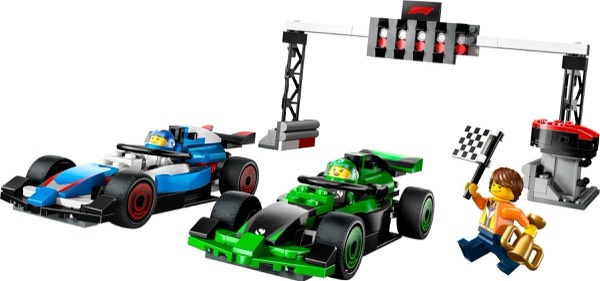
The F1 Grid set captures a specific moment in every race weekend: the starting grid, with cars positioned on their marks, waiting for the lights to go out. At 313 pieces, it delivers a mid-range build experience that sits between the entry-level single-car sets and the premium garage and truck releases. The build time is approximately 45-60 minutes, with the construction split between two F1 cars - the Visa Cash App RB (VCARB) and the KICK Sauber - and a grid section with starting position markings, timing equipment, and trackside infrastructure.
The two cars follow the standard City F1 chassis architecture. The VCARB builds in dark blue with red accents, creating a moody, understated car that mirrors the brooding intensity of its Speed Champions counterpart (#77246). The Sauber builds in green and white, and the lighter palette creates a welcome contrast during the build session. Building them back to back takes roughly 20 minutes per car, with the grid infrastructure consuming the remaining build time.
The overall build rhythm benefits from the three-part structure: car, car, infrastructure. Rather than building a single complex model, you complete three distinct subassemblies in quick succession, each delivering its own visual payoff. The first car provides instant gratification. The second car provides comparison. The grid section provides context. That layered reward structure keeps the build feeling fresh and purposeful across its full duration, even though no individual subassembly is particularly complex. The sum of the three parts creates a more satisfying total experience than any single element suggests on its own.
The grid section is the unique element that distinguishes this set from every other City F1 release. The construction uses flat tile elements to create the track surface with painted grid markings, plus a small timing tower structure with printed display elements. It is not a complex build, but it establishes a specific context - the starting grid - that gives the two cars a narrative setting. They are not just parked on a shelf; they are lined up for the start, ready to race. That contextual framing transforms the build from "two cars and some accessories" into "a moment in motorsport" - and that transformation matters for both play value and display quality.
The cars share the same technique vocabulary as every other City F1 build: simplified chassis, slope bodywork, printed livery elements, and clip-mounted rear wings. The technique value that distinguishes this set lives in the grid infrastructure. The flat track surface construction demonstrates how tiles and plates can create a horizontal display base that looks like an actual road surface - a technique directly applicable to any vehicle display MOC or diorama project. The grid position markings are achieved through printed tile elements that add authenticity without requiring stickers.
The timing tower is a small but instructive subassembly. It uses a combination of vertical bricks, a bracket-mounted display panel, and a flag element to create a trackside structure that communicates its function immediately. For builders who want to create motorsport dioramas or racing vignettes, the timing tower construction provides a template for how to suggest complex trackside infrastructure at City scale with minimal parts. The combination of two cars on a built track surface also teaches display composition - how to position vehicles relative to each other and to environmental elements to create a visually dynamic scene rather than a static lineup.
313 pieces spread across two cars and a grid section. The color split covers dark blue and red for the VCARB, green and white for the Sauber, and dark grey and black for the grid infrastructure and structural elements. The tile elements used for the track surface are the standout utility pieces - flat tiles in dark grey are consumed rapidly in any building project that requires smooth surfaces, and this set contributes a meaningful quantity. The two distinct car color palettes provide parts diversity that single-car sets cannot match.
Three minifigures are included: two drivers and one grid official or marshal. The drivers wear team-specific racing suits with VCARB and Sauber branding respectively, plus team-branded helmets. The marshal figure wears a high-visibility uniform with flag and radio accessories that establish the character's trackside role. The accessories are contextually appropriate and add play value through role differentiation. For parts-focused builders, the combined spread of vehicle elements, flat tiles, structural bricks, and minifigure accessories makes this a well-rounded purchase at the mid-range City F1 price point.
The starting grid concept gives this set a display quality that exceeds what the individual components would suggest. Two City-scale F1 cars sitting loose on a shelf are forgettable. Two City-scale F1 cars positioned on a grid surface with starting marks, a timing tower, and a marshal figure are a scene. Scenes tell stories. Stories hold attention. And this particular scene - the moment before a race begins, cars on the grid, tensions high - is one of the most visually evocative moments in all of motorsport.
The VCARB dark blue and Sauber green create a strong color pairing that works well on the grid surface. The dark grey tiles of the track provide a neutral backdrop that allows both car liveries to pop without competing with the environment. The timing tower adds a vertical element that breaks the horizontal plane and draws the eye upward, creating a more three-dimensional display than flat car-only arrangements. Positioned alongside other City F1 sets, the grid section serves as a natural transition piece between the garage/pit lane area and the track itself.
For builders assembling the complete City F1 collection, this set fills the crucial "race start" position in the narrative: cars arrive by the F1 Truck (#60445), get serviced in the F1 Garage (#60444), pit at the Ferrari Pit Stop (#60443), and line up on this grid for the start. That four-set narrative arc creates a City F1 display with genuine storytelling depth.
313 pieces with two F1 cars, a grid section, and three minifigures at a mid-range price point. The per-piece cost is competitive with other City F1 sets, and the inclusion of the grid infrastructure adds unique display value that pure car sets lack. You are paying for context as much as content - and that context transforms the purchase from "two more City F1 cars" into "a motorsport moment."
The VCARB and Sauber team pairing is interesting from a value perspective. Both teams represent the midfield-to-lower grid positions in Formula 1, which means this set captures a different competitive dynamic than the front-running Mercedes/Alpine garage or the Red Bull/Aston Martin truck. For F1 fans who follow the midfield battles and appreciate the underdog narratives that define much of the sport's drama, the team selection here resonates differently than a set featuring two championship contenders. The Sauber inclusion is particularly notable given the team's transition to Audi - this grid set and the Speed Champions C44 (#77247) may be the last LEGO sets to carry Sauber branding. For the complete F1 picture, see our definitive ranking guide.
Three minifigures are included: a VCARB driver, a Sauber driver, and a grid marshal. The VCARB driver wears a dark blue racing suit with red accents and Visa Cash App RB branding, paired with a dark blue-and-red team helmet. The Sauber driver wears a green racing suit with white accents and Stake F1 Team branding, paired with a green team helmet. Both drivers use the updated 2025 Speed Champions helmet mold and include alternate hair pieces for helmetless display. The suit printing on both figures is City-level detail - simpler than their Speed Champions counterparts in the VCARB 01 (#77246) and Sauber C44 (#77247), but team-accurate enough to be immediately identifiable.
The grid marshal figure wears a high-visibility vest over a black uniform, carrying a checkered flag accessory and a radio element. This is the only marshal/official figure in the entire City F1 range, which gives it a unique status among the wave's minifigures. The marshal adds narrative context that driver figures alone cannot provide - someone has to start the race, and this figure fills that role convincingly. Two of the three figures are unique to this set, making it a worthwhile purchase for City F1 minifigure completists.
The F1 Grid set is for the builder who understands that Formula 1 is about moments, not just machines. The starting grid - that electric pause before the lights go out, when twenty drivers hold their breath and a hundred million viewers lean forward - is the most dramatic ritual in all of motorsport. This set captures that specific moment in City-scale brick form, and it speaks directly to the F1 fan who appreciates the theatre of the sport as much as the speed.
It is also the essential connecting piece for builders assembling the complete City F1 collection. Without the grid set, your City F1 display has cars and garages but no race start - the story begins in the middle rather than at its most dramatic moment. The grid section fills that narrative gap with a display element that transforms isolated vehicles into a race day scene. For completists, this is not optional - it is the set that gives the entire collection its dramatic structure.
For the Sauber fan specifically, this set carries additional significance. With the team transitioning to Audi, the Sauber-branded LEGO sets - this grid set and the Speed Champions C44 - may represent the final LEGO appearance of the Sauber name. That historical bookend quality adds collector value to an already compelling purchase. If Sauber means anything to you, or if the midfield battles that define the character of Formula 1 resonate more than the front-runner domination, the VCARB and Sauber pairing on this grid tells your story.
- ✓ Starting grid concept creates a unique display scene in the City F1 range
- ✓ Two F1 cars (VCARB and Sauber) with contrasting dark blue and green liveries
- ✓ Grid marshal figure is unique to this set and the only official in the wave
- ✓ Track surface tiles are useful for any vehicle display or diorama MOC
- ✓ Fills a narrative gap between garage/pit sets and standalone car sets
- ✓ Competitive mid-range price point with strong display value
- ✗ Grid section is compact - a larger track surface would enhance the display
- ✗ Cars use simplified City chassis rather than Speed Champions detail
- ✗ Only three minifigures compared to six in the F1 Garage
Some products may be provided by manufacturers. This page contains affiliate links. All opinions are my own.
- VCARB 01 Speed Champions Review - VCARB at the detailed 8-wide scale
- Sauber C44 Speed Champions Review - The last Sauber at Speed Champions scale
- F1 Garage Mercedes & Alpine Review - The biggest City F1 garage set
- Ferrari F1 Pit Stop Review - The best single set in the City F1 range
- Every LEGO F1 Set Ranked - The definitive 2026 F1 guide
The chassis construction here uses a staggered stud layout that separates this from typical race car mocs, VCARB's sidepods sit offset from Sauber's, forcing builders to reckon with real-world aerodynamic asymmetry rather than mirroring. That constraint is surprisingly generative. The nose cone geometry, particularly how the front wing connects through a simplified bracket system, becomes a legitimate problem-solving opportunity if you're considering hybrid builds with other vehicle sets or scaling these designs upward.
Parts economy becomes the real story for moc work. The wheel assembly uses only four unique pieces per car, which means you're either rebuilding identical suspensions across multiple F1 mocs or completely rearchitecting how front and rear geometry work. That tension between authenticity and Lego's building limitations is exactly where interesting modifications happen, and why parallel sets matter more than singular releases.
Track it in your vault on GameSetBrick - our free collection app. Log your condition, price paid, and watch the real-time market value.
Track in Your Vault →Save it to your wishlist on GameSetBrick. Share your list with friends and family - every set has a buy button so gift givers know exactly where to go.
Add to Wishlist → GameSetBrick is a free app by The Earl of Bricks. See all features. Scan it. Track it. Trade it.