Is the LEGO F1 Garage Mercedes & Alpine Worth Buying?
8.8/10. Worth buying. Two F1 cars, a full garage, and six minifigures. This is the most complete City F1 experience in one box.
Comparing your options? See where it lands in our best LEGO F1 sets, ranked for 2026.

For the first time in City's F1 lineup, LEGO actually committed to the garage instead of treating it like an afterthought. The Mercedes and Alpine sit in a two-bay structure with genuine workshop depth, not just a backdrop with stickers. This matters because most F1 sets prioritize the cars and leave builders with a glorified display stand. Here, the garage earned its place in the box, which means this set solves a real problem for people who've been collecting the last three years of F1 releases without anywhere functional to store them.
The price point lands in uncomfortable territory, though, too expensive to impulse-buy as a casual City set, yet lacking the prestige of a proper Speed Champions release. The six minifigures and 678 pieces feel positioned for someone already invested in the F1 City ecosystem. That specificity is exactly why this set matters. It's not trying to be the gateway to F1 building; it's the consolidation point for people who've been patient enough to wait for LEGO to make F1 work properly in City scale.
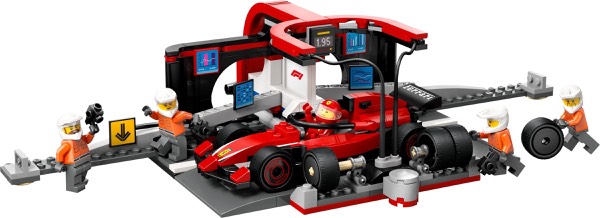
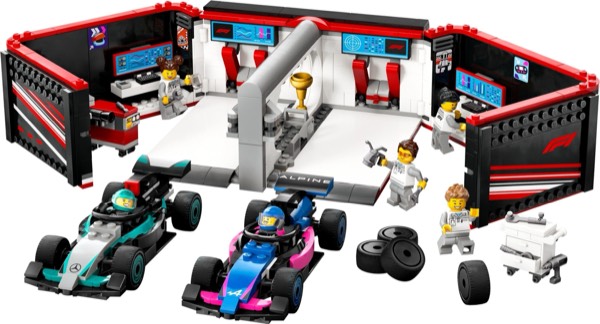
The F1 Garage is the flagship of the LEGO City Formula 1 range, and at 678 pieces it delivers the most substantial build experience in the wave. Where the Ferrari Pit Stop (#60443) gives you a single pit wall with a mechanism and the Williams/Haas two-pack (#60464) gives you two bare cars, the F1 Garage goes full paddock: a multi-bay garage structure, two complete F1 cars representing Mercedes-AMG and Alpine, a tool cart, workshop equipment, and six minifigures. The build time runs 90-120 minutes for an experienced builder, comfortably filling an evening session.
The build splits into three distinct phases. The two cars come first, each following the simplified City F1 chassis architecture that appears across the range. The Mercedes car builds in silver and teal, the Alpine in blue with pink BWT accents - both immediately recognizable at City scale. Building them back to back highlights the color-driven identity system that makes the City F1 range so effective: same structure, different personality. The third phase is the garage itself, a multi-section structure with bay doors, tool racks, monitor screens, and a lifting mechanism for servicing the cars.
The garage construction is the most architecturally interesting portion. The walls use a combination of standard bricks, panel elements, and printed tiles to create a purpose-built F1 facility that looks modern and functional. The bay doors open to receive the cars, and the interior details - tire racks, diagnostic screens, tool trolleys - transform the build from a simple box into a credible workspace. For younger builders, the garage teaches spatial reasoning and interior layout. For adults, it is a satisfying architectural subassembly that elevates the entire set from toy to display.
The three-phase build structure - car, car, garage - creates a satisfying narrative progression that most City sets do not achieve. Building the Mercedes first gives you a silver-and-teal machine that sets the quality expectation. Building the Alpine second gives you a blue-and-pink contrast that rewards comparison. And building the garage third provides the environment that contextualizes both cars, transforming two standalone vehicles into participants in a workspace scene. By the time you place both cars in their garage bays and position the crew figures with their tools, you have not just assembled a set - you have created a place where things happen. That environmental storytelling is what separates the F1 Garage from the simpler car-only sets in the wave, and it justifies the larger investment.
The garage structure introduces techniques that the car-only City F1 sets cannot deliver. The bay door mechanism uses hinge plates that allow the doors to swing open and shut, creating an interactive element that adds play value and demonstrates basic mechanical hinge construction. The internal lifting platform uses a simple but effective plate-on-bracket assembly that allows one car to be raised for underside work - a play feature that mirrors real F1 garage operations and teaches how vertical motion can be achieved through sliding plate connections.
The two car builds use the standard City F1 construction approach, but having both Mercedes and Alpine in the same set allows direct technique comparison. The Mercedes car's silver bodywork uses light bluish grey elements with teal accents, while the Alpine uses medium blue with pink and white detailing. Comparing how each car achieves its livery identity through different element selections on the same chassis platform is genuinely instructive for builders studying color-as-design at small scale. The technique ceiling remains lower than Speed Champions, but the garage adds an architectural dimension that expands the lesson beyond vehicles.
678 pieces makes this the largest set in the City F1 range by a significant margin. The parts spread covers three distinct color families: silver/grey for the Mercedes car and garage metalwork, blue/pink for the Alpine car, and black/dark grey for the structural elements. The diversity of element types is impressive - you get standard bricks, plates, slopes, and tiles for the cars, plus panel elements, hinge pieces, printed tiles, and specialized tool accessories for the garage. This is not a monotone parts pack; it is a genuinely varied collection that spans multiple building disciplines.
Six minifigures contribute twelve torso prints, twelve leg prints, and a variety of helmets, hair pieces, and accessories. The accessory count is notably higher than other City F1 sets: wrenches, clipboards, fuel hose elements, and tire tools all populate the garage with functional detail. For MOC builders, the garage wall panels and printed monitor tiles have applications in any modern architectural project. The combined parts value across vehicles, architecture, and accessories makes this the most versatile City F1 purchase for builders who plan to eventually disassemble and reuse. At the price point, the per-piece cost is competitive with larger City sets and significantly better than the smaller single-car entries.
The F1 Garage creates the most complete scene in the City F1 range. Where individual car sets are static objects, the garage is an environment - a place where things happen, where cars get serviced, where crew members work and drivers prepare. That environmental quality elevates the display value significantly. The garage structure provides a branded backdrop that frames both cars, and the six minifigures add human scale and narrative energy that transforms a shelf display into a story.
The Mercedes silver and Alpine blue cars provide strong color contrast against the darker garage structure, ensuring both vehicles pop visually in the scene. The open bay doors create depth and invite the eye into the interior, where the workshop details reward close inspection. Displayed alongside the Ferrari Pit Stop (#60443), you get a comprehensive City-scale pit lane that covers four F1 teams across two sets. Add the McLaren (#60442) and the Williams/Haas two-pack (#60464), and you have six teams represented in a City F1 paddock that fills a full shelf with F1 energy.
The dimensions work well for display - the garage measures approximately 46cm wide, which is substantial enough to command attention without overwhelming a standard bookshelf. The height is modest, keeping the visual weight low and grounded. Under room lighting, the combination of silver, blue, and dark structural elements creates a balanced palette that photographs well and integrates with most room aesthetics.
At the retail price, the F1 Garage delivers 678 pieces, two licensed F1 cars, a multi-section garage structure, and six minifigures. The price-per-piece is competitive for a licensed City set, and the minifigure-per-dollar ratio is the best in the entire City F1 range. You are paying roughly equivalent to two individual City F1 sets but getting significantly more build time, more display impact, and more play versatility than two separate purchases would deliver.
The Mercedes and Alpine licensing adds brand value that the cars carry independently. Mercedes is the most recognized F1 team globally, and Alpine's BWT pink-and-blue livery has become one of the most visually distinctive in the sport. Having both teams in one box means this set appeals to a broader fan base than single-team releases. For parents buying F1 sets for children, this is the one-box solution that delivers the most complete experience. For adult collectors building a City F1 display, it provides two grid positions and an architectural centerpiece in a single purchase. For the broader ranking of how this set compares across all LEGO F1 themes, see our definitive F1 guide.
Six minifigures make this the most figure-rich set in the entire LEGO City F1 range. The lineup includes two F1 drivers - one in Mercedes silver-and-teal racing suit and one in Alpine blue-and-pink - each with team-branded helmets and alternate hair pieces for helmetless display. The Mercedes driver's torso features the three-pointed star logo and PETRONAS branding, while the Alpine driver carries the BWT-pink accents that define the French team's visual identity. Both drivers use the updated 2025 helmet mold.
The remaining four figures are garage crew members in team-branded uniforms. Two wear Mercedes team gear and two wear Alpine colors, creating balanced team representation. Each crew figure carries role-specific accessories: wrenches, data tablets, tire equipment, and signaling tools that establish their function within the garage. The variety in accessories and uniform printing across the six figures adds genuine play value and creates natural team-based play scenarios. All six figures are unique to this set, making it the single best purchase for City F1 minifigure collectors. The combined driver lineup covers two teams that are also represented in Speed Champions form - the Mercedes W15 (#77244) and the Alpine A524 (#77248) - allowing cross-scale minifigure comparison for collectors who own both ranges.
The F1 Garage is for the builder who wants their City F1 collection to have a centerpiece - a set that provides the architectural anchor around which smaller car sets orbit. If you are buying a single City F1 set to maximize value, minifigure content, and display impact, this is the one. Two cars, six figures, a complete garage structure, and a 90-minute build that covers both vehicles and architecture - no other City F1 set delivers this breadth of experience in one box.
It is also the ideal purchase for parents looking to create a complete F1 play experience with a single purchase. The garage provides the setting, the cars provide the action, and the six minifigures provide the cast. Children can service cars, swap drivers, and recreate the pit lane drama that defines Formula 1 weekends - all from one set, without needing additional purchases to create a functional play scenario. For the parent who wants maximum play value per dollar, the F1 Garage is the answer.
For the adult collector building a comprehensive City F1 display, the garage is the structural backbone that holds the collection together. It provides the physical backdrop that transforms individual car sets from loose objects into participants in a paddock scene. Position the F1 Truck delivering cars to one end, the garage servicing them in the middle, and the F1 Grid lined up at the other end, and you have a narrative display that tells the full race weekend story. The garage is the chapter that makes that story coherent, and the Mercedes and Alpine branding gives it front-running credibility.
- ✓ Six minifigures - the most in any City F1 set
- ✓ Two licensed F1 cars (Mercedes and Alpine) in one box
- ✓ Multi-bay garage with opening doors and lifting mechanism
- ✓ Best per-piece and per-figure value in the City F1 range
- ✓ Creates a complete scene rather than isolated vehicles
- ✓ 678 pieces delivers 90+ minutes of engaged building
- ✗ Cars use simplified City chassis rather than Speed Champions detail
- ✗ Garage rear is open and less display-friendly from behind
- ✗ Higher price point than individual City F1 sets
Some products may be provided by manufacturers. This page contains affiliate links. All opinions are my own.
- Ferrari F1 Pit Stop Review - The other premium City F1 set with working mechanism
- Mercedes W15 Speed Champions Review - Mercedes at the detailed 8-wide scale
- Alpine A524 Speed Champions Review - Alpine at Speed Champions scale
- Williams & Haas Two-Pack Review - Complete your City F1 paddock
- Every LEGO F1 Set Ranked - The definitive 2026 F1 guide
- F1 Truck with RB20 & AMR24 Review - The City F1 transport truck with two race cars
The garage footprint is the real find here. The two-bay structure uses modular wall segments that separate cleanly, which means serious builders can extend this into a full paddock complex without demolishing existing builds. The wheel storage solutions, mounted racks that clip into the walls, give you a parts solution that transfers directly to larger workshop MOCs. That's genuinely useful, not just clever.
What nobody talks about: the floor baseplate pattern they've used creates natural expansion seams. Stack two of these garages side-by-side and the connection feels intentional rather than jury-rigged. The parts economy is clean here, minimal printed elements, maximum gray and dark gray structure, which keeps customization straightforward if you want to repaint or modify for team-specific liveries. The car builds are simple enough that garage space becomes the centerpiece of the actual build experience.
Track it in your vault on GameSetBrick - our free collection app. Log your condition, price paid, and watch the real-time market value.
Track in Your Vault →Save it to your wishlist on GameSetBrick. Share your list with friends and family - every set has a buy button so gift givers know exactly where to go.
Add to Wishlist → GameSetBrick is a free app by The Earl of Bricks. See all features. Scan it. Track it. Trade it.