Is the LEGO F1 Pit Stop with Ferrari Worth Buying?
9.12/10. Worth buying. Ferrari red, five minifigures, and a pit stop mechanism that actually works. This one's a keeper.
Comparing your options? See where it lands in our best LEGO F1 sets, ranked for 2026.
City sets live in an awkward middle ground, too simple for serious builders, too expensive for kids. The F1 Pit Stop breaks that pattern because it's genuinely built for adults who understand motorsports. The pit stop mechanism isn't a gimmick that falls apart after three uses; it's a functional representation of something real, with a jack that actually lifts the car and a tire-change workflow that respects the actual sequence. For Ferrari collectors specifically, this hits different. The 1:24 scale puts it in conversation with display models, not toy bins, and the minifigure lineup (driver, three crew members, plus a race official) reads like someone actually consulted the paddock.
What matters here is that LEGO didn't oversimplify the source material. The pit stop has depth, literal depth, with a raised platform, equipment racks, and a fuel pump station that occupies real buildable space. At 322 pieces, the set doesn't waste plastic on clutter. Every element serves either the mechanism or the visual narrative of a functioning pit crew. That's restraint. That's respect for the builder and the subject.
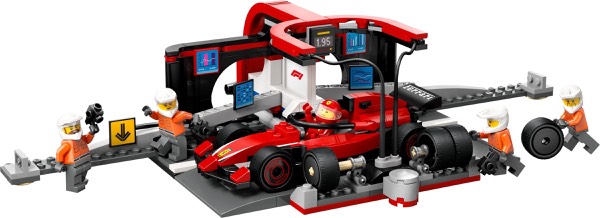
The Ferrari Pit Stop set splits into two distinct builds: the Ferrari F1 car itself, which accounts for roughly a third of the pieces, and the pit stop structure with its working mechanism, which consumes the remaining two-thirds. This split creates a build experience with genuine variety. The car construction follows the same simplified City F1 chassis architecture as the McLaren (#60442) - wide plate base, wheel arches, slope bodywork, and a rear wing assembly. But this time the bodywork is rendered in Ferrari's iconic scarlet red, and the printed elements carry the Scuderia Ferrari shield logo and team graphics that make it unmistakably a Ferrari even at City scale.
The pit stop structure is where the build gets interesting. The construction begins with a ground-level platform that establishes the workspace, then builds upward into a curved rear wall with team branding, monitor screens, and equipment storage. The architectural portion uses standard brick-and-plate construction with some angled wall elements that give the structure a modern, purpose-built feel rather than a generic building shape. It is not complex construction, but it is varied enough to hold attention through the full 60-75 minute build time.
The star of the build is the Technic-driven pit stop mechanism. A pair of Technic beams connect to an engine element at the rear of the structure, and when activated, they swing two pit crew members into position on either side of the car. The mechanism uses a simple but effective rotation-to-linear-motion conversion that moves both crew members simultaneously, simulating the coordinated choreography of a real F1 pit stop. Building the mechanism introduces younger builders to basic Technic principles - beam connections, axle rotation, and synchronized motion - within a System-built context. It is a bridge between pure System building and the mechanical thinking that Technic demands.
The pit stop mechanism is the primary technique feature, and it rewards examination. The swing-arm assembly uses Technic beam elements connected by pin joints to create a pivot-and-extend motion. Each beam carries a crew member on a small platform, and the synchronization between the two sides is achieved through a shared axle that rotates both arms simultaneously. This is a genuine mechanical linkage - the same principle used in industrial automation and robotics, scaled down to a toy context. For builders who will eventually progress to full Technic sets, this mechanism plants a seed of understanding about how rotational motion can be converted to linear motion through lever arms.
Beyond the mechanism, the pit structure itself demonstrates several useful architectural techniques. The curved rear wall uses a combination of standard bricks and angle plates to create a gentle curve that suggests the aerodynamic styling of a modern F1 pit building. The equipment details - a tire rack, a fuel hose element, and a monitor screen - are integrated into the wall construction rather than sitting loose on the ground, which teaches efficient use of vertical space in small builds. The color blocking on the structure uses red, dark red, and grey in deliberate zones that communicate the Ferrari brand identity without requiring extensive printed elements.
The car itself uses the same curved-slope nose technique found across the City F1 range, and comparing it to the McLaren (#60442) shows how identical structural approaches yield different visual results through color and print selection. For technique study purposes, having both sets allows direct comparison of LEGO's design vocabulary at this scale.
322 pieces is the largest count in the City F1 range, and the parts spread is correspondingly diverse. The dominant colors are red and dark red for the Ferrari-branded structure, with black, grey, and dark grey structural elements underneath. The red elements alone make this set a worthwhile purchase for builders working on Ferrari-themed MOCs, fire station builds, or any project requiring a critical mass of red plates, slopes, and bricks. Red is one of LEGO's most versatile display colors, and accumulating it at the City price point is more efficient than sourcing individual pieces through Bricklink.
The Technic beam elements from the pit stop mechanism are a bonus - these are standard Technic-compatible parts that integrate into any mechanical build. The axle, pin, and beam combination from the swing-arm assembly is a mini Technic starter kit in its own right. The curved wall elements, angled plates, and tile pieces used in the structure are all standard System elements with broad MOC applicability. Five minifigures add meaningful parts value: five torso prints, five leg prints, five hairpieces or helmets, and five distinct face prints. The Ferrari driver helmet is the most desirable individual element - it is unique to this set and immediately identifiable as a Ferrari piece.
For per-piece value against other City F1 sets, this is the clear leader. 322 pieces plus five figures for a mid-range price point delivers the best price-per-piece in the entire City F1 wave, beating the Williams/Haas two-pack (#60464) on raw count and the Audi Display Truck (#60493) on per-piece cost.
The Ferrari Pit Stop creates a scene rather than a single object, and that distinction elevates its display value above every other City F1 set. Where the individual car sets are small objects sitting on shelves, this set creates a vignette - a moment frozen in time, with a car stopped at the pit wall and crew members converging from both sides. Vignettes tell stories. Objects do not. And on a shelf, stories always win.
From the front, the display is strong. The red pit wall creates a branded backdrop that frames the scarlet Ferrari car, and the five minifigures add human scale and visual interest that pure vehicle sets lack. The monitor screens, tire rack, and equipment details provide depth and texture that reward close inspection. The curved wall shape prevents the structure from looking like a flat panel, adding dimensionality that works well under room lighting. Under warm light, the red-on-red color scheme has a richness that photographs beautifully - this is one of the most Instagram-friendly sets in the City F1 range.
The limitation is the mechanism. From the rear and sides, the Technic beams and axle assemblies are visible, and they break the visual coherence of the display. This is a set designed to be viewed from the front, which is typical of play-focused City sets but a compromise for adult display collectors. Position it against a wall with the mechanism facing away, and the display is excellent. Try to place it on an open shelf with 360-degree visibility, and the illusion weakens. For a child's desk or a themed shelf, this is not a problem. For an AFOL display cabinet, it requires thoughtful placement alongside other City F1 sets like the McLaren and Williams/Haas two-pack to create a complete pit lane scene.
The value proposition on the Ferrari Pit Stop is exceptional. 322 pieces, five minifigures, a working Technic mechanism, and the Ferrari license combine to create the most complete play experience in the City F1 range. The price-per-piece is the lowest of any City F1 set, and the minifigure-per-dollar ratio is similarly strong. You are getting more build time, more play value, more display impact, and more parts per dollar than any other set in this wave.
The Ferrari brand adds collector value that extends beyond the brick content. Ferrari licensing commands a premium across every product category, and LEGO's ability to absorb that premium into a mid-range City price point is impressive. The Scuderia shield prints, the red livery elements, and the driver figure in full Ferrari racing suit all carry a brand cachet that makes this set feel more premium than its price suggests. For comparison, the Ferrari SF-24 Speed Champions set (#77242) costs more for fewer pieces and fewer figures, though it delivers more display detail on the car itself.
If you are buying one City F1 set, buy this one. If you are building a City F1 collection, start with this one. If you are gifting a set to a young Ferrari fan, this is the obvious choice. And if you want to see how Ferrari stacks up across LEGO's entire F1 range from City to Technic, our definitive F1 ranking puts every set in context.
Five minifigures make this the most figure-rich set in the City F1 range. The headliner is the Ferrari F1 driver, wearing a full scarlet racing suit with detailed torso and leg printing that includes the Scuderia Ferrari shield, team sponsor logos, and the characteristic red-and-black color blocking of the real-world race suit. The driver's helmet is printed with Ferrari branding and a visor design that matches the team's 2024-2025 helmet style. A separate hair piece is included for display without the helmet. This is the best-looking driver figure in the entire City F1 wave.
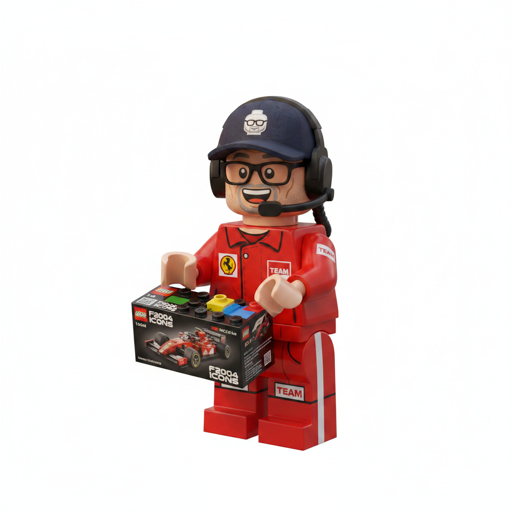
The four pit crew members are dressed in matching Ferrari red team uniforms with slightly different role-specific printing. Two crew members are designated as tire changers, identifiable by their tool accessories and slightly different torso graphics. A third serves as a lollipop operator with signaling equipment, and the fourth is a crew chief or engineer figure with a clipboard accessory. All four wear red caps rather than helmets, distinguishing them from the driver. The variety in accessories and subtle printing differences across the crew figures adds genuine play value and creates natural role assignment during pit stop play scenarios. Each figure is unique to this set.
- ✓ Five minifigures including the best City F1 driver figure
- ✓ Working Technic pit stop mechanism is genuinely fun and educational
- ✓ Ferrari red livery and branding throughout the entire build
- ✓ Best price-per-piece in the City F1 range
- ✓ Creates a complete vignette scene rather than just a vehicle
- ✓ Strong red parts haul with broad MOC applicability
- ✗ Technic mechanism elements visible from rear and side angles
- ✗ Pit structure is designed for front-facing display only
- ✗ Car itself uses the same simplified City chassis as the McLaren
Some products may be provided by manufacturers. This page contains affiliate links. All opinions are my own.
People watch a Formula 1 pit stop and think it looks fast. They do not appreciate how fast until they understand what is happening. A full stop, four tires changed and the car released, takes under three seconds. The record sits at 1.8 seconds, set by Red Bull on Max Verstappen's car at Brazil in 2019. That is roughly twenty people moving in a choreography tighter than anything you will see in professional sport, each wheel handled by three crew: one on the gun, one pulling the old tire, one fitting the new.
This set gives you five of those crew and a working jack, and that choice tells you LEGO understood the assignment. The pit stop is not a pause in the race, it is part of the race, and often the part that decides it. Ferrari has historically lived on both ends of that truth, capable of a blindingly quick stop and an agonizing fumble in the same season. Building this in Ferrari red, with the crew frozen mid-stop, captures the one moment in motorsport where the people behind the car matter as much as the driver in it.
- Ferrari SF-24 Speed Champions Review - Ferrari at the detailed 8-wide scale
- Ferrari F2004 Schumacher Icons Review - The greatest Ferrari F1 set ever made
- McLaren F1 City Review - McLaren at City scale for comparison
- Williams & Haas Two-Pack Review - Complete your City F1 paddock
- Every LEGO F1 Set Ranked - The definitive 2026 F1 guide
- F1 Truck with RB20 & AMR24 Review - Add the transport truck to your City F1 paddock
The tire build deserves mention because it's elegant engineering in miniature. Each wheel uses standard LEGO elements to create realistic offset and profile, not painted decals, not molded tire pieces, but actual stacked construction that reads as correct from any angle. The black and red Ferraris aren't the same old studs painted down a slope; the Technic frame underneath gives genuine structural weight to what could've been a hollow shell. Builders who've worked with Technic will appreciate the suspension geometry, even scaled down for a display piece.
The minifigure torsos do heavy lifting that cash-strapped builders will recognize immediately: each crew member has printed details specific to their role, and the driver's suit matches the classic Ferrari palette. This isn't a set that forces custom decals or hunting secondary markets for parts. The pit crew looks credible out of the box, which matters when you're building a diorama that's meant to hold up to scrutiny from people who actually know what they're looking at.
Track it in your vault on GameSetBrick - our free collection app. Log your condition, price paid, and watch the real-time market value.
Track in Your Vault →Save it to your wishlist on GameSetBrick. Share your list with friends and family - every set has a buy button so gift givers know exactly where to go.
Add to Wishlist → GameSetBrick is a free app by The Earl of Bricks. See all features. Scan it. Track it. Trade it.