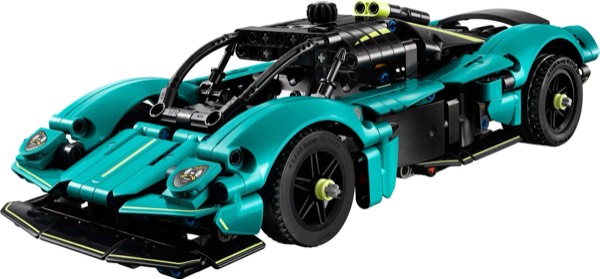
The Aston Martin Valkyrie occupies a compelling middle ground in the Technic lineup - not the premium flagship tier of the 1:8 F1 cars, but far more mechanically ambitious than entry-level Technic vehicles. At 707 pieces, the build is approachable enough for a single extended afternoon session, with most builders completing it in 3-5 hours. The instruction manual is cleanly organized with the build divided into distinct phases: chassis and mechanical systems first, then bodywork and aerodynamic surfaces, and finally the detail elements that give the Valkyrie its distinctive hypercar identity. The pacing is well-calibrated, with each bag of parts corresponding to a meaningful phase of construction that delivers visible progress.
The chassis phase establishes the car's mechanical foundation with a working steering system and basic drivetrain. The steering mechanism uses a series of Technic links and connectors to translate steering wheel rotation into front wheel movement, and the connection path requires careful attention to ensure smooth operation without binding. This is where the build earns its Technic credentials - the mechanism is genuinely functional rather than decorative, and the satisfaction of seeing the front wheels respond to the steering wheel for the first time is a meaningful milestone. The drivetrain is simpler than the 1:8 F1 cars, with a piston engine assembly that cycles when the car is pushed forward, but the mechanical principle is sound and the visual effect is convincing.
The bodywork phase is where the Valkyrie's dramatic aerodynamic profile takes shape. The real Aston Martin Valkyrie is one of the most visually extreme road cars ever designed, with massive underfloor aerodynamics, deeply sculpted sidepods, and a teardrop cockpit that looks like it was designed in a wind tunnel rather than a styling studio. LEGO's Technic interpretation captures this drama surprisingly well at the 15-wide scale, with curved panels and angled elements creating the deep channels and aggressive scoops that define the Valkyrie's silhouette. The build is compact enough that you can see the full proportional impact of each panel as it is added, which gives the bodywork phase a sculptural quality that larger builds sometimes lack - you are shaping the car's visual identity in real time.
For a set in the mid-tier Technic range, the Valkyrie delivers a respectable collection of working mechanisms. The functional steering system is the primary mechanical feature, connecting the cockpit steering wheel to the front wheels through a linkage that routes through the car's compact chassis. The steering response is smooth and proportional, with the front wheels tracking the steering input through a convincing range of motion. The mechanism is simpler than the universal-joint-based steering systems in the 1:8 F1 cars, but it demonstrates the same fundamental engineering principle - translating rotational input at one point into a different axis of movement at another point - in a more accessible package.
For a deeper dive into the Technic F1 builds that share the Valkyrie's engineering DNA, the McLaren MCL39 Technic is the flagship of the range. The piston engine assembly adds a second mechanical dimension to the build. Pushing the car forward drives the rear axle, which in turn cycles the engine's pistons through a gear train. The piston count is lower than the V6 engines in the full-size Technic F1 cars, but the mechanical principle is identical - rotational input is converted to reciprocating motion through crankshaft and connecting rod assemblies. For builders who are encountering Technic mechanical systems for the first time, the Valkyrie's engine is an excellent introduction that teaches the piston engine concept without the complexity and precision demands of a larger assembly. For experienced builders, it is a satisfying but familiar mechanism that serves its purpose without breaking new ground.
The aerodynamic design of the bodywork represents a different kind of technique value - visual engineering rather than mechanical engineering. The real Aston Martin Valkyrie generates enormous aerodynamic downforce through its underfloor design, and LEGO's interpretation captures this design philosophy through panel angles, gap placement, and structural geometry that suggest airflow management even in static form. The deep sidepod channels, the high-mounted rear diffuser area, and the flowing body lines all demonstrate how Technic's pin-and-beam construction can approximate organic aerodynamic surfaces when thoughtfully applied. For builders interested in automotive design as a discipline, the Valkyrie's bodywork is a lesson in how form follows function in hypercar engineering.
707 pieces with a color palette centered on British Racing Green and silver-grey elements. The green Technic panels are the standout elements in the parts inventory - British Racing Green is not a common color in the broader LEGO Technic catalog, which gives these elements elevated value for builders seeking specific automotive colors for custom creations. The silver and dark grey structural elements are more commonly available across the Technic range, but they are always useful additions to any builder's parts library, providing the neutral-toned beams, pins, and connectors that form the skeleton of most Technic builds.
The panel elements are the most valuable individual parts in the inventory. The curved fairings that form the Valkyrie's dramatic bodywork are designed specifically for this set's aerodynamic profile, and their organic curves are useful for any build requiring smooth, flowing surfaces. Hypercar builds, aircraft models, and sculptural displays all benefit from panels with this kind of curvature. The smaller detail elements - axle connectors, pin-hole beams, and gearing components - round out the parts list with the utility elements that every Technic builder needs in quantity.
At 707 pieces, the parts haul is modest compared to flagship Technic sets, but the quality and specificity of the elements compensate for the lower quantity. The green panels alone justify a meaningful portion of the set's value for parts-focused builders, and the mechanical components - gears, axles, connectors - add practical utility that extends well beyond this specific build. For builders who are expanding their Technic parts library while keeping budget constraints in mind, the Valkyrie offers a focused collection of useful elements without the premium price point of the 1:8 scale sets.
The Aston Martin Valkyrie is one of the most visually dramatic cars in production today, and LEGO's 15-wide Technic interpretation captures that drama with impressive fidelity. The completed model is approximately 13 inches long - large enough to command presence on a display shelf without dominating it - and the proportions faithfully replicate the Valkyrie's extreme design language. The teardrop cockpit, deeply sculpted sidepods, and aggressive rear diffuser area are all recognizable from the real car, and the British Racing Green colorway gives the model a sophisticated elegance that sets it apart from the more vivid primary-color Technic vehicles in the lineup.
The display presence benefits from the Valkyrie's inherently dramatic proportions. Where most Technic cars present relatively conventional automotive shapes, the Valkyrie's extreme aerodynamic design creates visual tension and movement even when the model is sitting still. The low nose, high cockpit, and flowing body lines create a sense of speed and purpose that makes the model visually engaging from every angle. For collectors who display multiple Technic vehicles, the Valkyrie provides welcome visual variety - it looks nothing like an F1 car, a sports car, or a supercar, because it occupies its own design category entirely.
Pairing the Valkyrie with the Aston Martin Safety Car Speed Champions set and the Aston Martin AMR24 Speed Champions set creates a three-car Aston Martin display that showcases the brand across different LEGO building systems and automotive categories. The Technic Valkyrie represents the hypercar pinnacle, the AMR24 represents the F1 program, and the Safety Car represents the brand's motorsport support role. Together, they tell a more comprehensive Aston Martin story than any single set can tell alone. For a full overview of the Speed Champions lineup, see our complete Speed Champions review guide, and browse the full review archive for more automotive builds.
At $64.99 for 707 pieces, the Valkyrie sits in the accessible mid-tier of the Technic price spectrum. The price-per-piece ratio is competitive with other Technic sets in this range, and the inclusion of working mechanical systems - functional steering and a cycling piston engine - adds engagement value that simpler Technic vehicles at similar price points do not offer. The build delivers 3-5 hours of engaged construction time, a display model with genuine visual presence, and a parts collection anchored by rare green Technic elements. For builders who want a Technic experience without the flagship commitment, the Valkyrie hits a sweet spot between ambition and accessibility.
The Aston Martin badge carries brand recognition that adds perceived value, though the effect is less pronounced than with Ferrari or McLaren in the motorsport context. Aston Martin's association with luxury, sophistication, and James Bond culture gives the Valkyrie a lifestyle appeal that extends beyond the traditional LEGO audience, making it a strong gift option for car enthusiasts who may not identify as LEGO fans. The hypercar context - the Valkyrie is a million-dollar road car designed in collaboration with Red Bull's Adrian Newey - adds aspirational value that connects the set to one of the most ambitious automotive engineering projects of the modern era.
For builders comparing the Valkyrie against other mid-tier Technic vehicles, the key differentiator is the car's visual distinctiveness. Many Technic sets in this price range depict conventional sports cars or supercars with proportions that are difficult to distinguish from one another at LEGO scale. The Valkyrie's extreme design language - the teardrop cockpit, the massive aerodynamic channels, the Le Mans prototype-inspired proportions - makes it immediately identifiable and visually unique on any shelf. That distinctiveness is a form of value that transcends piece counts and mechanical feature lists. The Bugatti Chiron Pur Sport at the same price point offers a different flavor of hypercar drama, and choosing between them is purely a matter of design preference.
The Technic Valkyrie does not include minifigures, which is standard for Technic sets across all scales. The cockpit area is occupied by the steering mechanism linkage and is not designed to accommodate a driver figure. The cockpit detailing includes a printed steering wheel element and a simplified instrument panel area that suggests the Valkyrie's real-world digital dashboard. The teardrop cockpit canopy frames the driver's compartment with a distinctive shape that is one of the model's most recognizable visual features, even without a figure seated inside.
The interactive elements give the Valkyrie more tactile engagement than its compact size might suggest. The functional steering invites handling - turning the steering wheel and watching the front wheels respond is a simple but satisfying interaction that never gets old. Pushing the car forward to cycle the piston engine adds a dynamic element that transforms the model from static display piece to functional mechanical toy. The combination of display quality and mechanical interactivity makes the Valkyrie a Technic set that works equally well on a shelf and in your hands, which is the ideal outcome for any Technic vehicle at this scale. The aerodynamic bodywork can be partially removed to reveal the internal mechanical systems, adding a display option that highlights the engineering beneath the dramatic exterior.
- ✓ Captures the Valkyrie's extreme aerodynamic design language faithfully
- ✓ Functional steering system with smooth, proportional response
- ✓ British Racing Green Technic elements are rare and desirable
- ✓ Accessible build time of 3-5 hours suits single-session building
- ✓ Visually distinctive silhouette stands out among Technic vehicles
- ✓ Mid-tier price point offers Technic quality without flagship investment
- ✗ Mechanical systems are simpler than the 1:8 F1 flagships
- ✗ Some panel gaps visible along the sidepod transitions
- ✗ Piston engine assembly is compact with limited visual impact
- ✗ Sticker sheet required for brand and livery details
Some products may be provided by manufacturers. This page contains affiliate links. All opinions are my own.
- Aston Martin AMR24 Speed Champions Review - Aston Martin's F1 car at 8-wide scale
- Aston Martin Safety Car Review - The F1 safety car in Speed Champions form
- Bugatti Chiron Pur Sport Technic Review - Another hypercar at the same price tier
- Every Speed Champions Set Reviewed - The complete Speed Champions guide
- Best LEGO F1 Sets Ranked 2026 - The complete F1 set hierarchy
- All Reviews - Browse the full Earl of Bricks review archive
- Lamborghini Revuelto Technic Review - Another premium Technic hypercar build
Track it in your vault on GameSetBrick - our free collection app. Log your condition, price paid, and watch the real-time market value.
Track in Your Vault →Save it to your wishlist on GameSetBrick. Share your list with friends and family - every set has a buy button so gift givers know exactly where to go.
Add to Wishlist → GameSetBrick is a free app by The Earl of Bricks. See all features. Scan it. Track it. Trade it.