Is the LEGO Porsche 911 GT3 R Rexy Worth Buying?
8.52/10. Worth buying. A dinosaur-liveried endurance racer with mechanical soul. This is Technic doing what Technic does best.

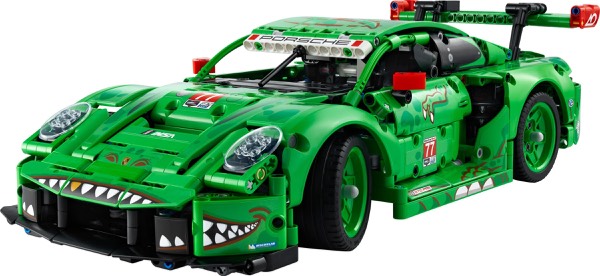
The Rexy livery on this 42224 is doing heavy lifting that most people won't acknowledge, it's the reason this set exists at all in 2025, and it's also why serious builders need to separate the marketing from what's actually in the box. Porsche's famous racing number 911 with a dinosaur wrapped around it became internet culture, and LEGO capitalized. But here's what matters: beneath that livery sits a legitimate endurance-racing chassis with functional steering, a real differential, and suspension geometry that tracks how actual GT3 cars behave. This isn't novelty wrapping a compromised build. The Rexy branding brought attention, but the engineering underneath is where the set proves itself.
Building this felt like watching Technic remember its purpose. The gearbox is clean. The double-wishbone suspension actually articulates with intent rather than wobbling like a toy. Around hour four, the mechanical personality of this car becomes obvious, it's not chasing piece count or shocking building moments. It's methodical, precise, and structured like a real race platform should be. That's either exactly what you want from Technic, or it's not. There's no middle ground with this one.
Technic Porsche builds have a particular rhythm to them, and the 42224 GT3 R doesn't disappoint. At 1,450 pieces you're looking at a solid 3-4 hour build session - the kind where you settle in with coffee, clear the table, and let the engineering unfold. The chassis comes together first, establishing a rigid spine that everything else hangs off. This is not a Speed Champions set where you snap plates together and admire the result in fifteen minutes. This is mechanical sculpture.
The build flows through distinct phases: chassis and drivetrain, then bodywork panels, then the livery details that bring Rexy to life. Each phase has its own personality. The drivetrain section is pure Technic problem-solving - gears meshing, axles threading through beams. The bodywork shifts into something more sculptural, curving panels around the mechanical core. And the final livery stage is where you start grinning, because the AO Racing dinosaur branding transforms it from "another Porsche" into something with genuine character.
LEGO has gotten better at pacing Technic builds over the last few years. The bag numbering is logical, the sub-assemblies click together satisfyingly, and there are enough "aha" moments to keep you engaged throughout. This isn't their most complex Technic build, but the complexity-to-enjoyment ratio is excellent.
What distinguishes the GT3 R build from other mid-range Technic cars is the personality that emerges during construction. Most Technic vehicles are serious machines built by serious instructions for serious builders. The Rexy livery disrupts that expectation in the best possible way. You spend two hours building a precision chassis with working suspension and a proper gear train, and then you spend the next hour applying dinosaur stickers and blue racing panels that give the whole thing a sense of humor. That tonal shift from engineering to personality is rare in Technic, and it makes the final hour of the build genuinely fun rather than just technically satisfying. The car goes from anonymous Porsche to identifiable character, and that transformation is the build's most memorable moment.
If you build Technic sets to learn engineering principles, the GT3 R delivers. The working suspension system is the standout - independent front and rear suspension with proper geometry that actually demonstrates how a real GT3 car manages weight transfer. Push down on a corner and watch the opposite side respond. It's not just decorative; it's functional enough to teach something.
The steering linkage is another highlight. The front wheels connect through a proper rack-and-pinion assembly, and turning the steering wheel on top produces clean, mechanical articulation at the wheels. For builders studying gear ratios and mechanical advantage, this is a live textbook. The flat-six engine representation uses a crankshaft-and-piston assembly that rotates when the car is pushed - not the most complex implementation LEGO has done, but satisfying nonetheless.
Where the technique value shines brightest is in how the body panels attach to the Technic frame. LEGO uses a combination of pin connections and clip assemblies that allow curved surfaces to sit smoothly over angular beams. If you've ever struggled to make Technic builds look good rather than just function, study how this set handles the transition from structure to surface. It's masterclass stuff.
The panel-to-frame attachment system warrants deeper analysis because it represents LEGO's current best thinking on a problem that has challenged Technic designers for decades. Early Technic vehicles looked like exposed skeletons. Modern ones look like production cars. The difference is in how the skin meets the bones. The GT3 R uses a layered approach where inner structural beams carry the mechanical systems, intermediate bracket assemblies set the body panel angles, and the outer panels click onto those brackets at precisely calibrated positions. This three-layer system means you can remove the panels to expose the mechanicals without disturbing the frame, and you can admire the mechanicals without any panels flopping loose. For MOC builders working on their own Technic vehicles, reverse-engineering this panel mounting system is worth the price of the set. It solves problems that took LEGO's professional designers years to refine, and it hands you those solutions in a form you can study, replicate, and adapt to your own projects.
1,450 pieces across a Technic build means a healthy mix of beams, pins, axles, gears, and panels. The standout parts here are the white and blue curved panels that form the AO Racing livery - these are useful for any MOC builder working on vehicle bodywork. You get a generous selection of Technic beams in standard lengths, plus some of the newer curved panel elements that LEGO has been rolling out.
The gear assortment is solid: bevel gears, spur gears, and worm gears all make appearances. If you're building up a Technic parts library, this set contributes meaningfully. The pin collection alone is worth noting - you'll pull out a good variety of friction and frictionless pins in black and tan.
The sticker sheet is substantial, which is the one area where parts haul takes a minor hit. The Rexy dinosaur graphics and AO Racing sponsor logos are stickers rather than prints, which means they're less useful for future builds unless you're specifically recreating this livery. That said, the structural parts underneath are all clean and reusable.
For Technic builders maintaining a working parts library, the GT3 R contributes in all the right categories. The beam lengths are the standard sizes that appear in most Technic constructions, the pin variety covers both friction and frictionless types in the quantities you need, and the gear selection fills gaps without duplicating what you already have from other mid-range Technic sets. The curved panel elements in white and blue are the standout additions because they represent LEGO's newer panel generation with improved connection geometry and smoother surface finish. These panels are becoming increasingly common in Technic designs, and having a stock of them in neutral colors expands your MOC possibilities significantly. The rubber tires and wheel assemblies are Porsche-specific in size but work well for any GT or sports car build at this scale.
This is where the Porsche GT3 R earns its keep. On a shelf, it commands attention. The proportions are genuinely Porsche - that wide rear haunches stance, the aggressive front splitter, the massive rear wing. LEGO has nailed the silhouette, which is the hardest thing to get right at Technic scale. You look at this from across the room and your brain reads "911" before you see any details.
The AO Racing livery elevates it further. Most Technic cars default to red or yellow - safe, primary colors that read well at a distance. This one goes with the actual blue-and-white AO Racing scheme, complete with the Rexy dinosaur branding. It's distinctive. It has personality. On a shelf next to other Technic cars, it stands out precisely because it doesn't look like every other Technic Porsche or Ferrari LEGO has released.
At approximately 13 inches long, it's a substantial display piece without being a space hog. It sits at a scale that works on a desk, a bookshelf, or a dedicated display cabinet. The wide track and low stance give it visual weight. This is a car that looks like it belongs on a shelf. It doesn't need a stand or a plaque to justify its presence.
The display quality also benefits from the model's stance, which LEGO has tuned with noticeable care. The ride height is low and level. The wheel camber is correct for a GT3 race car. The front splitter sits close to the display surface, and the rear diffuser is visible from behind in a way that adds visual complexity to an angle that most Technic cars neglect. The rear wing casts a subtle shadow across the engine cover that breaks up the surface and adds depth. These details individually are minor, but collectively they create a model that looks right from every angle, including angles that the box art does not show. A Technic car that looks good from behind and below is a Technic car that was designed by someone who understands display as well as engineering, and the GT3 R delivers on both counts.
Technic licensed car sets occupy an interesting price bracket. You're paying a Porsche tax and a Technic tax simultaneously, which means the price-per-piece isn't going to compete with a Creator 3-in-1 set. That's the reality of the theme. What you're evaluating instead is: does the build experience, display quality, and mechanical complexity justify the premium?
For the GT3 R, the answer is yes - with a caveat. If you're a Porsche enthusiast or a motorsport fan, this is essentially a detailed model kit that happens to be made of LEGO. The build time, the mechanical features, and the shelf presence all deliver. If you're purely a parts buyer looking for the best brick-per-dollar ratio, Technic licensed sets are never going to be your best option.
Compared to other Technic cars in a similar price range, the 42224 holds its own. The piece count is competitive, the build complexity is satisfying, and the AO Racing livery gives it a uniqueness factor that generic color schemes can't match. It's not a bargain, but it's fair value for what you get.
The AO Racing livery adds an intangible value component that deserves explicit recognition. Most Technic cars are visually interchangeable on a shelf after a few months because the standard racing color schemes blend together. The Rexy dinosaur and the blue-and-white AO Racing palette are distinctive enough that this car retains its individual identity indefinitely. You will never confuse it with another set in your collection, and visitors will always ask about the dinosaur. That conversation-starting quality extends the set's display life and social utility well beyond the initial build, which is a form of value that price-per-piece calculations cannot capture but real-world ownership absolutely confirms.
The Porsche GT3 R Rexy is the ideal Technic set for the builder who wants engineering substance and visual personality in equal measure. If your Technic shelf is populated with red Ferraris and yellow Lamborghinis and you want something that stands out, the AO Racing livery delivers that differentiation instantly. If you are a Porsche enthusiast who appreciates the 911's motorsport pedigree beyond the road cars, the GT3 R represents the competition side of Stuttgart's most famous nameplate with accuracy and respect.
This set also works well as an introduction to mid-range Technic for builders stepping up from Speed Champions or Creator vehicles. The mechanical complexity is present but not overwhelming, the build time is manageable in a single dedicated session, and the finished model rewards both display and mechanical interaction. For younger builders with an interest in engineering or motorsport, the working suspension and steering provide tangible demonstrations of mechanical principles that textbooks explain abstractly. And for the builder who simply wants a good-looking car on their desk that was fun to build and teaches something worth knowing, the GT3 R checks every box. Rexy earns his spot not through flashiness but through the honest quality of the experience he provides.
- ✓ AO Racing Rexy livery is distinctive and full of character
- ✓ Excellent working suspension and steering mechanisms
- ✓ Porsche proportions nailed - unmistakable 911 silhouette
- ✓ Well-paced 3-4 hour build with satisfying phases
- ✓ Strong display presence without excessive shelf footprint
- ✗ Heavy sticker reliance for livery details
- ✗ Technic + Porsche license means premium pricing
- ✗ Rear engine detail is functional but not the most refined
Some products may be provided by manufacturers. This page contains affiliate links. All opinions are my own.
- Porsche 911 GT3 RS Review - Porsche at Speed Champions scale
- Every Speed Champions Set Reviewed - Every Speed Champions set ranked and reviewed
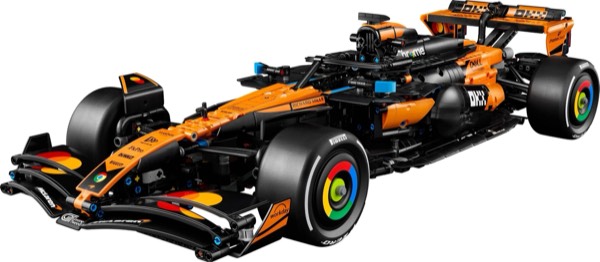
- McLaren MCL39 Technic Review - Another Technic motorsport masterpiece
- 1966 Ford GT40 MKII Technic Review - Legendary Le Mans racer in Technic form
The Porsche endurance livery means this car comes with a specific color palette that limits MOC directions most builders assume are open, the blue, white, and red are baked into the identity, and the printed windscreen becomes a reference point you either commit to or fight against. But the differential assembly and the way the suspension mounts actually invites chassis experimentation without requiring major rework. Swapping this into a wider wheelbase or adjusting track width demands only modest bracket modifications. The core mechanical language translates.
What catches experienced builders off-guard is how much lateral thinking the parts distribution actually supports. The axle count and beam inventory aren't typical for a car this size, which means piecing together a custom off-road variant or a different racing silhouette becomes possible without part-hunting desperation. The Rexy branding anchors this set in 2025 release cycle novelty, but the underlying part selection reads like someone was building for modularity, not just this specific model.
Track it in your vault on GameSetBrick - our free collection app. Log your condition, price paid, and watch the real-time market value.
Track in Your Vault →Save it to your wishlist on GameSetBrick. Share your list with friends and family - every set has a buy button so gift givers know exactly where to go.
Add to Wishlist → GameSetBrick is a free app by The Earl of Bricks. See all features. Scan it. Track it. Trade it.