Is the LEGO Fast and Furious Mitsubishi Eclipse Worth Buying?
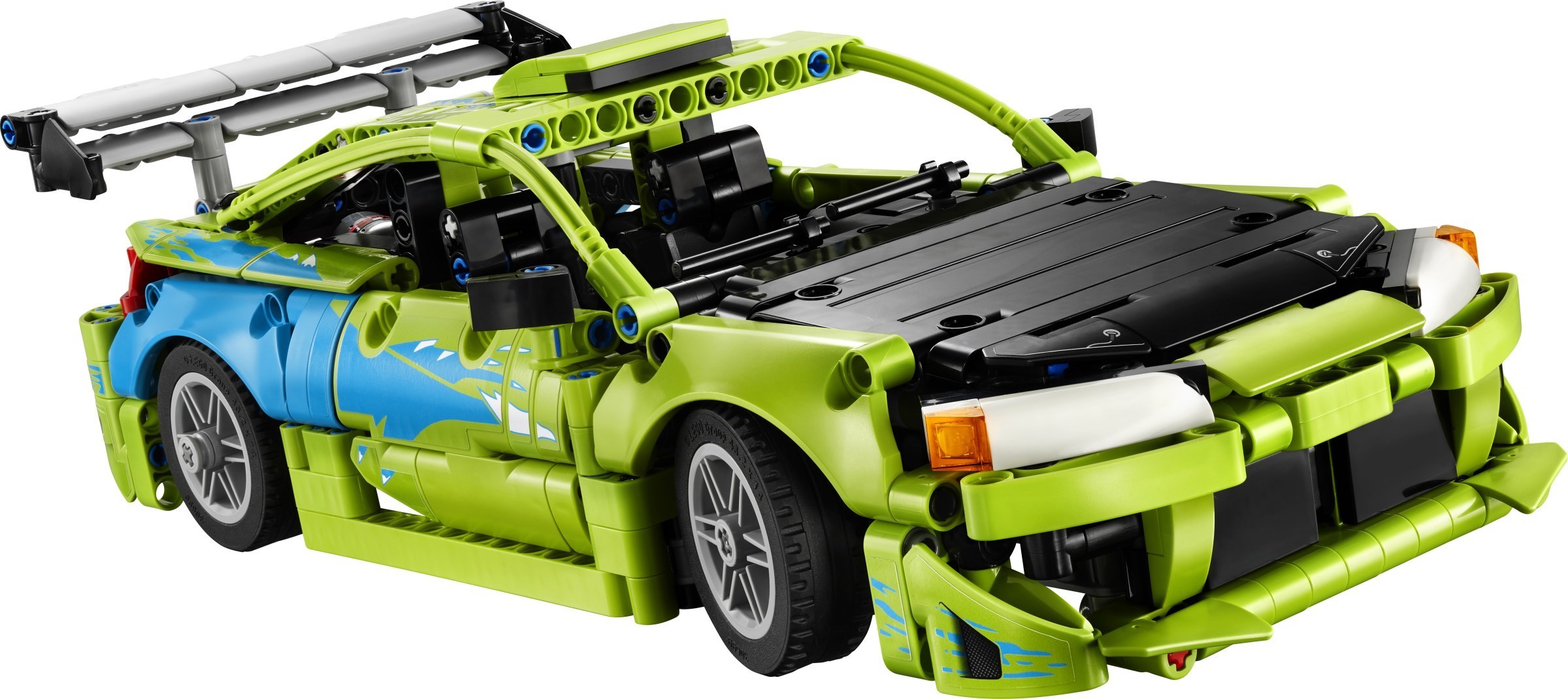
7.6/10. Worth buying. Brian O'Conner's lime green tuner car, complete with a moving-piston engine you can admire under the popped hood.

Smaller Technic sets live or die on how well they concentrate their engineering budget. You cannot fit a full drivetrain simulation into 827 pieces, so the design team has to pick two or three mechanisms and make them count. The Mitsubishi Eclipse makes the right choices: a moving-piston engine you can actually see working under a popped hood, and steering that feels precise rather than sloppy for a car this size.
What I appreciate most is that this set does not try to punch above its weight class. It knows it is a compact, accessible Technic build aimed at a younger or newer builder, and it delivers real mechanical satisfaction within that scope rather than padding itself out with decorative filler to look more substantial than it is.
At 827 pieces, the Eclipse is a compact, focused build that moves quickly without feeling thin. Construction starts with the chassis and engine assembly, establishing the moving-piston mechanism early so you can watch it come to life almost immediately, before working outward to the body panels, hood, and the movie-specific detailing including the twin NOS bottles tucked into the trunk.
The engine is genuinely the highlight of this build. The piston assembly connects to the wheel rotation, so pushing the finished model across a table visibly cycles the pistons up and down under the open hood. For a set at this scale, that is a meaningful mechanical payoff, and it teaches the underlying concept of how internal combustion motion translates from wheel rotation cleanly enough that younger builders will genuinely understand what they built, not just that it moves.
Steering is functional and reasonably precise for a compact chassis, using a simplified linkage that avoids the sloppiness that can plague smaller Technic steering systems. It will not offer the tight, weighted feel of a larger flagship build, but within its scale it performs exactly as it should.
The custom paint scheme and driver modification details called out in LEGO's own product copy translate into a handful of specific styling choices, like the front splitter shaping and the trunk-mounted NOS bottles, that give this more character than a generic sports car build. These are not deep mechanical features, but they are the kind of thoughtful reference-driven detailing that signals the design team actually watched the source film.
Build time runs around three to four hours for most builders, making this an accessible single-session project, well suited as an introduction to Technic mechanics for a builder who has outgrown basic System sets but is not ready for an 18+ flagship.
Finished, the model measures roughly 9 x 31 x 13 cm, a compact scale that fits easily on a crowded shelf without demanding significant dedicated space. The proportions capture the Eclipse's low, wide tuner-car stance convincingly, with a hood line and rear haunches that read clearly as a late-1990s Japanese sports coupe rather than a generic sports car shape.
The lime green colorway is the standout visual choice, and it is the correct one. The real car's signature paint from the film is instantly recognizable to anyone familiar with the franchise, and rendering it accurately in LEGO elements gives this set an identity that a more conservative color choice would have squandered. Against the darker Technic parts used for the chassis and engine bay, the green pops convincingly under normal shelf lighting.
Popping the hood to display the piston engine is worthwhile here, more so than on many compact Technic builds where the engine bay is minimal. The visible pistons give the display genuine mechanical interest even at rest, and the overall presentation punches above what you would expect from a set this size.
For 827 pieces, the price-per-piece value here is reasonable for a licensed Technic build, sitting in the expected range for a mid-tier set carrying a popular film license. The moving-piston engine and functional steering justify the piece count better than a purely static display model at a similar price would.
The parts selection includes a genuinely useful supply of lime green elements, a color that is comparatively rare in LEGO's broader palette and therefore holds real appeal for MOC builders working on tuner-car, sports-car, or generally green-accented projects. This is a meaningful secondary value driver for a set at this scale, where the color rarity does real work for BrickLink demand.
As a franchise entry point, the Eclipse offers a lower-cost way into the Fast and Furious Technic line compared to the flagship Dodge Charger R/T (#42231), reviewed separately on this site. For builders or gift-givers working with a tighter budget, this delivers a satisfying, movie-accurate build without the premium of the franchise's larger releases.
The Mitsubishi Eclipse became one of the most iconic vehicles in tuner car culture largely because of its starring role in the original 2001 film, The Fast and the Furious, where Brian O'Conner's lime green example became a defining image of the early-2000s import scene. The Eclipse was already a respected platform among tuner enthusiasts before the film, but its on-screen presence cemented it as one of the genre's most recognizable silhouettes.
Unlike the Dodge Charger's brute-force American muscle identity, the Eclipse represented a different philosophy entirely, lightweight Japanese engineering, turbocharged four-cylinder power, and a modification culture built around precision tuning rather than raw displacement. The film's central rivalry between these two vehicle philosophies, muscle versus import, became one of the franchise's foundational themes, one it would return to repeatedly across subsequent installments.
The real car's second-generation platform, produced through the late 1990s and early 2000s, was a genuinely popular tuner base independent of its movie fame, and the film's success helped drive a broader cultural moment for imported Japanese sports coupes that extended well beyond this single model. Building it in LEGO Technic form, with a functioning engine and correct paint, honors both the film's legacy and the real car's place in tuner history.
Fast and Furious fans, particularly those with an affection for the franchise's earliest films, are the natural core audience here, and the accurate lime green paint and NOS detailing will land immediately for anyone who remembers Brian O'Conner's Eclipse from the original movie.
This is also a genuinely strong entry point for younger or newer Technic builders. The compact scale, focused mechanisms, and manageable build time make it approachable without feeling simplistic, and the visible piston engine teaches a real mechanical concept in a way that sticks. If you are looking to introduce someone to advanced Technic building without the intimidation of an 18+ flagship, this is a smart, budget-conscious choice.
Collectors building a Fast and Furious themed shelf will want this alongside the Dodge Charger R/T to complete the franchise's central rivalry, and MOC builders specifically hunting for lime green elements will find real practical value here beyond the licensed build itself.
The most natural pairing is the Dodge Charger R/T (#42231), reviewed separately on this site, giving you both sides of the franchise's muscle-versus-import rivalry displayed together. The contrast between the Charger's black-red-orange aggression and the Eclipse's bright lime green tuner styling makes for one of the more visually compelling pairings in the current Technic lineup.
For a broader tuner and import-culture display shelf, this also pairs well with any smaller-scale Technic sports cars in similar lime, yellow, or bright accent colorways, and it is worth exploring our best LEGO F1 sets ranked guide for how Technic's motorsport releases compare against its licensed movie-car lineup.
Builders who enjoy the compact-scale Technic format should also look at the Green Bugatti Chiron Pur Sport (#42241), also reviewed here, another accessible mid-tier build that concentrates its engineering budget carefully within a smaller piece count.
Pros
- Visible moving-piston engine delivers real mechanical payoff at a compact scale
- Accurate, screen-correct lime green paint scheme
- Functional steering that feels precise despite the smaller chassis
- Accessible build time and complexity, great for newer Technic builders
- Rare lime green elements have genuine MOC value
- Movie-accurate detailing including NOS bottles
- Strong entry-price point into the Fast and Furious Technic line
Cons
- Smaller scale means fewer standout mechanisms overall
- No functional differential or drivetrain simulation at this price point
- Interior detail is minimal, in line with the compact scale
- Less imposing shelf presence next to larger flagship Technic vehicles
The Mitsubishi Eclipse punches above its price point by concentrating its engineering budget where it counts: a genuinely satisfying moving-piston engine, precise steering, and a screen-accurate paint job that nails the character of Brian O'Conner's most iconic car. It does not overreach, and that restraint is exactly why it works.
This is not a flagship Technic build, and it does not pretend to be. What it delivers instead is an accessible, well-executed mid-tier set that respects both its price point and its source material. For the budget and complexity it targets, this is close to ideal.
Available now. A strong, honest recommendation for Fast and Furious fans and newer Technic builders alike.
- LEGO Dodge Charger R/T Review - The franchise's flagship rival, muscle versus import on the same shelf
- LEGO Green Bugatti Chiron Pur Sport Review - Another accessible mid-tier Technic build worth comparing
- Best LEGO F1 Sets, Ranked - See how Technic's motorsport lineup compares
- April 2026 - What to Buy, Skip, and Wait On - Our latest buying guidance across the current lineup
- All Reviews - Browse the full archive of Earl of Bricks set reviews
Track it in your vault on GameSetBrick - our free collection app. Log your condition, price paid, and watch the real-time market value.
Track in Your Vault →Save it to your wishlist on GameSetBrick. Share your list with friends and family - every set has a buy button so gift givers know exactly where to go.
Add to Wishlist → GameSetBrick is a free app by The Earl of Bricks. See all features. Scan it. Track it. Trade it.